
Executive SummaryAutomotive lead tracking software follows a lead from its first click to a closed deal, tagging its source, logging every interaction, and recording VIN-level interest along the way. Cox Automotive’s 2024 Car Buyer Journey Study found 71 percent of car buyers now expect an omnichannel experience, and nearly 80 percent visit a third-party site such as Autotrader or CarGurus before ever contacting a dealer. Without that tracked thread, the lead and the deal it was heading toward disappear the moment a rep leaves or a channel switches. |
A shopper checks your inventory on Autotrader, texts your website, then calls two days later asking about the same truck. If nothing connects those three touchpoints, the salesperson who answers has no idea this is a warm lead three steps into the funnel. Automotive lead tracking software exists to follow that lead from the first click to a closed deal. This guide covers how it works, how to track car dealer leads across every channel, the automotive lead tracking strategies that separate high performers from the rest, and what franchise dealers should choose.
What Is Automotive Lead Tracking Software?
Automotive lead tracking software is the layer of a dealership’s technology stack that records where a lead came from, what it did next, and whether it turned into a sale. It usually lives inside, or connects directly to, a dealership CRM, and it exists to answer a question basic contact forms cannot: which sources, campaigns, and reps are producing buyers, not just clicks.
Independent dealers use it to stop losing track of the handful of leads coming in from a website, Facebook, and walk-ins. Franchise groups use it for a harder problem: proving OEM-mandated response times, reconciling leads from a dozen sources at once, and rolling it into reporting that holds up across rooftops. Nearly 80 percent of car shoppers now visit a third-party site like Autotrader, Kelley Blue Book, or CarGurus during their buying journey, according to Cox Automotive’s Car Buyer Journey Study, so a lead’s real starting point is rarely the dealership’s own website.
How Does Automotive Lead Tracking Software Work?
Automotive lead tracking software works by attaching a source and a timeline to every lead the moment it enters the system, then updating it every time the customer acts again, so nothing about the customer’s history lives in one salesperson’s memory. That tracked thread turns a first click into a closed deal instead of a lost lead.
1. Source attribution
Every lead is tagged with where it originated: dealer website, OEM portal, Autotrader, CarGurus, Facebook, phone, or walk-in. This lets a dealership tell marketing spend apart from noise.
2. Cross-channel interaction logging
Calls, texts, emails, chat messages, and in-person notes attach to the same customer record, so a rep opening a lead sees the full history, not just the most recent message.
3. Vehicle and browsing interest tracking
Some platforms link a customer’s website browsing, including specific VINs viewed, to their profile the moment they submit a lead, giving the sales rep a clear read on what the customer has been looking at.
4. Response-time and pipeline tracking
The system timestamps how fast a lead was contacted and where it sits in the pipeline, from new inquiry to appointment to sold or lost, so managers can see delays before they cost a sale.
5. Reporting and attribution
Dashboards tie sources and reps back to closed deals, not just submitted forms, which is the only way to know if a lead source is worth the spend.
| Tracking Component | What It Captures | Why It Matters |
| Source attribution | Origin of every lead (website, OEM, marketplace, social, phone, walk-in) | Shows which channels produce buyers, not just inquiries |
| Interaction log | Every call, text, email, and chat on one timeline | Gives reps full context without re-asking the customer |
| Vehicle interest tracking | VINs and inventory pages a lead viewed before contact | Tells the rep what the customer already wants |
| Response-time tracking | Time from lead creation to first contact | Flags slow follow-up before the lead goes cold |
| Conversion reporting | Which sources and reps produce closed deals | Directs ad spend and staffing toward what works |

How to Track Car Dealer Leads Across Every Channel
Dealerships that want to track car dealer leads properly need a system that treats every channel as one connected pipeline, not five separate inboxes. The automotive lead tracking tips below apply to any dealership juggling several lead sources at once.
- Website and digital retail tools: Track form submissions, chat conversations, and anonymous browsing behavior tied back to a lead once identified.
- Third-party marketplaces and OEM portals: Autotrader, CarGurus, and manufacturer lead providers should feed directly into the same tracking system, tagged by source, instead of arriving as unstructured emails.
- Phone and call tracking: Recorded, logged calls let managers audit what was said, not just whether a call happened.
- Text, chat, and messaging apps: SMS remains the dominant channel for U.S. dealer-to-customer contact, though dealerships working with Spanish-speaking or international buyers increasingly need WhatsApp tracking in the same system.
- Walk-ins and DMS-linked records: A driver’s license scan or DMS lookup at the door should update the same lead record used for digital inquiries, so a walk-in never becomes a brand-new, untracked contact.
Automotive Lead Tracking Best Practices and Strategies for Dealers
The automotive lead tracking tips and automotive lead tracking strategies below apply whether a dealership runs one lot or fifteen rooftops.
Automotive Lead Tracking Best Practices
- Route every lead source, including OEM and marketplace leads, through the same system instead of separate inboxes.
- Set a response-time target, five minutes is the common speed-to-lead benchmark, and track it as a reported metric, not a verbal expectation.
- Tag duplicate leads automatically so the same customer contacting through two channels does not get counted, or worked, twice.
- Review lead source ROI monthly, not just volume, since a source producing many leads and few sales is not performing.
Automotive Lead Tracking Strategies to Improve Conversion
- Build lead scoring around actual buying signals (VIN views, financing pre-qualification, trade-in submissions) instead of treating every inquiry the same.
- Use automated first-response messages while a human follow-up is queued, since the first few minutes matter more than message polish.
- Give BDC and floor reps shared visibility into the same tracked pipeline so handoffs do not reset the customer’s history.
- Audit lost leads quarterly. A pattern in why leads go cold is itself a tracking insight worth acting on.
Common Lead Tracking Mistakes to Avoid
- Letting OEM or marketplace leads land in a personal inbox instead of the tracking system.
- Measuring only lead volume instead of lead-to-sale conversion by source.
- Failing to track after-hours leads separately, even though a large share of inquiries arrive outside business hours.
- Losing a customer’s tracked history when they are handed from BDC to a floor salesperson, a real risk given that sales staff turnover in dealership retail roles averages 34 percent a year, according to a McKinsey analysis of NADA data published in January 2025.
Best Automotive Lead Tracking Tool for Franchise Dealerships
The right automotive lead tracking software for a franchise dealership depends on the DMS it already runs on, not just its feature list. Franchise groups evaluating options should look for OEM-certified lead routing, DMS integration, call recording, SMS and WhatsApp tracking, and multi-rooftop reporting that reconciles across stores.
1. Spyne Automotive CRM
Spyne Automotive CRM is best for auto dealerships that don’t want to be locked into one DMS. A DMS-agnostic platform built around automated lead capture, a unified omnichannel inbox, and AI-based lead scoring, with reporting that shows source-level ROI across rooftops.
2. VinSolutions CRM
VinSolutions is best for dealerships already inside the Cox Automotive ecosystem. Its browsing-behavior tracking attaches a customer’s anonymous website activity to their profile the moment they submit a lead, which suits groups already running vAuto or Kelley Blue Book tools.
3. DealerSocket CRM
Best for large multi-rooftop groups needing strict OEM co-op compliance. Built around cross-store lead ownership rules and compliance reporting for groups managing several brands across locations.
4. Elead CRM
Elead CRM is best for dealerships running on a CDK DMS. Native integration avoids the data lag that comes from connecting a third-party CRM to CDK Drive.
5. AutoRaptor
AutoRaptor is one of the best CRM for independent and buy-here-pay-here dealers. A lighter option for straightforward lead tracking without the complexity of an enterprise platform.
For franchise groups specifically, the deciding factor is usually OEM compliance reporting and how cleanly the tracking data reconciles across rooftops, not which platform has the most features on paper.
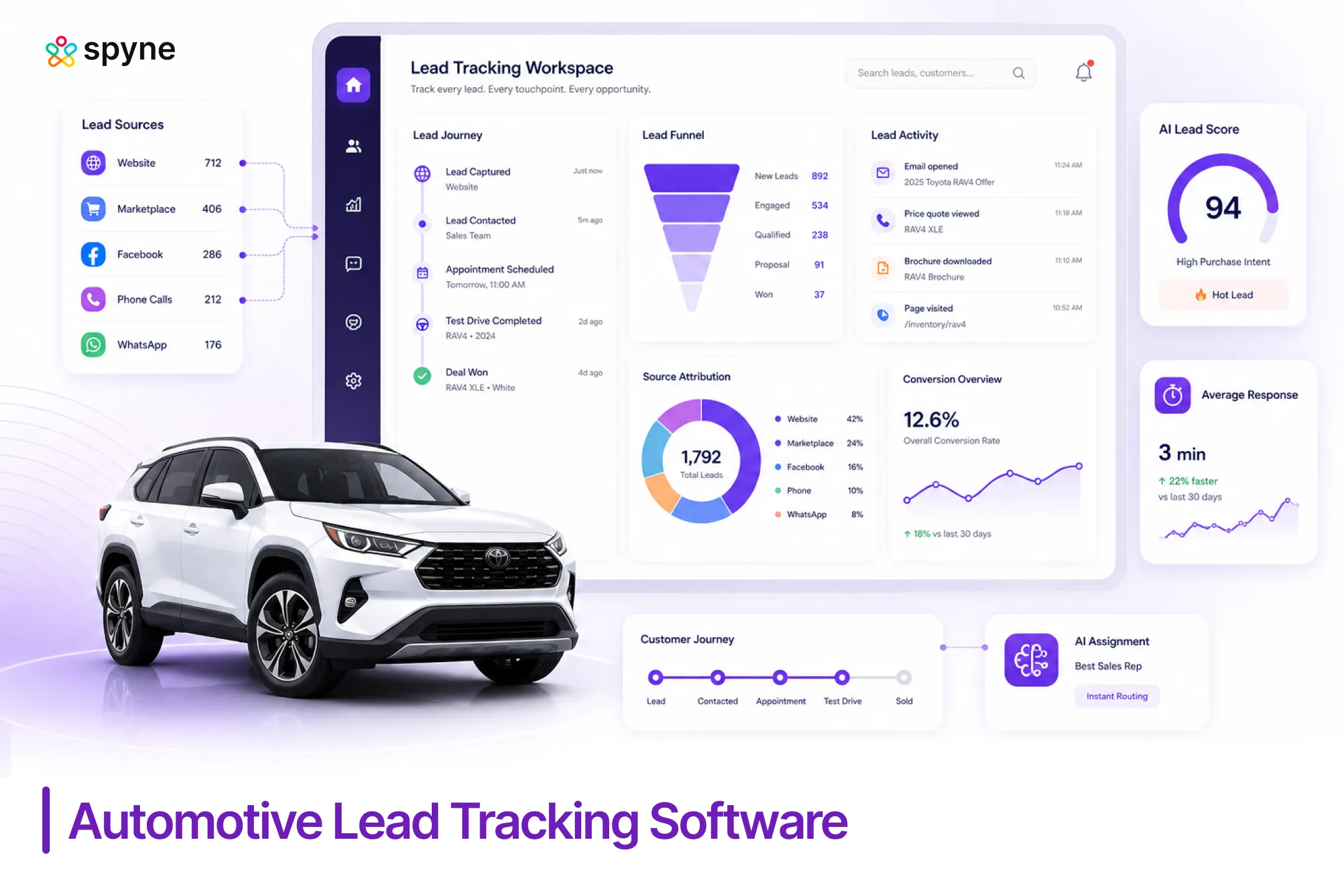
Spyne Automotive Lead Tracking Software for Dealerships
Spyne automotive CRM system gives dealerships a single tracking layer for every lead source, so nothing about a customer’s history depends on which channel they used or which rep last spoke to them. It sits on top of a dealership’s existing DMS rather than requiring a full system switch, which matters for franchise groups running different DMS platforms across rooftops. The goal is simple: every lead gets a source, a timeline, and a reason it converted or didn’t.
1. Unified lead capture
Every inquiry from the website, OEM portals, marketplaces, social ads, and phone calls lands in one tracked record instead of scattered inboxes. Example: a Facebook lead and a later phone call from the same customer merge into a single history instead of creating two disconnected entries.
2. AI-based lead scoring
Leads are ranked by buying signals like VIN views, financing checks, and trade-in submissions, so reps work the most likely buyers first. Example: a lead who viewed the same SUV three times and submitted a trade-in estimate surfaces above a first-time form fill.
3. Unified omnichannel inbox
Spyne conversational AI calls, texts, WhatsApp, emails, and chat all land in one inbox attached to the same customer timeline. Example: a rep opening a lead sees the full conversation history before calling back, instead of asking the customer to repeat themselves.
4. Source-level reporting
Dashboards tie leads back to closed deals by source and rep, not just submission counts. Example: a GM sees OEM portal leads close at a lower rate than website leads and shifts marketing spend accordingly.
5. Response-time tracking
Spyne’s automotive CRM software for car dealerships timestamps first contact against lead creation, flagging leads that are aging without a response. Example: a lead untouched for 20 minutes triggers an alert to a manager, not just the assigned rep.
6. Multi-rooftop visibility
Franchise groups can view tracking data by store or rolled up across the group, without separate reporting tools per rooftop.
7. Duplicate detection
Spyne CRM system flags when the same customer reaches out through two channels, preventing double-counted leads and duplicate outreach from two reps.

Conclusion
Automotive lead tracking software only earns its place in the tech stack if it changes what a dealership can actually see: which sources produce buyers, how fast leads get worked, and where they go cold. Getting that right does not require the flashiest platform, it requires a system that treats every channel, from a third-party marketplace click to a walk-in at the door, as part of one connected record. Dealerships that track leads this way stop guessing at what’s working and start proving it. That is the whole job: carry a lead from its first click to a closed deal without losing track of it along the way. See every lead tracked from click to close with Spyne’s automotive lead tracking software. Book a Demo today!