
| Executive Summary: The best automotive answering service for car dealerships in 2026 is Vini AI by Spyne, built specifically for automotive workflows and covering inbound voice, SMS, and chat across sales, service, parts, and finance departments, with direct DMS integration into CDK, Reynolds & Reynolds, and Tekion. For service-heavy stores prioritising the morning rush, Numa is the strongest specialised alternative for RO status updates and Xtime-integrated scheduling. For dealerships that need a combination of AI and live agents, Smith.ai and CallSource cover that gap. The right decision comes down to three variables: monthly call volume, your DMS environment, and whether your primary coverage gap sits in the service lane or on the sales floor. |
The average dealership misses 23% of all inbound calls. The miss rate rises sharply after 6 PM and on weekends, exactly when staffing is thinnest and a buyer has finally found time to call. At an average repair order value of $450 and a 74% phone-to-appointment conversion rate, every unanswered call is a statistically probable lost service appointment.
That is not a staffing problem. That is a coverage infrastructure problem.
An automotive answering service closes that gap. It ensures every call across sales, service, parts, and finance reaches a qualified responder, whether that is a live agent, a virtual receptionist, or an AI system trained on dealership workflows.
This guide covers the 10 best automotive answering services for car dealerships in 2026, how they compare across price, features, and integrations, and how to choose the right one based on your store’s size, call volume, and department emphasis.
The Real Scale of the Missed Call Revenue Problem
Industry data puts the average inbound call miss rate at 23%, roughly one in four callers who reach out never reaching a human. In busy service departments during the 8am to 11:30am morning rush, the miss rate can exceed 35%. Phone callers convert to appointments at a 74% rate compared to web form leads at 40%. The phone is your highest-intent channel, and it is being handled the worst.
At a 23% miss rate on 400 monthly inbound calls with a 74% conversion rate and 450 dollar average repair order, the monthly revenue exposure from unanswered calls exceeds 30,000 dollars for a typical mid-size service department. This is entirely recoverable revenue.
Where After-Hours Calls Go and What They Cost?
The average dealership service department misses 158 calls per month. At a $450 average repair order value and a 74% phone-to-appointment conversion rate, that is $52,650 in potential service revenue lost every month, not from poor performance, but from calls that were never answered.
Those missed calls share a common cause. After-hours callers hit one of three dead ends:
- Voicemail without a callback
- An automated greeting that cannot schedule
- A hold queue that disconnects them
Unlike web form abandonment where a buyer may return the next day, a phone caller who reaches voicemail at a dealership almost never calls back. The lead is permanently lost, and so is the revenue attached to it.
Calculate Your Missed Call Revenue Exposure
Use the formula below to estimate what your store is leaving on the table each month.
| Step | Calculation |
|---|---|
| Monthly inbound calls × 23% miss rate | = Missed calls per month |
| Missed calls × 74% phone-to-appointment rate | = Lost appointments per month |
| Lost appointments × $450 average repair order | = Monthly service revenue at risk |
Example outputs by store size:
- 300 calls/month: 69 missed → 51 lost appointments → $22,950/month in recoverable service revenue
- 450 calls/month: 104 missed → 77 lost appointments → $34,650/month in recoverable service revenue
- 600 calls/month: 138 missed → 102 lost appointments → $45,900/month in recoverable service revenue
The 23% miss rate applies to aggregate inbound call volume. During the 8 AM to 11:30 AM peak window, the miss rate climbs to 60% specifically for service calls, meaning the actual revenue exposure for a service-heavy store is substantially higher than the aggregate figure suggests.

Top 10 Automotive Answering Service for Car Dealerships in 2026
The right after hour automotive answering service depends on three variables most comparison guides skip: your call volume (sales-heavy vs. service-heavy), your tech stack (which DMS and CRM you run), and your staffing model (whether you want AI to replace human coverage or supplement it). The 10 AI phone answering services below are organized with those variables in mind. Each entry is written to help you make a fast, well-informed decision, not to rank every feature equally.
| Service | Type | Best For | Appt Booking | DMS Integration | Voice AI | 24/7 Coverage | Pricing |
| Spyne Vini AI | Automotive AI agent | Dealerships wanting full inbound call automation across sales and service | Direct to DMS | CDK, Reynolds, Tekion | Native | Yes | Custom quote |
| Podium (Jerry AI) | AI BDC + voice | Dealerships needing AI across calls, texts, chat, and reputation management | Calendar and CRM sync | VinSolutions, Elead, Dealertrack, FordDirect | Native | Yes | From $399/mo; AI Employee add-on $99–$399/mo |
| Numa | Automotive AI ops | Service-heavy stores needing AI call handling, status updates, and CSI protection | Xtime, CDK scheduler | CDK, Reynolds, Tekion | Native | Yes | From $49/mo (Pro); enterprise custom |
| DealerSocket CRM | Automotive CRM + call management | Franchise dealers wanting CRM-native call tracking and AI-assisted lead response | Via CRM service scheduler | Native (Solera DMS stack) | AI lead response only; no full voice agent | Limited; no native after-hours AI | Custom quote |
| CallSource Auto | Live agent BDC | Stores that prefer US-based human agents for service department call handling | 88% confirmed booking rate | Works with existing DMS via integration | No; live agents only | Mon–Sat, 7am–9pm ET | Custom quote |
| Conversica | AI multi-channel | Dealers with high lead volume needing persistent AI follow-up across phone, email, and SMS | CRM-based scheduling | Via CRM integration | Yes; voice, email, and SMS | Yes | Custom quote |
| RingCentral AIR | AI Receptionist (UCaaS) | Multi-rooftop dealer groups replacing legacy phone infrastructure with AI | Calendly and CRM sync | No native DMS integration | Native | Yes | From $65/mo (100 min included); usage bundles available |
| Dialpad AI | AI UCaaS + receptionist | Dealers wanting AI transcription, call coaching, and voice intelligence across teams | Basic scheduling only | No native DMS integration | Native (DialpadGPT) | Yes | From $15/user/mo (Standard); AI Agents custom |
| Smith.ai | Hybrid AI + live agents | Stores wanting human backup for complex calls with AI handling overflow and after-hours | Via intake and routing | No native DMS integration | AI-assisted; human escalation available | Yes | AI Receptionist from $95/mo; Live Receptionist from $300/mo |
| Air AI | General voice AI, note: FTC action filed Aug 2025 | High-volume outbound campaigns; not purpose-built for dealerships | Via Zapier integrations | No native DMS integration | Native | Yes | $25,000+ upfront license; $0.11/min outbound, $0.32/min inbound |
Which AI Tools Handle Dealership Service Call Volume During Peak Hours?
The 8 AM to 11:30 AM service drive window is where the majority of missed-call revenue is lost. According to Car Wars call tracking data, up to 60% of service calls go unanswered during that window. Service advisors are writing up walk-in customers, the phones ring without a dedicated handler, and the result is a compounding queue of callers who reach voicemail and do not call back.
Generic AI answering tools fail during this window specifically because they cannot access live DMS scheduler data, cannot handle concurrent calls at the volumes a busy service lane generates, and cannot distinguish a service appointment call from a parts inquiry or a sales call in real time.
The platforms that perform during peak hours share three operational traits: unlimited simultaneous inbound call handling without queuing, live scheduler availability read directly from the DMS rather than from a static calendar, and department-intent routing from the first few seconds of the call.
Peak-Hours Performance Comparison: Vini AI vs. Numa vs. Toma
| Capability | Vini AI (by Spyne) | Numa | Toma |
|---|---|---|---|
| Concurrent call capacity during peak hours | Unlimited | Unlimited | Unlimited |
| Live DMS scheduler access | CDK, Reynolds & Reynolds, Tekion | Xtime, CDK | Select schedulers only |
| Service department-specific routing | Yes (dedicated service agent) | Yes (service-focused) | Yes |
| RO status updates during an active repair order | Yes | Yes, via LiveCSI | Limited |
| Human handoff with full call context | Yes | Yes | Yes |
| Bilingual coverage (English and Spanish) | Yes (native) | Limited | No |
| Sales and service in one deployment | Yes | Service-primary | Service-primary |
| Human QA on calls (daily) | Yes | Not documented | Not documented |
For stores where the primary operational gap is the morning service rush, all three platforms handle concurrent call volume without queuing. Vini AI by Spyne is the only option on this list that covers both service and sales in a single deployment, which matters for franchise dealers whose inbound phones handle both departments simultaneously without a separate BDC routing structure.
How to Choose the Right Answering Service for Your Dealership?
The right answering service depends on three operational variables: your store’s size, your monthly call volume, and whether your primary coverage gap is in sales or service. Most dealers get this wrong by evaluating features before diagnosing the actual problem.
#1 – By Dealership Size
Single-rooftop independent or small franchise (under 150 calls/month)
At this volume, a full enterprise AI deployment is overkill. The coverage gap is usually after-hours and weekend calls, not a systemic inbound problem. A hybrid service like Smith.ai or an AI for car dealerships like RingCentral AIR covers the gap without overcomplicating the stack.
Mid-size franchise dealer (150–400 calls/month)
This is where missed calls start compounding into measurable revenue loss. A purpose-built automotive AI platform, Spyne Vini AI, Numa, or Podium, delivers the best return at this volume. The DMS and CRM integration pays for itself quickly when every booked appointment syncs automatically without a human touchpoint.
Large franchise or dealer group (400+ calls/month across multiple rooftops)
At scale, the priority shifts from answering calls to managing call intelligence across locations. Platforms like Podium, Conversica, and DealerSocket CRM become more relevant because they provide group-level visibility, cross-rooftop consistency, and reporting that individual-store tools cannot.
#2 – By Call Volume
| Monthly Call Volume | Recommended Approach |
| Under 150 calls | Hybrid AI + live agent (Smith.ai, RingCentral AIR) |
| 150–400 calls | Automotive-native AI platform (Spyne Vini AI, Numa, Podium) |
| 400+ calls, single store | Full-platform AI with DMS integration (Spyne Vini AI, Numa) |
| 400+ calls, multi-rooftop | Enterprise AI with group reporting (Podium, Conversica, DealerSocket) |
#3 – By Department Emphasis
Sales-first stores
If the primary gap is inbound sales leads going unanswered, after-hours web inquiries, weekend phone calls, overflow during floor traffic, prioritize a platform with inventory-aware responses and fast lead qualification. Podium Jerry and Spyne Vini AI both connect to live inventory data and can qualify a buyer and book a test drive without a rep involved.
Service-first stores
If the gap is in the service lane, missed calls during the morning rush, RO status callbacks consuming advisor time, low CSI scores tied to communication failures, prioritize a platform with direct scheduler integration and proactive status update capability. Numa is the strongest option in this category, with Xtime integration, LiveCSI monitoring, and RO-aware conversations.
Balanced sales and service coverage
Most franchise dealers need both. The short list here is Spyne Vini AI, which deploys department-specific agents across sales, service, BDC, parts, and finance from a single platform, and Podium, which covers both via a unified inbox with AI handling across all channels.
How VINI AI Handles After-Hours Dealership Calls?
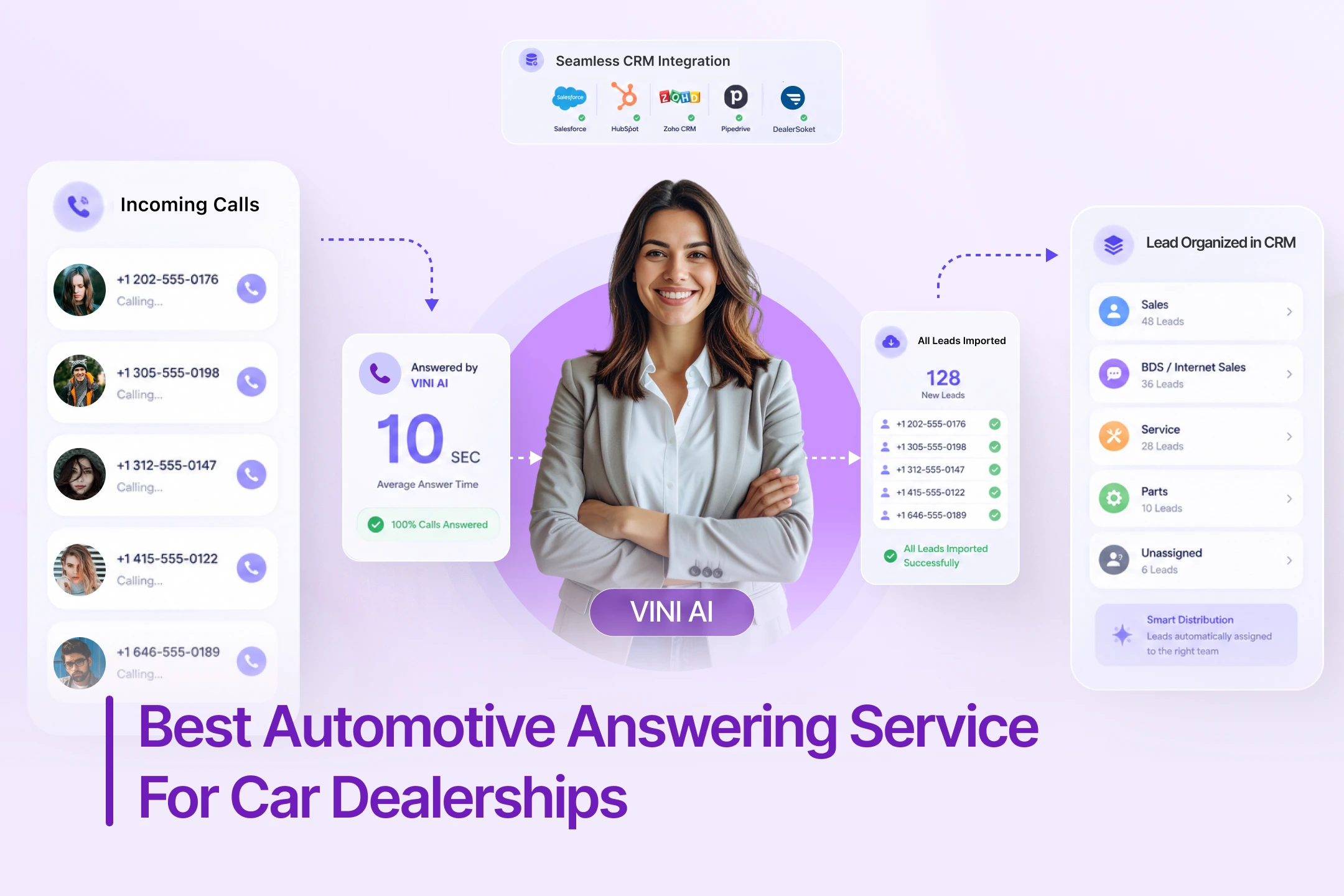
Most after-hours ‘solutions’ acknowledge the caller. Spyne’s conversational AI (Vini) resolves them. Here is exactly what happens when a call comes in outside business hours or during peak overflow.
Step 1: Call is detected and routed
The phone system detects that all advisors are occupied or the store is outside business hours. The call routes to Vini AI instantly, no hold queue, no voicemail prompt.
Step 2: Vini answers in natural voice
Vini picks up within two rings using conversational voice AI, not an IVR menu, not a scripted prompt tree. The caller experiences a two-way conversation that adjusts to what they say in real time.
Step 3: Intent is identified
Vini determines the caller’s need in the first exchange: service appointment, vehicle inquiry, parts question, or general information. The conversation routes accordingly from that point.
Step 4: Appointment booked directly into the DMS
For service calls, Vini checks real-time DMS availability and confirms the slot before the call ends. No callback required. No ‘we’ll follow up in the morning.’
Step 5: Caller receives a text confirmation
The appointment appears in the DMS exactly as if a human advisor had scheduled it, no manual entry, no reconciliation, no data gaps.
Step 6: Full summary logged in the CRM
Caller details, stated need, and outcome are captured and flagged for the relevant team member. When the store opens, the team has a complete record of every after-hours interaction, not a voicemail inbox.

Closing Thoughts
Missed calls are not a staffing problem. They are a coverage infrastructure problem. and the data makes the cost impossible to ignore. One in four inbound calls goes unanswered. After 6 PM and on weekends, that rate climbs higher. Every unanswered call at a $450 repair order value is a statistically probable lost appointment.
The services on this list solve that problem in different ways, live agents, hybrid models, and purpose-built AI. For dealerships that want a single platform covering sales, service, parts, and finance with direct DMS integration, 24/7 availability, and bilingual support, the decision is straightforward. See what Vini AI recovers for your store, book a demo with Spyne.