
Modern customers keep connecting with you, sending inquiries, but instead of having real conversations, they are stuck in endless IVR menus pressing buttons that lead them nowhere. This made urgent calls slip away through the cracks. So what could be the best solution for this? Well, automating your inbound calls is actually the real solution. Understanding how to automate inbound calls helps you handle all incoming calls effectively with virtual AI agents.
In this blog, you will learn how you can automate inbound calls and how it will help your business. So, let’s delve into the blog ASAP and explore it together.
What Are Inbound AI Calls?
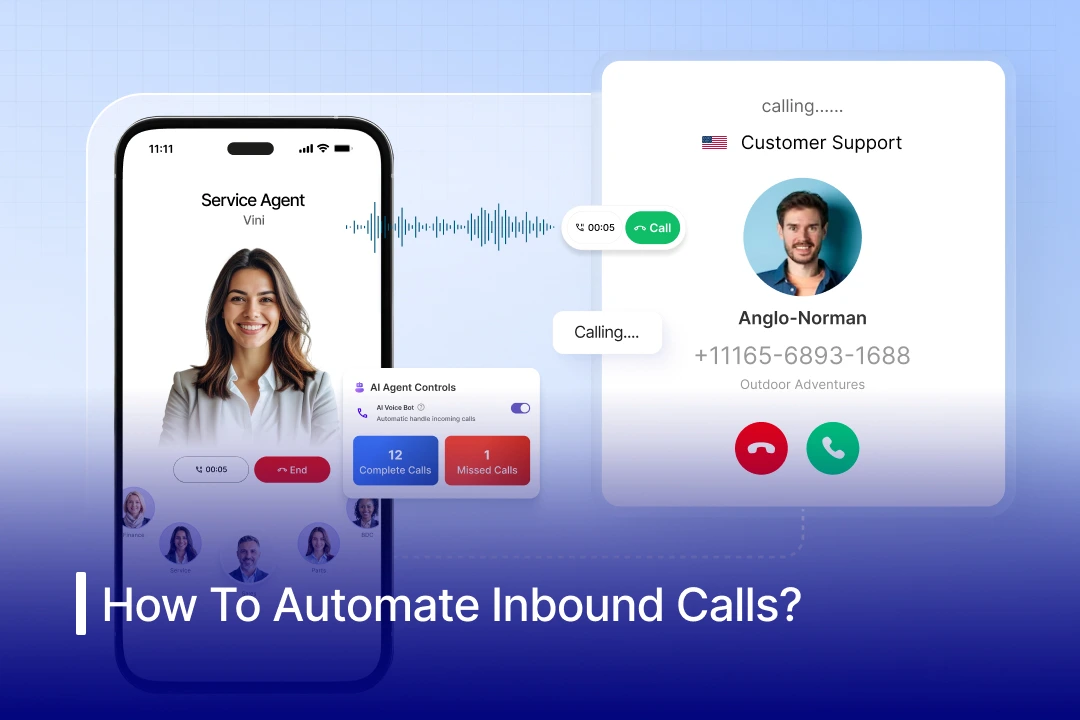
Inbound AI calls are customer-initiated phone calls to businesses that are answered and managed by conversational AI agents instead of human agents or receptionists. These AI inbound call softwares use natural language processing (NLP) and voice recognition to understand customer intent and respond promptly with personalized messages, delivering a seamless customer experience.
Besides, unlike traditional IVR calls, it allows customers to have a real, natural conversation, reducing repetitive friction and wait time. These calls include:
- Customer Support
- Appointment Booking
- Order Status Check
- Lead Qualification
- Billing Questions
AI agents operate 24/7 without taking breaks, ensuring no call goes unanswered.
How AI Handles Inbound Calls
AI call handling automates conversations by using voice agents powered by natural language processing (NLP) and large language models (LLMs). It understands, processes, and resolves customer inquiries in real time with no human interference. Let’s have a quick overview of how AI handles inbound calls:
1. Instant Answering
As soon as a customer sends an inquiry via call or initiates a call, AI immediately responds, eliminating wait time and busy signals. Every call gets an instant response. It enhances first impressions and prevents revenue loss from unanswered calls.
2. Information Gathering
AI agents collect essential information such as customers’ identities, account information, intent, needs, and preferences. All this data is captured and saved conversationally, while reducing friction.
3. Query Resolution
AI agents handle common customer questions by providing accurate information about the business, its products, and service availability, while resolving their issues. This reduces your human agent workload while delivering fast, personalized, and conversational responses.
4. Smart Call Routing
When a customer asks a complex question, the system intelligently routes the call to the appropriate department or team member with full context without delay. It removes unnecessary call transfers and ensures customers reach the right resource on their first attempt.
5. CRM Sync
AI is synced with your CRM and automatically transcribes, summarizes, and logs call data into your system. This data is accessible whenever AI takes follow-ups or interacts with customers, helping avoid repetitive questions and send personalized messages.

How to Automate Inbound Calls?
Understanding how to automate inbound calls perfectly helps you deliver an enhanced customer experience. However, successful automation still requires a human-in-the-loop. AI can handle calls 24/7, answer common questions, and quickly transfer complex issues to a human agent when needed. This ensures faster support while also reducing customer waiting time. Here’s your complete step-by-step guide on how to automate inbound calls:
1. Define Goals
The first thing you need to do is assess your business goals, “What you want to achieve” by automating inbound calls. It should be either reducing calls, improving response time, handling high-volume calls, or capturing more leads. Defining your business goals clearly helps you choose the right solution and design the right automation strategy.
2. Choose The Vendor
You know what you want to achieve by automating inbound calls? Now is the time to choose the right vendor. You have to pick an AI solution for your business that comes with the most advanced features, such as conversational AI, natural language understanding, intelligent call routing, CRM integrations, and real-time AI call analytics. Vendors like Spyne offer smooth integration, scalability, and strong customer support.
3. Build & Train AI
Once you choose the right platform, the next step is to build and train your AI agent for your business. Feed AI with common FAQs, business information, and call scenarios. Training helps AI understand your niche, customer, and service or product effectively and respond to customer inquiries with personalized responses.
4. Integrate With Your Existing Systems
To smooth your call-handling workflow, connect your AI call system with your existing tools such as CRM platforms, helpdesk software, and scheduling systems. This will allow the AI to access customer information and deliver personalized responses, together with updating records in your system automatically in real-time.
5. Implement Conversational Interactions
Instead of using outdated call bots for call handling, implement conversational AI that handles each conversation like a real-human. It understands customer intent, behavior, and tone to deliver more personalized responses. It can resolve customer inquiries directly or route the call to the appropriate department or agent when needed.
6. Test & Deploy
Before launching your AI agent, test it across multiple scenarios to ensure it responds accurately and takes effective actions. Include both successful call flows and potential error cases during testing. Once deployed, monitor performance through call transcripts and analytics to deliver a consistent, enhanced customer experience.
Key Benefits of AI Inbound Call Automation
Automating inbound calls offers several benefits, including reducing operational costs, improving efficiency, and enhancing the overall customer experience. It creates value for both businesses and their customers. Here are the key benefits of inbound AI call automation:
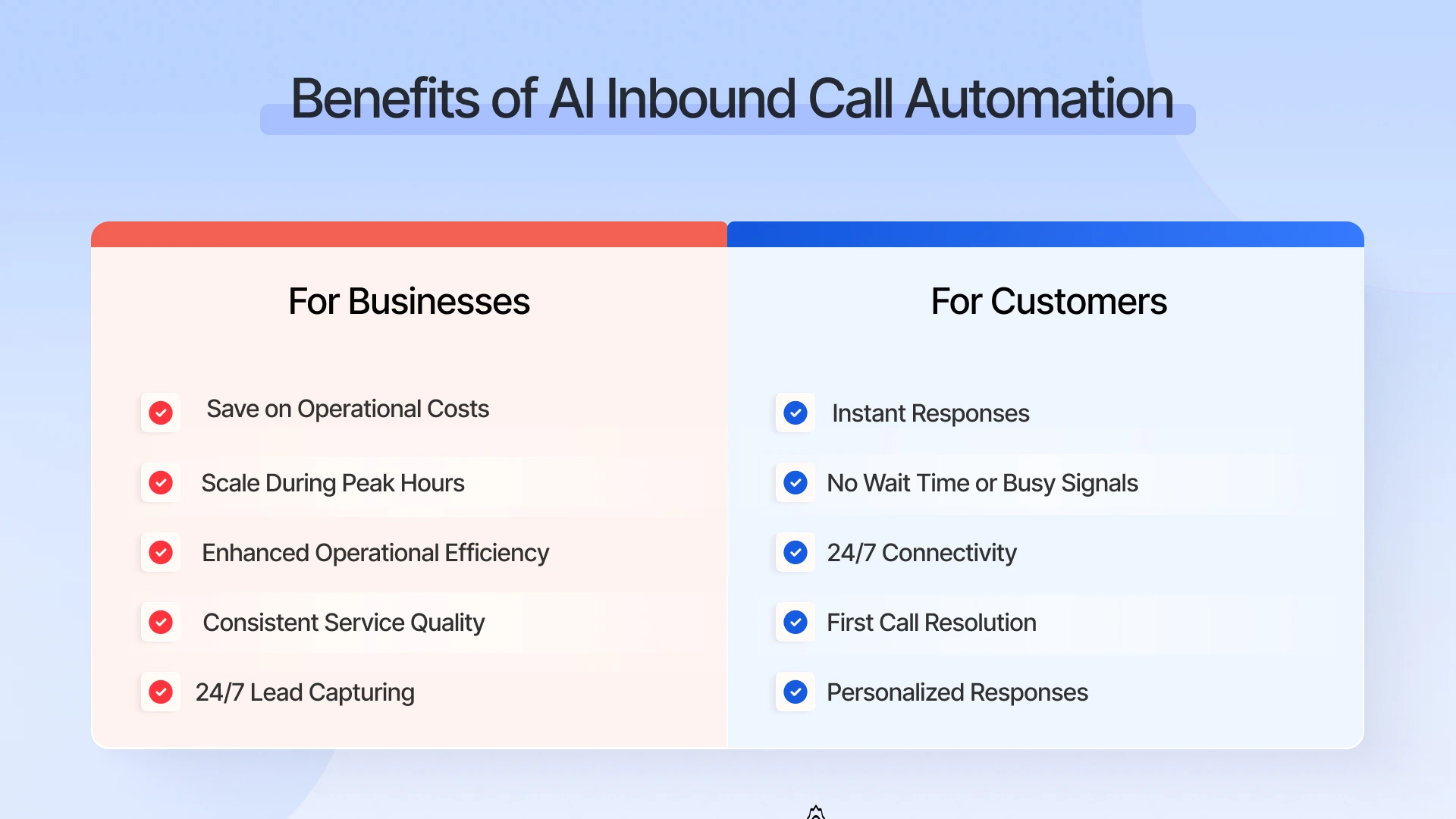
For Businesses-
1. Save on Operational Costs
AI call automation helps businesses reduce operational costs by managing large volumes of inbound calls without hiring additional staff. You can avoid additional costs related to hiring, training, and managing large support teams while still maintaining high service levels.
2. Scale During Peak Hours
Unlike human agents, AI agents can handle calls simultaneously without taking a break or being tired, especially during peak hours. This ensures that no opportunity is missed through unanswered or ignored calls.
3. Enhanced Operational Efficiency
AI automates repetitive tasks such as answering FAQs, capturing customer information, or routing calls to the correct department. This allows your staff to focus on complex issues, enhancing productivity and overall service quality.
4. Consistent Service Quality
AI systems deliver standardized responses based on predefined knowledge and policies. This erodes the inconsistency that often occurs due to human error, training differences, or agent fatigue, ensuring every customer receives accurate and consistent information.
5. 24/7 Lead Capturing
AI phone call services instantly pick up every call 24/7, even after business hours, ensuring that no opportunity goes unseen. It can capture caller information, qualify leads, and schedule follow-ups automatically.
For Customers-
1. Instant Responses
Customers can get immediate answers to frequently asked questions such as product details, order status, or appointment availability. This reduces frustration and eliminates the need to wait for callbacks or repeated follow-ups.
2. No Wait Time or Busy Signals
Through instant responses, AI inbound call automation eliminates long queues and busy signals. Customers can connect with businesses instantly and get assistance without waiting on hold for hours.
3. 24/7 Connectivity
AI voice agents operate 24/7 without taking a break, delivering consistent support even after business hours. Customers can receive help at any time, including nights, weekends, and holidays.
4. First Call Resolution
Understanding customer intent and routing calls to the right person in real time, AI enhances customers’ first call resolution rates. Many issues can be solved during the first interaction, reducing the need for call forwarding and multiple calls.
5. Personalized Responses
An AI system can access customer data in real-time to deliver more personalized responses to customer inquiries. Further, understanding customer history, preferences, and behavior, it can deliver relevant support.
The Reason Inbound Calls Break Down When You Grow
As your business grows, you receive more calls and more inquiries from customers. Handling inbound calls effectively becomes a challenging task, due to which many calls going unanswered. You might not realize it in the first place, but when you look at metrics, you’ll soon realize how missing calls are hurting your business growth.
The Core Problems
Recent studies show that nearly 62% of calls go unanswered in small businesses, especially during peak hours or after business hours. This isn’t something you should be ignoring. It is a major growth blocker for your business. Here’s why your inbound calls break first as your business scales:
1. Limited Human Resources
Having limited manpower in your business can’t handle the increased call volumes. Inbound calls need immediate attention, but when your staff is already busy taking calls, they won’t be available every time to pick up and answer every customer call in real-time. According to metrics, most businesses miss between 48% to 62% of their inbound calls.
2. Customers Don’t Wait or Call Back
Customers these days expect a lot from businesses, like quick responses and assistance. In fact, studies show that almost 85% of customers won’t call back or respond if their first attempt fails. Also, around 78% of these customers will go to your competitor instantly without waiting.
3. Manual System Doesn’t Scale
Traditional phone systems, manual routing, or basic IVRs are not built to handle high-volume calls. Even if they can, there won’t be the same efficiency. As complexity increases, these systems fail to respond effectively, causing friction, delays, confusion, and poor customer experience.
4. Slow Response Time
In inbound calls, response time is critical. Instant and personalized responses significantly increase the chances of converting a lead into a sale. Studies show that responding within 5 minutes makes you 21x more likely to convert, while a 10-minute delay can reduce contact rates by 400%. If the response is delayed by 30 minutes, most potential customers have already moved on to competitors.
5. Lost Revenue & Opportunities
Lost missed calls directly impact your revenue. Missing out on one call means missing out on your revenue. In industries like automotive, businesses can lose $850,000 to over $1.17 million annually due to missed calls, with each missed appointment costing around $450–$470 on average.
Why Traditional Solutions Don’t Work For Inbound Calls?
Most businesses think they can fix these issues by adding a receptionist or hiring more staff, carrying their phone everywhere, or relying on voicemail. But any of these won’t actually solve these issues. Such as even if you hire more people for your business, their availability will be limited. They need breaks, vacations, handle multiple tasks, or simply can’t answer every call. Voicemail isn’t reliable either, as most customers don’t leave messages and expect quick callbacks. Even adding more phone lines doesn’t solve the issue, because the real problem isn’t capacity. It’s the inability to respond instantly.
As call volumes grow, traditional systems start to break down. Response times increase, context gets lost, and leads slip away. In a fast-paced environment, even small delays can cost you customers, leading to lost revenue despite your efforts.
What Does It Actually Mean “Automating Inbound Calls”?
Automating inbound calls means leveraging AI-powered conversational voice agents to immediately handle all incoming calls without requiring human involvement.
1. Instant 24/7 Responses
Conversational AI call bot picks up calls and responds immediately around the clock. No matter when customers initiate a call, it responds instantly, operating and delivering assistance 24/7 without getting tired.
2. Human-Like Conversations
Conversational AI uses natural language processing (NLP) and voice AI to understand customer intent, behavior, and tone while delivering personalized responses meeting their requirements. They don’t rely on rigid scripts, making interactions feel smooth and natural.
3. Action-Oriented Self Service
The AI goes beyond just answering questions. It takes required actions in real-time to resolve customer inquiries during the call, like booking an appointment, sharing updates, or resolving common queries.
4. Smart Call Routing
If a customer query becomes complex, AI instantly transfers the call to the right person at the right time, ensuring no delays and minimizing wait time for the customer. It also provides a full context of conversations, helping human agents avoid repetitive questions.
5. CRM Integration
The AI integrates with your existing systems and automatically logs call transcripts, records details, and updates in your CRM. It eliminates manual work and keeps your customer data accurate and up-to-date.
How Automated Inbound Calls Transform Your Business
Missed calls, long wait times, and outdated phone systems don’t just frustrate customers. They directly impact your revenue. As your business grows, handling every call manually becomes nearly impossible, leading to lost opportunities. Modern inbound call automation solves this by answering instantly, understanding customer needs, and ensuring every interaction is handled efficiently.
With AI-powered solutions like Spyne, every call is captured, qualified, and acted upon in real time. From booking appointments to routing complex queries with full context, it ensures your team never misses a lead. The result is faster response times, better customer experiences, and a system that scales with your business without adding operational burden.
Why Automating Inbound Calls for Your Auto Business is Important?
Most car buyers search online and reach out via phone, but your staff may not always be available to answer calls and address their questions. And missing calls directly impacts your revenue and growth. Here’s why your automotive businesses need an AI call bot for car dealerships to handle inbound calls:
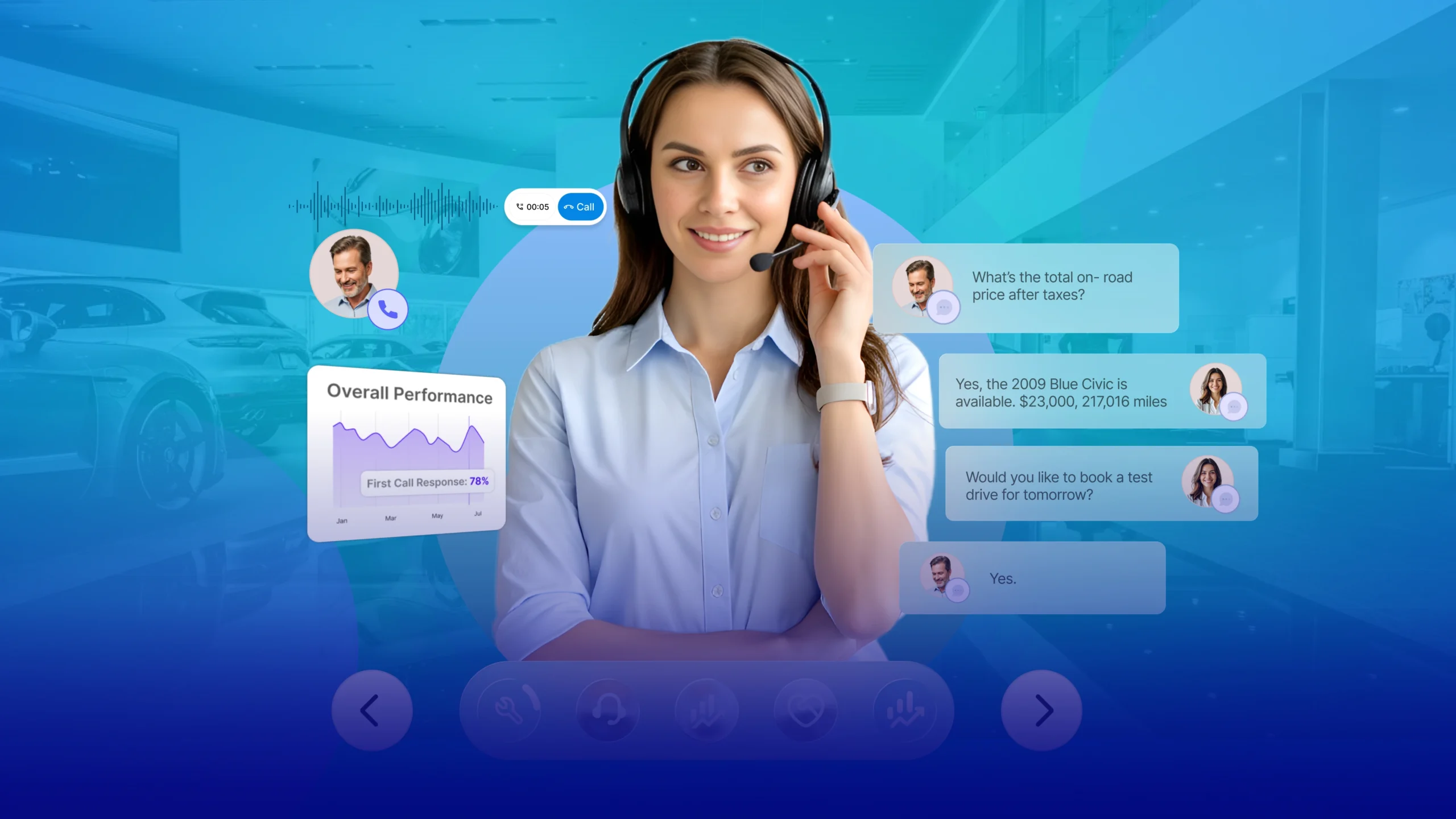
1. Capturing Leads 24/7
The AI ensures to capture every lead coming to your dealership by delivering instant responses, even during peak hours or after business hours. This helps you capture high-intent buyers who would otherwise move on to competitors.
2. Deliver Enhanced Customer Experience
Customers expect quick and seamless interactions. AI helps you deliver a consistent, enhanced customer experience by eliminating hold times, understanding queries naturally, and connecting callers to the right department, creating a smooth and frustration-free experience.
3. Enhance Operational Efficiency
By handling repetitive queries like service bookings, hours of operation, and basic inquiries, AI reduces staff workload and allows your team to focus on high-priority tasks, such as handling customer interactions and closing deals faster.
4. Better Lead Management
AI inbound call handling captures customer details, qualifies leads, and logs every interaction directly into your CRM. With built-in automotive call monitoring software, you can track each call and take timely action.
5. Scale and Grow Your Business
AI call volumes increase, and AI scales effortlessly without additional hiring. It helps you handle more inquiries, book more appointments, and drive consistent revenue growth without operational bottlenecks. Further, with an automated lead follow up system for car dealerships, it ensures no potential customer is missed.
Why Spyne’s AI Inbound Call Is The Best Choice For Your Automotive Dealership?
When every call can turn into a revenue opportunity, then why not choose a system that never misses a call or a revenue opportunity? Spyne AI helps automotive businesses capture, manage, and convert every customer interaction into a sales opportunity seamlessly.
1. Industry Specific
Unlike generic voice AI, our conversational AI is specifically designed for automotive businesses. It understands your business, service, product, and customers. It can automate test drive scheduling, service appointments, and lead qualification with accuracy.
2. Never Misses a Lead
Our AI operates 24/7, capturing and qualifying every lead coming to your dealership, even after business hours. It ensures an instant call routing to the right human agents whenever needed.
3. Personalized and Instant Responses
Our AI inbound call doesn’t just answer calls. It identifies high-intent buyers by asking the right questions and prioritizing leads, helping your sales team focus on customers that are most likely to convert.
4. A Smooth Integration To Your Existing Systems
With a smooth integration, all call data is automatically logged, transcribed, and synced with your CRM. You can also track each call log using our automotive call tracking. This ensures your team always has complete context for follow-ups, reducing manual work and improving efficiency.
5. Scalable Without Extra Cost
As your call volume grows, our AI can seamlessly handle every call simultaneously without taking breaks. You can rely on one of the best AI inbound call overflow solutions for your automotive business. It helps you scale and grow without hiring more staff, helping save on your operational costs.

Conclusion
Inbound calls are critical to your business, but they are also where opportunities are lost. As call volume grows, manual processes lead to missed calls, slow responses, and lost revenue. Automating inbound calls ensures every conversation is handled instantly and efficiently.
With solutions like Spyne AI, you can capture more leads, improve customer experience, and scale effortlessly. In today’s fast-paced automotive market, automating inbound calls isn’t just an option. It’s essential for growth. See our AI inbound call solution in action for your auto dealership. Book a demo now!