
Every day a vehicle sits on your lot without a live, polished listing, it costs you money. Floorplan interest does not pause, and neither does your competition. Yet across dealerships of every size, photo editing remains one of the most persistent operational bottlenecks between a vehicle arriving at auction and appearing in front of an online buyer. A skilled human editor working in Photoshop and Lightroom takes 8 to 15 minutes per image, which translates to 2 to 4 hours of editing time for a single 15-image vehicle set. At 100 units per month, that is between 200 and 400 hours of labor dedicated entirely to image processing. For context, that is more than two full-time employees working exclusively on photo editing every month.
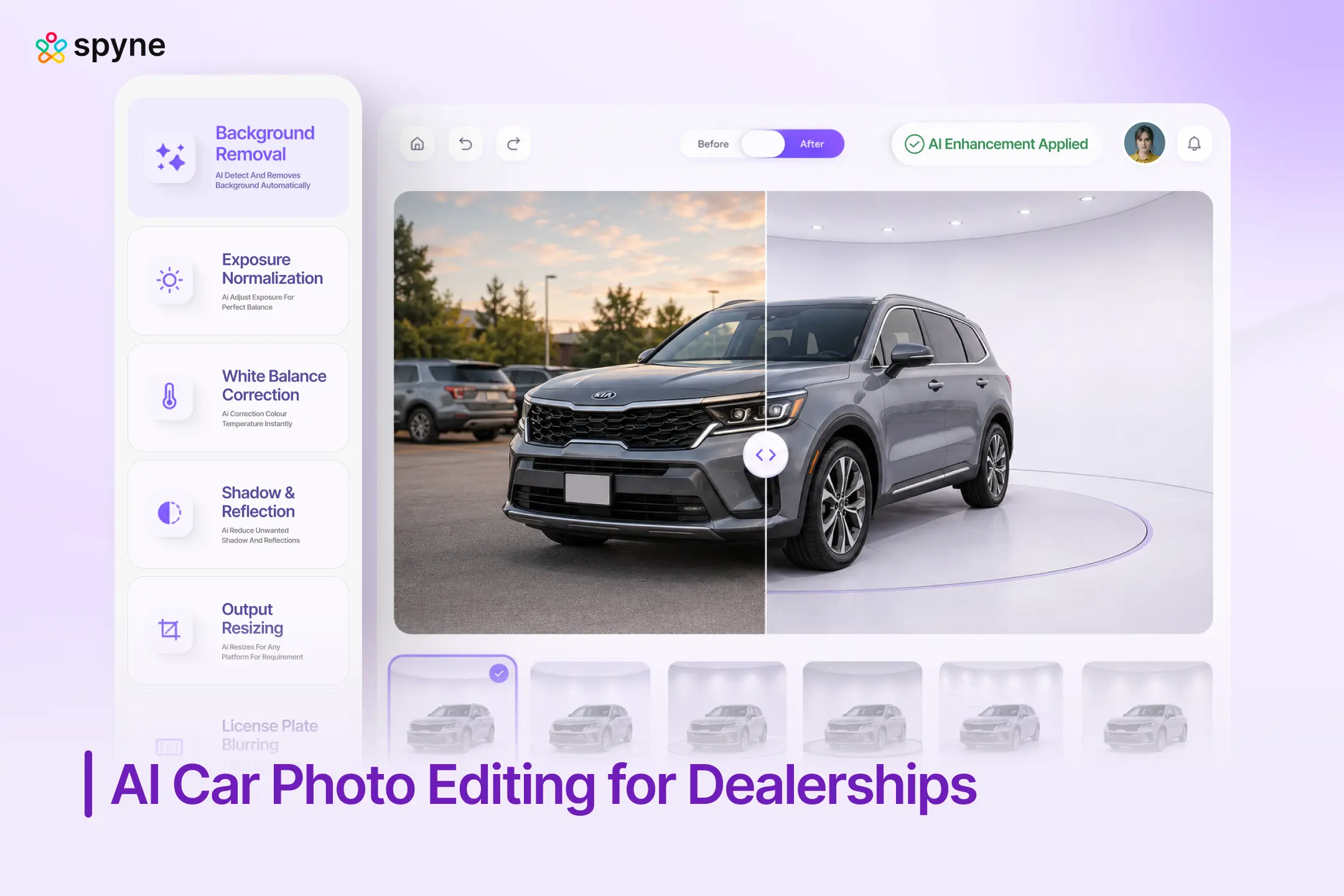
AI-powered car photo editing changes that math entirely. Platforms like Spyne Studio AI process a complete 15-image vehicle set in under 60 seconds, applying background removal, exposure correction, white balance normalization, shadow reduction, license plate blurring, and marketplace-formatted output simultaneously. The cost differential is equally significant: outsourced manual editing runs between $45 and $120 per vehicle, while AI batch processing operates at under $0.50 per image at standard volume.
Why Car Photo Editing Is an Inventory Operations Problem, Not a Marketing Task?
Most dealerships treat car photo editing as a creative function, something handled by the marketing department or outsourced to an agency after the vehicle is photographed. That framing creates the backlog. A dealership moving 100 units per month is producing 1,500 to 2,500 listing images every single month, each one requiring six distinct editing operations before it meets marketplace standards. At that volume, photo editing is not a creative function. It is an inventory operations pipeline, and it needs to be treated like one.
The consequences of treating it as an afterthought are measurable. Shift Digital’s 2025 Automotive Vehicle Merchandising Trends Report found that high-quality, VIN-specific imagery lifts VDP views by 20% and increases lead volume by 12% over time compared to listings with generic or low-quality photos. Each additional day a vehicle sits without a complete, polished listing is a day of suppressed VDP traffic. Industry benchmarks put average floorplan cost at approximately $46 per vehicle per day, meaning a 5-day photo editing backlog on 20 acquired units represents roughly $4,600 in avoidable holding costs, purely from the delay in getting images live.
The dealerships consistently hitting the 3-day frontline standard, vehicles live on all connected marketplaces within 72 hours of acquisition, do so because they have moved photo editing out of a manual queue and into an automated pipeline.
What Car Photo Editing Actually Involves: The Six Steps Every Listing Requires?
Most general managers think of inventory photo editing as simply removing the lot of background. In practice, a marketplace-ready vehicle listing image requires six distinct editing operations, and each one takes meaningful time when done manually.
1. Background Removal and Replacement
This is the most technically demanding and time-intensive step in the manual workflow. An editor must precisely trace the vehicle’s boundary, including wheel spokes, side mirrors, antennae, and chrome trim, remove the lot environment entirely, and replace it with a clean white, studio-grey, or branded dealership background. In Photoshop, using either Quick Selection or the Pen Tool on a complex vehicle boundary, a skilled editor takes 5 to 10 minutes per image to produce a clean result. On a 15-image set, background removal alone accounts for 75 to 150 minutes of editing time.
2. Exposure Normalization
Car photography across different days, times of day, and weather conditions arrive with wildly inconsistent brightness and contrast levels. A vehicle set photographed half in morning overcast and half in afternoon sun looks like it belongs to two different inventories. Manual exposure correction in Lightroom or Photoshop takes 1 to 3 minutes per image, and it requires judgment, the editor is setting a consistent brightness target for the full set, not just adjusting individual images in isolation. AI normalization applies a consistent exposure standard across the entire batch simultaneously, without per-image input.
3. White Balance Correction
Camera sensors shift their color interpretation based on light source. A white sedan photographed under fluorescent service bay lighting looks green-tinged. The same vehicle photographed in morning sun reads warm orange. Left uncorrected, a vehicle’s listed color does not match the actual car, a problem that compounds when the same unit’s exterior and interior shots were taken under different lighting. Manual white balance correction takes 1 to 2 minutes per image. AI correction normalizes color temperature across the full set in seconds.
4. Shadow and Reflection Reduction
Hard midday sun creates dark, harsh shadows under front bumpers, rocker panels, and wheel arches that make a clean vehicle look dirty or damaged. Reflections from adjacent vehicles, buildings, or the photographer show up in gloss paint, side glass, and polished trim. Correcting shadows manually requires dodge-and-burn techniques that are skilled, time-consuming, and easy to overdo, over-dodged shadows flatten the vehicle’s dimensional appearance. Reflections require intelligent content-aware fill that understands what the surface should look like without the intrusion.
5. Output Resizing for Marketplace Specifications
Each major automotive marketplace publishes its own image specification, and a dealership publishing to four platforms needs four correctly sized and formatted versions of every image:
| Marketplace | Minimum Resolution | Recommended Resolution |
| Cars.com | 640×480px | 2048×1360px |
| AutoTrader | 640×480px | Up to 4096×2731px |
| CarGurus | 800×600px | 1600×1200px |
| Facebook Marketplace | 1200×628px | 1200×628px |
Manual resizing and format conversion for four platforms takes 2 to 4 minutes per image, and it is exactly the kind of repetitive work that introduces errors when someone is processing 300 images in a single session. AI export produces the correct specification for each connected marketplace simultaneously, with no per-image manual work.
6. Number Plate Blurring or Overlay
Federal privacy standards and listing platform policies require number plate blur to be obscured in all published inventory photos. Manual blurring requires identifying the plate location in each exterior shot, typically 6 to 8 images per vehicle, and applying a blur or overlay to each one. It takes 30 to 60 seconds per image and is easy to miss on wide-angle shots where the plate is small. AI detection identifies and blurs license plates automatically across all exterior images without requiring manual identification.
The Full Time and Cost Comparison: Manual Editing vs Studio AI by Spyne
The numbers below reflect a skilled editor with professional Photoshop and Lightroom proficiency. Dealerships relying on less experienced staff or inconsistent outsourcing vendors see higher times and more variable output quality.
| Editing Step | Manual Time (per image) | Outsourced Cost | Spyne AI Time |
| Background removal | 5–10 min | $1.00–$3.00 | Under 2 sec |
| Exposure normalization | 1–3 min | Included | Automatic |
| White balance correction | 1–2 min | Included | Automatic |
| Shadow & reflection reduction | 2–4 min | Included | Automatic |
| Output resize per platform | 1–2 min | $0.50–$1.00 | Automatic |
| License plate blur | 30–60 sec | Included | Automatic |
| Total per vehicle (15 images) | 2–4 hours | $45–$120 | Under 60 sec |
| Monthly total (100 vehicles) | 200–400 hours | $4,500–$12,000 | Under 2 hrs review |
At 100 vehicles per month with 15 images each, the dealership is processing 1,500 images that all need these six steps applied. Monthly outsourcing spend at that volume ranges from $4,500 at the low end to $12,000 for dealerships using premium editing services. Add in turnaround time, most outsourcing vendors operate on 24 to 48-hour delivery windows, and you have a workflow that structurally prevents same-day or next-day listings on newly acquired vehicles.

AI Car Photo Editing vs Manual Retouching: Which Approach Is Right for Your Dealership?
Most dealerships treat this as a binary choice. It is not. AI and manual editing are not competing for the same job, they serve different parts of the same inventory. Knowing which method belongs where is what separates an efficient editing workflow from an expensive one.
#1- Speed: Same-Day Listings vs a Multi-Day Queue
Manual editing runs at 8 to 15 minutes per image, or 2 to 4 hours per vehicle set. At 100 units a month, that is a 200 to 400-hour monthly obligation that creates a structural backlog. Most outsourcing vendors add another 24 to 48 hours on top. Vehicles routinely sit offline for 3 to 7 days after acquisition.
AI editing processes a complete 15-image set in under 60 seconds. At $46 per vehicle per day in floorplan interest, a 5-day backlog on 20 units costs $4,600 in avoidable holding costs, every time it happens.
#2- Consistency: Uniform Presentation vs Variable Output
Manual editing quality shifts with the person doing the work. Skill level, workload, and turnaround pressure all affect output. The result is an inventory where some listings look polished and others look rushed.
AI applies identical parameters to every image in every batch, the same background, the same exposure, the same color standard. Shift Digital’s 2025 Automotive Merchandising report found that consistent, VIN-specific imagery lifts VDP views by 20% and increases leads by 12%. For dealerships spending $10,000 to $50,000 per month driving VDP traffic, inconsistent photos are a conversion problem that looks like a traffic problem.
#3- Cost: Flat Platform Pricing vs Compounding Per-Vehicle Spend
Manual outsourcing runs $45 to $120 per vehicle. At 100 units per month, that is $54,000 to $144,000 annually. In-house editing trades that spend for salary, software, and queue management overhead.
AI editing runs under $0.50 per image on flat platform pricing. The cost does not scale with volume, which means the ROI improves as inventory grows.
Where Manual Retouching Still Has a Role
Three situations justify the added cost:
- High-ASP and luxury CPO units: Buyers above $60,000 scrutinize listing quality closely, and professional retouching can make creative choices that batch AI processing is not designed for.
- OEM portal submissions: Manufacturer programs often have aesthetic standards that require human sign-off beyond technical compliance.
- Damage documentation: Disclosing a vehicle’s condition accurately requires editorial judgment about what to show and how. That belongs to a person.
For everything else, AI processing is faster, more consistent, and cheaper. The two methods are not competitors. They serve different segments of the same inventory.
How Spyne’s Studio AI Handles Batch Car Photo Editing for Dealerships?
Spyne’s Studio AI is built specifically for automotive inventory merchandising, not adapted from a general-purpose photo editing tool. The workflow operates across three integrated components.
#1- Guided Capture: Lot technicians and photographers use Spyne’s mobile capture app, which provides angle-by-angle shot prompts, front three-quarter, rear three-quarter, driver-side profile, passenger-side profile, front straight, rear straight, interior driver, interior rear, dash, odometer, and so on.
#2- AI Processing: Uploaded images are processed through Spyne’s Studio AI, which applies around six editing operations simultaneously: background editing, exposure normalization, white balance correction, shadow and reflection reduction, license plate detection and blurring, and marketplace-formatted output generation. A complete 15-image vehicle set processes in under 60 seconds.
#3- Publishing: Processed images are reviewed in a centralized dashboard and published directly to connected marketplaces, Cars.com, AutoTrader, CarGurus, OEM portals, and the dealership’s DMS or website platform, in the correct technical specification for each platform. No manual resizing, no format conversion, no separate upload workflow per marketplace.
Marketplace Photo Standards: What Cars.com and AutoTrader Actually Require?
Both platforms have moved beyond minimum technical specs. Their listing quality algorithms now actively reward consistent, high-quality imagery with better placement and visibility in search results.
Cars.com
- Minimum resolution: 640×480px | Recommended: 2048×1360px
- Must show the actual vehicle for sale, no stock photos or manufacturer renders
- Backgrounds must be neutral and non-distracting
- License plates must be obscured
- Watermarks and contact information overlays are rejected
AutoTrader
- Minimum resolution: 640×480px | Accepts up to 4096×2731px
- Clean, neutral backgrounds are weighted in listing quality scoring
- License plate obscuring is required
- Contact information overlays are prohibited
The Holding Cost Argument: Why Photo Editing Speed Is a P&L Decision
The financial case for reducing time-to-listing extends beyond the cost of editing itself. Every day a newly acquired vehicle sits without a live online listing, the dealership is paying floorplan interest on a unit generating zero online leads. Average floorplan cost across most franchise and independent dealers in 2025 runs approximately $46 per vehicle per day. A dealership with 20 vehicles caught in a 5-day editing queue is absorbing $4,600 in pure holding cost from the bottleneck, not from the editing cost itself, but from the delay.
Manual editing and outsourcing workflows routinely create 3 to 7-day backlogs, particularly during high-acquisition periods when the editing queue outpaces the editor’s capacity. AI processing eliminates the backlog entirely. A vehicle photographed on a Tuesday afternoon can be processed, reviewed, and published by Tuesday evening. The listing is live when buyers are actively searching, not five days later.
For dealer groups and high-volume independents, the cumulative impact of consistent fast-listing across all acquired inventory is measurable in turn rate and days-in-stock metrics, the leading indicators that directly feed into gross profit per unit and overall inventory profitability.
Manual Car Photo Editing for Small Dealerships
Not every dealership is moving 100 units a month, and the cost-benefit calculation changes at lower volumes. Here is how the math breaks down at each stage.
Under 25 units per month
Manual editing or selective outsourcing is viable. At 20 units a month, the total editing load is around 300 images, manageable for a staff member with basic Lightroom proficiency working 20 to 30 hours a month, provided turnaround stays within 24 hours and no backlog builds.
25 to 50 units per month
This is the inflection point. Listing delays start appearing in days-in-stock data, and the labor cost starts competing with AI platform pricing. A part-time editor at $18 to $25 per hour, working 30 hours a month, costs $540 to $750 in labor alone, before software licenses or outsourcing markups. The holding cost from consistent 3 to 5-day listing delays often exceeds that figure on its own.
50+ units per month
Manual editing is no longer a cost-effective option. The backlog it creates is structural, not occasional, and the per-vehicle economics of AI batch processing are unambiguously better at this volume.

Key Takeaways: Choosing the Right Editing Approach for Your Dealership
At scale, photo editing is an inventory operations problem and the cost of getting it wrong shows up in days-in-stock, holding costs, and missed leads, not just listing aesthetics. Dealerships moving 50 or more units a month need a workflow that keeps vehicles live within 72 hours of acquisition, without compounding per-vehicle costs.
Spyne Studio AI handles the full editing pipeline, background removal, exposure, white balance, platform formatting, in under 60 seconds per vehicle set. And when those listings drive inbound traffic, Vini AI ensures every lead is captured and converted. Book a demo with Spyne to see it in action.