
Customer calls are no longer just a support channel to your business. Instead, they are a focus area that most support teams are stretched thin catering to, especially when customers expect instant responses, leading to businesses losing the customer’s valuable trust that took time to build. This is why the concept of call deflection has become a core strategy of modern business support, especially for omnichannel contact center businesses. When done right, deflecting calls gets customers what they need faster without waiting on hold; ultimately decreasing the volume of calls, reducing costs, and enhancing response times: a true win-win for both customers and businesses.
This guide breaks down call deflection techniques, strategies, use cases, benefits, best practices, and how AI-powered deflection is a game-changer, particularly in high-intent domains, such as the automotive industry.
What is Call Deflection?
Call deflection is the process of redirecting customer inquiries away from phone calls to alternative support channels. These channels may include chatbots, self-service portals, FAQ pages, SMS, messaging applications, or automated voice services. The true strategy of deflection tactics lies in the fact that if a customer’s inquiry is solved through a quicker channel, then a call is no longer necessary in the first place.
How Does Call Deflection Work?
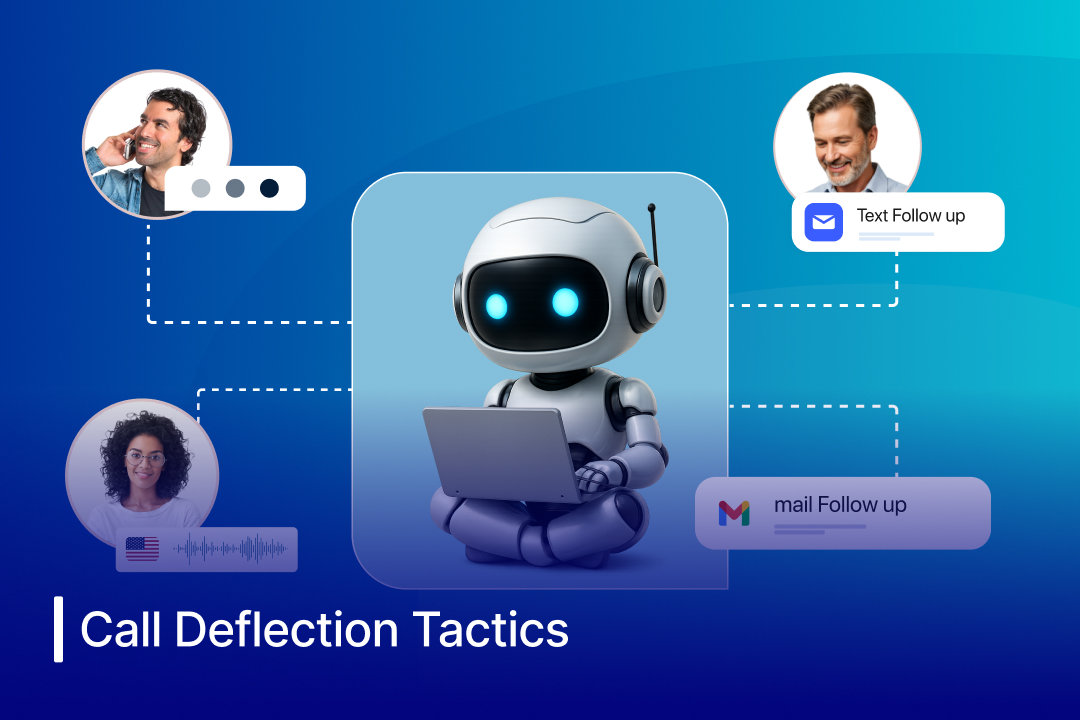
Call deflection is a process that directs customer calls to alternative digital communication methods. In case of simpler issues, automated systems can offer customers the most optimal alternative solution, like chatbots, SMS, email, self-service FAQs, or messaging platforms.
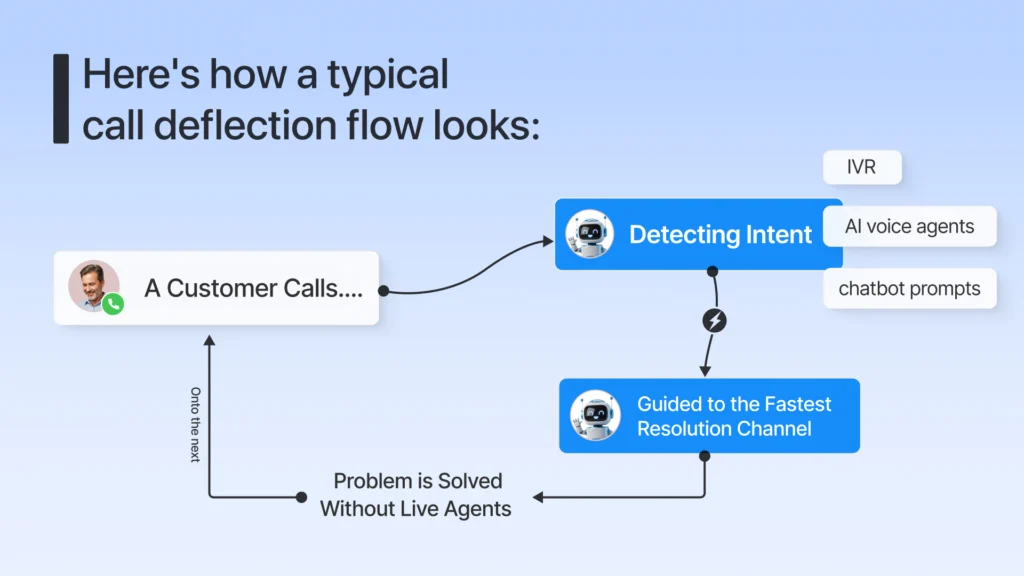
Now this may happen before a call connects or during the call journey through an IVR call deflection.
Modern contact center call deflection systems depend heavily on AI-powered call deflection tactics like natural language understanding and real-time intent detection. This is why customers don’t feel deflected when such strategies are implemented properly. Instead, they feel seen, heard, and helped.
5 Benefits of Call Deflection
Call deflection provides actual business value in terms of operations and customer experience benefits when executed properly, such as:
1. Cost Efficiency
Deflecting calls helps decrease the cost of call centers as it lessens the number of calls attended by the live agents. Reduced incoming calls means less stress on staffing, lower operational costs, and increased resource utilization.
2. Better Customer Experience (CX)
Customers receive quicker responses without having to wait on the phone. Answering questions via chat, self-service, or automated support enhances customer satisfaction and long-term trust.
3. Reduced Call Volume
Repelling repetitive and low-complexity questions saves businesses a lot of unnecessary inbound calls. This enhances the call deflection rate and maintenance of support responsiveness.
4. Scalability and Peak-Hour Readiness
Deflecting calls enables businesses to deal with peak demand without the need to employ more people. Automation helps take-in volume during peak hours, allowing agents to concentrate on complex, high-value conversations.
5. Reduced Agent Burnout
If the repetitive calls are eliminated in the queue of agents, it allows the support teams to concentrate on meaningful interactions. This enhances productivity, morale, and retention in the long run.

These advantages, when combined, allow deflecting calls to be a core approach to establishing effective, scalable, and customer-centric support operations.
7 Biggest Reasons Why Call Deflection Doesn’t Work?
Most call deflection systems fail since they are aimed at cutting costs, rather than serving the customers.
The most common reasons include:
1. Failure to Resolve Core Issues:
The process of deflection fails when systems create call diversion for the customers without necessarily addressing their problem. Customers will make repeat calls as long as the root cause isn’t fixed, reducing trust and deflection rates.
2. Weakly Designed Self-Service:
Dead ends occur as a result of self-service content that is either outdated, difficult to find, or unfinished. Deflection becomes friction instead of support when customers don’t find easy answers.
3. Complicated IVR Menus:
Customers are confused by long IVR flows and are delayed in resolving issues. Abandonment and repeat calls are more frequent when there is no clear definition of intent, and the callers are made to go through several layers with multiple calls.
4. Misunderstood Strategy (Callbacks as Deflection):
One of the pitfalls is to treat callbacks or voicemails as deflection. Late response does not solve customer requirements in real time and, in actual cases, results in more follow-up as opposed to fewer calls.
5. Lack of Empathy or Nuance:
The automation, where there is no emphasis on the urgency, tone, or emotional context, is impersonal. Demanding high-intent or sensitive problems need not be deflected through hard and fast lines.
6. Inadequate Context:
Interactions break down when the AI systems do not have access to customer history, or the intent is misunderstood. The lack of confidence in automated support is easily destroyed by repetition and false answers.
7. Customer Deflection Resistance:
When deflection is mandatory or impeding, customers are resistant. Deflection is seen as avoidance, not help, since there is no clear choice to contact a human agent.
In call center deflection, unsuccessful calls frequently lead to repeat calls, which adds to the support load. The low deflection rate in call centers is usually an indicator of poor experience design, rather than bad customer behavior.
8 Solutions That Can Be Used to Improve Call Deflection
In regulated industries like automotive, missed or mishandled calls can also expose dealerships to compliance, making structured, compliant call handling just as critical as speed. Businesses need to invest in intent, context, and urgency-detecting systems to improve call deflection and reduce friction. The most effective solutions include:
1. AI-powered chatbots and Virtual Assistants:
These chatbots are capable of supporting repetitive queries that could be of high volume and in real time. By being trained in multi-lingual customer languages, they can also achieve high deflection rates as a result of solving problems before a call is placed.
2. Interactive Voice Response through call deflection systems:
IVR systems direct callers to the correct answer early in their calling process, and with intent-based call routing, can eliminate unwarranted agent transfers and call traffic.
3. Comprehensive knowledge bases & FAQs:
A knowledge base that is properly organized and updated periodically will provide the customers with the necessary answers as quickly as possible, and can be among the most important drivers in call center deflection.
4. SMS and messaging channel automation:
Messaging provides a low-effort alternative to cold calling scripts, with customers receiving their simple questions solved asynchronously, which assists in reducing the volume of inbound calls.
5. Proactive Communication:
Informing customers proactively via SMS, email, and in-app notifications minimizes the number of unnecessary calls before their occurrence. Notifications on order status, service delays, or appointment reminders pre-answer frequently asked questions and increase the overall call deflection rate.
6. Callback Options:
The callback options provide the customers with flexibility by giving them the option of requesting a callback rather than waiting on hold. Selective usage of the selective callback under the aim of high intent or complex issues assists in controlling the volume of calls without compromising customer experience.
7. Social Media Support:
The provision of support via the social media channels provides an alternative means of customer support easily, without calling. Public and private messages on apps such as WhatsApp, Facebook, or X serve to push calls away and get there in front of customers.
8. Voice AI platforms:
AI voice agents can handle conversations end-to-end and are especially effective for businesses aiming to improve call deflection without compromising on responsiveness.
Nowadays, generative AI and deflecting calls are inseparable. Generative models help systems become more responsive, analyze follow-up questions, and solve more issues without necessarily having to escalate to humans.
3 Proven Ways for Effective Call Deflection
There’s no one-size-fits-all deflecting call technique that works for every business. The approach is to align the channel with the customer’s intention, urgency, and complexity.
1. Deflect low-urgency queries first:
Requests like status updates or FAQs can be resolved through chats or self-service systems without annoying the customer. This way, the customers can receive SMS links while in IVR wait-queues.
2. Implement AI voice agents for frequent searches:
Repetitive questions eat up agent bandwidth and time. Voice AI handles these systematically, improving deflection rates in call centers.
3. Enabling self-service early in the journey:
When your customers can view helpful alternatives before waiting on hold, they are most likely to engage with those channels, reducing unnecessary call volume.
How to Maintain a Good Customer Experience with Strategic Call Deflection
Understanding deflection is just the beginning. Understanding how deflecting calls builds or breaks trust is a crucial point in customer experience. Strategic execution helps customer interactions stay smooth, natural, and respectful. Effective deflection plans focus on:
Step 1. Implement Intelligent Self-Service
Effective call deflection meaning goes beyond pushing customers away from agents. Intelligent self-service uses AI-powered strategies, such as generative AI and contextual understanding, to address common inquiries on the first call. This is the foundation of modern digital deflection, e.g., text-to-landline messaging service for customer support.
Step 2. Optimize IVR Call Deflection
The primary cause of call deflection failure is due to traditional IVR systems. Optimized IVR deflection focuses on intent-based routing, minimal menu depth, and natural language prompts. This decreases the call abandonment and increases the call deflection rates.
Step 3. Use Clear, Human Language
Automation should never sound like automation. Customers disengage when deflection feels robotic or repetitive. Using clear, conversational language helps customers feel guided rather than blocked: an essential technique to improve deflection without harming CX.
Step 4. Keep Interaction Paths Short
Overly long menus and excessive options reduce the deflection rate in call centers. The intuitive interaction paths, which are short, also enable customers to resolve issues more quickly, enhancing their satisfaction, and making call center deflection actually effective
Step 5. Proactive Digital Deflection
The most effective deflecting techniques don’t wait for the phone to ring. Proactive digital deflection via SMS, automotive chat software, or voice nudges answers common questions early, reduces inbound call volume, and improves overall omnichannel contact center call deflection performance.
Step 6. Build and Maintain a Knowledge Base
A strong knowledge base powers successful deflecting calls. Effective deflection FAQs, self-service documentation, and dynamic help articles help customers self-deflect and are useful in both digital and voice-based deflection processes.
Step 7. Seamless Channel Transitions
Customers should be able to move from voice to chat or messaging without repeating themselves. Seamless channel transitions preserve context, reduce friction, and make AI-powered call deflection strategies feel supportive, not dismissive.
Step 8. Enable Easy Human Handoffs
Strategic call deflection never traps customers. Clear escalation paths to human agents increase customer confidence and willingness to engage with automation, key to sustaining high deflection rates over time.
Step 9. Analyze Call Deflection Statistics
Continuous improvement depends on data. Tracking call deflection statistics, deflection success rates, drop-offs, and resolution outcomes helps teams refine workflows, optimize IVR logic, and identify gaps across contact center deflection programs.
Effective Call Deflection Strategies For Success
Effective call deflection strategies focus on faster resolution, not simply reducing call volume. The most successful deflection programs combine digital deflection, IVR optimization, and AI-driven automation to improve customer experience while increasing the call deflection rate.
Here’s what consistently works:
Proactive Chat on High-Intent Pages
Placing chat software or AI assistants on high-intent pages (pricing, support, booking, checkout) enables digital deflection before a call is even placed. Customers get instant answers, reducing inbound calls and improving contact center call deflection outcomes.
Smart IVR Call Deflection
Modern IVR call deflection relies on intent recognition rather than rigid menus. Smart IVR routing ensures callers reach the right resolution, or channel, on the first attempt, reducing transfers, callbacks, and abandonment.
AI Voice Agents for Frequent Queries
Using the best voice AI agents to handle repetitive questions (hours, order status, availability) improves response time and significantly lifts call deflection statistics. This is where generative AI delivers the most immediate ROI.
Unified Context Across Channels
When CRM, voice, chat, and messaging systems share context, customers don’t have to repeat themselves. Unified data flows improve efficiency and trust, strengthening AI-powered strategies across channels.
Real-World Use Cases of Call Deflection
Certain call deflection scenarios are suited for a large percentage of inbound call volume, like:
IVR Self-Service Options
Modern IVR call deflection enables customers to complete simple tasks, such as checking status, updating details, or accessing information, without speaking to an agent. Intent-aware IVR flows reduce transfers and improve call center deflection outcomes.
Chatbot and AI Integration
Integrating chatbots and voice AI across web, app, and messaging channels enables effective digital deflection. These AI-powered strategies resolve routine queries instantly while maintaining consistent context across channels.
Deflect to Digital (Callback or SMS)
Instead of placing callers on hold, contact centers can deflect calls to faster digital channels like SMS, WhatsApp, or scheduled callbacks. This approach reduces queue times, improves customer satisfaction, and increases the overall call deflection rate.
After-Hours Support
After-hours calls are a prime opportunity for deflection. AI voice agents and self-service workflows handle common requests outside business hours, ensuring 24×7 coverage without increasing staffing costs: one of the most effective deflection strategies.
Order Tracking and Status Updates
Order and request status checks are highly predictable and easy to automate. Voice AI, chat, or SMS-based updates significantly improve call deflection statistics while delivering instant answers to customers.
Appointment Scheduling and Rescheduling
Automated scheduling eliminates the need for manual back-and-forth and confirmation calls. This use case consistently drives higher deflection rates in call centers, especially in high-volume environments.
Documentation Delivery
Requests for invoices, receipts, policies, or confirmations can be deflected to email, SMS, or chat. Automating document delivery reduces agent workload while supporting seamless digital and voice-based deflection.
Why Traditional Call Deflection Falls Short for the Automotive Industry
Automotive BDC runs on speed and intent. Every inbound call typically reflects a high-value action: a buyer checking inventory, negotiating a deal, scheduling a test drive, confirming a service slot, or following up on financing. In this environment, precision and quick response aren’t optional; they directly influence revenue.
Traditional models, however, fall short here. Designed mainly to cut call volumes, they use generic IVR menus, callback systems, or digital redirects like automotive chatbots. While those methods work for simple support queries, they create friction in automotive workflows, where customers expect instant, contextual answers. Deflecting a high-intent caller to a menu or delayed response doesn’t just reduce volume; it risks losing qualified leads and ready-to-buy customers.
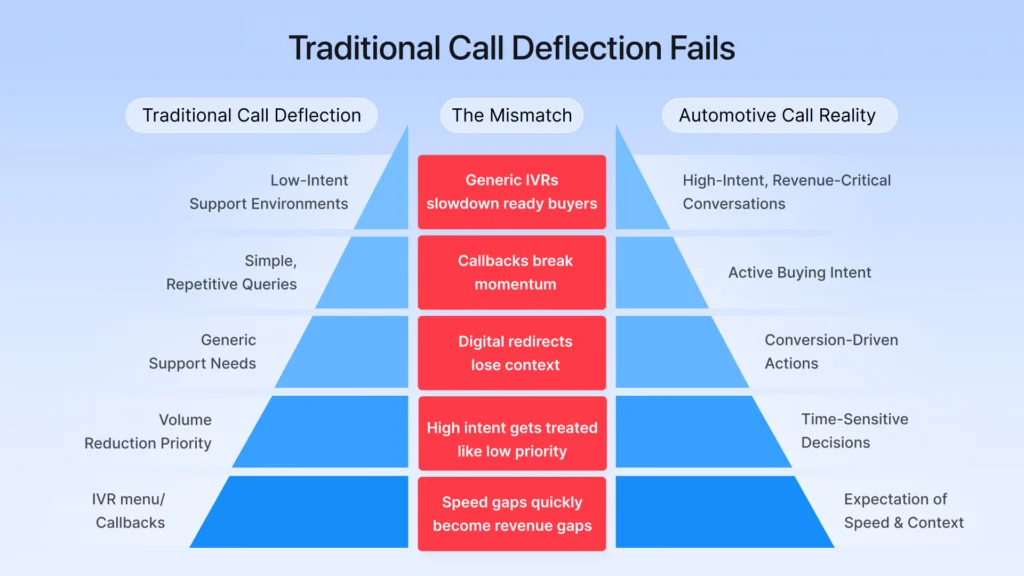
Automotive businesses don’t suffer from low-intent calls. They struggle with executing at speed.
That’s why forward-thinking car retailers es are adopting intent-aware, call handling, powered by AI call bot for car dealerships. The shift is from asking, “How do we deflect this call?” to “How do we capture, qualify, and convert this intent in real time?”
This is exactly where conversational AI agents like Vini change the game. Instead of deflecting calls, Vini manages them end-to-end: understanding buyer intent on the fly, qualifying leads, booking appointments, and passing only high-value, context-rich interactions to human agents. It doesn’t lower call volumes by avoidance; it improves efficiency through intelligent execution.
For automotive businesses, success isn’t about maximizing deflection rates. It’s about maximizing speed-to-lead capture, accelerating response times, and ensuring zero intent leakage.
What Spyne Does Better than Call Deflection
Traditional call deflection is built to reduce call volume via automotive chat, call, or other channels. Vini, our conversational AI agent, is built to capture, qualify, and convert demand. That difference matters, especially in automotive, where nearly every call carries revenue intent.
Call deflection strategies focus on:
- Redirecting callers to IVR menus, callbacks, or digital channels
- Increasing the call deflection rate in the contact center
- Reducing agent workload and operational costs
This works for low-intent, transactional support environments. It breaks down in automotive, where deflecting a call often means deflecting a buyer. Vini doesn’t avoid conversations; it completes them. Here’s how it moves automotive businesses beyond deflecting calls:
1. Intent Capture vs. Call Avoidance
Traditional deflection asks, “How do we move this caller away from agents?”
Vini asks, “What does this caller want, and how fast can we act on it?”
Vini’s automotive answering service responds to every call, understands buyer or service intent in real time, and takes action instantly, without pushing customers into dead ends.
2. End-to-End Conversation Handling
Deflection systems stop at routing. Vini goes end-to-end:
- Answers inbound calls
- Qualifies leads
- Books test drives or service appointments
- Shares inventory or availability details
- Escalates to humans only when needed, with full context.
3. Built for High-Intent Automotive Workflows
IVR automotive deflection treats all calls the same. Vini is trained specifically on automotive conversations: sales, service, pricing, inventory, financing, making responses faster, more accurate, and conversion-ready.
4. Zero Context Loss
Deflection often fragments conversations across channels. Vini maintains a unified context across voice, CRM, calendars, and lead systems: so customers never repeat themselves and teams never chase missing details.
A higher deflection rate achieved through a call center software for automotive industry doesn’t mean higher revenue. Vini measures success differently:
- More leads captured
- Faster response times
- Higher appointment show-up rates
- Fewer missed opportunities
For automotive businesses, these metrics matter far more than deflected calls.

Conclusion
Call deflection isn’t about avoiding phone calls, but serving callers faster and without friction. When done poorly, it causes burnout. When done right, it generates speed, scale, and satisfaction. In AI-first environments, outdated call deflection strategies not just fall short; they cause damage. Businesses adopting AI-powered strategies and conversational intelligence scale ops effectively.
And in automotive retail, the future is not deflection. Book a demo to see how intelligent conversations turn every call into measurable revenue.