
Every inbound call is a buying signal. When language becomes a barrier at that moment, the lead does not wait, it moves on. For dealerships in high-density Hispanic markets, English-only inbound handling is not a minor gap. It is a structural leak that routes a calculable share of ready buyers directly to competitors who answer in their language.
Hispanic consumers account for 26% of all U.S. vehicle sales and have driven 68% of the automotive industry’s total growth over the past several years. A bilingual AI answering service built for automotive handles that inbound call natively, detecting language automatically, qualifying the lead, booking the appointment, and syncing to the CRM, without adding a single bilingual hire to your payroll.
This blog breaks down the opportunity, the cost of inaction, and how the right bilingual solution operates inside a dealership’s existing workflow.
Do Hispanic Car Buyers Actually Prefer Spanish-Language Service?
Research across consumer preference studies consistently shows that 40–50% of bilingual Hispanic car buyers prefer to conduct at least part of the purchase or service transaction in Spanish, even when they speak English proficiently. The preference is strongest for service interactions involving technical repair terminology and for financing conversations where precise understanding of terms directly affects the transaction.
58% of Spanish-dominant Hispanics and 48% of bilingual Hispanics believe that brands reaching out to them in Spanish demonstrate genuine respect for their community. Studies consistently show that 75–90% of consumers prefer to transact with companies that speak their native language, regardless of price differences.
This preference extends to second-generation Hispanic Americans who are fully English-proficient. For these buyers, being served in Spanish is not a linguistic necessity, it is a trust signal. According to research published by Nielsen, 40% of Hispanics say it is important for brand communications to be in their preferred language, and another 32% find it somewhat important.
A dealership that can serve them in Spanish is communicating cultural awareness. That awareness influences both first purchases and long-term service loyalty, the revenue stream that determines fixed ops absorption rates.
Why a Bilingual Phone Answering Service Is Important for Your Business?
Most dealers understand they miss calls. Few have run the bilingual version of math. Start with what the industry already knows about call handling. According to research across nearly 600 dealerships by Numa, service departments miss an average of 158 appointment calls per month, with some missing over 216. At an industry-average repair order of $450, that translates to $71,000–$97,200 in lost service revenue every single month. That’s before accounting for the wasted ad spend, one analysis found dealerships can waste over $53,000 monthly on Google Ads alone simply by failing to answer the inbound calls those ads generate.
Now layer in the language gap.
If a dealership’s service area is 30% Hispanic residents, and 40% of that group prefers Spanish-language service, approximately 12% of total potential callers are being structurally underserved by English-only operations. For a dealership running 150 service appointments per month, that represents roughly 18 monthly appointments in addressable but uncaptured demand.
At $450 average RO:
- Language gap monthly recoverable value: ~$8,100
- Annualized: ~$97,200, from one language gap alone
In high-density Hispanic markets, Texas, California, Florida, New York, inbound Spanish call volume can reach 25–40% of total inbound volume during certain hours. The revenue exposure scales proportionally.
The automotive sector already has a 23% unanswered call rate. When you combine that with a language gap, you’re not missing leads, you’re systematically routing an entire demographic to your competition every week.
Top 5 Bilingual Answering Solutions for Car Dealerships in 2026
Not every bilingual answering solution is built for automotive. A general-purpose service can take a message in Spanish. What it cannot do is check live inventory for a caller asking about a specific trim, access open RO status for a service customer, or book directly into Xtime while the caller is on the line. These are baseline dealership expectations, not premium add-ons.
Here is how the leading solutions compare, and where each fits.
1. Vini AI by Spyne (Best AI-Driven Bilingual Appointment & Lead Capture for Dealerships)
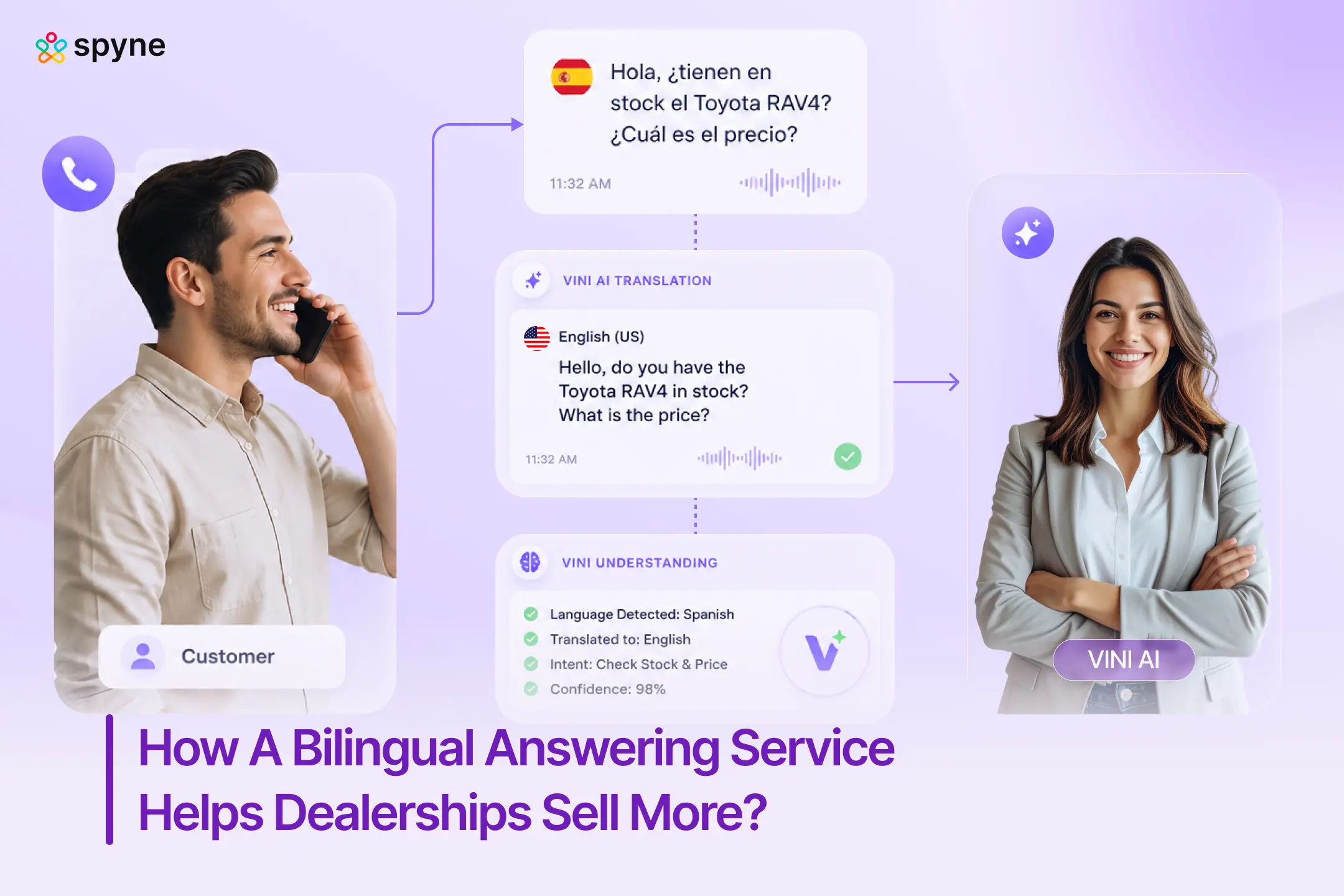
Vini AI is the only solution in this list built exclusively for automotive dealerships. It detects a caller’s language automatically from the first words of the conversation, no press-2-for-Spanish, no menu navigation, and handles the entire interaction natively in English or Spanish using purpose-trained language models, not machine translation.
What makes it categorically different from every other option here:
- Automotive-native AI, trained on dealership conversations, not generic call center scripts
- Live DMS and CRM integration, checks inventory, RO status, and customer history in real time during the call
- Full bilingual BDC capability, handles sales inquiries, service booking, lead qualification, and follow-up in Spanish with no capability loss vs. English
- 24/7 coverage with zero staffing dependency, no shift gaps, no single-bilingual-employee bottleneck
- CRM logging in English, every Spanish-language call is logged with full intent data and source attribution in English for staff review
For dealerships in high-density Hispanic markets asking how to serve Spanish-speaking car buyers without hiring bilingual staff, Vini AI is the operational answer. It functions as a fully capable bilingual AI BDC that never clocks out.
2. AnswerConnect (Best for 24/7 Live Human Bilingual Coverage)
AnswerConnect uses trained human receptionists fluent in English and Spanish, available 24/7. It handles live call answering, lead qualification, appointment scheduling, and web chat. Custom call-handling protocols are built per business, so Spanish-speaking callers receive a consistent, scripted experience rather than improvised handling.
The core limitation for dealerships: AnswerConnect is a general-business service. It has no automotive workflow integration, no DMS access, no inventory lookup, no RO context. A Spanish-speaking caller asking about a specific vehicle or service status will get a message taken, not an answer. For dealerships that want human-staffed bilingual coverage as a supplement to their existing team, it is a credible option. As a primary bilingual BDC replacement, the capability gap is significant.
3. Smith.ai (Best AI-Assisted Bilingual Receptionist for SMBs)
Smith.ai operates a hybrid model, AI-assisted workflows backed by human agents, with bilingual English and Spanish support included at no extra charge across plans. It handles lead screening, appointment booking, and basic qualification, and integrates with a range of CRM platforms via Zapier.
For small or independent dealerships with lower inbound volumes, Smith.ai is a cost-effective entry point into bilingual coverage. The limitation is scale and specialization: Smith.ai is built for SMBs broadly, not for automotive retail specifically. There is no DMS integration, no live inventory access, and no dealership-specific workflow logic. It handles general call intakes well; it is not a bilingual BDC replacement for a franchise store running 500+ inbound calls per month.
4. Ruby (Best Premium Bilingual Virtual Receptionist)
Ruby offers live human receptionists available 24/7/365 in both English and Spanish, with a strong emphasis on caller experience quality. It integrates with CRM and calendar systems and delivers sub-10-second response times through its proprietary routing platform. Ruby is particularly well-regarded in professional services, legal, financial advisory, healthcare adjacent, where a high-touch human interaction is the primary differentiator.
For automotive dealerships, the fit is limited by the same general-purpose constraint. Ruby’s receptionists are trained for professional service warmth, not for handling a caller who wants to know if a specific F-150 with a tow package is still on the lot. Premium pricing relative to AI alternatives also makes it a difficult case to justify for high-volume dealership inbound.
5. PATLive (Best for Script-Based Bilingual Appointment Scheduling)
PATLive uses U.S.-based receptionists with 80+ hours of onboarding training and a strong emphasis on script consistency, every call follows a protocol built specifically for the business. Spanish support is available, though it is offered as an add-on rather than a native capability. PATLive integrates with CRMs, calendars, and scheduling tools via API and Zapier, making it a reasonable option for dealerships that want structured, repeatable call handling with appointment booking.
The Spanish add-on structure is the key distinction to understand before evaluating it: unlike Vini AI, where Spanish is a native language model, PATLive’s bilingual capability is a staffing layer. Coverage consistency in Spanish depends on receptionist availability, which introduces the same gap risk as internal bilingual staff dependency.

How Does a Bilingual AI Answering Service Work at a Dealership?
Vini AI detects language preference from the natural opening of the conversation, not from a menu selection, not from pressing “2 for Spanish,” not from any forced pre-call routing. A caller speaks their first sentence in Spanish; Vini responds in Spanish for the remainder of the interaction. This matters operationally because forced menu-based language selection is one of the primary friction points callers cite with traditional bilingual phone systems. Removing that friction keeps the caller in the interaction.
Here is how the full interaction works:
- Call arrives, in English or Spanish, any time of day or night.
- Language detection, Vini identifies the caller’s preferred language within the first few words of natural speech.
- Native response, the entire conversation proceeds in the caller’s language with no switching or degraded capability.
- Full functionality preserved, appointment booking, service inquiry, inventory questions, lead qualification, and CRM logging all operate identically in Spanish as in English.
- CRM and DMS entry, call summary, lead source, and intent data are logged in English for dealership staff review, even when the call was conducted in Spanish.
- Confirmations, text and email confirmations are sent to the caller in their preferred language.
Key Operational Metrics
| Metric | Vini AI Performance |
| Inbound Coverage | 100% of calls and chats answered instantly |
| Language Detection | Automatic, no menu or keyword required |
| Languages Supported | English and Spanish (native models) |
| Response Time | Under 60 seconds for 95% of inquiries |
| CRM Integration | Full, all interactions logged in English for staff |
| Lead-to-Appointment Conversion | +20–25% improvement vs. unassisted handling |
| After-Hours Coverage | 24/7, no staffing dependency |
Does the AI Sound Natural in Spanish, or Like Machine Translation?
This is a legitimate operational concern, and the distinction matters significantly.
Machine translation, converting English text to Spanish in real time, produces stilted, grammatically awkward output that immediately signals to a fluent speaker that the system was not built for them. A Spanish-dominant caller who hears machine-translated Spanish will disengage faster than a caller who reaches English voicemail. The experience is actively worse than the problem it is supposed to solve.
Vini AI uses native Spanish language models. The conversation is built in Spanish from the ground up, not translated from English. This produces natural, conversational Spanish that operates the same way a Spanish-speaking human receptionist would conduct the interaction.
A recent Reddit thread on AI receptionists for multilingual customer service captures exactly this debate, operators looking for solutions that handle Spanish natively, not through translation layers, because callers can tell the difference immediately.
What Is a Bilingual BDC for Car Dealerships, and How Does It Work?
A bilingual BDC (Business Development Center) is the dealership’s inbound and outbound communication operation, capable of handling customer interactions in both English and Spanish. Traditional bilingual BDC staffing requires hiring dedicated bilingual agents, adding payroll cost, creating coverage gaps during breaks, nights, weekends, and high-volume peaks, and introducing a single point of failure whenever that agent is unavailable.
An AI bilingual BDC via Vini AI provides the same language capability without any of those constraints. The system handles:
- Inbound sales inquiries, vehicle availability, pricing, trade-in questions, test drive scheduling
- Service appointment booking, integrated with scheduling platforms like Xtime and CDK
- Lead qualification, capturing intent data, vehicle of interest, timeline, contact information
- Follow-up, automated outbound follow-through on incomplete inquiries
- CRM sync, every interaction logged with full source attribution and intent context
The cost differential between AI bilingual BDC coverage and staffed bilingual BDC coverage is substantial. Most rooftops running Vini AI see 5–10x ROI within the first 90 days, primarily from recovered opportunities that previously fell into the language gap or the after-hours gap.

How to Market Your Dealership to Hispanic Car Buyers?
Language capability at the point of inbound contact is the foundation. Without it, all other marketing investment targeting Hispanic buyers leaks at the conversion point.
The operational logic is straightforward. A dealer in a high-Hispanic-density market runs Spanish-language social media ads, Google campaigns in Spanish, and a Spanish-language Google Business Profile. A Spanish-dominant buyer finds the dealership through one of these channels and calls in. If they reach English-only handling, or worse, English voicemail, the entire upstream marketing investment is lost at the final conversion point.
Marketing to Hispanic car buyers effectively also involves:
- Google Business Profile in Spanish, local search queries from Spanish-dominant users return results in their language; a Spanish-language GBP listing signals relevance
- Spanish-language social presence, particularly on platforms with high Hispanic engagement, including Facebook and YouTube
- Cultural alignment in creative, imagery, scenarios, and messaging that reflect actual customer experience, not generic automotive stock
- Staff training on communication preferences, operational follow-through after Vini captures the appointment
Language capability at inbound is table stakes. What happens after the AI books the appointment, the in-store experience, the service advisor interaction, the F&I conversation, is where cultural awareness converts a first transaction into a long-term service customer.
Closing Thoughts
Hispanics account for 26% of U.S. vehicle sales and have driven 68% of the industry’s growth. They show strong brand loyalty when brands meet them in their language, and the inbound call is where that commitment is either demonstrated or broken.
A dealership running Spanish-language marketing but routing callers to English voicemail has built a funnel that fails at the highest-intent moment.
Vini AI closes that gap without adding headcount, without shift schedules, and without the coverage inconsistency of relying on a single bilingual employee. The system handles the call natively, books the appointment, logs the interaction, and sends the confirmation, all in the caller’s language.
If your service area includes a material Hispanic population and your inbound call handling is English-only, the revenue exposure is calculable. The fix is operational, not structural.
Book a demo with Spyne to see Vini AI handle a bilingual inbound call, and to run the addressable opportunity math for your specific market.