
Executive SummaryVehicle listing management software keeps every online listing accurate, complete, and current across a dealership’s website and every marketplace it sells on, syncing price and status changes everywhere at once instead of channel by channel. Used-vehicle listings averaged 46 days’ supply and a $27,028 asking price nationally in July 2026 (Cox Automotive, 2026), and a stale or mismatched listing now carries FTC pricing-compliance exposure, not just a missed sale (CBT News, 2026). The right platform closes both problems in the same workflow. |
A used truck’s price drops on the website on a Tuesday. The marketplace feed still shows last week’s number, and a shopper calls asking why they don’t match. Multiply that across eighty units and four channels, and it’s a pattern dealers pay for twice: lost buyer trust and regulatory exposure now that inconsistent online pricing draws real FTC scrutiny. Vehicle listing management software exists to close that gap. Here’s what it does, what separates the strong platforms from the thin ones, and how to run the process well.
What Is Vehicle Listing Management Software?
Vehicle listing management software is the system that lets a dealer add a vehicle once, manage its photos, description, and price, and keep every listing synced and accurate across the dealer’s website and every third-party marketplace, from the moment a unit goes live to the day it’s marked sold. That’s the same job most dealers mean when they ask about this category, whether they call it listing management, listing syndication, or just “getting cars online.” Inside that job, two things get bundled together that are worth separating: getting a listing out to every channel in the first place, and keeping what’s already live accurate as price, status, and condition change. Listing management picks up on the second part, and the strongest platforms handle both without treating them as separate workflows.
The distinction matters most in practice, not in theory: a listing can be perfectly published everywhere and still be wrong an hour later.
Three categories get confused with this one, and the differences matter when you’re evaluating a purchase:
- Publishing or syndication tools move inventory data from a DMS to marketplaces. Useful, but they’re a one-way feed, not an ongoing accuracy layer.
- A full DMS handles accounting, F&I, and compliance, with listing features bundled in as one module among many.
- Vehicle listing management software sits specifically on the content and consistency of the listing itself: completeness, pricing accuracy, freshness, and performance by channel.
A 2025 Clarivoy marketplace-behavior study, reported by CBT News in 2026, found that 93% of engaged car buyers use auto marketplaces during their shopping journey, more than any other channel including search. That’s the practical stakes: most buyers are seeing a dealership’s inventory through a listing the dealership doesn’t fully control the layout of, which is exactly why the underlying data has to be right every time. A dealership can have excellent inventory and still lose a sale to a competitor with a cleaner, more current listing on the same marketplace page.
What to Look for in Vehicle Listing Management Software
Six capabilities separate a real listing management platform from a basic feed tool, and they’re worth checking for specifically during a demo.
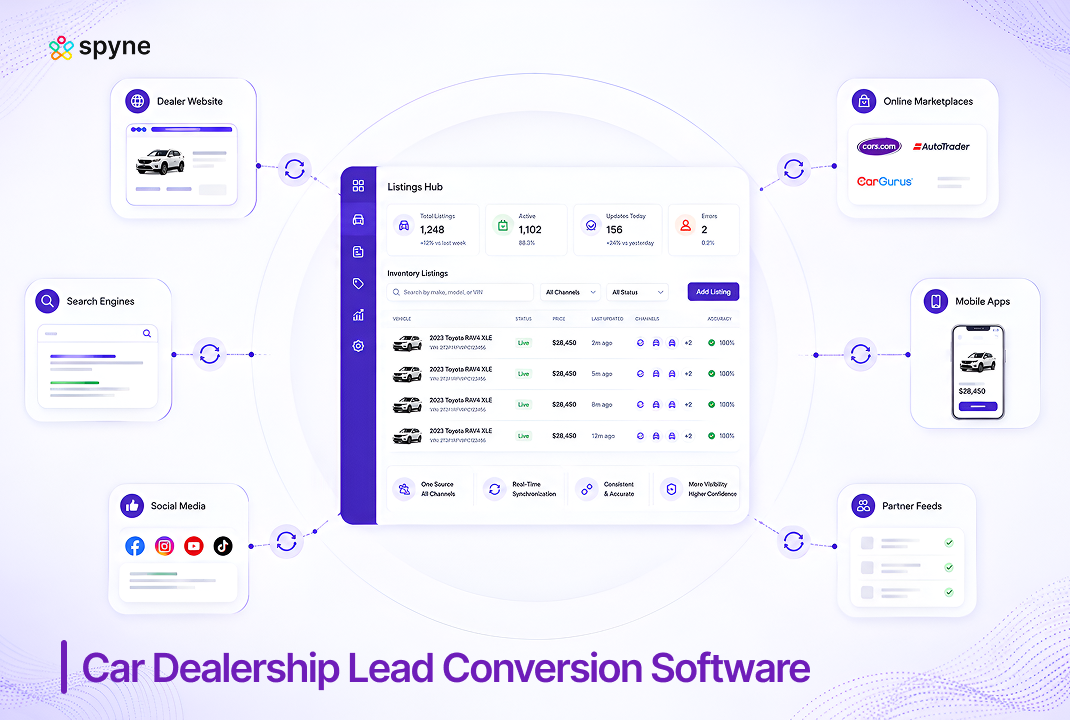
- Multi-channel synchronization: A price, photo, or status change should push to the website and every marketplace from one action, not require a separate update per channel. This is the single feature that eliminates the most common source of listing mismatches.
- AI-powered content and merchandising: Automated photo enhancement and description generation keep listing quality consistent regardless of who uploaded the original photos, and they remove the bottleneck that keeps listings from going live quickly.
- Real-time inventory visibility: A manager should be able to see stock levels, pricing, and listing status in one dashboard rather than piecing it together from separate marketplace logins.
- Integration with existing systems: The platform should connect cleanly with a dealership’s DMS and CRM rather than creating a separate, disconnected data set that needs manual reconciliation.
- Aging and performance reporting: Reports on which listings are stale, incomplete, or underperforming by channel let a manager act on a specific problem instead of scanning inventory manually.
- Scalability across rooftops: A platform that works for one location should work the same way for ten, without a full system overhaul as a dealer group grows.
Best Vehicle Listing Management Software for Dealers
The best vehicle listing management software for dealers depends on what’s actually breaking today: content quality, pricing consistency, or visibility into which listings are aging. A few decision points narrow it fast.
The comparison below reflects how the platforms that show up most often for this decision actually differ, based on their published capabilities as of 2026.
| Software | Best For | Key Strengths |
| Spyne Inventory Management | Independent and mid-size dealers who want listing accuracy, AI-generated content, and multi-channel sync in one workflow | AI-generated photos and descriptions, automatic price and status sync across every published channel, listing completeness and aging alerts |
| vAuto | High-volume and franchise dealers focused on pricing, acquisition, and syndication at scale | Live Market View pricing, reconditioning, merchandising, and listing syndication to third-party sites |
| DealerCenter | Independent and used-car dealers who want inventory, appraisal, and listings in one system | Photos, descriptions, listing exports and imports, AI-generated vehicle descriptions, mobile tools |
| Dealertrack DMS | Larger dealership operations that need inventory tied into full DMS workflows | Inventory management integrated with finance, sales, and dealership-wide data |
| HomeNet Automotive | Dealers whose main problem is getting listings distributed to as many destinations as possible | Built specifically for listing syndication, with near-real-time updates across thousands of online destinations |
| CDK Global | Large dealership networks needing enterprise-wide inventory and analytics | Inventory management as part of a full DMS, with cross-departmental data and reporting |
Pricing for all six platforms is customized to dealership size, rooftop count, and feature set. None publish flat rates.
Which software fits your dealership:
- Independent or mid-size dealer whose main gap is listing accuracy, content quality, or staying consistent across channels: Spyne Inventory Management.
- High-volume or franchise dealer prioritizing pricing strategy and acquisition: vAuto.
- Independent used-car dealer wanting inventory, appraisal, and listings bundled with financing tools: DealerCenter.
- Large dealer group standardized on a full DMS: Dealertrack DMS or CDK Global.
- Dealer whose only real problem is distributing listings to as many marketplaces as possible: HomeNet Automotive.

Vehicle Listing Management Tips for Keeping Every Channel Accurate
These vehicle listing management tips address the specific failure points that show up most often once a dealership is running listings across more than two channels.
1. Set a re-check cadence, not just a publish-once habit
A listing that was accurate on day one drifts as price, status, and even photo quality expectations shift. Reviewing active listings on a fixed schedule, weekly for fast-moving segments, catches drift before a shopper does.
2. Match photo and description standards across every channel
A listing with four photos on the website and twelve on a marketplace signals inconsistency even when the price is right. Standardizing minimum photo counts and description depth across every channel keeps the buying experience the same no matter where a shopper lands.
3. Treat price changes as a single action, not four
Every manual repricing step across separate marketplace logins is a chance for one channel to fall out of sync. A price update should propagate everywhere at once, ideally with a timestamp showing when each channel last synced.
4. Audit for sold vehicles still showing as available
CBT News reported in 2026 that regulators have flagged third-party listings that remain live after a vehicle sells as a potential bait-and-switch violation under FTC advertising rules. This isn’t just a lost lead risk anymore; it’s a compliance one.
5. Track listing age the same way you track inventory age
A unit sitting on the lot for 45 days and a listing sitting unedited for 45 days are related problems. Refreshing photos, descriptions, or price on an aging listing often does as much for a sale as a price cut alone.
How to Manage Car Listings Online: A Step-by-Step Workflow
Knowing how to manage car listings online comes down to a repeatable sequence, not a one-time setup. Here’s the workflow that holds up as inventory scales past a handful of units.
1. Pull accurate vehicle data at intake
VIN decode should populate year, make, model, trim, and mileage automatically, so every downstream listing starts from the same correct baseline instead of a manual entry that might not match across channels.
2. Build listing content once, in a format every channel can use
Photos, a description, and pricing should be created a single time and distributed everywhere, not rebuilt per marketplace.
3. Publish to every active channel from one action
Whether that’s a website, a marketplace, or social platforms, the goal is one confirmation step, not a separate login for each destination.
4. Set an update cadence tied to real triggers
Price changes, reconditioning completion, and aging thresholds should each automatically prompt a listing refresh rather than waiting for someone to remember.
5. Monitor for gaps before they become complaints
Missing photos, an outdated price, or a description that doesn’t match current condition should surface as an alert, not get discovered by a shopper on the phone.
6. Remove or update listings the moment status changes
A sold vehicle should come down everywhere within the same day, both for buyer trust and for the compliance reasons noted above.
Best Tool to Manage Car Listings Across Platforms
The best tool to manage car listings across platforms depends on which of two different jobs a dealer actually needs solved, and they get confused often enough that it’s worth separating clearly. Syndication is the job of pushing a listing out to as many destinations as possible. HomeNet Automotive is built specifically for that, with near-real-time updates across a large network of online destinations, and it’s a strong fit for a dealer whose only bottleneck is reach. Listing management is a different job: keeping whatever is already live accurate, complete, and synced as price, status, and condition change. Syndication gets a listing out the door once. Listing management is what keeps it correct for as long as the vehicle is for sale.
Most dealers actually need both, not one or the other, which is why the strongest platforms in this category don’t treat them as separate tools. Spyne’s new and used vehicle inventory system is built around the second job, ongoing accuracy, and includes the first as part of the same workflow: it publishes listings to a dealership’s website and connected marketplaces and then keeps price, status, and content synced across every one of them automatically. A platform built for this job should give a dealership one place to see, for every vehicle, exactly where it’s listed, whether the content is complete, and whether the price matches everywhere it appears. Franchise groups running several rooftops need that visibility multiplied across locations; a single independent store needs it just as much across a smaller set of channels, since the cost of a mismatch doesn’t scale down with volume.
Vehicle Listing Management Strategies That Cut Errors and Aging
These vehicle listing management strategies target the two costs that compound the longest when left unaddressed: pricing errors and aging listings. Getting them right is less about picking new vehicle listing management software and more about how consistently the platform you have gets used.
1. Segment your update cadence by how fast a vehicle moves
A fast-turning economy sedan needs tighter price monitoring than a slow-moving specialty truck. Applying one blanket review schedule to every vehicle wastes attention on units that don’t need it and under-serves the ones that do.
2. Build a listing quality score, not just a publish checklist
A completeness score across photos, description depth, and pricing freshness gives a manager one number to act on instead of scanning individual listings for gaps.
3. Coordinate pricing changes across pricing software and listing channels
A dealer inventory pricing software platform that recommends a price adjustment is only useful if that change reaches every channel the same day. Treat pricing and listing management as one pipeline, not two disconnected tools.
4. Give every rooftop the same listing standard
In a multi-location group, one store running looser content standards drags down buyer trust for the whole brand. A shared listing quality bar, enforced through the software rather than a memo, closes that gap.
Common Vehicle Listing Management Mistakes That Cost Dealers Sales
1. Updating price on the website but forgetting the marketplace feed
This is the single most common gap dealers report, and it’s the one most likely to trigger a customer complaint or a compliance flag under current FTC guidance.
2. Treating listing photos as a one-time task
Photos taken at intake don’t always reflect a vehicle after reconditioning. A listing with pre-recon photos undersells a vehicle that’s actually ready to sell.
3. Letting sold vehicles linger on third-party sites
Beyond the lost-lead risk, CBT News’s 2026 coverage of FTC guidance flags this specifically as a potential bait-and-switch exposure, not just a customer experience issue.
4. Running the same content standard regardless of channel reach
A listing on a high-traffic marketplace deserves the same completeness as one on the dealership’s own site. Thin content on a high-visibility channel wastes the traffic that channel is generating, and it’s the specific gap vehicle listing management software is built to catch before a shopper does.
5. Assuming more channels always means more sales
Every added channel adds another place a listing can go stale. Dealers get more value from fewer channels managed well than from broad reach managed inconsistently, and that trade-off is exactly what vehicle listing management software is built to make visible rather than something a manager has to sense on their own.
Spyne Inventory Management: Vehicle Listing Management Software Built for Accuracy Across Every Channel
Spyne Inventory Management is dealership software for tracking, merchandising, and listing vehicles across the sales cycle. For dealers managing listings on a website and several marketplaces at once, it centralizes the parts of the job that break most often: content quality, price and status consistency, and visibility into which listings are falling behind.
1. Listing Completeness Scoring
Every vehicle record gets checked against a completeness standard before it goes live, flagging units missing photos, a description, or a price. A used car manager catches a trade-in with only three photos before a shopper does, rather than after a low-intent inquiry comes in.
2. Price and Status Sync Across Channels
A price change or a sold status updates everywhere the vehicle is listed from a single action, instead of requiring a manager to edit four separate marketplace listings after every reprice. This is also the direct fix for the price-mismatch and compliance risk that shows up repeatedly across dealer feedback on this topic.
3. AI-Generated Descriptions and Photos
Studio AI turns raw lot photos into consistent, professional images and generates descriptions automatically, so every listing meets the same content bar regardless of who uploaded the original photos. A high-volume store no longer depends on one strong writer to keep quality even across the lot.
4. Stale and Underperforming Listing Alerts
Listings that sit without views or inquiries past a set threshold get flagged automatically, so a manager can refresh photos, adjust price, or pull the listing for review instead of discovering the problem weeks later in a monthly report.
5. VIN-Based Data Consistency
Specs pull automatically from VIN decode data, so trim, mileage, and features match across every channel from the start. This removes the manual re-entry step that’s the most common source of listings showing conflicting details across a website and a marketplace.
6. Multi-Rooftop Listing Visibility
Dealer groups see listing status across every location in one dashboard, so an inconsistent or incomplete listing at one store doesn’t go unnoticed just because a manager is sitting at another. A slow-moving unit at one rooftop can also be matched against demand at a sister store instead of sitting untouched.
7. Listing Performance Reporting
Managers can see which listings are generating views and inquiries by channel, giving a factual basis for deciding where content investment is paying off rather than guessing which marketplace is actually working.
Conclusion
Vehicle listing management software isn’t about getting a listing online once. It’s about keeping every listing accurate, complete, and consistent for as long as that vehicle is for sale, across every channel a dealership uses. The dealers who treat that as an ongoing discipline, not a one-time setup, are the ones avoiding both the lost sales and the compliance exposure that come from listings that quietly drift out of sync. Whether that means tighter update cadences, a completeness score, or software that syncs changes everywhere at once, the goal is the same: one accurate version of every listing, everywhere a buyer might find it.