
Executive SummaryDealer inventory publishing software pushes vehicle listings from a dealership’s inventory system to its own website and every third-party marketplace in one action, keeping price, photos, and availability consistent everywhere a shopper looks. Cox Automotive (2025) found that 48% of car shoppers start their search on a marketplace, not a dealer website, and the average buyer touches four separate channels before purchase. With used-vehicle days’ supply sitting at 47 days in June 2026 (Cox Automotive, 2026), how fast and accurately a dealership publishes inventory online now decides how many of those shoppers ever see the listing at all. |
A new trade-in sits reconditioned and ready, but its listing is still missing from three of the five sites where buyers are actually looking. That gap costs real leads. Cox Automotive (2025) reports the average buyer uses four channels and 48% start on a marketplace before ever landing on a dealer site. Dealer inventory publishing software closes that gap by syncing every listing, price change, and sold status across channels the moment it happens. This guide covers what the software does, how to pick one, step-by-step publishing, and the mistakes that quietly cost dealerships leads.
What Is Dealer Inventory Publishing Software?
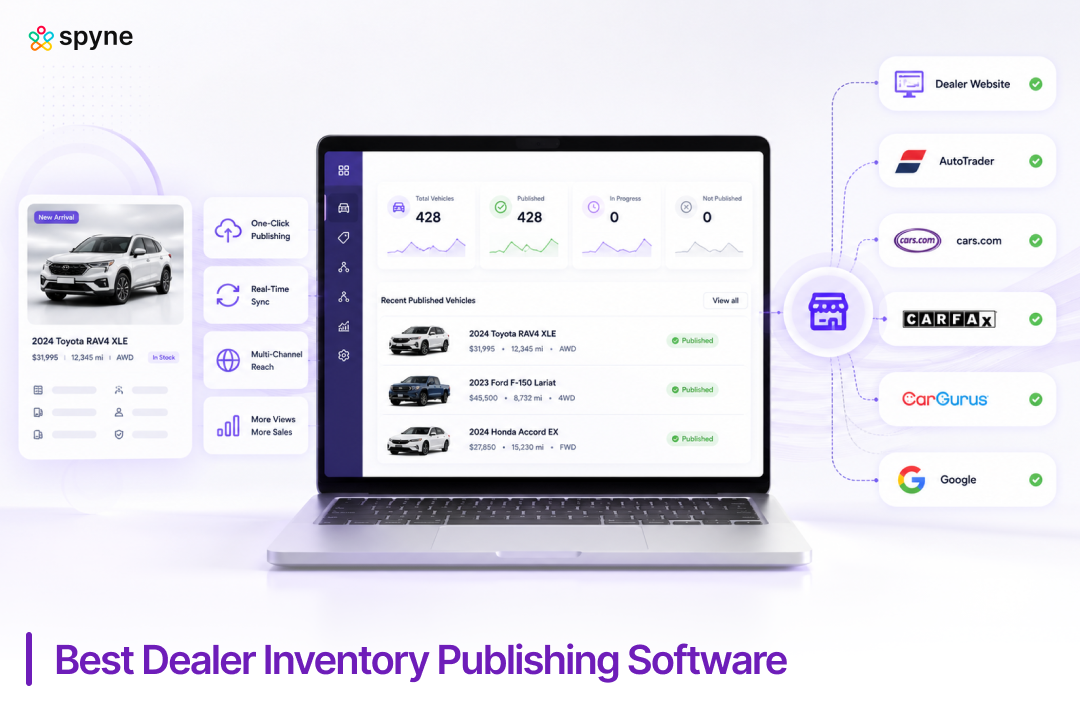
Dealer inventory publishing software is a system that takes vehicle data, photos, and pricing from a dealership’s inventory or DMS and distributes that information automatically to a dealer website and third-party listing sites such as Cars.com, Autotrader, CarGurus, and Facebook Marketplace. Instead of a manager re-entering the same vehicle on five different platforms, the software pulls the data once and publishes it everywhere, updating price drops, photo changes, and sold status in near real time.
This is a narrower category than a full dealer management system or a general inventory management platform. A DMS handles accounting, service, and titling. Broader inventory management software tracks vehicle health, reconditioning, and merchandising across the full lifecycle. Dealer inventory publishing software sits at the distribution step specifically, the part of the workflow where a finished, priced, and photographed vehicle actually goes live for shoppers to find. Many dealerships run publishing tools alongside their DMS and merchandising software rather than as a replacement for either.
Under the hood, the workflow is consistent: vehicle data comes in from the DMS or inventory source, gets normalized into one vehicle record (make, model, trim, color, options, mileage, pricing), runs through validation rules, gets photos and video attached, then publishes out to marketplaces and the dealer website. Core capabilities to confirm in any dealer inventory publishing software include a VIN-level inventory database, automatic new and used vehicle ingestion, marketplace feeds to sites like Autotrader, Cars.com, CarGurus, and Facebook Marketplace, automatic delisting once a vehicle sells, feed error monitoring, an audit trail, multi-rooftop support, and API or webhook access. This guide is scoped to the US dealer market, where DMS platforms such as CDK, Reynolds and Reynolds, and Dealertrack are what these publishing tools most commonly connect to.
Why Inventory Publishing Speed and Accuracy Directly Affect Sales
The direct answer: slower or inconsistent publishing means fewer shoppers ever see a vehicle, and inconsistent listings across sites erode trust before a buyer ever calls. Cox Automotive (2025) found that eight of ten shoppers interact with a third-party marketplace during their buying journey, and the average shopper spends 95 days in market before purchasing. Every day a vehicle sits published on the dealer site but missing from Autotrader or CarGurus is a day it is invisible to a large share of active buyers.
Pricing accuracy compounds this. Cox Automotive (2026) puts the national used-vehicle days’ supply at 47 days as of June 2026, up two days from May, with the average listing price at $27,027. Vehicles priced under $15,000 turn far faster, carrying just 33 days’ supply against that 47-day market average. A vehicle published with a stale price on even one channel can undercut or overprice the same unit relative to its other listings, confusing shoppers who cross-shop the same VIN across sites, which happens often given how many channels buyers now use.
Best Tool to Publish Dealership Inventory to Multiple Sites
The best tool to publish dealership inventory to multiple sites is the one that connects directly to a dealership’s DMS or inventory system and pushes listings to every major marketplace and the dealer website from a single dashboard, without manual re-entry. Which specific tool fits best depends on what a dealership needs beyond publishing itself:
- Franchise and multi-rooftop groups already invested in market-based pricing typically lean on platforms like vAuto, where syndication is one part of a broader pricing and merchandising system.
- Dealerships wanting a dedicated syndication layer, separate from pricing or DMS, often choose feed-focused tools such as HomeNet Automotive or SmartPublisher, both built specifically to centralize vehicle data and photos, then distribute them across dozens of marketplaces.
- Independent, single-rooftop dealers wanting inventory, CRM, and publishing in one system frequently choose an all-in-one platform such as DealerCenter rather than stitching together separate tools.
- Dealerships where listing quality, not just listing speed, drives leads are better served by a platform like Spyne Inventory Management, which pairs one-click publishing with AI-generated photos and descriptions so every channel gets a complete, professional listing on the first push.
Whichever category fits best, treat DMS integration, marketplace coverage, real-time sync, and rooftop-level rules as non-negotiable. The “What to Check Before You Buy” section further down walks through exactly what to verify on each before committing.

Best Dealer Inventory Publishing Software With One-Click Listing
The best dealer inventory publishing software with one-click listing lets a manager approve a vehicle once and have it go live on the dealer website and every connected marketplace simultaneously, with no per-site re-entry. This kind of one-click dealer inventory publishing works by treating the vehicle record, not the destination site, as the source of truth. When a manager updates the price, adds a new photo, or marks a unit sold, that single change propagates outward instead of requiring the same edit repeated on each platform.
One caveat worth knowing before buying: one-click publishing to “every channel” usually means a feed or catalog integration with each marketplace, not unrestricted direct posting to any site on the internet. Marketplace eligibility rules and account permissions still apply, so the real question to ask a vendor is how many of the marketplaces a dealership already pays for are actually covered by that one click.
Tools built purely for one-click publishing speed, such as HomeNet Automotive or Clutchly, fit best when the only goal is getting a vehicle live everywhere as fast as possible. Dealerships that want that same speed combined with AI-generated descriptions, photo enhancement, and pricing insight are better matched to a platform like Spyne Inventory Management, which pairs one-click sync with automated photo cleanup and description generation so speed and listing quality improve together.
Before choosing, ask any vendor to demo these exact actions on real inventory: publish one vehicle to the website and every connected marketplace at once, change the price and confirm every listing updates, and mark a vehicle sold and confirm it disappears everywhere.
How to Publish Dealer Inventory Online: A 5-Step Workflow
Here is how to publish dealer inventory online correctly, from intake to live listing:
- Complete the vehicle record first: VIN decode, trim, mileage, and condition notes should be accurate before anything is published, since errors here carry through to every channel.
- Attach full photo and media sets: Listings with complete photo sets get more attention from shoppers who are already comparing the same vehicle across multiple sites.
- Set the price and publishing rules: Confirm the price reflects current market position, then set which channels this specific vehicle should publish to.
- Publish once, to all channels: Use the publishing software’s single action to push the listing live on the website and every connected marketplace together. This single action is one-click dealer inventory publishing in practice.
- Monitor and update centrally: Any price change, reconditioning update, or sale should be entered once in the source system and allowed to sync outward automatically.
Skipping step one is the most common failure point. A dealership that publishes fast but with an incomplete vehicle record just distributes the error across five sites instead of one.
Dealer Inventory Publishing Strategies That Cut Days to List
Effective dealer inventory publishing strategies focus on shrinking the time between a vehicle becoming sale-ready and its listing going live everywhere. Three strategies consistently move that number:
- Publish in batches by readiness, not by schedule: Rather than running a single daily publish job, dealerships that publish the moment reconditioning and photography are done, rather than waiting for a fixed time of day, get listings live hours sooner.
- Standardize photo and description templates by body style: Pre-built templates for sedans, trucks, and SUVs cut the time a photographer or manager spends per vehicle, which speeds up the whole publishing pipeline upstream of the software itself.
- Route pricing exceptions to a single approver: When any manager can change a price on any channel independently, listings drift out of sync. One approver per rooftop, using the publishing tool’s central pricing controls, keeps every channel showing the same number.
- Track the full funnel, not just publish confirmations: A publish confirmation only shows a listing went live, not whether it is working. Following the path from impressions to vehicle detail page views to leads to actual sales shows which channels and which vehicles are worth the publishing effort, and which listings need a new photo set or price adjustment instead.
These dealer inventory publishing strategies work because the software only moves as fast as the process feeding it. A well-integrated tool cannot fix a reconditioning bottleneck, but it can make sure that once a vehicle clears that bottleneck, it reaches every channel within minutes instead of days.
What to Check Before You Buy Dealer Inventory Publishing Software
Run through this checklist before signing with any vendor, since it separates software that truly delivers one-click, multi-channel publishing from a tool that only automates part of the process:
- Integration fit: The software should connect directly to your DMS, such as CDK, Reynolds and Reynolds, or Dealertrack, rather than requiring CSV exports and manual uploads.
- Channel coverage: Match supported marketplaces against the ones your shoppers actually use, not a generic list of every site a vendor claims to reach.
- Automatic delisting: A sold vehicle should disappear from every channel within minutes, not stay live generating dead-end leads.
- Field mapping: VIN, mileage, trim, options, and pricing should map correctly to each marketplace’s own format, since a mismatch is what produces incomplete-looking listings.
- Update frequency: Ask whether price and status changes sync in real time or only on a scheduled batch; some feed providers update just twice a day.
- Multi-location support: Multi-rooftop groups need publishing and pricing rules that can differ by location while reporting from one dashboard.
- Lead routing: Inquiries from every marketplace should land in one CRM or inbox, not scattered across each platform’s own messaging system.
- Audit trail: The software should show what changed, when, and on which channel, so errors can be traced to their source.
A live demo against real inventory, not a features page, is the fastest way to see which of these actually hold up.
Dealer Inventory Publishing Tips and Mistakes to Avoid
The dealer inventory publishing tips below take minutes to apply each week and prevent most of the mistakes that follow.
Tips that improve publishing performance:
- Audit listings monthly across every channel to confirm price, photo count, and availability actually match the source system.
- Prioritize marketplaces where Cox Automotive (2025) data shows shoppers actually start, since 48% begin on a marketplace rather than a dealer site.
- Keep VIN-level data identical across channels so shoppers cross-shopping the same vehicle on two sites see consistent information.
- Set alerts for listings that fail to publish, rather than discovering the gap when a shopper mentions it.
Common mistakes that quietly cost leads:
- Publishing to a new marketplace without validating how that platform maps trim, feature, and photo data, which produces listings that look incomplete even when the source data is not.
- Letting sold vehicles stay live on slower-syncing channels, generating dead-end inquiries and wasted BDC follow-up time.
- Treating dealer inventory publishing tips as a one-time setup instead of an ongoing process, then letting feed errors accumulate for months before anyone audits the listings.
Comparing the Top Dealer Inventory Publishing Software
The table below compares dealer inventory publishing software commonly used by US dealerships, evaluated specifically on publishing capability rather than full DMS functionality.
| Software | Best For | Key Publishing Strengths |
| Spyne Inventory Management | Dealerships wanting one-click publishing paired with AI-driven photo and description quality | One-click sync to the dealer website and third-party marketplaces, automated listing validation, AI-generated photos and descriptions, publishing status visibility |
| vAuto | Franchise and multi-rooftop groups wanting publishing tied to market-based pricing | Market-based pricing integrated with listing distribution, widely cited as an industry benchmark for inventory and merchandising |
| HomeNet Automotive | Dealerships wanting a dedicated, high-volume syndication layer | Centralizes vehicle data and photos, distributes to a wide network of marketplaces, established DMS integrations |
| SmartPublisher | Dealerships prioritizing clean, validated data before it reaches any channel | Aggregates and validates vehicle data feeds, controls where and when listings publish, unlimited advertising destinations |
| DealerCenter | Independent, single-rooftop dealers wanting inventory, CRM, and publishing together | Inventory distribution bundled with CRM and DMS-style tools, built for independent dealer workflows |
| MAXDigital | Dealerships prioritizing media and photo-driven merchandising in the publish step | Unit-level media indexing, structured photo workflows tied to listing accuracy |
Spyne Inventory Management: Dealer Inventory Publishing Software for Dealerships
Spyne Inventory Management gives dealerships a dealer inventory publishing software layer built directly into the same system used for merchandising and inventory health, so a vehicle moves from reconditioned to fully published without switching tools. It fits into the workflow at the exact point where a finished vehicle needs to reach a dealer’s own site and every connected marketplace at once, without a manager re-keying the same listing five times.
1. One-Click Publishing Across Channels
A manager approves a vehicle once inside Spyne, and the listing goes live on the dealer website and connected third-party marketplaces at the same time. There is no separate upload step per site, which removes the most common source of listing drift between channels. For a store running four or five marketplace connections, this alone removes hours of repeat data entry each week.
2. Automated Listing Validation
Before a listing publishes, Spyne checks for missing photos, incomplete descriptions, and VIN mismatches, catching the errors that normally surface only after a shopper calls to ask why the vehicle in the photo does not match the one on the lot.
3. Real-Time Price and Status Sync
When a price changes or a vehicle sells, that update pushes to every connected channel immediately rather than on the next scheduled batch job, closing the gap where sold vehicles keep generating dead-end leads.
4. AI-Powered Photo and Description Tools
Spyne’s merchandising tools clean up and standardize vehicle photos and generate consistent descriptions, so listings look complete and professional across every channel without a separate editing step before publishing.
5. DMS and Inventory-Source Integration
Vehicle data flows in from the dealership’s existing inventory or DMS source, so publishing pulls accurate VIN, trim, and pricing information automatically instead of requiring manual re-entry before a listing goes live.
6. Rooftop-Level Publishing Rules
Multi-location dealer groups can set different publishing and pricing rules by rooftop while still managing every location’s listings from one dashboard, which matters when promotions or pricing strategy differ by store.
7. Inventory Health Tied to Publishing Status
Spyne connects days-in-inventory and aging alerts directly to what is and is not yet published, so a vehicle that has been sitting unlisted for days gets flagged before it becomes a stale unit nobody is actively marketing.
8. Publishing Status Visibility Across Every Channel
Spyne shows which channels a vehicle is currently live on and flags any channel that failed to update, so a manager does not have to check five separate marketplace dashboards to confirm a listing actually went through. This turns feed errors into something a team catches and fixes the same day instead of discovering them weeks later through a confused phone call.

Conclusion
Getting a vehicle in front of buyers fast, and keeping that listing accurate everywhere it appears, is no longer a back-office detail. With shoppers spending an average of 95 days in market and touching four channels along the way (Cox Automotive, 2025), dealer inventory publishing software has become the difference between a listing that gets seen and one that quietly sits idle. Whether the priority is one-click dealer inventory publishing, tighter dealer inventory publishing strategies, or simply learning how to publish dealer inventory online without the manual re-entry, the right dealer inventory publishing software turns a multi-step, error-prone process into a single action that keeps every channel in sync.