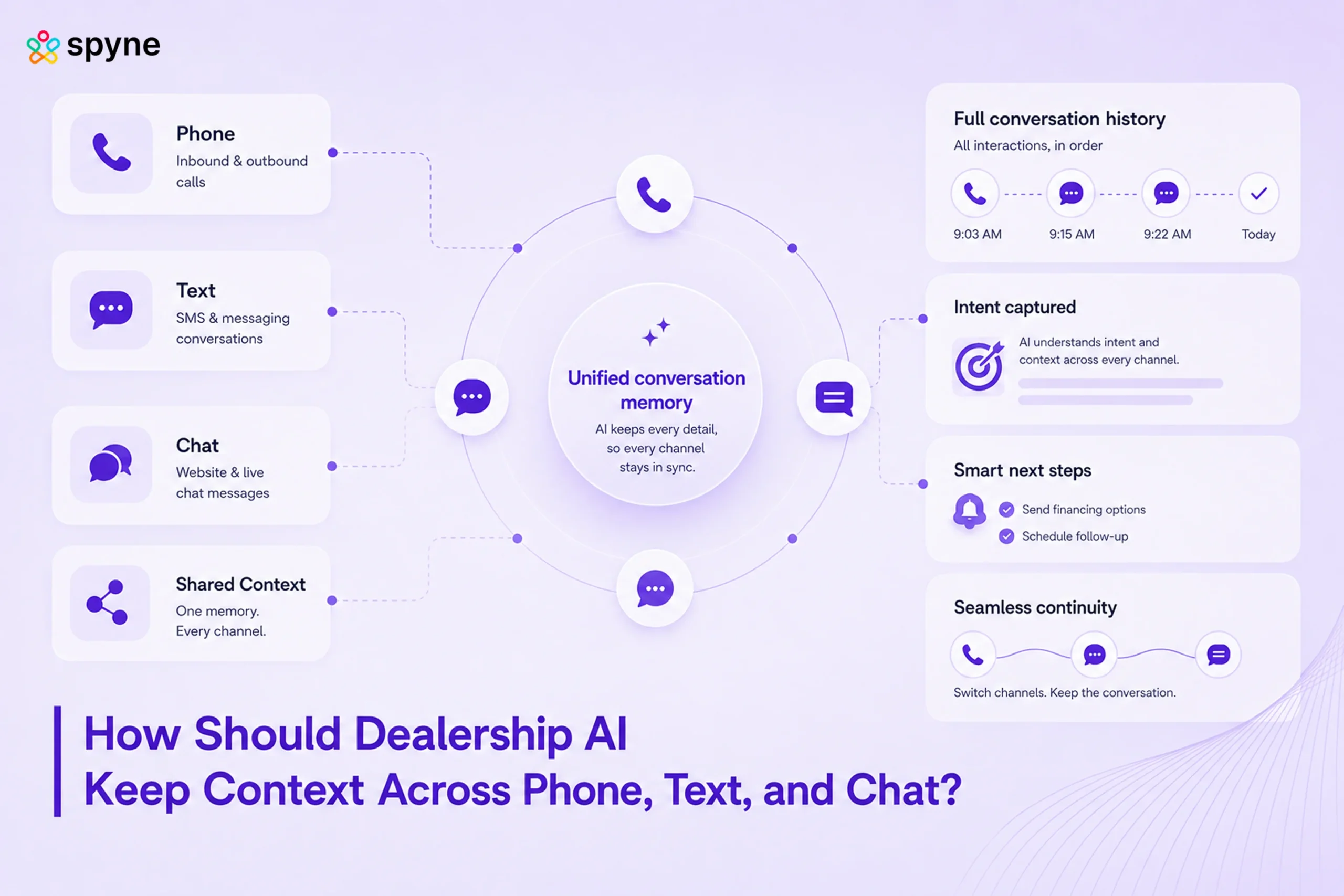

| Executive Summary: Dealership AI should preserve verified customer identity, intent, vehicle or service context, conversation history, appointment status, CRM ownership, and next actions when customers move between phone, text, and chat. True omnichannel AI does more than support several channels. It coordinates them around one current customer state. This reduces repeated questions, conflicting messages, duplicate outreach, and cold human handoffs. In 2026, dealerships should evaluate AI platforms on identity resolution, CRM synchronization, stopping rules, contextual handoffs, channel switching, and measurable continuity rather than simply comparing how many communication channels each platform supports. |
A shopper may start on website chat, reply later by text, and finally call when they are ready to visit. A service customer may schedule by phone, receive details over SMS, and call again when plans change. Dealership AI should understand these as continuing customer journeys rather than unrelated conversations.
That requires more than putting AI on several communication channels. Customer identity, vehicle or service intent, conversation history, appointment state, CRM ownership, and next actions need to remain connected. This guide explains what cross-channel dealership AI should remember, how context should move between systems, where continuity breaks, and what dealers should test before adopting an omnichannel AI platform.
Can Dealership AI Manage Customer Conversations Across Phone, Text, and Chat?
Yes. Dealership-specific conversational AI can manage customer conversations across phone, SMS, website chat, and other digital channels, depending on the platform and its integrations.
The bigger question is whether those channels share customer context. A dealer can have AI answering calls, responding to texts, and operating website chat while still forcing the same shopper to restart the conversation every time the channel changes.
Current automotive platforms are already moving toward unified communication. Numa describes its Smart Inbox around “every channel, one conversation,” while Podium brings calls, texts, chats, and emails into one automotive inbox with shared conversation history. Impel emphasizes conversation history and contextual human handoffs, while Matador has focused on centralized automotive conversations and messaging automation.
For dealers, the evaluation should therefore move from:
“Does the AI support phone, text, and chat?”
to:
“What does the AI remember when the customer moves between them?”
That distinction separates multichannel availability from genuine conversation continuity. Dealers exploring the broader difference can also compare an AI virtual assistant with a traditional dealership chatbot.
What Does Cross-Channel Context Mean for Dealership AI?
Cross-channel context means information collected during one customer interaction remains usable when the same verified customer continues through another supported channel.
The customer should continue from the point they reached previously. They should not have to repeatedly explain the vehicle, service request, appointment, trade-in, or unresolved issue simply because they changed communication methods.
For example:
A shopper chats:
“Do you still have the white 2026 CR-V?”
Later, the same shopper calls:
“What was the out-the-door price on the one we discussed?”
If the system has correctly resolved the customer’s identity and retained the earlier interaction, the AI should be able to continue using that vehicle context rather than asking, “Which model are you interested in?”
This is close to what happens in one supplied Vini conversation. When a returning caller asked which vehicle had been discussed earlier, Vini identified the earlier interest in white 2026 Honda CR-V models and continued the pricing conversation from there.
The important capability is not remembering for memory’s sake. It is using prior verified information to avoid unnecessary friction and move the customer toward the next relevant action.
What Customer Context Should Follow Across Dealership Channels?
Dealership AI should carry forward verified information that materially changes what the dealership should say or do next. That does not require putting an entire transcript into every response. The system needs a useful current state that can inform the next interaction.
Important context can include:
- Customer name and verified contact information
- Vehicle, VIN, stock number, or model of interest
- Sales, service, parts, or finance intent
- Questions already asked and answered
- Trade-in interest already disclosed
- Appointment date, time, and type
- Service vehicle information
- Lead source and CRM status
- Assigned salesperson or service advisor
- Previous AI or employee interaction
- Communication preference
- Consent and opt-out status
- Unresolved issues
- Current next action
A connected automotive lead management system becomes especially important here because the customer state needs to follow the lead through qualification, routing, follow-up, and human ownership rather than remaining trapped inside a single message thread.
The useful unit of memory is therefore not simply “what was said?”
It is “what does the dealership already know, what has already happened, and what needs to happen next?”
How Should Dealership AI Identify the Same Customer Across Channels?
Dealership AI should connect conversations using verified identifiers and existing dealership records before assuming two interactions belong to the same person.
This process is often called identity resolution. Poor identity resolution creates the opposite problem from lost context: the AI confidently uses someone else’s information.
Useful matching signals may include:
- Phone number
- Email address
- CRM customer or lead ID
- Appointment record
- Lead-source identifier
- Verified vehicle or VIN information combined with customer details
Website chat creates an additional challenge because visitors can initially be anonymous. Once the shopper provides a verified phone number, email, or other identifier, the system may be able to connect the chat with an existing dealership record.
The matching logic should remain conservative. Two people asking about the same F-150 are not automatically the same lead. A household phone number may also belong to spouses discussing the same vehicle for different reasons.
How Should Phone-to-Text and Chat-to-Phone Context Work?
Changing channels should change the communication format without resetting the customer’s progress. This is one of the easiest ways for a dealership to test whether an AI platform actually delivers connected conversations.
Consider a service interaction from a call taken by Vini.
A customer called to schedule service for his wife’s 2023 Mazda CX-5. Vini confirmed an appointment request for February 7 at 8:15 AM. The customer then asked where to drop the vehicle. Instead of ending the voice interaction and forcing the customer to find the location separately, Vini offered to send the address by text.
The customer accepted, and the address moved from phone to SMS while the underlying appointment context remained intact. That is a useful cross-channel workflow because SMS becomes an extension of the phone conversation rather than a new lead source.
Dealers building similar workflows can use automotive text messaging for appointment details, confirmations, follow-up, and ongoing customer engagement, while automotive chat software can capture and qualify conversations starting on dealership websites.
Why Is CRM State Critical for Connected Dealership Conversations?
CRM state tells dealership AI what has already happened with a customer and what should happen next. Conversation history explains what was said, while CRM data shows whether the lead is assigned, qualified, booked, sold, closed, or already being handled by an employee.
Without that shared state, different channels can act on outdated information. An AI might keep asking a customer to schedule after an appointment is booked, or continue follow-up after a salesperson has taken ownership.
A connected workflow should keep these elements synchronized:
- Lead status: New, contacted, qualified, booked, sold, or closed
- Customer ownership: Which salesperson, BDC agent, or advisor owns the conversation
- Appointment state: Scheduled, rescheduled, canceled, completed, or missed
- Conversation outcome: What the customer asked, confirmed, or declined
- Next action: Follow up, pause automation, transfer, schedule, or stop outreach
Foureyes’ 2026 Automotive Dealer Benchmarks Report found that 42.7% of qualified leads were mishandled and 15.2% were never logged into the CRM. That becomes especially risky when AI is operating across several communication channels.
A connected workflow should therefore work in both directions:
Customer interaction → AI action → CRM update → latest customer state → next interaction
Dealers looking deeper into that layer can review how an AI CRM for car dealerships uses customer and interaction data to support automated engagement and follow-up.
How Should Dealership AI Prevent Duplicate Outreach Across Channels?
Dealership AI should re-check the customer’s latest state before initiating another automated call, text, or follow-up sequence.
Without shared state, automation can quickly become repetitive. One workflow sends an SMS, another initiates an outbound call, and a salesperson starts manual follow-up without knowing either interaction already happened.
Before sending the next contact, the system should check:
- Has the customer already replied?
- Has an appointment been scheduled?
- Has the appointment changed?
- Has a human taken ownership?
- Has the customer purchased?
- Has the lead been closed?
- Did the customer opt out?
- Is another active campaign already contacting them?
- Has the vehicle’s availability changed?
These checks act as stopping and suppression rules. They matter because scale amplifies mistakes. Automation capable of contacting thousands of leads quickly can also duplicate thousands of interactions quickly when systems are disconnected.
A broader BDC software workflow should therefore coordinate lead routing, automated follow-up, CRM logging, appointment status, and human ownership instead of treating each channel as an independent queue.
What Should Happen When Dealership AI Hands a Customer to a Human?
A dealership AI handoff should transfer both the customer and the context needed to continue the conversation.
The salesperson, BDC representative, service advisor, or manager should receive more than a name and phone number.
A useful contextual handoff may contain:
- Who the customer is
- Why they contacted the dealership
- Vehicle or service request
- Important information already collected
- Questions already answered
- Unresolved issue
- Appointment status
- Customer urgency
- Recommended next action
Pied Piper’s 2026 Internet Lead Effectiveness study tested 3,290 dealership websites and found customer inquiries requiring human help scored nine points lower. Customers were also twice as likely to receive no personal response when human intervention became necessary.
That makes handoff quality an important part of the AI workflow.
One Vini service recording demonstrates why. A customer had previously been transferred to voicemail while seeking a repair-status update. He also had an urgent concern about a loaner agreement under his wife’s name.
Vini first confirmed both issues and their urgency. When human help became necessary, it summarized the situation for the service team: the customer’s identity, repair-status request, loaner concern, and need for assistance that day.
The useful behavior is the preservation of the unresolved problem during escalation. The customer does not need to reconstruct the issue from the beginning after every transfer.
For dealerships where missed calls and failed transfers are recurring problems, an AI call overflow workflow can provide another layer of coverage when employees are busy or unavailable.
How Do Dealerships Automate Customer Conversations at Scale?
Dealerships automate customer conversations at scale by connecting lead sources, CRM data, conversational AI, communication channels, scheduling, and human teams into one coordinated workflow. The goal is not to automate every customer interaction. It is to give each conversation to the right system or employee at the right stage.
A typical dealership workflow looks like this:
Lead source → Customer identified → CRM checked → AI responds → Action completed → CRM updated → Follow-up or human handoff
Within that workflow:
- AI handles speed: Immediate responses, routine questions, qualification, reminders, and supported appointment scheduling
- Dealership systems provide accuracy: Inventory, customer records, service availability, appointment details, and CRM status
- Automation manages repetition: Follow-up, confirmations, missed appointments, and approved re-engagement sequences
- Humans handle judgment: Negotiation, complaints, unusual requests, sensitive issues, and complex sales or service conversations
The most important requirement is that each step reads the customer’s latest status before acting.
For example, once a customer books an appointment, another text or outbound call should not continue asking them to schedule. If a salesperson takes over, automated follow-up should pause or change according to dealership rules.
Pied Piper’s 2026 automotive study found 62% of dealerships both responded by email or text and called the customer, up from 49% the previous year. As dealerships use more channels together, coordination becomes more important than simply increasing message volume.
A connected BDC software workflow should therefore keep lead routing, follow-up, appointment status, CRM activity, and human ownership synchronized across the customer journey.
What Usually Breaks Cross-Channel Dealership AI?
Cross-channel AI usually breaks when dealership systems disagree about customer identity, workflow state, ownership, inventory, or the next action. The most damaging context failure is rarely forgetting an individual sentence. It is acting on information that another system has already changed.
| Context failure | What the customer experiences | Likely operational problem |
| Duplicate lead records | Repeated questions and outreach | Identity resolution failed |
| Missing CRM write-back | Employees cannot see AI activity | Integration or logging failure |
| Stale appointment status | Wrong reminders or duplicate bookings | Scheduler and CRM disagree |
| Separate channel histories | Customer repeats information | Channel data remains siloed |
| Human ownership not recorded | AI continues contacting customer | Handoff state did not update |
| Vehicle sold | AI discusses unavailable inventory | Inventory was not refreshed |
| Opt-out not synchronized | Another channel keeps contacting | Suppression data is disconnected |
| Failed transfer | Customer falls between AI and employee | No fallback ownership workflow |
Foureyes found mishandled chat leads increased by three percentage points in its 2026 benchmark data, even while overall mishandled qualified leads improved slightly. Pied Piper separately warned that system-to-system failures can occur between dealership websites, DMS platforms, CRM systems, AI tools, email, text, and phone infrastructure.
These findings matter because a dashboard can show that automation ran successfully while the customer’s actual request remains unresolved.
How Should Dealerships Measure Cross-Channel Conversation Continuity?
Dealerships should measure whether customers and employees can successfully continue interactions across channels, not simply how many conversations the AI handled.
Useful metrics include:
1. Cross-channel recognition rate
The percentage of returning customers correctly connected to the appropriate existing customer or lead record.
2. Repeat-information rate
How often customers are asked for information they already provided during an earlier supported interaction.
3. CRM write-back success rate
The percentage of AI conversations whose outcomes, appointments, notes, and status changes reach the CRM correctly.
4. Duplicate-contact rate
How often customers receive unnecessary outreach from overlapping workflows.
5. Context-complete handoff rate
The percentage of escalations where the receiving employee gets enough information to continue without restarting qualification.
6. Appointment conflict rate
Duplicate, stale, or contradictory bookings caused by synchronization problems.
7. Suppression accuracy
Whether sold, opted-out, booked, closed, or human-owned customers stop receiving incompatible automated outreach.
8. Channel-switch completion rate
How often customers successfully complete an intended workflow after moving from one supported channel to another. This measurement layer matters because Foureyes found 62.8% of sales leads that returned to a dealership website still did not hear from a salesperson within 24 hours. A technically successful AI interaction does not guarantee that the wider dealership workflow reached the next step.
How Vini AI Supports Connected Dealership Conversations
Vini AI is Spyne’s automotive conversational AI platform for managing dealership sales and service interactions across voice, SMS, and web chat while connecting conversations with dealership workflows and CRM activity.
Its role in conversation continuity goes further than providing multiple communication channels.
- Maintains useful customer and conversation context: Vini can use lead details, vehicle interest, customer preferences, conversation outcomes, and action items to keep supported interactions relevant instead of treating every contact as completely new.
- Supports voice, SMS, and web chat: The platform can manage inbound dealership conversations across these channels. Vini’s product documentation specifically supports context retention when switching between SMS and voice within the same conversation session.
- Keeps vehicle and service information connected to the interaction: Supported inventory, CRM, vehicle-history, and service-scheduling integrations can provide the information required to continue sales or service workflows without unnecessarily collecting the same details again.
- Writes conversation outcomes into supported CRM workflows: Vini can log conversation notes, appointment activity, customer intent, lead status, and next actions. Exact read-and-write behavior depends on the dealership’s CRM and integration configuration.
- Supports contextual human handoffs: When a salesperson, advisor, or another employee needs to take over, Vini can warm-transfer the customer with a conversation summary. When employees are unavailable, callback workflows can retain relevant notes.
- Keeps sales and service logic separate: Connected customer context does not mean every department follows the same workflow. Sales and service can maintain different operating hours, qualification logic, scheduling rules, escalation routes, and data dependencies.
- Carries completed actions into the next step: Once an appointment, callback, qualification step, or supported customer action occurs, subsequent interactions can work from that state rather than automatically restarting the journey.
What This Looks Like in Actual Vini Conversations
Three supplied Vini conversations illustrate different layers of continuity.
#1 Earlier vehicle context: A returning customer asked which vehicle had been discussed previously. Vini recalled the earlier conversation around white 2026 Honda CR-V models before continuing the pricing discussion.
#2 Phone-to-text continuity: A service customer scheduled a 2023 Mazda CX-5 appointment by phone and then requested the dealership address. Vini sent the requested information by text without reopening the scheduling conversation.
#3 Context-aware escalation: A service customer needed a repair update plus urgent clarification about a loaner agreement in his wife’s name. Vini preserved both issues and passed the service team a concise summary when escalation became necessary.
These examples are useful because they test the behavior dealers actually care about: Can the customer move forward without repeatedly reconstructing the conversation?
Dealers evaluating these workflows can explore Vini AI’s conversational AI capabilities or see how Spyne approaches AI lead qualification and CRM handoff.
What Should Dealerships Test Before Buying Omnichannel AI?
Dealerships should test one customer journey across several channels instead of accepting separate phone, text, and chat demonstrations.
A practical test could look like this:
- Start a website chat about a specific VIN.
- Provide a verified phone number.
- Continue the conversation through SMS.
- Call from the same number.
- Ask what vehicle was discussed.
- Book an appointment.
- Change the appointment by another channel.
- Request a human employee.
- Inspect the transfer summary.
- Review the final CRM record.
- Confirm automated follow-up stops or changes appropriately.
Then evaluate the outcome.
- Did the AI recognize the customer?
- Did it preserve the correct vehicle?
- Did it know an appointment already existed?
- Did the employee receive useful context?
- Did the CRM reflect what happened?
- Did any unnecessary outreach continue?
For multi-rooftop organizations, these questions become even more important because customer ownership, permissions, and CRM configuration may vary by location. Dealers operating several stores can also review the considerations in Spyne’s guide to choosing an AI platform for dealership groups.
A dealer that cannot pass this test may have several AI-enabled channels. It does not necessarily have a connected conversation system.

Conclusion
Dealership AI creates value when every supported channel works from the same current customer state, rather than creating more automated touchpoints in separate systems. Foureyes found 42.7% of qualified leads were mishandled in its 2026 benchmark, while Pied Piper identified failures between AI, CRM, DMS, communication tools, and human handoffs as a growing risk.
Connected AI should preserve verified identity, customer intent, appointment status, dealership ownership, and relevant conversation history while knowing when to update, escalate, or stop. That continuity determines whether automation removes friction or creates more of it.
Book a demo with Spyne to see how Vini AI can support connected customer conversations across your dealership.