
| Executive Summary
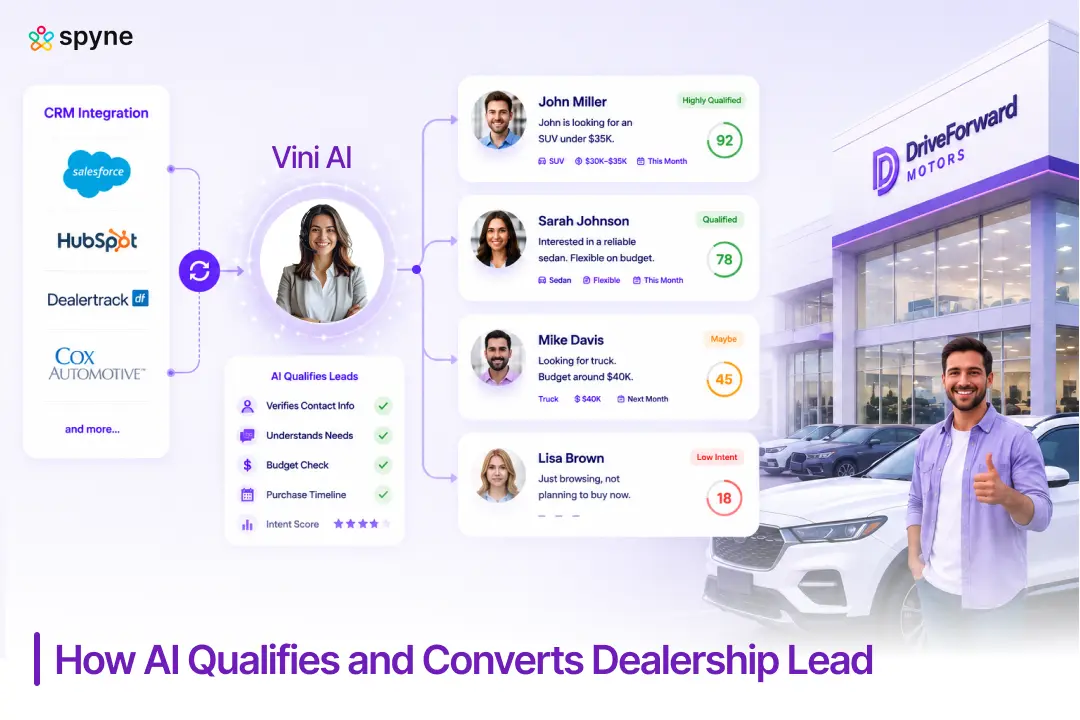
AI qualifies dealership leads through a four-stage workflow: capture, intent scoring, conversational qualification, and CRM handoff. The handoff is where most deployments lose conversion value, AI books the appointment but passes an incomplete record to the sales rep. Vini AI captures six qualification data points and writes a full conversation transcript to the CRM before every handoff, giving sales reps the context they need to close, not just a name and a callback number. |
Most dealerships measure AI performance by appointment volume. That is the wrong metric. The 2025 Cox Automotive Car Buyer Journey Study found that 84% of buyers who engaged with AI-powered tools reported high satisfaction, yet the average internet lead still converts at under 6%. That gap is not about how many appointments AI books. It is about what the AI hands off when it books one. This guide covers what AI lead qualification looks like at the workflow level, where it breaks in most deployments, and what a complete CRM handoff record must contain before a rep picks up the phone.
What Is the Difference Between AI Lead Qualification and AI Lead Follow-Up?
AI lead qualification and AI lead follow-up are distinct capabilities that serve different parts of the sales funnel. Deploying them interchangeably costs appointments.
Qualification: First Contact, One Time
Qualification happens once, at first contact. Its job is to answer two questions: is this lead worth a sales rep’s time right now, and what does the rep need to know to close them?
To do this well, AI qualification requires three specific capabilities:
- Real-time DMS inventory access, to confirm vehicle availability before the conversation proceeds
- Natural language understanding, to detect urgency and intent signals that a keyword match cannot catch (“I need something before the weekend” reads very differently from “just browsing”)
- CRM write-back, to log the full qualifying conversation, not just an appointment confirmation
Follow-Up: Multi-Touch, Over Days
Follow-up is what happens after the qualification determination. It covers re-engagement sequences, multi-touch nurture over days or weeks, and reminder cadences for leads not ready to buy immediately. It requires sequencing logic, channel diversification, and timing optimization, none of which are relevant to a buyer who is ready now.
Why the Distinction Matters Operationally
| AI Lead Qualification | AI Lead Follow-Up | |
| When it runs | First contact, one time | After qualification, over days/weeks |
| Primary capability | DMS check + conversational data capture | Sequencing + timing optimization |
| Failure mode | Books appointments on mismatched inventory | Loses 60% of leads not ready on first contact |
| CRM output | 6-field profile + transcript + intent score | Engagement log + touchpoint history |
A dealer who deploys a follow-up tool expecting it to qualify will book appointments on vehicles that sold yesterday. A dealer who deploys a qualification tool without a follow-up layer loses the 60% of leads who are not ready to buy on first contact.
The Four-Stage AI Lead Qualification Workflow
Between a lead arriving and a rep picking up the phone, a properly configured AI qualification system runs four stages. Most platforms handle Stage 1 and Stage 4 adequately. Stages 2 and 3 are where quality separates.
Stage 1: Capture
The lead arrives via form, call, chat, or SMS, and AI responds within seconds regardless of channel or time of day. Speed matters here, but content matters more. A 2025 DAS Technology study across 1,700 dealerships found that 91% of first responses excluded payment details, 74% offered no price quote, and 89% included no alternative vehicle options, meaning most “fast” responses were functionally useless. The capture stage’s only job is keeping the lead in the conversation long enough for qualification to begin.
Stage 2: Intent Scoring
Before the qualification conversation starts, AI scores the lead using behavioral signals: time spent on a specific VDP, the vehicle page visited, form completion depth, whether the inquiry came in after hours, and prior interaction history if the lead is already in the CRM. This score determines qualification depth and routing priority. A buyer who spent 14 minutes on a 2024 Camry XSE VDP at 10 PM on a Saturday warrants a deeper, faster-escalating sequence than someone who clicked a retargeting ad and submitted a general inquiry form. Machine learning-based lead scoring reduces time wasted on unqualified leads by 45%, freeing sales teams to concentrate effort where buying intent is confirmed.
Stage 3: Conversational Qualification
The AI runs six questions in natural conversation order, not as a form. The order is operationally critical: inventory confirmation runs before budget, because qualifying a buyer on their payment target for a vehicle that sold yesterday destroys the appointment before the rep even dials.
- Vehicle of interest, confirmed against live DMS inventory, not just stated preference
- Budget or payment target, monthly payment is more actionable than purchase price for most buyers
- Trade-in status, yes/no and rough condition; a trade changes the entire desk structure and F&I lineup
- Purchase timeline, “this weekend” versus “sometime this summer” determines routing priority
- Financing intent, cash, finance, or lease; determines the desk structure the rep prepares
- Preferred contact channel and best callback time, the 11 PM text-only lead is a different conversation than the 2 PM caller who wants to speak immediately
Stage 4: CRM Handoff
AI writes the full qualification record to the CRM: all six data fields, a full conversation transcript, a behavioral intent score, and a suggested next action. A complete handoff record reads like: “Call within 2 hours, high intent. Confirmed interest in 2024 Camry XSE, vehicle in stock at VIN [X]. Payment target: $450/month. No trade. Finance preferred. Best contact: phone after 6 PM.” That is the difference between a warm lead and a cold name. Most platforms log only a booking confirmation. A complete qualification record logs context.

The 6 Data Points AI Must Capture Before Handing Off to Your Sales Team
A qualification handoff without all six data points is not a handoff, it is an appointment with a stranger.
| # | Data Point | Why It Matters | Cost of Missing It |
| 1 | Vehicle of interest (confirmed against live DMS) | Rep knows what to sell; avoids calling about a sold unit | Buyer is told the car they want is gone; call ends in 90 seconds |
| 2 | Budget or monthly payment target | Rep knows which financing structure to lead with before dialing | Rep leads with wrong trim; buyer disengages immediately |
| 3 | Trade-in status (yes/no + rough condition) | Changes desk structure, F&I lineup, and gross calculation | Rep learns about the trade on the lot; loses control of the negotiation |
| 4 | Purchase timeline | Determines routing priority and follow-up urgency | High-intent buyer routed into 7-day nurture sequence; buys from a competitor the same afternoon |
| 5 | Financing intent (cash / finance / lease) | Determines desk structure and F&I product relevance | Rep pitches a lease to a cash buyer; trust breaks down before the close |
| 6 | Preferred contact channel and best callback time | Routes the right channel to the right rep at the right time | Rep calls at 9 AM a lead who works nights and prefers text; no answer, no show |
Where AI Lead Qualification Breaks: 4 Failure Patterns That Kill Conversion After Handoff
If your AI-booked appointments show at a lower rate than BDC-booked appointments, or close at lower gross, the problem is almost always in one of these four places.
Failure Pattern 1: Inventory Mismatch at Qualification
The AI qualifies a lead on a specific vehicle without first verifying live DMS availability. The rep calls back and delivers the worst possible opening line: that vehicle sold. The lead goes cold, the trust is gone, and the appointment is lost before the conversation started. The fix is structural, DMS inventory confirmation must run at Stage 2, before any qualifying question is asked, not after the appointment is booked.
Failure Pattern 2: Incomplete Handoff Record
The AI books the appointment but writes only name, phone number, and appointment time to the CRM. The rep walks into the call with zero context, re-asks every question the buyer already answered, and the buyer experiences the dealership as disorganized. This is the single most common failure point in AI-enabled BDC deployments, and it is entirely a configuration problem, not an AI capability problem. Requiring all six data fields before an appointment confirmation is permitted solves it. Incomplete records should trigger a follow-up qualification sequence, not a premature booking.
Failure Pattern 3: Intent Score Not Used for Routing
High-intent and low-intent leads land in the same rep queue with identical priority. A buyer who confirmed “this weekend” for a specific in-stock vehicle waits four hours for a callback because the CRM treats it identically to a “just looking” form submission. Only 11% of dealerships respond to internet leads within five minutes, the stores that consistently hit that window use intent-score-based routing that separates the queues. Without it, the high-intent buyer buys from whoever calls first.
Failure Pattern 4: AI and Rep Conversations Out of Sync
The rep calls a lead the AI already qualified and re-asks every question the AI captured. The buyer has already answered these questions. The conversation feels like a system failure, because it is. The CRM record must surface to the rep before every AI-qualified call with a two-line summary: what the AI confirmed, and what the rep must not re-ask. This is a CRM configuration and rep training decision that requires explicit setup during deployment. It does not happen automatically.
7 AI Platforms for Dealership Lead Qualification (2026)
The right evaluation criterion is not feature count or pricing. It is whether the platform captures qualifying data conversationally, confirms inventory against your live DMS, and writes a complete record to the CRM before handoff.
| Platform | DMS Write-Back | Intent Scoring | Handoff Record Quality | Best For |
| Vini AI (Spyne) | Yes, full transcript + next action | Behavioral + conversational | 6 fields + transcript + suggested next action | Dealers who need complete CRM handoff records with DMS-confirmed inventory qualification |
| Podium (Jerry) | Yes, conversation log + CRM alert | No | Booking confirmation + conversation summary | Omnichannel response; 36-second average response time; strong test-drive conversion |
| Conversica | Partial | Yes | Appointment + conversation context via Rep Assignment Rules | Long-cycle follow-up persistence; cold lead re-engagement sequences |
| Numa | Yes, DMS-integrated scheduling | No | Booking confirmation + intent routing | After-hours coverage and Fixed Ops scheduling; service lane communication |
| Toma | Yes, 20+ CRM and DMS integrations | No | Conversation summary + Transfer Clawback flag | Voice-first qualification; dropped-call SMS recovery; stores needing per-rooftop AI learning |
| Matador AI | No | No | Consolidated SMS thread log | Third-party lead capture (AutoTrader, CarGurus); SMS nurture sequencing |
| Owini | No | No | Basic notes + Smart Pause/Resume flag | Smooth AI-to-human handoff via Smart Pause; lighter qualification data capture |
All competitor data sourced from official vendor websites and product documentation only.
Which Platform Fits Your Situation
The table above maps capability. The question below maps use case. Pick the row that describes your store’s primary problem, and the platform column follows.
| Your Primary Problem | Platform to Evaluate |
| AI books appointments but CRM records are incomplete, reps call blind | Vini AI: only platform that writes all 6 fields + transcript + next action before handoff |
| Leads submit after hours and go cold by morning | Numa or Vini AI: both handle after-hours engagement with DMS-integrated scheduling |
| You have a large cold lead list that human BDC has stopped working | Conversica: built specifically for persistent re-engagement of unresponsive leads |
| Your phones are the primary lead channel and you miss calls during peak hours | Toma: voice-first AI with dropped-call SMS recovery and per-store learning via Toma IQ |
| Most leads come from CarGurus, AutoTrader, or Facebook Marketplace | Matador AI: built around third-party lead source capture and SMS nurture sequences |
| You want omnichannel first response with test-drive conversion focus | Podium (Jerry): 36-second response across all channels, 82% average show rate reported |
How to Measure Whether Your AI Is Qualifying Leads Well: 4 KPIs That Actually Matter
Appointment volume is the wrong KPI for AI lead qualification. These four metrics isolate whether the AI is doing its actual job.
KPI 1: Qualification Completion Rate
This is the percentage of AI-handled leads where all six data fields were captured before handoff. It is the leading indicator for every downstream conversion problem. A rate below 80% means the qualification sequence is breaking down, most commonly at the trade-in or purchase timeline question where buyers most frequently disengage. Low completion rate explains low show rates before you ever look at rep performance
KPI 2: Intent Score Accuracy
This measures the correlation between AI-assigned intent scores and actual appointment show rates and close rates by score tier. If high-intent leads show and close at the same rate as low-intent leads, the scoring model is not calibrated to your store’s buyer behavior, and high-value leads are being routed identically to cold ones. Cox Automotive’s Dealership Operations Survey benchmarks appointment-to-write rate at 40–50% for qualified BDC-generated appointments, rates below 35% indicate qualification problems upstream.
KPI 3: Handoff-to-Appointment Conversion Rate
Of leads handed to a rep with a complete six-field qualification record, what percentage result in a confirmed appointment? This metric isolates rep performance from AI qualification quality. A high rate with low total appointment volume points to a qualification completion problem, the AI is qualifying well but not finishing the conversation. A low rate on complete records points to rep performance or a handoff presentation problem.
KPI 4: Rep Override Rate on AI-Qualified Leads
This is how often a rep re-qualifies a lead the AI already qualified. A rate above 15% means reps do not trust the qualification records, either because they have found them inaccurate, or because the CRM does not surface the AI’s summary clearly before the call. The fix is a CRM configuration decision: the AI’s qualification summary must be the first thing a rep sees when opening an AI-sourced lead, not buried in a notes field.

Closing Thoughts
Most dealerships focus on how many leads AI captures. The dealers outperforming their market focus on what the AI hands off. A complete qualification record, six data points, a conversation transcript, an intent score, and a suggested next action, is worth more than three times the appointment volume with an incomplete one. The close happens on the floor. The close rate is decided at qualification. If you want to see exactly what a Vini AI qualification record looks like in your CRM before committing to a deployment, book a demo with Spyne.