
Executive SummaryFor dealer groups evaluating AI at scale, the platform that fits depends on which operational gap you’re actually closing: conversational AI for lead response and BDC coverage, DMS-native infrastructure for unified group operations, or a marketing CDP for cross-rooftop data activation. For inbound communications, lead response, BDC coverage, service scheduling, Vini AI by Spyne is purpose-built for multi-rooftop deployment. Paragon Honda recovered $310,000 in one week. For groups whose pain is the DMS layer, Tekion ARC is the all-in-one alternative. For marketing and customer data, Fullpath (now Cox Automotive) leads. This page maps each category to the right platform. |
According to CDK’s 2025 AI at the Dealership Study, 48% of dealers are already using AI in Variable Operations and 51% in Sales. The question is no longer whether to deploy AI, it’s which operational gap you fix first, and which platform handles it at the group level rather than store by store. When each store manager picks their own vendor independently, you end up with five different dashboards, five different data formats, and no way to hold any location accountable to a group-wide performance benchmark. The three-category framework below is how sophisticated dealer group operators are structuring this decision.
Three Categories of Dealership AI, And Which One You Actually Need
Every “best AI for dealer groups” comparison conflates three fundamentally different product categories. A dealer group that deploys one of each, for the right use case, will outperform a group that deploys one platform and tries to make it do everything. Here’s how to separate them.
# Category 1: Conversational AI for Inbound Communications (BDC, Lead Response, Service Scheduling)
- Solves: Missed calls, slow lead response, BDC overflow, after-hours coverage, service lane call volume
- Not a replacement for: DMS, CRM, or marketing automation
- Right fit if: Your group has no visibility into which stores are answering calls and which aren’t
- Platforms: Vini AI (Spyne), Numa, Matador AI, Mia Labs
# Category 2: All-in-One DMS/CRM Ecosystem with Native AI
- Solves: Fragmented data across rooftops, inconsistent deal workflows, manual cross-department reporting
- Not a replacement for: Conversational AI for customer-facing calls or a marketing platform
- Right fit if: Your group is actively modernizing its tech stack or managing too many disconnected systems
- Platforms: Tekion ARC (with T1 AI), CDK Intelligence Suite
# Category 3: AI-Powered Marketing CDP and Customer Data Platform
- Solves: Fragmented customer data across rooftops, inefficient ad spend, disconnected CRM and DMS history
- Not a replacement for: Call-handling AI or DMS infrastructure
- Right fit if: Your group is spending heavily on digital advertising with no clear cross-store attribution, or sitting on dormant database equity
- Platforms: Fullpath (now Cox Automotive)
Category 1 Deep Dive: Which Conversational AI Platform Is Right for Your Dealer Group?
This is where most dealer groups are actually spending their evaluation cycles right now, and where the architectural differences between platforms matter most at the group level.
1. Vini AI (Spyne)- Best for Groups That Need Full Coverage Across All Departments
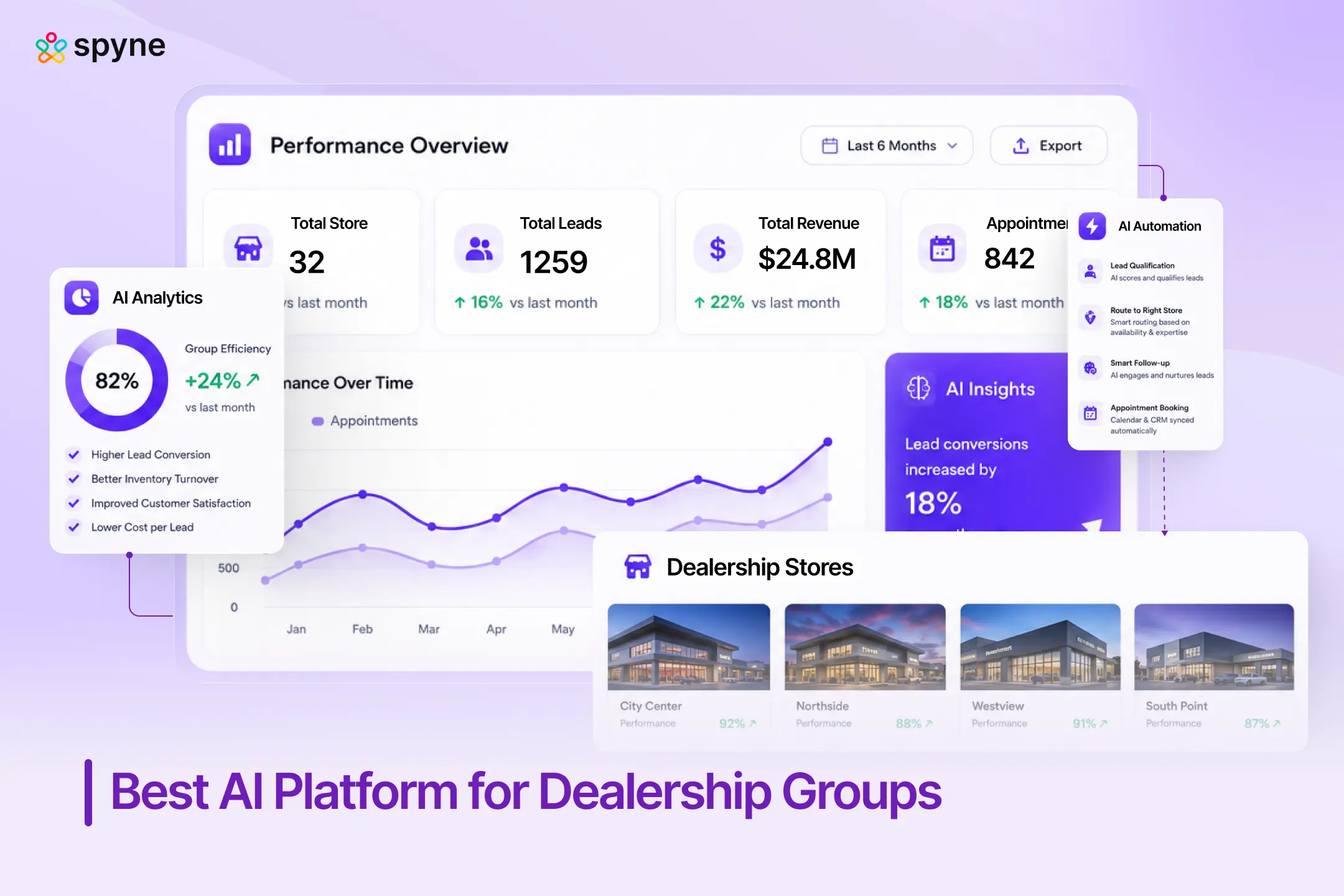
Vini AI handles inbound and outbound communications across sales, service, BDC, parts, and F&I, responding to leads in under 5 seconds, booking appointments, handling service scheduling, and logging every interaction to the CRM automatically. It deploys at the group level rather than per store, integrates natively with CDK, VinSolutions, DealerSocket, Reynolds & Reynolds, Tekion, and DealerTrack simultaneously, and surfaces a single performance dashboard across all rooftops. Paragon Honda recovered $310,000 in one week. Human QA reviews every call daily, across all locations. Pricing is volume-based with group contract terms.
Best for: Groups that want one AI layer covering all departments and all rooftops under one contract and one dashboard.
2. Numa- Best for Service-Heavy Groups
Numa is purpose-built for Fixed Operations. It handles inbound service calls, appointment booking, status updates, follow-up on declined work, and advisor communication across phone, text, and email. Numa integrates independently with each store’s DMS, so if Store A runs CDK and Store B runs Reynolds & Reynolds, each integration is configured separately during onboarding, with the group reporting layer unified above the DMS level. One multi-store group moved from 7 of 9 brands below national CSI average to all 9 above after standardizing communication across stores.
Best for: Groups whose primary pain is service lane call volume, advisor overload, and CSI performance gaps between locations.
3. Matador AI- Best for Sales-Focused Groups
Matador AI handles SMS, calls, email, web chat, and social messaging with a focus on appointment setting and sales conversion. It integrates with VinSolutions and DealerSocket and is structured around per-store accounts that can be run in parallel across a group. Strong lead nurturing workflows and BDC augmentation.
Best for: High-volume sales groups focused on speed-to-lead and internet lead conversion.
4. Mia Labs- Best for Franchise Groups Focused on Measurable Revenue Outcomes
Mia Labs is a purpose-built dealer communication platform handling phone calls, appointment scheduling, and multi-department workflows across sales and service. It has 350+ franchise dealerships and claims $45M in AI-booked dealership revenue for 2025.
Best for: Franchise dealers who want a purpose-built platform with a documented focus on revenue outcomes.
Category 2 Deep Dive: All-in-One DMS Ecosystems with Native AI
1. Tekion- Best for Groups Modernizing Their Entire Technology Foundation
Tekion’s Automotive Retail Cloud is the only AI-native, cloud-native DMS/CRM platform built from the ground up for enterprise dealer groups, connecting sales, service, F&I, and accounting on one unified data layer across every rooftop. Its T1 conversational AI agent surfaces insights across the entire dealer group instantly: ask questions, compare rooftop performance, and take action without pulling manual reports. Tekion posted 60% ARC revenue growth in 2025. The platform supports seamless onboarding of new rooftops with consistent security and compliance standards across every location.
Best for: Groups that are willing to migrate off legacy DMS systems in exchange for a fully unified, AI-native operational infrastructure.
2. CDK Intelligence Suite- Best for Groups Already on CDK
CDK’s Intelligence Suite is integrated within the CDK Dealership Xperience Platform, drawing KPIs from standardized data sources across departments and rooftops. Lead response time, close rate, front- and back-end gross, and salesperson productivity are all surfaced from aligned data rather than siloed systems. According to CDK’s own 2025 AI study, 51% of dealers are already using AI-based tools in their Sales department.
Best for: Groups already running CDK at all or most locations who want group-level reporting and AI features without a platform migration.
Category 3 Deep Dive: AI Marketing CDP for Dealer Groups
1. Fullpath- Best for Groups Activating Their Customer Database
Fullpath was acquired by Cox Automotive and is now part of Cox’s Retail360 platform, combining Fullpath’s CDP with consumer vehicle views from Autotrader and Kelley Blue Book, unifying dealer first-party data with Cox’s shopper signals from tens of millions of active car buyers. The platform resolves years of fragmented CRM and DMS history into single actionable customer profiles, then activates them for automated campaigns with individual-level attribution from ad click to purchase.
Best for: Groups spending heavily on digital advertising who want unified cross-rooftop data and always-on marketing automation within the Cox Automotive ecosystem.

Platform Comparison Table: Group-Level Evaluation Criteria
Every cell is sourced from official vendor websites or verified product documentation. “Not specified” means the vendor’s own website does not disclose this capability, not that it doesn’t exist. Verify all cells with a live demo before signing.
| Platform | Category | Group Deployment | Mixed DMS Support | Consolidated Group Reporting | Departments Covered | Pricing Model |
| Vini AI (Spyne) | Conversational AI | Group-level config | CDK, VinSolutions, DealerSocket, R&R, Tekion, DealerTrack | Single dashboard across rooftops | Sales, Service, BDC, Parts, F&I | Volume-based |
| Numa | Conversational AI (Service) | Per-store (unified platform layer) | CDK, Reynolds & Reynolds, Xtime | Group dashboard by store | Service-primary | Per-store |
| Matador AI | Conversational AI (Sales) | Per-store | VinSolutions, DealerSocket | No native group view | Sales + Service | Volume-based |
| Mia Labs | Conversational AI | Per-store | Not specified | Not specified | Sales + Service | Per-rooftop SaaS |
| Tekion ARC | DMS/CRM Ecosystem | Group-level (native) | Tekion-native only | Native group dashboard | Sales, Service, F&I, Accounting | Not public |
| CDK Intelligence Suite | DMS/CRM Ecosystem | CDK-native | CDK only | Standardized cross-rooftop KPIs | All departments | CDK contract |
| Fullpath | Marketing CDP | Per-store (now Cox network) | CDK, DealerSocket, VinSolutions | Group CDP Reporting | Marketing + CRM | Custom enterprise |
Is One AI Platform Enough, or Do Dealer Groups Need a Stack?
The old model, one point solution per function, five vendor contracts, five logins, five support queues, is actively collapsing. The dealer groups that are outperforming are consolidating, not adding.
The driver isn’t preference, it’s the data fragmentation problem. When a dealer group runs separate platforms for BDC response, service scheduling, marketing automation, and DMS, none of those systems talk to each other. The AI in each silo makes decisions without the context the other silos hold.
For a dealer group, the consolidation question has a practical answer: start with one layer, prove it, then decide what it touches next. The right first layer for most groups is conversational AI for inbound communications, it has the fastest measurable ROI (recoverable gross from missed calls shows up on the P&L within 30 days) and the lowest implementation risk (it doesn’t require replacing the DMS). Once that layer is proven, the group is in a much stronger negotiating position to evaluate the DMS or marketing data layer.
The groups that try to solve all three layers simultaneously take 12–18 months to show any ROI because every deployment is blocked by every other deployment. The ones that sequence it see returns in 30 days and build from there.
The order that works:
- Conversational AI for inbound, 30-day ROI window
- Group reporting infrastructure, 60–90 days to stabilize
- DMS consolidation or marketing CDP, 12+ month horizon
What Questions Should a Dealer Group Ask Before Signing?
Six questions that separate group infrastructure from single-store tools marketed to groups:
- Does the platform configure at the group level or per location, and what does re-configuration cost if we acquire a new rooftop? Per-store onboarding at full price for each new acquisition signals a per-store tool, not a group platform.
- Which specific DMS instances do you have live, bi-directional integrations with, not “compatible with,” but live two-way write-back? “Compatible with” typically means one-way data flow or manual reconciliation. Two-way write-back means lead data, appointment logs, and RO records sync automatically into the DMS record.
- What does your group reporting dashboard show, and can I see a live example from a current multi-rooftop client? A vendor that can’t demo a live group dashboard doesn’t have one. Cobbled screenshots of individual store views are not group reporting.
- How do you handle a mixed DMS environment, specifically if two stores are on different systems? The answer should name specific DMS instances and describe how each integration is configured. Vague API connectivity answers are a red flag.
- What is your human QA process, and who reviews call quality across multiple locations? Vini AI runs human QA on every call daily across all deployments. Ask every other vendor exactly how they verify call quality at the group level, not just AI confidence scores.
- How is pricing structured, per rooftop, per call volume, or negotiated group contract? Get renewal terms, per-acquisition cost for new stores, and any price escalation clause in writing before signing.
Should a Dealer Group Sign an Annual AI Contract or Run a Pilot First?
Don’t sign an annual contract before running a 30–60 day pilot in your specific stores. This is now the explicit standard among experienced dealer operators. As one AI founder told Car Dealership Guy in March 2026: “Don’t sign up for an annual contract. You need to give 30 days, 60 days to do pilots to see how the AI is improving for your store.”
The reason this matters more for dealer groups than single stores: a configuration that works at Store A may not translate to Store B if the DMS is different, the call volume profile is different, or the service mix is different. Annual contracts signed before validating performance at each store force groups into a deployment that may be underperforming at 3 of 8 locations, with no exit ramp until renewal.
A credible group AI deployment should offer a phased pilot structure: start with 2–3 stores in the first 30 days, measure against defined KPIs (call answer rate, appointment set rate, CRM log completeness), then expand based on results. Any vendor unwilling to structure the contract this way is either not confident in their product or not experienced with group-level deployments.
The metrics to measure during the pilot are not vanity metrics. They are: call answer rate change vs. the 30 days prior, CRM record completion rate, appointment show rate on AI-booked appointments, and escalation resolution rate. If the vendor can’t provide these by rooftop within 72 hours of being asked, the reporting infrastructure isn’t ready for a group deployment.

Closing Thoughts
The dealer groups outperforming their markets over the next 18 months are not the ones with the most rooftops, they’re the ones where every location runs the same response standard. Sub-60-second first contact. Every lead logged. Every call reviewed. The gap between your best store and your weakest store is measurable in lost gross right now.
A 5-store group deploying Vini AI can recover more than $65,000 in monthly gross from calls currently going unanswered, no new ad spend, no added headcount. If you have 5 or more rooftops and no unified conversational AI layer, you are funding your competitors’ appointments. Book a demo with Spyne and see what your group recovers in the first 30 days.