
| Executive Summary: Dealership AI has moved from experimental chatbots into production workflows across sales and fixed operations. Paragon Honda, Bob King Mazda, Martin Management Group, Walter’s Auto Group, Etheridge Ford, and Team Gillman are among the dealerships with publicly documented AI deployments.
Reported outcomes include faster lead-to-sale cycles, increased appointment volume, recovered missed calls, greater BDC capacity, and measurable revenue impact. Most dealership-specific figures come from vendor case studies rather than independent audits. Independent automotive research supports a similar conclusion: AI performs particularly well on repetitive workflows, but reliable dealership data and successful human escalation remain critical. |
AI agents are already handling real sales, service, and BDC workflows inside U.S. dealerships. Their most proven role is not replacing salespeople or service advisors. Instead, AI handles high-volume work such as first response, inbound calls, appointment scheduling, missed-call recovery, lead follow-up, and customer outreach.
Public case studies now provide measurable evidence from dealerships and dealer groups using platforms including Vini AI, Toma, Impel, and Numa. Independent automotive research also shows AI performing well on repeatable customer interactions while exposing weaknesses when human handoffs fail.
This guide examines which dealerships are using AI successfully, how they improve lead response times, what conversational AI tools dealers use, and where human involvement still matters.
Which Dealerships Are Already Using AI Agents Successfully?
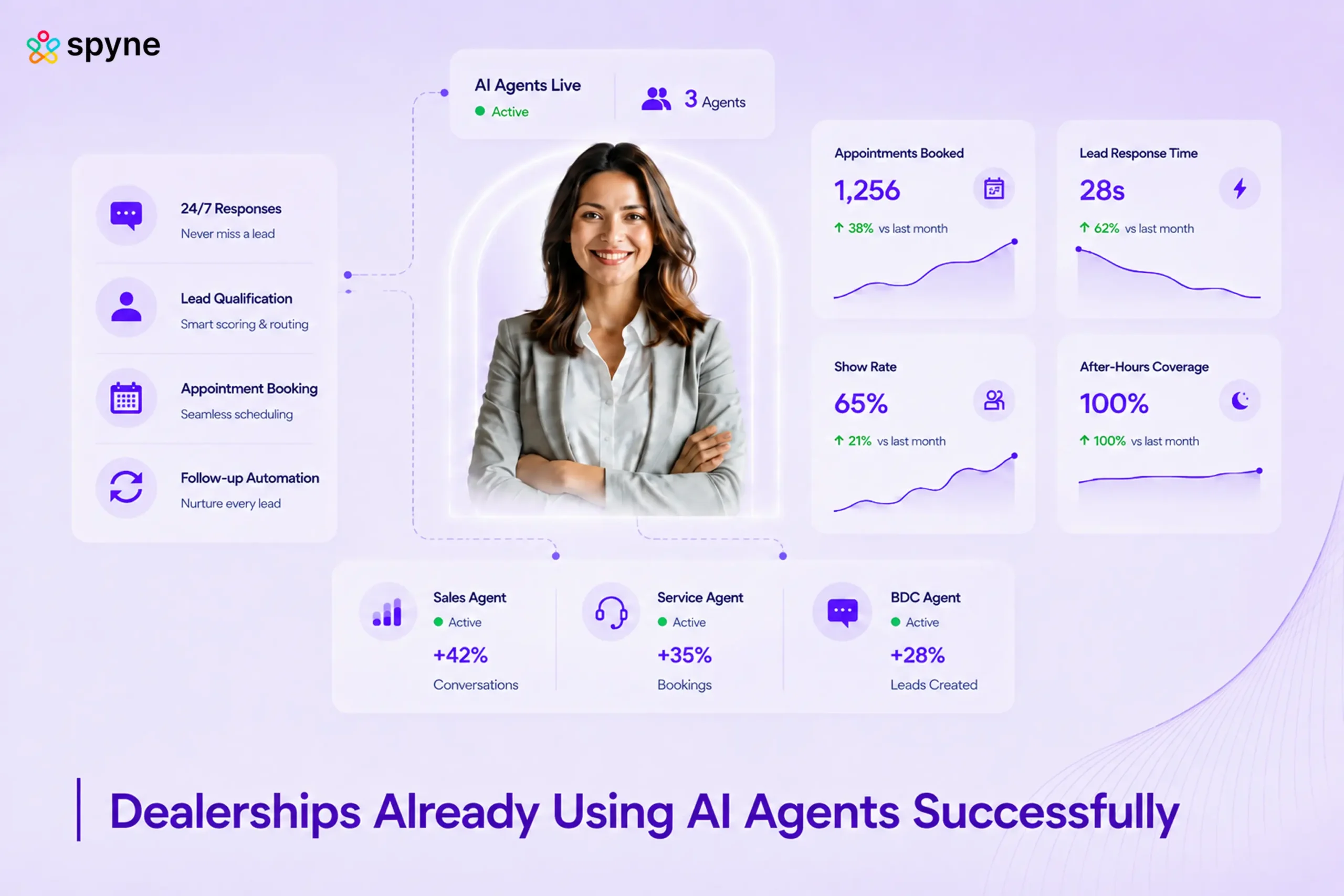
Dealerships already using AI agents successfully include Paragon Honda, Bob King Mazda, Martin Management Group, Walter’s Auto Group, Etheridge Ford, and Team Gillman. They use AI primarily for lead response, service-call handling, follow-up, missed-call recovery, qualification, and appointment generation.
The strongest deployments share one important characteristic. They automate a specific operational bottleneck and measure the outcome through appointments, revenue, customer contacts, staff workload, or sales progression.
| Dealership | AI Platform | Main AI Workflow | Publicly Reported Outcome |
| Paragon Honda | Vini AI by Spyne | Inbound coverage, qualification, recall outreach | $314K recovered in 30 days |
| Bob King Mazda | Vini AI by Spyne | Service inbound and after-hours calls | 30% higher demand capture, 12% appointment lift |
| Martin Management Group | Toma | Service voice AI and scheduling | 9,000+ appointments in 90 days |
| Walter’s Auto Group | Impel | Sales response, follow-up, overnight engagement | 56% faster lead-to-sale |
| Etheridge Ford | Impel | 24/7 sales lead engagement | 27% of showroom appointments set by AI |
| Team Gillman | Numa | Missed-call recovery and customer follow-up | 190 appointments from 662 contacted customers |
Evidence note: These dealership outcomes are reported by the vendors serving each store or dealer group. They establish real-world deployment and measurable performance, but they should not be interpreted as independently audited financial comparisons.
How We Evaluated Successful Dealership AI Deployments
A useful AI case study needs more evidence than a dealership testimonial. It should identify the dealership, define the operational problem, explain what the AI handled, provide a measurable result, and state the measurement period whenever the source discloses one.
This distinction matters when dealerships compare AI platforms. Appointment counts, revenue figures, response rates, and workload reductions measure different outcomes, so results from separate vendor case studies should not be treated as directly comparable benchmarks.
Paragon Honda: Vini AI for Inbound Coverage and Recall Outreach
Paragon Honda was dealing with unanswered inbound conversations, inconsistent response during call spikes, and recall outreach that was difficult to scale manually.
The dealership deployed Vini AI across inbound and outbound workflows. According to Spyne’s case study, Vini provided continuous conversational coverage, qualified incoming opportunities, and automated recall outreach through appointment generation.
Over a 30-day measurement period, Paragon Honda reported $314,000 in recovered revenue, a 48% appointment-to-sale rate, a 53% recall connect rate, and a 33% recall booking rate.
The important lesson is not the revenue figure alone. AI was connected to existing demand that the dealership already generated but could not consistently work.
Bob King Mazda: Vini AI for Service Calls and After-Hours Demand
Bob King Mazda faced another common dealership problem: service demand exceeded the team’s ability to answer every call during peak and after-hours periods.
According to Spyne’s case study, approximately 30% of this service demand previously went uncaptured. Vini AI was deployed as a service inbound agent to handle overflow, qualify service intent, assist customers with scheduling, and maintain after-hours coverage.
The dealership reported 30% higher demand capture, a 40% lead qualification rate, a 12% lift in service appointments, and complete after-hours coverage.
The same always-on communication model can also strengthen automotive customer retention by reducing gaps in service follow-up, reminders, and customer re-engagement.
This case demonstrates an important fixed-ops use case. AI can create value by recovering customer demand that already exists without requiring additional advertising spend.
Martin Management Group: Toma for Service Voice AI
Martin Management Group provides one of the clearest large-group examples of dealership voice AI operating in production.
The group faced inbound service-call volume that placed pressure on BDC and service teams. Toma’s AI agents were deployed to handle calls and service appointment workflows at scale.
Toma reports that within 90 days, the AI automated more than 22,000 calls, booked over 9,000 service appointments, reduced BDC workload by more than 40%, and was associated with over $2 million in service revenue.
The deployment shows where voice AI is particularly mature: repetitive service conversations with a clearly defined next action, such as scheduling an appointment.
Walter’s Auto Group: Impel for Sales Lead Response
Walter’s Auto Group operates six luxury rooftops representing brands including Porsche, Mercedes-Benz, Audi, and Sprinter.
Its BDC was managing large lead volumes while maintaining the response standard expected by luxury customers. Impel’s AI handles first response, persistent follow-up, and overnight engagement before human representatives take over higher-value conversations.
Impel reports that Walter’s reduced lead-to-sale time by 56%. A related company resource says AI-supported workflows have handled more than 107,000 leads and 600,000 messages, while individual BDC representatives can manage roughly 300 to 400 leads instead of around 200.
The case shows how AI can expand BDC capacity without removing relationship-driven work from salespeople.
Etheridge Ford: Impel for 24/7 Lead Engagement
Etheridge Ford faced a different capacity problem. Its lean sales team generated more leads than employees could consistently work.
Impel AI engaged incoming opportunities continuously and handled repetitive early-stage conversations before sales-team involvement. According to Impel, AI generated 27% of the dealership’s showroom appointments and saved approximately 400 labor hours during a 90-day period.
On the sales side, AI sales assistants for car dealerships are increasingly being used between lead arrival and salesperson handoff for response, qualification, inventory-related conversations, and appointment progression.
The value comes from consistent execution. AI does not need to close a vehicle sale to improve sales productivity. Responding, qualifying, following up, and creating an appointment can materially change how salespeople spend their time.
Team Gillman: Numa for Missed-Call Recovery
Team Gillman uses Numa across seven dealership locations, primarily as a safety net for missed customer calls and follow-up. Its workflow starts when a customer cannot reach someone. Numa can send a text offering assistance, then use an AI-assisted call when the customer does not respond. This provides another route to engagement without relying solely on manual callback queues.
In one reported set of 1,203 customers needing return calls, Team Gillman reached 662 customers, a 55.03% contact rate, and set 190 appointments.
This deployment illustrates one of the simplest dealership AI opportunities: recover conversations that might otherwise disappear after the first missed call.
Sales vs. Service: Where Are Dealership AI Agents Working Best?
Dealership AI is producing measurable results on both sides of the business, but each department requires different boundaries. Sales automation is strongest around speed, qualification, follow-up, and appointment generation, while service AI has particularly strong evidence around calls and scheduling.
Independent research currently provides stronger validation for routine service-call automation. Sales use cases remain well established through dealership deployments, but negotiation and deal-specific decisions require significantly more human judgment.
| Workflow | Sales AI | Service AI |
| First response | New internet and phone leads | Inbound service inquiries |
| Qualification | Vehicle, timing, trade, visit intent | Vehicle and service need |
| Appointment action | Showroom or test-drive appointment | Service appointment |
| Follow-up | Unsold, aged, no-response leads | Recalls, reminders, declined work |
| Missed-call recovery | Sales opportunities | Service demand |
| Strong human role | Pricing, negotiation, F&I, trade decisions | Diagnosis, complaints, warranty and safety issues |
Pied Piper’s 2025 Service Telephone Effectiveness Study tested 2,105 dealerships. At dealerships using AI for service calls, AI completed the customer’s request without human assistance 91% of the time.
When AI completed the entire call, those interactions earned an average Service Telephone Effectiveness score of 72, compared with 64 for the national dealer-group average.
The limitation is equally important. When AI could not complete the request and attempted to transfer the customer, human handoffs frequently failed. For dealerships considering deeper automation across both departments, understanding where conversational AI for car dealerships works best can help separate proven workflows from higher-risk automation.
How Are Dealerships Using AI to Improve Lead Response Times?
Dealerships are using AI to improve lead response times by engaging new leads before employee availability becomes the bottleneck. AI can start the conversation, gather context, qualify intent, maintain follow-up, and move ready shoppers toward an appointment.
This matters because the sales window remains compressed. Foureyes’ 2026 Automotive Dealer Benchmarks Report analyzed more than one billion dealer website visits and found that 62.8% of qualified sales leads did not hear from a salesperson within 24 hours after returning to the dealership website.
Among sales leads that eventually purchased, 61.2% closed within three days of their initial website inquiry.
A modern workflow typically looks like:
Lead enters → AI responds → customer intent is identified → routine questions are answered → lead is qualified → appointment is offered → conversation is documented → salesperson takes over when needed.
For dealerships struggling to separate high-intent prospects from low-quality inquiries, AI lead qualification for dealerships can add useful context before a salesperson takes over. AI improves dealership response performance in several ways.
Immediate First Contact
New inquiries can be engaged during business hours, overnight, on weekends, or while dealership employees handle customers already in the showroom. AI does not need to wait for a BDC representative to see another CRM task before beginning the conversation. Dealerships can also use an AI receptionist to improve lead response time when employees cannot consistently answer every inbound conversation.
Persistent Follow-Up
Many dealership leads do not respond to the first text, email, or phone call. AI can maintain structured follow-up instead of depending entirely on employees completing every CRM task manually. The goal should not be unlimited messaging. Follow-up needs approved cadence, channel rules, customer preferences, and a defined stopping point.
Qualification Before Handoff
AI can establish vehicle interest, buying timeframe, trade intent, appointment readiness, and other approved information before a salesperson joins. That changes the handoff from a generic new lead into a conversation with more actionable context.
Missed-Call Recovery
Phone leads that fail to connect can automatically receive another communication path. This is particularly useful when sales or service teams are busy with customers already at the dealership.
Appointment Progression
Where reliable integration exists, AI can move from conversation toward an actual appointment rather than ending with a generic acknowledgement. Speed therefore matters, but speed without accurate dealership data and dependable escalation is incomplete automation.
What Conversational AI Tools Are Dealerships Using Right Now?
Conversational AI tools dealerships are using in 2026 include Vini AI, Toma, Impel, Numa, Podium Jerry, Fullpath, STELLA Automotive AI, and Gubagoo’s GubaIQ. These products overlap, but they do not all solve the same dealership problem.
The useful way to understand the category is by workflow rather than ranking vendors. A dealership focused on service calls may need something different from a group focused on internet leads, database reactivation, or omnichannel BDC operations.
| Platform | Current Automotive Focus |
| Vini AI by Spyne | Inbound and outbound sales and service conversations, qualification, appointments, follow-up |
| Toma | Voice AI, dealership calls, service scheduling, routing |
| Impel | Sales lead response, lifecycle engagement, follow-up, service retention |
| Numa | Voice and messaging, missed-call recovery, service communication |
| Podium Jerry | Sales and service AI across calls, messaging, lead conversion, and appointments |
| Fullpath | AI lead handling using dealership customer, inventory, and CRM data |
| STELLA Automotive AI | Voice-led service scheduling, reception, and outbound outreach |
| Gubagoo GubaIQ | Automotive web conversations, vehicle questions, and AI-to-human chat handoff |
These descriptions reflect product positioning rather than a market-share ranking. The market is also shifting away from single-purpose website bots. Newer automotive AI systems increasingly connect conversations with CRM workflows, dealership data, qualification, scheduling, and follow-up.
How Does Vini AI Fit Into Modern Dealership AI Workflows?
Vini AI is Spyne’s conversational AI platform for dealership sales, service, and BDC workflows across voice, SMS, and chat.
It can support customer conversations including lead qualification, inbound service requests, appointment-related interactions, follow-up, and outbound customer engagement.
Its role is better understood as an operational layer around dealership conversations than as a replacement for dealership employees. The goal is to prevent repetitive communication work from becoming a bottleneck between customer interest and employee action.
The Paragon Honda and Bob King Mazda deployments illustrate two different applications. Paragon used Vini across inbound lead handling and recall outreach, while Bob King Mazda concentrated on service demand lost during overflow and after-hours periods.
That distinction matters for implementation. Dealerships should choose the workflow they need to fix first rather than deploying AI everywhere simply because a platform supports multiple departments.
What Dealership Work Should Remain Human-Led?
AI should handle conversations where the information is verifiable, the workflow is repeatable, and the next action is clearly defined. Humans should remain responsible when judgment, authorization, technical expertise, negotiation, or sensitive customer handling becomes necessary.
A dealership should design escalation into the workflow before launch.
Human involvement remains important for:
- Final vehicle pricing and negotiation
- Complex trade-in discussions
- Credit and financing decisions
- Technical diagnosis
- Safety-sensitive service questions
- Warranty disputes
- Customer complaints
- Manager exceptions
- Situations where current information cannot be verified
The evidence supports this hybrid model. AI performs best when it can complete routine requests independently, but customer experience can deteriorate when a necessary human handoff fails. A successful AI agent should therefore know both what it can do and when it should stop.
What Do Successful Dealership AI Deployments Have in Common?
Successful dealership AI deployments usually begin with an operational leak that can already be measured.
The objective should not simply be to “use AI.” The dealership should be trying to improve a specific workflow without breaking the systems or human processes around it.
Five patterns appear repeatedly across the dealership cases reviewed:
1. They Start With a Defined Workflow
Missed calls, routine service scheduling, new internet leads, and structured follow-up provide clearer starting points than trying to automate every customer conversation.
2. They Connect AI to an Outcome
Dealers measure appointments, contacts, workload, sales progression, repair orders, or recovered revenue rather than conversation volume alone.
3. They Use AI Where Availability Matters
After-hours, overflow, and repetitive follow-up are common deployment points because continuous human coverage is expensive and difficult to maintain.
4. They Preserve Human Judgment
Salespeople, advisors, BDC teams, and managers continue handling situations where dealership knowledge, persuasion, or discretion matters.
5. They Measure Handoffs
A system that performs well until the customer needs an employee can still create a poor customer experience.
Why Dealership AI Adoption Matters in 2026?
The economics behind automotive AI become clearer when viewed against dealership scale. NADA reports that 16,990 franchised light-vehicle dealerships operated in the United States during 2025. Those dealerships wrote more than 276 million repair orders, while service and parts sales exceeded $164 billion.
Communication problems also remain visible. Car Wars reported an average dealership sales Connect score of 62.39% during 2025, indicating significant room for improvement in connecting inbound callers with sales teams.
At that scale, dealership AI does not need to transform every conversation to create value. Recovering a portion of missed demand, shortening the response gap, or increasing scheduling consistency can materially affect dealership performance.
What Should a Dealership Automate First With AI?
The best first AI workflow is usually one with high volume, predictable customer intent, reliable underlying data, and an outcome the dealership can already measure.
For many stores, that means starting with:
- Missed-call recovery
- Routine service scheduling
- New internet lead response
- After-hours inquiries
- Aged lead follow-up
These workflows provide clearer baselines than attempting to automate negotiations or complicated customer situations. Before launching an AI agent, dealerships should establish their current response rate, appointment performance, handoff process, source of truth, and rules for when AI must involve an employee. That creates a stronger test than asking whether an AI agent simply sounds human.

Conclusion
Dealership AI is already delivering measurable value across sales, service, and BDC workflows. The strongest results come from automating high-volume tasks such as lead response, service calls, missed-call recovery, follow-up, and appointment scheduling, while keeping complex decisions human-led.
For dealerships evaluating AI, the priority should be simple: identify where customer demand is being lost, automate that workflow, and measure the outcome.
Book a demo with Spyne to see how Vini AI can help your dealership capture more conversations, appointments, and revenue opportunities.
Disclaimer: All dealership results, performance metrics, and third-party product information referenced in this article are based on publicly available sources and vendor-published case studies as cited. Results may vary by dealership, implementation, market, and workflow. References to third-party companies, products, and trademarks are for informational purposes only and do not imply affiliation, sponsorship, or endorsement. Spyne makes no representation that these results are typical or guaranteed.