
Modern sales teams are under constant pressure to respond faster, personalize every interaction, and manage increasing lead volumes across multiple channels. However, handling all of this manually often leads to missed opportunities, slower response times, and inconsistent customer experiences.
AI sales agents are changing this by automating conversations, lead qualification, follow-ups, and customer engagement at scale. Businesses across industries are now using AI-powered sales automation to improve productivity, streamline workflows, and close deals faster with smarter, data-driven interactions.
Let’s dive deeper into this blog and explore how AI sales agents are transforming modern business operations and helping teams improve productivity, customer engagement, and revenue growth. Together, you will get to explore top AI agents for your business.
What is an AI Sales Agent?
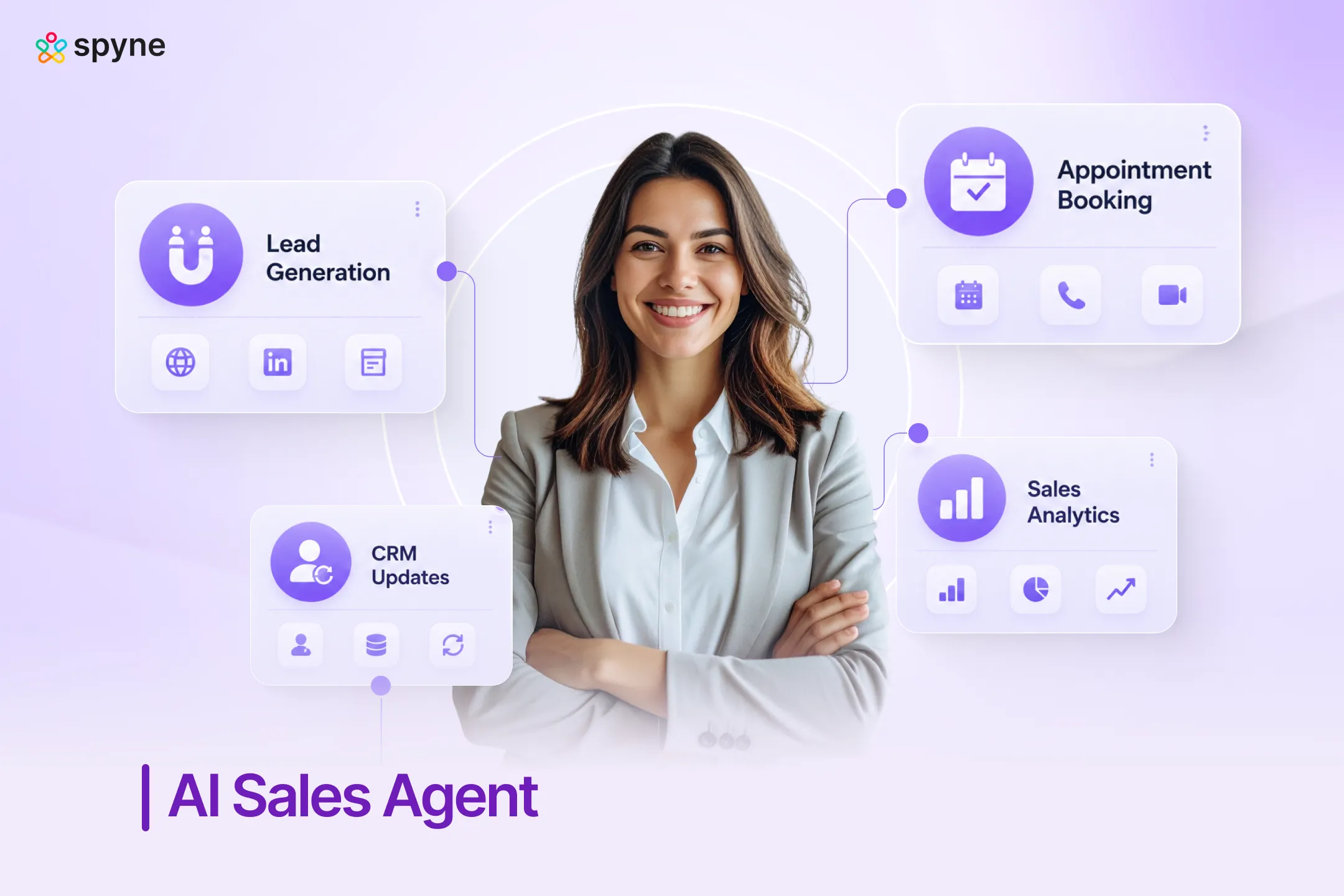
An AI sales agent is an autonomous application that uses artificial intelligence to analyze and learn from your sales and customer data, handling repetitive or time-consuming tasks. Sales agent AI goes beyond traditional chatbots. It can perform multiple tasks, like nurturing leads through outbound engagement, answering common inquiries, booking appointments, and creating quotations. An AI sales agent helps you execute a smooth workflow across the sales pipeline with minimal human intervention.
Types of AI Sales Agents
In general, AI sales agents are categorized into 2 main types: supportive and autonomous. These are designed to handle specific tasks across the five key stages of the sales funnel. Let’s discuss in brief:
1. Supportive AI Sales Agents
Supportive AI sales agents work alongside human agents to boost operational productivity and efficiency. They help automate repetitive tasks such as lead enrichment, follow-up emails, meeting scheduling, CRM updates, and sales call summaries. They can also provide real-time recommendations, customer insights, and next-best actions during sales conversations.
Further, they don’t replace sales reps; instead, they act as intelligent virtual sales assistants and allow your human agents to focus more on relationship-building and closing deals.
2. Autonomous AI Sales Agents
Autonomous AI sales agents operate independently with minimal human intervention. They can automatically analyze customer data, qualify leads, engage prospects via email or chat, answer questions, and even book meetings. Also, using machine learning and natural language processing, these agents can manage complete workflows across the sales process.
These AI sales agents are used to handle a large volume of leads, where speed, scalability, and 24/7 customer engagement are important.
Categorized by Functional Role in Sales Funnel:
1. Lead Generation Agents
These AI agents identify potential customers and generate qualified leads. These lead generation agents scan databases, analyze buying signals, enrich contact information, and match leads against the ideal customer profile (ICP). This improves lead quality and boosts conversion chances.
2. SDR and Outreach Agents
Sales Development Representative (SDR) agents automate outbound activities such as sending personalized emails, managing follow-up sequences, and engaging leads across multiple channels. These AI agents help your sales teams scale outreach efforts while maintaining personalization.
3. Conversational AI Agents
Conversational AI agents interact directly with prospects through chatbots, emails, SMS, or messaging platforms. They answer questions, resolve objections, provide product information, and guide potential buyers through the early stages of the sales journey in real time.
4. Sales Operations & RevOps Agents
These agents support sales reps by recommending relevant case studies, pricing documents, pitch decks, and sales content based on customer needs. They also help buyers make informed decisions by guiding them through complex purchasing processes.
5. Analytics & Forecasting Agents
Analytics-driven AI agents analyze sales conversations, CRM data, and historical performance to generate insights, forecast revenue, predict customer behavior, and identify deals at risk. They help businesses make smarter and more data-driven sales decisions.

Key Features of AI Sales Agents
Top AI agent for sales enablement are transforming the way businesses manage sales operations by automating repetitive tasks, improving customer interactions, and increasing overall efficiency. From qualifying leads to personalizing outreach and analyzing sales performance, these AI-powered tools help sales teams work smarter, scale faster, and close deals more effectively.
1. Autonomous Lead Qualification
Best AI sales agent automatically evaluates and qualifies leads by analyzing customer behavior, engagement history, buying intent, and demographic data. This helps human sales reps focus on high-potential leads and close deals more effectively.
2. Personalization
An AI sales voice agent creates highly personalized interactions by analyzing customer preferences, past conversations, and behavior patterns. They can tailor emails, messages, recommendations, and follow-ups to improve customer engagement and response rates.
3. Omnichannel Engagement
The best AI agent for sales provides seamless omnichannel support, helping businesses manage customer interactions across calls, chat, email, SMS, social media, and websites from a single platform. This ensures every inquiry is captured, responded to instantly, and consistently managed across all customer touchpoints.
4. Conversational AI
Leading sales AI agent solutions use natural language processing (NLP) and natural language understanding (NLU), allowing them to engage with customers in a human conversational tone, via chat, email, SMS, or voice interactions. These conversational AI can answer questions, resolve objections, understand buyer intent, and provide real-time responses for a smoother customer experience.
5. CRM & Workflow Integration
AI sales agents integrate directly with CRM platforms and sales tools to automatically update customer records, log interactions, assign tasks, and trigger follow-up workflows. This keeps sales operations organized and reduces administrative work for sales teams.
6. Performance Analytics
AI sales agents provide detailed insights into sales performance, customer behavior, engagement rates, and pipeline health. These analytics help businesses identify trends, optimize sales strategies, and make data-driven decisions for better results.
Top 5 Benefits of AI Sales Agents
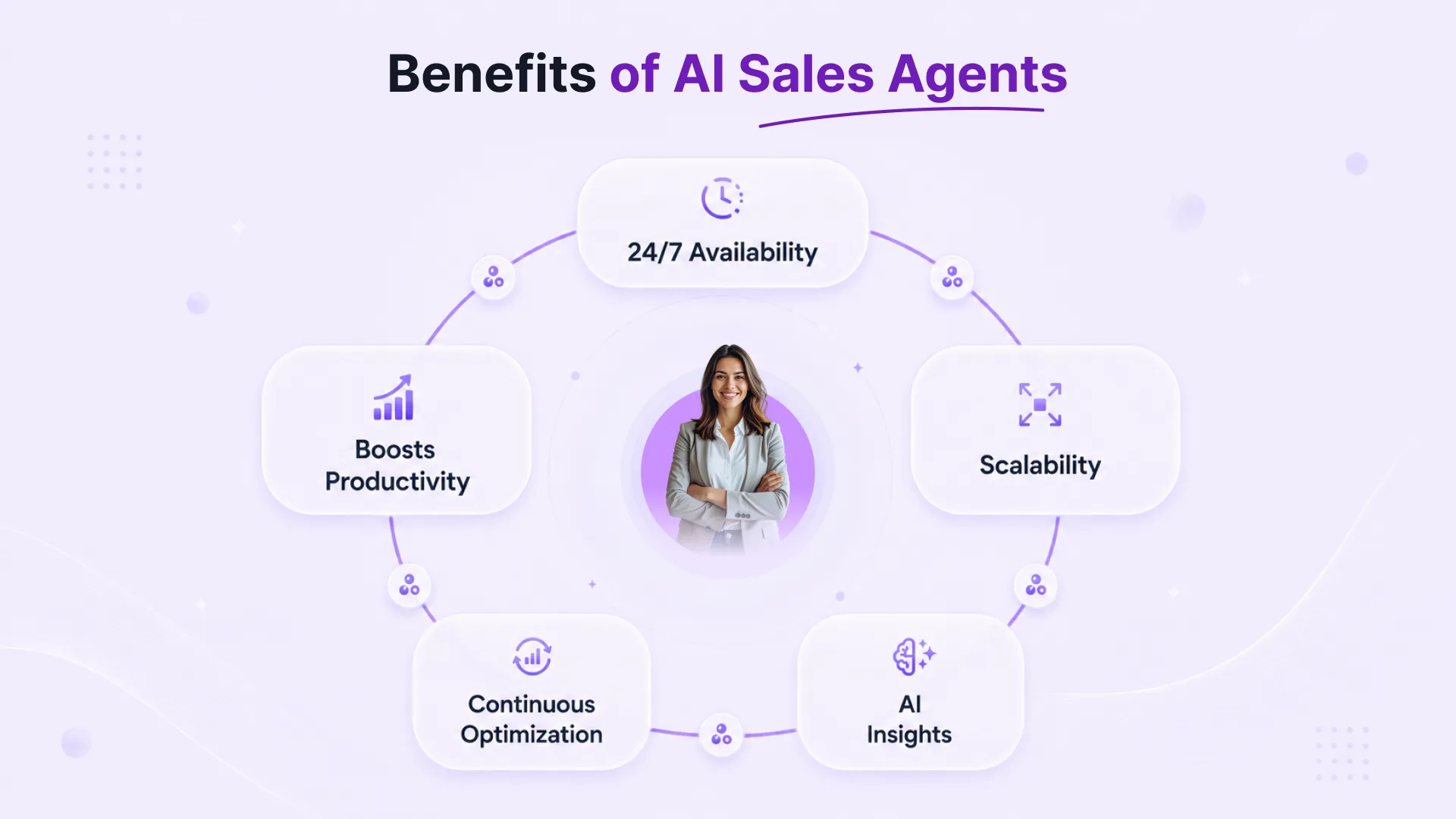
AI sales agents help businesses automate repetitive sales activities, improve customer engagement, and streamline the entire sales process. By combining automation, real-time insights, and intelligent decision-making, they enable sales teams to work more efficiently and close deals faster.
1. 24/7 Availability
AI sales agents work around the clock, ensuring customers receive instant responses no matter the time zones or business hours. This 24/7 availability helps businesses engage leads faster, reduce response delays, and prevent potential customers from losing interest.
2. Boosts Productivity
By automating routine tasks such as lead qualification, follow-up emails, meeting scheduling, and CRM updates, an AI sales call agent frees up valuable time for sales representatives. This allows teams to focus more on strategic activities like relationship-building, negotiations, and closing high-value deals.
3. Scalability
An AI voice agent for sales can manage thousands of conversations and outreach campaigns simultaneously across email, chat, text, and call. Businesses can scale sales operations efficiently without increasing their manpower or operational costs.
4. AI Insights
An AI sales call agent analyzes customer interactions, CRM data, buying signals, and engagement history to provide actionable insights. These insights help sales teams identify high-potential leads, predict customer behavior, and make smarter, data-driven decisions.
5. Continuous Optimization
AI sales agents continuously learn from every customer interaction. This continuous optimization improves messaging, personalizes communication more effectively, and optimizes sales strategies based on customer behavior and performance trends.
15+ Best AI Sales Agents In 2026
1. Spyne
Spyne is the best all-in-one AI for car dealerships. It helps automotive businesses automate their operations from merchandising to customer engagement and lead management. Spyne’s AI sales agent “Vini” streamlines conversations, qualifies buyers instantly, and improves dealership operations with intelligent automation built specifically for automotive retail workflows.
Features
- AI-powered conversational sales agents
- Automated lead qualification and engagement
- AI vehicle merchandising and image enhancement
- CRM, DMS, and IMS integrations
- AI-generated vehicle descriptions and content
- 24/7 customer interaction support
Limitations
- Best optimized for automotive dealerships
- Advanced workflows may require onboarding support
Pricing
Customizable plans available. You can connect with their sales team for pricing.
2. Amplemarket
Amplemarket helps sales teams automate prospecting and multichannel outreach with AI-powered research, sequencing, and personalization tools designed for outbound sales growth.
Features
- AI prospect research
- Personalized outreach automation
- Multichannel sales sequences
- Lead scoring and enrichment
Limitations
- Learning curve for new users
- Higher-tier features can be costly
- Mainly focused on outbound workflows
Pricing
Connect with their sales team for pricing.
3. Salesforce Agentforce
Salesforce Agentforce delivers enterprise-grade AI sales automation directly inside the Salesforce ecosystem, helping teams streamline workflows, CRM management, and customer engagement.
Features
- Native Salesforce integration
- Autonomous workflow automation
- AI lead routing
- Predictive sales forecasting
Limitations
- Expensive for smaller businesses
- Requires Salesforce ecosystem adoption
- Complex setup for beginners
Pricing
Connect with their sales team for pricing.
4. 11x
11x provides autonomous AI digital workers that automate lead generation, prospect research, and personalized outreach for enterprise sales teams at scale.
Features
- Autonomous SDR workflows
- AI lead enrichment
- Personalized outbound campaigns
- Multi-agent collaboration
Limitations
- Enterprise-focused pricing
- Requires workflow monitoring
- Limited transparency in pricing
Pricing
Connect with their sales team for pricing.
5. Artisan
Artisan automates outbound sales prospecting with AI agents that research leads, personalize outreach, and book meetings with minimal human involvement.
Features
- AI outbound prospecting
- Automated lead research
- LinkedIn and email outreach
- Demo scheduling automation
Limitations
- Primarily outbound-focused
- Limited CRM capabilities
- Depends heavily on data quality
Pricing
Connect with their sales team for pricing.
6. Apollo.io
Apollo.io combines prospecting, enrichment, and sales engagement tools into a single AI-powered platform designed for SMB and mid-market sales teams.
Features
- Large B2B contact database
- AI lead scoring
- Email automation
- CRM integrations
Limitations
- Data accuracy may vary
- Premium plans needed for advanced tools
- Can become expensive at scale
Pricing
Paid plans available with free tier support. Advanced plans vary by team size.
7. HubSpot
HubSpot Sales Hub AI helps businesses automate sales activities, improve customer engagement, and manage pipelines with AI-powered CRM capabilities.
Features
- AI email generation
- Pipeline automation
- Meeting scheduling
- Sales forecasting
Limitations
- Advanced AI is locked behind premium plans
- Costs rise with scaling
- Limited deep customization
Pricing
Free CRM available. Paid plans start with per-seat monthly pricing.
8. Outreach
Outreach is an AI sales engagement platform that helps teams automate workflows, optimize outreach, and improve pipeline management with data-driven insights.
Features
- AI-guided selling
- Automated outreach workflows
- Conversation intelligence
- Pipeline forecasting
Limitations
- Steep learning curve
- Enterprise-level pricing
- Better suited for larger teams
Pricing
Connect with their sales team for pricing.
9. Gong
Gong uses AI-powered conversation intelligence to analyze sales calls, identify deal risks, and provide coaching insights for revenue teams.
Features
- Sales call analysis
- Buyer sentiment tracking
- Revenue forecasting
- AI coaching recommendations
Limitations
- Limited outreach automation
- Works best with large datasets
- Premium pricing structure
Pricing
Connect with their sales team for pricing.
10. Drift
Drift specializes in conversational AI that helps businesses engage website visitors, qualify leads, and automate customer interactions in real time.
Features
- AI chatbots
- Lead qualification automation
- Real-time conversations
- Meeting booking tools
Limitations
- Mainly web-chat focused
- Limited outbound sales features
- Advanced AI features are expensive
Pricing
Connect with their sales team for pricing.
11. Conversica
Conversica automates lead engagement through AI-powered virtual assistants that nurture prospects and maintain ongoing customer communication.
Features
- Automated lead follow-ups
- Conversational email AI
- CRM synchronization
- Lead nurturing workflows
Limitations
- Email-centric workflows
- Limited advanced personalization
- Enterprise-focused onboarding
Pricing
Connect with their sales team for pricing.
12. Clari
Clari helps businesses improve forecasting accuracy and pipeline visibility using AI-powered revenue operations and sales analytics tools.
Features
- Revenue forecasting
- Pipeline visibility
- Predictive analytics
- Deal risk management
Limitations
- Less focus on outreach automation
- Requires mature CRM processes
- Enterprise-oriented platform
Pricing
Connect with their sales team for pricing.
13. People.ai
People.ai provides AI-driven revenue intelligence that helps sales teams track activities, improve performance, and optimize sales execution.
Features
- Sales activity tracking
- Revenue analytics
- CRM automation
- Pipeline insights
Limitations
- Dependent on CRM data quality
- Complex implementation process
- Best suited for enterprises
Pricing
Connect with their sales team for pricing.
14. Salesloft
Salesloft combines AI-powered sales engagement, cadence automation, and conversation intelligence to improve productivity and customer interactions.
Features
- Automated cadences
- AI conversation insights
- Sales analytics
- Workflow automation
Limitations
- Expensive for SMBs
- Complex onboarding process
- Advanced tools require training
Pricing
Connect with their sales team for pricing.
15. Lavender
Lavender is an AI email assistant that helps sales reps improve outreach quality with personalization tips and real-time writing suggestions.
Features
- AI email assistance
- Personalization recommendations
- Email scoring
- Writing optimization tools
Limitations
- Limited beyond email workflows
- Not a full CRM platform
- Works best with other sales tools
Pricing
Free plan available with premium paid upgrades.
16. Exceed.ai
Exceed.ai automates lead qualification and customer follow-ups using conversational AI to help sales teams improve response speed and conversions.
Features
- AI lead qualification
- Automated follow-ups
- Meeting scheduling
- CRM integrations
Limitations
- Limited advanced analytics
- Requires structured workflows
- Enterprise-focused pricing
Pricing
Connect with their sales team for pricing.
17. Tofu
Tofu helps businesses personalize marketing and sales messaging at scale using AI-generated campaigns and account-based personalization.
Features
- AI campaign generation
- Personalized messaging
- Marketing automation
- Sales content creation
Limitations
- More marketing-focused
- Limited standalone CRM functionality
- Requires quality customer data
Pricing
Connect with their sales team for pricing.
Top Use Cases of Sales Agent AI
AI sales agents are transforming how businesses manage sales operations by automating repetitive tasks, improving customer engagement, and helping sales teams make faster, data-driven decisions. From lead nurturing to forecasting and onboarding, these AI-powered systems support every stage of the sales funnel.
1. Outreach at Scale
AI sales agents help businesses automate personalized outreach across email, SMS, chat, and social media platforms. They can send tailored cold emails, follow up with leads automatically, and engage prospects across multiple channels simultaneously. This allows sales teams to scale outreach efforts without increasing manual workload.
2. Lead Nurturing & Qualification
AI agents qualify leads by analyzing customer behavior, engagement history, and buying intent. They can ask qualifying questions through chat or email, score leads based on predefined criteria, and route high-intent prospects directly to sales representatives. This improves lead quality and speeds up the sales cycle.
3. Sales Forecasting
Sales AI agents analyze historical sales data, pipeline activity, and customer interactions to predict future revenue and deal outcomes. These insights help businesses improve forecasting accuracy, identify sales risks early, and make more informed strategic decisions.
4. Next Best Action
Using real-time customer insights and behavioral analysis, an AI agent for sales recommends the most effective next steps for sales teams. This may include suggesting follow-up emails, identifying stalled deals, recommending outreach timing, or surfacing relevant sales content to improve conversion chances.
5. Call Summaries & CRM Updates
Sales AI agent automatically transcribes sales calls, generates meeting summaries, extracts action items, and updates CRM records without manual input. This reduces administrative work for sales reps and ensures customer data stays accurate and organized.
6. Reps & Partners Onboarding
An AI sales assistant helps train new sales reps and partners through roleplay simulations, guided learning, and real-time feedback. They can simulate buyer objections, evaluate sales pitches, and provide coaching recommendations to improve sales performance faster.
7. Quoting, Invoicing, & Payments
An AI voice sales agent can automate administrative sales workflows such as quote generation, invoice creation, payment reminders, and order processing. This helps businesses reduce delays, improve operational efficiency, and create a smoother customer purchasing experience.
Considerations for Choosing the Right Sales AI Agent
Choosing the right AI agent sales depends on your business goals, sales workflows, and customer engagement strategy. Here are some key factors businesses should evaluate before investing in an AI-powered sales solution.
1. Industry Specific
Select an AI sales agent that understands your industry requirements, customer behavior, and sales processes. Industry-focused solutions often deliver better automation, personalization, and workflow efficiency compared to generic platforms.
2. System Integration
The platform should integrate smoothly with your CRM, marketing tools, communication channels, and existing sales stack. Strong integrations help maintain accurate customer data and streamline workflows across teams.
3. Transparency & Pricing
Look for platforms with clear pricing structures, flexible plans, and transparent feature access. Businesses should also evaluate hidden costs related to onboarding, integrations, support, or advanced AI capabilities.
4. Privacy & Compliance
Since AI sales agent call handles customer conversations and sensitive business data, it is important to choose a platform that follows security standards and compliance regulations like GDPR or CCPA.
5. Customization
Every business has unique sales workflows. The ideal AI sales agent should offer customizable automation rules, workflows, conversation flows, and reporting features that align with your sales strategy.
6. Advanced Capabilities
Modern sales agent AI should support omnichannel communication across email, chat, SMS, social media, and voice. Businesses should also look for advanced AI analytics, forecasting capabilities, and scalability to handle growing sales operations efficiently.
7. Accuracy & Context Understanding
A reliable sales AI agent should accurately understand customer intent, maintain conversation context, and provide relevant responses. Better contextual understanding improves customer experience and increases conversion opportunities.
How to Deploy AI Agent Sales?
Deploying an AI sales agent involves more than simply installing software. Businesses need to define their sales goals, integrate the AI with existing systems, set clear workflows, and continuously monitor performance to ensure successful adoption. Here’s a step-by-step process for effectively deploying an AI agent for sales.
1. Define Your Ideal Customer Profile (ICP)
Start by identifying your target audience, industry focus, customer pain points, and buying behavior. Defining your ideal customer profile helps the AI sales agent understand who to target and how to personalize outreach effectively.
2. Audit Your Existing Sales Workflow
Analyze your current sales process to identify repetitive and time-consuming tasks such as lead research, follow-up emails, qualification calls, scheduling, or CRM updates. This helps determine where AI can create the biggest impact.
3. Choose the Right AI Sales Platform
Select a leading AI agent for sales enablement platform that aligns with your business needs and integrates seamlessly with your CRM, communication tools, and sales software. Businesses should also evaluate scalability, customization options, and omnichannel support before deployment.
4. Configure Business Rules & Workflows
Set up the AI agent by defining qualification criteria, response workflows, escalation rules, messaging tone, and automation triggers. You can also provide product information, FAQs, pricing details, and sales scripts to improve response accuracy.
5. Integrate CRM & Sales Tools
Connect the AI sales agent with essential business tools such as CRM systems, email platforms, calendars, chat systems, and sales engagement software. This allows the AI to automate tasks like updating records, scheduling meetings, and tracking customer interactions.
6. Add Knowledge Sources & Training Data
Upload sales documents, product catalogs, customer support resources, case studies, and internal knowledge bases so the AI agent for sales can provide more accurate and context-aware responses during customer interactions.
7. Set Guardrails & Compliance Rules
Establish security policies, privacy controls, and communication guidelines to ensure the AI agent handles customer data responsibly. Guardrails also help maintain brand tone, compliance standards, and workflow consistency.
8. Test in a Sandbox Environment
Before full deployment, test the best AI sales agent software in a controlled environment with internal teams or a limited customer segment. This helps identify errors, improve workflows, and optimize conversation quality before going live.
9. Launch Gradually & Monitor Performance
Deploy the AI sales agent in phases instead of a full-scale rollout. Monitor key performance metrics such as response rates, lead quality, conversion rates, and customer engagement to evaluate effectiveness and make improvements.
10. Continuously Optimize & Improve
AI sales agents improve over time through continuous learning and feedback. Regularly update workflows, prompts, product data, and automation rules based on customer interactions and sales performance insights to maximize ROI.
What to Expect in the Future? Top Trends
AI sales agents are rapidly evolving from basic assistants into fully autonomous systems capable of handling complex, multi-step sales workflows with minimal human involvement. In the coming years, businesses can expect AI agents to manage personalized outreach, lead nurturing, deal coordination, forecasting, and customer interactions across multiple channels while sales teams focus more on relationship-building and strategic decision-making.
Future sales AI agent solutions will become more intelligent, scalable, and collaborative. Advanced capabilities like multilingual communication, real-time sales coaching, predictive analytics, dynamic dashboards, and AI-driven negotiation support will become more common. As adoption grows, businesses will increasingly rely on human-AI collaboration models, where AI agents work alongside sales reps to improve productivity, automate routine operations, and drive faster revenue growth.
Why Do Automotive Businesses Need AI Sales Agents?
Running an automotive business has never been easier, especially for car dealerships and repair shops. Small teams, limited resources, and budgets. All these create challenges for meeting customer expectations, instant responses, personalized communication, and seamless interactions across every touchpoint. AI sales agents help automotive businesses automate conversations, improve lead management, and deliver better customer experiences at scale.
1. Faster Response Times
Car buyers often contact multiple dealerships before making a decision, making speed a major competitive advantage. AI sales agents instantly respond to inquiries from websites, marketplaces, and social media channels without delays. This keeps buyers engaged early and increases the chances of converting leads into sales.
2. 24/7 Customer Support
Customers search for vehicles at all hours, not just during dealership operating times. Best AI sales agent like Spyne’s Vini remains available round the clock to answer questions, capture leads, and schedule appointments automatically. This ensures dealerships never miss opportunities simply because staff members are offline.
3. Smarter Lead Qualification
Not every inquiry is ready to convert immediately, and sorting through leads manually takes time. Sales AI agent solutions automatically identify serious buyers by analyzing intent, preferences, and engagement levels through conversations. This allows sales teams to focus more on high-potential customers and close deals faster.
4. Personalized Buyer Experiences
Modern customers expect recommendations and conversations tailored to their specific needs and preferences. AI sales agents can suggest relevant vehicles, financing options, and next steps based on customer behavior and interests. This creates a more engaging buying journey that improves customer satisfaction and trust.
5. Improved Sales Efficiency
Automotive businesses handle repetitive tasks like follow-ups, appointment booking, and customer query management every day. AI agent sales automate these workflows, reducing manual workload for dealership teams. This improves operational efficiency while allowing sales staff to focus on meaningful customer interactions.
Why Do Dealerships Choose Spyne’s AI Sales Agent?
Choosing Spyne means getting an all-in-one best AI sales agent software that manages leads, handles inbound and outbound engagement 24/7, streamlines your dealership’s workflow, and boosts customer satisfaction, operational efficiency, and sales. Our automotive sales solution helps you meet customer expectations from every touchpoint.
1. AI Inbound Call Handling
Spyne’s AI inbound call center instantly answers customer calls, reducing missed opportunities and long wait times. It can handle inquiries related to inventory, pricing, financing, service bookings, and test drives without human intervention. This ensures every customer receives quick and accurate responses at any time of the day.
2. Outbound Follow-Ups
Spyne’s outbound call center software automatically follows up with leads, appointment no-shows, service reminders, and inactive prospects. Instead of relying on manual callbacks, dealerships can consistently nurture leads with personalized conversations at scale. This improves engagement rates and helps sales teams recover more opportunities.
3. Faster Lead Qualification and Routing
Spyne’s AI voice sales agent identifies high-intent buyers by analyzing customer conversations and behavior in real time. It qualifies leads automatically and routes them to the right sales representatives based on urgency and interest level. This helps dealerships reduce response delays and focus on leads most likely to convert.
4. Omnichannel Support
Customers interact with dealerships through calls, websites, WhatsApp, social media, and marketplaces. Spyne’s voice AI sales agent creates a unified experience by managing conversations across multiple channels from a single platform. This helps dealerships maintain consistent communication throughout the customer journey.
5. Higher Efficiency With Lower Operational Costs
Managing large sales teams and call centers can increase operational expenses for dealerships. Spyne AI call bot for car dealerships automates repetitive tasks like lead nurturing, appointment scheduling, customer query handling, and follow-ups through AI-driven workflows. This improves team productivity while reducing dependency on manual processes and additional staffing.

Conclusion
AI sales agents are transforming modern sales operations by helping businesses automate repetitive tasks, engage customers faster, and improve overall sales efficiency. From lead qualification and outreach automation to real-time customer support and predictive analytics, these AI-powered systems allow businesses to scale smarter while delivering more personalized buying experiences.
For automotive dealerships, the impact is even greater. With solutions like Spyne’s Vini AI, dealerships can manage inbound and outbound customer engagement 24/7, reduce missed opportunities, streamline workflows, and convert more leads into revenue. As AI technology continues to evolve, businesses that adopt intelligent sales automation early will gain a stronger competitive advantage in the future. Transform every customer interaction into a sales opportunity with Spyne’s AI voice sales agent. Book a demo now!