
Executive SummaryA car dealer inventory management system tracks every vehicle from acquisition to sale, syncs that data to your DMS, CRM, and listing sites, and gives you VIN-level visibility across the lot. Cox Automotive (October 2025) found the average dealership already runs more than 40 separate software systems, which is exactly why picking the right one matters. This guide covers which systems car dealers actually use, what VIN tracking should include, and how to run a real comparison before you buy. |
Picture this: a used SUV sits on your lot three extra weeks because nobody flagged that its price fell out of step with the market. By the time someone notices, you have eaten the floorplan interest and lost the deal to a competitor’s fresher listing. That is the cost of running a lot without the right car dealer inventory management system. Cox Automotive (January 2026) found buyer satisfaction with vehicle selection is climbing again after the 2022 inventory crunch, but only at stores that stock and price with real data. Here is what actually works, system by system.
What Inventory Management System Do Car Dealers Use?
Most car dealers use one of three types of systems, chosen by store size and vehicle mix, not by a single “best” answer.
- DMS-embedded inventory: CDK Global, Reynolds and Reynolds, and Tekion bundle inventory into a full DMS that also runs accounting, F&I, and service. Multi-rooftop franchise dealers often start here since the inventory module already talks to the general ledger.
- Standalone specialists: Spyne, vAuto, VinSolutions, and DealerSocket sit on top of whichever DMS a dealer already runs, and tend to win on live market pricing, VIN scanning, and marketplace syndication.
- Independent and BHPH tools: Smaller used-car and Buy Here, Pay Here dealers often pick lighter platforms such as DealerCenter or Frazer for VIN decoding, title paperwork, and basic syndication without enterprise overhead.
The system also has to carry work that goes beyond the VIN itself – Appraisal and trade-in valuation against ACV, MMR, KBB, or Black Book – auction sourcing from Manheim or ADESA – and floorplan curtailment tracking once a vehicle is acquired. A single-rooftop independent dealer moving 40 units a month needs a different mix of that work than a five-store group. The honest answer to what inventory management system car dealers use is “whichever one matches volume, staff, and integration needs,” not one named winner.
Core Capabilities to Look for in a Car Dealer Inventory Management System
A car dealer inventory management system inspecting subscription fee across the full acquisition-to-delivery lifecycle. This includes acquiring, decoding the VIN, inspecting, reconditioning, photographing, pricing, publishing, matching to a lead, selling, and handing off to accounting. NADA (2025) puts used-vehicle department gross profit under real pressure industry-wide, which is exactly why the six capabilities below matter more than a long feature list.
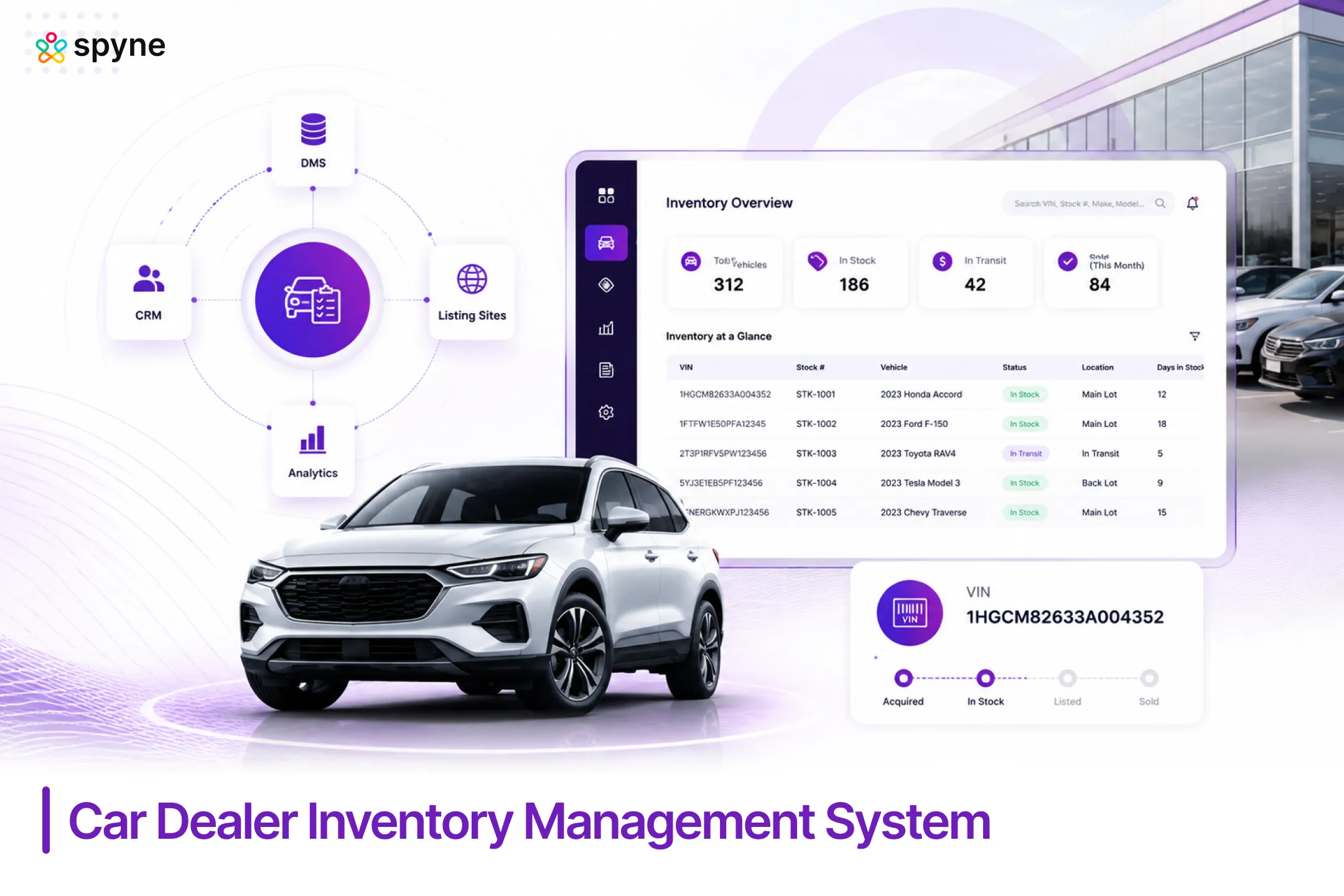
- VIN decoding on intake: It pulls year, make, model, trim, and factory options the moment a VIN is scanned. This cuts data-entry errors before a listing goes live.
- Real-time status tracking: Every vehicle shows its stage in transit, recon, photos, listed, sold. This real-time status allows managers to see all the updates instantly.
- DMS and CRM sync: Inventory flows both ways. So a sold unit updates accounting and a hot lead gets matched to the right VIN automatically.
- Marketplace syndication: One-click publishing to Autotrader, Cars.com, and CarGurus keeps listings consistent without manual re-entry.
- Mobile VIN scanning: Lot staff scans a barcode from a phone, and the vehicle enters inventory in seconds.
- Aging and pricing alerts: This feature flags units approaching 30, 60, and 90 days. Together, it recommends a price move before that unit becomes a write-off risk.
If you are gathering car dealer inventory management tips from your own team before a vendor call. Ask which of these six capabilities they actually use today, and which only show up in the sales demo.
Best Car Dealer Inventory Management System With VIN Tracking
The best system treats the VIN as the single source of truth, not just a field on an intake form. VIN accuracy matters more than most dealers assume. Cox Automotive and vAuto (January 2025) found appraisal inconsistencies cost dealers roughly $1,000 per vehicle on nearly 39% of VINs. It is almost always from a decoding error or a duplicate record. At minimum, confirm the system offers automatic VIN decoding, duplicate VIN detection, and an audit trail before you buy.
Multi-rooftop groups have the most at stake here. Cox Automotive and vAuto (January 2025) reported that 80 percent of vAuto’s dealer clients now operate more than one rooftop. Due to this a VIN error at one store can quietly cost a sister store a sale too.
For the full breakdown of VIN decoding, lifecycle tracking, and document workflows, see our complete guide to VIN-based inventory management.

Car Dealer Inventory System Strategies That Cut Days on the Lot
The car dealer inventory system strategies that actually move the needle are operational, not just technical.
- Run a weekly aging review: Pull every unit over 30 days old every Monday and decide on the spot: reprice, transfer, or wholesale. Waiting for month-end reports lets aging units pile up.
- Price to the live market, not the invoice: Set pricing rules that check comparable listings at least every three days rather than relying on a one-time appraisal number.
- Put a clock on reconditioning: Give every recon step a target turnaround and flag anything that misses it by more than a day.
- Set transfer rules across rooftops: If you run more than one store, build a rule that flags a slow-moving unit as a transfer candidate to a rooftop where it sells faster.
- Match inventory to CRM demand: Before you stock a vehicle, check whether your CRM already has active leads or saved searches asking for that make, model, and trim.
None of these strategies require new headcount. They require a car dealer inventory management system that surfaces the data automatically instead of waiting for someone to go looking for it.
How to Choose the Best Car Dealer Inventory Management System for Your Dealership
Choosing the best car dealer inventory management system starts with an honest read of your own operation, not a vendor’s feature list.
- If you are an independent, used car or BHPH dealer moving under 75 units a month, prioritize fast VIN scanning, simple title and compliance forms, and low monthly cost over enterprise reporting you will not use.
- If you are a single-rooftop franchise dealer, prioritize DMS and CRM integration first. A system that does not talk to your existing DMS creates double entry.
- If you run a multi-rooftop group, prioritize centralized visibility and transfer tools above almost everything else. The value of one system managing inventory across every store outweighs any single feature at the individual-store level.
Whatever category you fall into, run a real car dealer inventory management comparison before signing anything, not just a feature checklist. Score any vendor against these five questions:
| Question to Ask | Why It Matters | Red Flag |
| How does VIN decoding work? | Determines whether trim, color, and options load automatically or need manual entry every time. | Vendor cannot explain the data source behind the decoder. |
| How fast is DMS sync? | A slow or one-way sync creates double entry and accounting mismatches. | Sync is “coming soon” or needs a manual export. |
| What does marketplace syndication cost per listing? | Per-listing fees can turn a cheap base price expensive at real volume. | Pricing is only quoted as a bundle, never per unit. |
| What is the contract length? | Long lock-in periods make a bad fit expensive to escape. | No month-to-month option exists at any tier. |
| What does support look like after 90 days? | Onboarding support is common; ongoing support quality varies widely. | Support is ticket-only, with no phone or chat option. |
A vendor that answers all five clearly, without vague marketing language, is usually the one worth trusting with your lot.
Judged against every capability above, from VIN decoding through DMS sync to aging alerts, here is how one platform in this category is built.
Spyne’s Auto Dealer Inventory Management System Built for VIN Accuracy
Spyne’s auto dealer inventory management system is built around the VIN as the anchor for every workflow, from intake to sale. It fits dealerships tired of chasing the same vehicle data across a DMS, a spreadsheet, and three marketplace logins. Rather than replacing your DMS, Spyne Inventory Management sits on top of it, syncing vehicle records so your team enters data once and sees it everywhere it needs to appear.
1. VIN decoding and duplicate detection
Every vehicle entered by VIN pulls year, make, model, trim, and factory data automatically. Based on this information, the system automatically blocks a second entry of a VIN that already exists. This helps avoid errors that leads to costly appraisal mistakes.
2. Real-time inventory status tracking:
Vehicles move through clear stages including in transit, recon, photos, listed, and sold. This updates the moment a team member changes a status allowing Used Car Manager to see the whole lot without walking it.
3. Multi-marketplace and DMS sync
Listings publish to major marketplaces from one entry point, and inventory data flows back into your existing DMS. This updates sold vehicle accounting without a second data-entry step.
4. AI-assisted merchandising
Photos and descriptions are cleaned up and generated through Spyne’s car merchandising tools. This allows a unit to go from reconditioning to a market-ready listing the same day it is detailed.
5. Reconditioning workflow tracking
Each recon step carries a status and a target turnaround. This gives Fixed Ops and Used Car Managers a shared view of where a vehicle is stuck and why.
6. Mobile VIN scanning for lot staff
Staff can scan a vehicle into inventory from a phone on the lot instead of walking back to a desktop. This matters most on multi-acre lots and multi-rooftop groups.
7. Inventory health reporting
Aging, turn rate, and per-unit reconditioning cost roll up into one dashboard. This allwos Dealer Principal to spot a stalling rooftop before it shows up in the monthly financials.

Conclusion
The right car dealer inventory management system will not fix the stocking decision. It will make sure you see the problem in days, not weeks. Whether you land on a DMS-embedded system, a standalone specialist, or a platform built around VIN accuracy like Spyne Inventory Management, judge it on the same terms. Like how fast it catches a VIN error, how well it syncs with your tools, and how clearly it shows you which units need attention today.
See how Spyne’s inventory management solution can boost your inventory turnover. Book a demo now!