
| Executive Summary: Dealer groups should govern AI through centralized standards and controlled rooftop-level configuration. Group leadership should standardize approved use cases, data access, customer experience rules, permissions, escalation requirements, KPI definitions, quality assurance, and accountability. Individual dealerships should retain flexibility over hours, staffing, routing, inventory, appointment capacity, local offers, and system-specific workflows.
The goal is not identical AI at every store. It is one accountable operating framework that can adapt to how each rooftop works while preserving consistent customer experience, data controls, reporting, and human oversight. |
AI adoption is quickly becoming an operating issue for U.S. dealerships rather than an experimental technology project. Cox Automotive’s August 2026 AI in Auto Retail Tracker found that 82% of dealers now use AI in some form. However, only 22% reported seeing the sales and revenue growth many expected from AI.
For dealer groups, the challenge becomes harder across multiple rooftops. Stores may use different CRMs, DMS platforms, schedulers, BDC structures, staffing models, inventory systems, routing rules, and appointment capacity.
This guide explains how dealer groups should govern AI centrally while preserving legitimate rooftop differences, including integrations, permissions, routing, measurement, quality control, and phased rollout.
What Does AI Governance Mean for a Dealer Group?
Dealer group AI governance is the framework that defines what AI may access, what it can do, who controls it, when people intervene, and how performance is monitored.
For every AI use case, leadership should be able to answer:
- Which AI platforms and workflows are approved?
- Which customer and dealership data can AI access?
- What information may AI provide?
- What actions can AI complete independently?
- When must a conversation reach an employee?
- Who can modify AI workflows?
- How will accuracy and business impact be measured?
Governance becomes especially important when AI connects directly with dealership systems. CDK reported in January 2026 that nearly 40% of dealerships were already using AI, and 77% of those users had integrated AI tools into dealership systems.
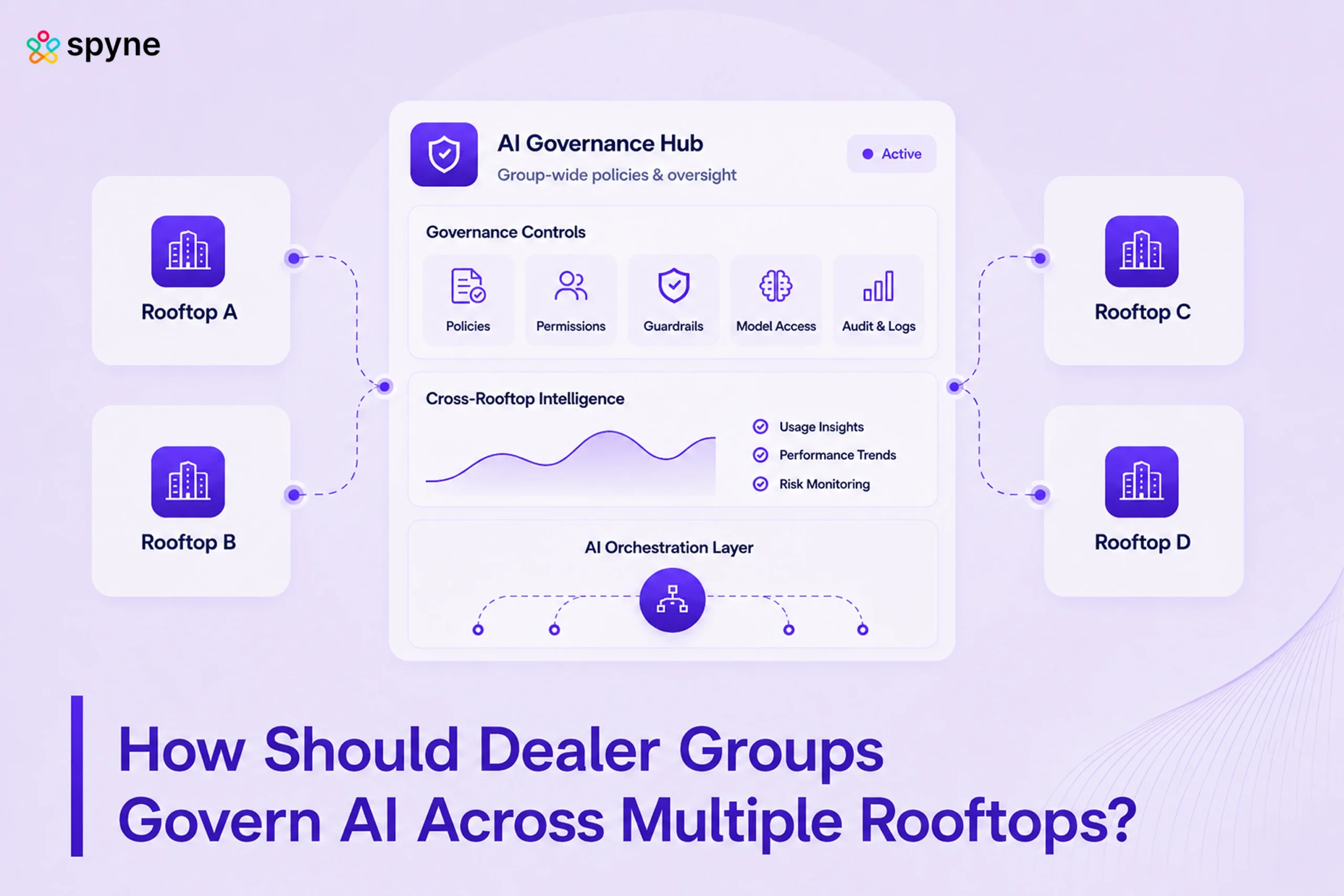
Multi-rooftop AI governance defines what every dealership must follow, what each rooftop may configure, who owns the information AI uses, and how performance is corrected.
Why Does AI Become Harder to Manage Across Multiple Dealership Locations?
Multi-rooftop AI becomes harder because scaling adds operational variation, not simply more customer conversations.
One rooftop may send every internet lead through a centralized BDC while another routes leads directly to sales consultants. Service scheduling rules, business hours, employee assignments, inventory ownership, phone systems, franchise requirements, and escalation paths can also differ.
The group therefore needs to distinguish between necessary local variation and unnecessary technology fragmentation.
Without that distinction, 20 rooftops can quickly become 20 different AI deployments with different prompts, permissions, metrics, integrations, customer experiences, and vendor dependencies.
What Should Dealer Groups Standardize Across Every Rooftop?
Dealer groups should standardize AI wherever inconsistency creates customer, data, measurement, or operational risk.
| Standardize Group-Wide | Why It Matters |
| Approved AI platforms | Reduces unapproved or fragmented tools |
| Approved use cases | Defines where automation is permitted |
| Data-access policies | Controls what AI can read and use |
| Customer-answer standards | Reduces conflicting information |
| Escalation requirements | Creates consistent human intervention |
| Permissions | Controls who can change AI behavior |
| KPI definitions | Makes rooftop results comparable |
| QA criteria | Establishes acceptable quality |
| Change management | Prevents uncontrolled updates |
| Incident processes | Creates accountability when AI fails |
Dealer groups should also define clear boundaries around consequential decisions. Routine questions, reminders, lead qualification, and scheduling can operate within approved rules. Complex pricing exceptions, credit decisions, sensitive disputes, or unusual customer situations should have named human owners.
Dealers evaluating these controls before selecting technology can also use Spyne’s dealership AI buyer’s guide as a broader vendor-evaluation framework. Corporate should standardize the rules governing AI. Rooftops should configure the operating details required to execute those rules.
What Should Stay Configurable at Each Dealership Rooftop?
Rooftops should retain control over AI settings determined by local systems, staffing, inventory, capacity, and dealership processes.
| Govern at Group Level | Configure at Rooftop Level |
| AI policies | Business hours |
| Approved use cases | Employee assignments |
| Data standards | Lead routing |
| Escalation principles | Appointment capacity |
| KPI definitions | Local inventory |
| QA standards | Local offers |
| Access framework | Escalation contacts |
| Customer experience rules | Franchise-specific workflows |
A Toyota rooftop and a CDJR rooftop can follow the same escalation and data rules without using identical service workflows or employee routing.
Is There an AI Platform That Can Support Multiple Dealership Locations With Different Workflows and Systems?
Yes. A multi-rooftop dealership AI platform should combine centralized oversight with controlled store-level configuration.
The important distinction is between multi-location access and true multi-rooftop operations. Adding several dealerships to one dashboard does not automatically mean the AI can accommodate different systems and processes.
Dealer groups should evaluate whether a platform supports:
- rooftop-specific workflows;
- different CRM, DMS, and scheduling environments;
- local routing;
- separate appointment rules;
- centralized reporting;
- configurable permissions;
- human escalation;
- expansion without rebuilding every deployment.
For dealerships comparing platforms specifically, Spyne’s best AI platforms for dealership groups covers the vendor-selection question separately.
The right multi-rooftop platform standardizes governance without forcing every dealership to standardize operations.
How Should AI Work Across Different CRM, DMS, and Dealership Systems?
Dealer groups should define the authoritative source for customer, inventory, scheduling, and reporting information before connecting AI.
For each rooftop, leadership needs to determine which system owns the lead, where current inventory originates, which scheduler controls appointment availability, where conversations are recorded, and which actions AI can write back.
Integration depth matters more than an integration logo.
A connection may allow AI to read customer records but not update appointments. Another may support real-time scheduling and CRM writeback. Groups should therefore test each important workflow using the actual technology environment deployed at that rooftop.
This becomes increasingly important as AI and CRM functionality converge. Spyne’s automotive CRM with AI guide explains how AI-assisted lead response, prioritization, follow-up, and reporting depend on the underlying dealership data environment.
How Should AI Route Leads and Customers Across Multiple Rooftops?
Dealer-group AI should route customers using explicit rules for location, inventory, department ownership, customer history, and fallback handling.
Consider three common situations:
- A shopper contacts one rooftop about inventory held by another store. The group needs a rule determining who owns the lead after the transfer.
- A service customer reaches the wrong location. AI should identify the correct store and transfer the customer without losing relevant context.
- A lead enters through a group website without selecting a dealership. Routing may depend on brand, ZIP code, inventory, existing customer history, or another group-defined rule.
The same applies to centralized BDCs. AI may receive the inquiry centrally, but ownership eventually needs to move to a specific rooftop, department, or employee.
Vini AI supports round-robin lead routing while keeping conversation context available during the handoff. It also supports CRM updates, appointment scheduling, and dealership-specific workflows.
Spyne’s AI lead qualification guide provides a deeper look at how dealership AI can qualify a customer before transferring the opportunity. Every cross-rooftop lead needs a clear ownership rule before AI decides where the customer goes next.
Who Should Own the AI’s Knowledge Across a Dealer Group?
Every information category used by dealership AI needs both an approved source of truth and an accountable business owner.
Groups should identify ownership for inventory, hours, pricing policies, service information, appointment rules, staff directories, promotions, and escalation contacts.
If AI presents an expired offer, leadership should know which system supplied that information and who was responsible for keeping it current.
The same principle becomes critical with higher-intent questions. Spyne’s guide to AI pricing and trade-in conversations explains why AI should rely on verified dealership information and escalate situations that require human judgment.
If nobody owns the information, the group cannot reliably govern the AI answer built from it.
How Should Dealer Groups Manage AI Permissions and Administrative Access?
Dealer groups should manage AI access by role, rooftop, department, and data sensitivity rather than giving every store unrestricted administrative control.
An employee who needs to review a lead conversation should not automatically be able to change routing, scripts, integrations, knowledge sources, or group-wide AI behavior.
NADA’s Safeguards Rule resources specifically highlight limiting and monitoring access to sensitive customer information, multi-factor authentication, service-provider oversight, risk assessment, and incident-response requirements for franchised dealers.
A practical AI permission structure includes:
- Group administrators: Control approved platforms, integrations, group policies, reporting definitions, and major workflow changes.
- Rooftop administrators: Manage approved local settings such as hours, staff, routing destinations, appointment rules, and escalation contacts.
- Department managers: Review relevant conversations, outcomes, errors, and workflow performance.
- Frontline employees: Receive only the customer context and access required to continue follow-up.
Groups should also separate permission to view, edit, approve, and publish AI changes. A service manager may need to update a local transfer destination without gaining authority to alter AI behavior at 20 other stores.
Access should also change when employees move roles or leave the organization. Temporary vendor access should have a defined purpose and removal point.
How Should Dealer Groups Measure AI Performance Across Multiple Rooftops?
Dealer groups should measure AI at both group and rooftop levels because averages can hide local workflow failures.
Group-level reporting should track:
- response coverage;
- appointments generated;
- qualified leads;
- successful transfers;
- escalation rate;
- after-hours coverage;
- resolution;
- AI errors;
- rooftop adoption.
Rooftop reporting should add booking completion, routing failures, unsuccessful transfers, appointment-capacity failures, escalation outcomes, and department-level conversion. Raw volume should not determine which dealership is performing best. A large metro rooftop naturally generates more interactions than a smaller regional store. Groups should compare rate-based outcomes, changes against pre-AI baselines, and similar rooftop cohorts. Group reporting tells leadership whether the AI program works. Rooftop reporting explains where and why it does not.
How Should Dealer Groups Maintain Consistent AI Quality?
Dealer groups should use common QA criteria across locations even when individual workflows differ.
Quality reviews should examine factual accuracy, successful scheduling, routing, escalation, customer tone, CRM updates, and adherence to dealership rules.
Cox Automotive’s latest 2026 tracker shows that AI usage is already widespread, with 82% of dealers reporting some adoption. The governance challenge is therefore moving from basic adoption toward reliable business outcomes.
Leadership should also distinguish local failures from systemic failures. An outdated transfer destination at one store requires a rooftop fix. The same incorrect answer appearing across several dealerships suggests a group-level workflow, data, or configuration problem.
How Should Human Escalation Work Across a Dealer Group?
Every AI escalation should have a named destination, ownership rule, and fallback when the first employee cannot respond.
Escalations can include pricing exceptions, manager requests, complaints, complex service questions, failed scheduling, unsupported requests, or high-intent customers requiring human involvement.
The handoff should preserve context. Customers should not need to explain the same vehicle, service requirement, or appointment request again after reaching an employee.
Vini AI’s conversational workflows support lead routing with context, CRM synchronization, appointment scheduling, and separate sales and service conversations.
Dealerships considering one AI layer across departments can also read Spyne’s guide to AI BDC for sales and service.
How Should a Dealer Group Roll Out AI Across Multiple Locations?
Dealer groups should prove AI workflows at representative rooftops before expanding them across the organization. The objective is not simply a successful pilot. It is determining whether the workflow can be repeated across dealerships with different systems, staffing, and operating structures.
CDK’s 2026 research found nearly 40% of dealerships already use AI, with 77% of AI users integrating it into dealership systems. This makes implementation discipline increasingly important.
1. Start With a Defined Workflow
Choose a measurable operational problem such as inbound lead response, missed-call recovery, appointment scheduling, service follow-up, or lead qualification. Establish the pre-AI baseline before deployment.
2. Select a Representative Pilot Rooftop
Do not automatically choose the easiest dealership. Select a rooftop with enough activity to expose real problems and a technology environment similar to other stores in the group.
3. Test the Entire Workflow
Evaluate more than conversational quality. Verify routing, dealership information, appointment accuracy, CRM updates, human handoffs, reporting, and failure scenarios.
4. Separate Group Standards From Local Configuration
After the pilot works, document which decisions should become group standards. Data rules, KPI definitions, QA, escalation principles, and customer-experience expectations should usually remain consistent. Hours, staffing, routing, capacity, inventory, and local workflows can remain configurable.
5. Expand by Rooftop Cohorts
Group similar stores by franchise, technology stack, BDC model, or service workflow. Rolling out similar stores together makes problems easier to diagnose before adding substantially different rooftops.
6. Compare Results Against the Baseline
Ask three questions before expanding further: Did the AI improve the target business outcome? Is the workflow reliable? Are differences between rooftops understood?
Appointments, qualified leads, successful transfers, response coverage, routing errors, escalation accuracy, and booking failures are more meaningful than raw AI activity.
7. Move From Deployment to Ongoing Governance
After launch, continue reviewing integrations, configuration changes, knowledge accuracy, employee adoption, escalation problems, and performance differences.
Spyne’s 90-day dealership AI implementation roadmap documents this rollout in greater detail. For Vini deployments, Spyne notes that each rooftop requires its own configuration and phone setup, which is why multi-rooftop deployments should not be treated as identical go-live events.
Successful dealer-group AI scaling means proving the workflow, standardizing what works, configuring what differs, and validating each expansion stage.
How Can Vini AI Support Multi-Rooftop Dealership Operations?
Vini AI is Spyne’s conversational AI platform for dealership sales, service, BDC, parts, and customer communication workflows.
For dealer groups, its value is not simply answering more calls. The platform connects conversational AI with dealership-specific workflows and systems.
| Dealer-Group Requirement | Vini AI Capability |
| Sales and service coverage | Separate conversational workflows for both departments |
| Customer routing | Round-robin routing with context preserved |
| Scheduling | Real-time test-drive and service appointment scheduling |
| CRM continuity | Lead details, preferences, outcomes, and actions sync into supported CRMs |
| Local configuration | Custom scripts and sales or service workflows |
| Reporting | Calls, resolution, response quality, and related performance metrics |
| Technology connectivity | CRM, DMS, IMS, and VDP integrations |
| Scale | 50+ integrations documented on the Vini product page |
Spyne’s current Vini AI conversational AI platform documents these capabilities, including 50+ integrations, CRM synchronization, appointment scheduling, custom workflows, contextual routing, and performance dashboards.
That combination can give dealer groups a common conversational AI layer while allowing dealership-specific workflows underneath it.
However, governance remains the dealer group’s responsibility. Before deployment, leadership should verify the exact integration, scheduling, routing, data, and writeback requirements for each rooftop.
Multi-Rooftop AI Governance Checklist
Before expanding AI to another rooftop, confirm:
- approved use cases are documented;
- group and rooftop responsibilities are clear;
- data and knowledge owners are assigned;
- CRM, DMS, inventory, and scheduling sources are defined;
- integration capabilities are tested;
- routing and appointment workflows are validated;
- escalation owners and fallbacks exist;
- administrative permissions are assigned;
- KPI definitions match group standards;
- rooftop reporting exposes local failures;
- QA standards are documented;
- pilot results have been reviewed.

Conclusion
Multi-rooftop AI governance determines whether AI becomes a scalable dealership capability or another fragmented layer in the technology stack. Dealer groups need central control over data access, permissions, QA, escalation, integrations, and KPI definitions while allowing rooftops to configure staffing, routing, capacity, inventory, and local workflows. As dealership AI adoption accelerates in 2026, the advantage will come from operating it consistently and measuring real outcomes, not simply deploying more tools. Vini AI gives dealer groups a connected foundation for customer conversations, scheduling, routing, CRM synchronization, and sales and service workflows. Book a demo with Spyne to see how Vini AI can scale across your dealer group.