
If you have spent any time in automotive retail, you have heard fixed ops mentioned in every performance review, every twenty group conversation, and every NADA session on dealership profitability. But how many stores are actually running it like the profit center it is?
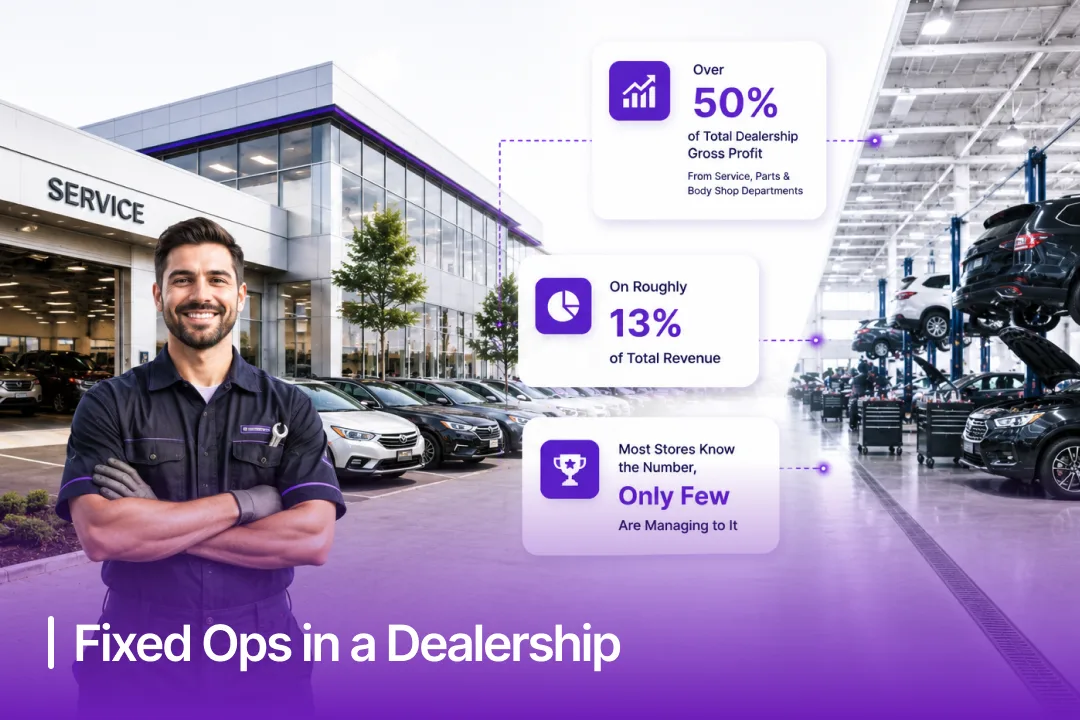
Fixed ops runs quietly in the background, where service lanes stay full, advisors juggle calls, and technicians turn wrenches, stacking revenue month after month without a scoreboard anyone watches closely. According to the 2025 NADA data, service, parts, and body shop departments generate over 50% of total dealership gross profit on roughly 13% of total revenue. While most dealerships recognize the value of fixed operations, only a few consistently capitalize on it.
This guide covers what fixed ops actually is, how it stacks up against variable ops financially, and the KPIs that move the needle for dealerships. We will also discuss the revenue leaks that most stores overlook and proven strategies to increase absorption rates.
What Is Fixed Operations in a Dealership, and Why Should You Care About It?
Fixed ops, short for automotive fixed operations, refers to the service department, parts counter, and body shop at a franchised dealership. These departments generate revenue after the vehicle is sold, through maintenance, repairs, parts sales, and collision work. This ensures that
The name comes from the nature of the income. Unlike vehicle sales, which fluctuate with inventory availability and interest rates, fixed ops revenue is predictable month over month. People still need brake jobs during a market downturn.
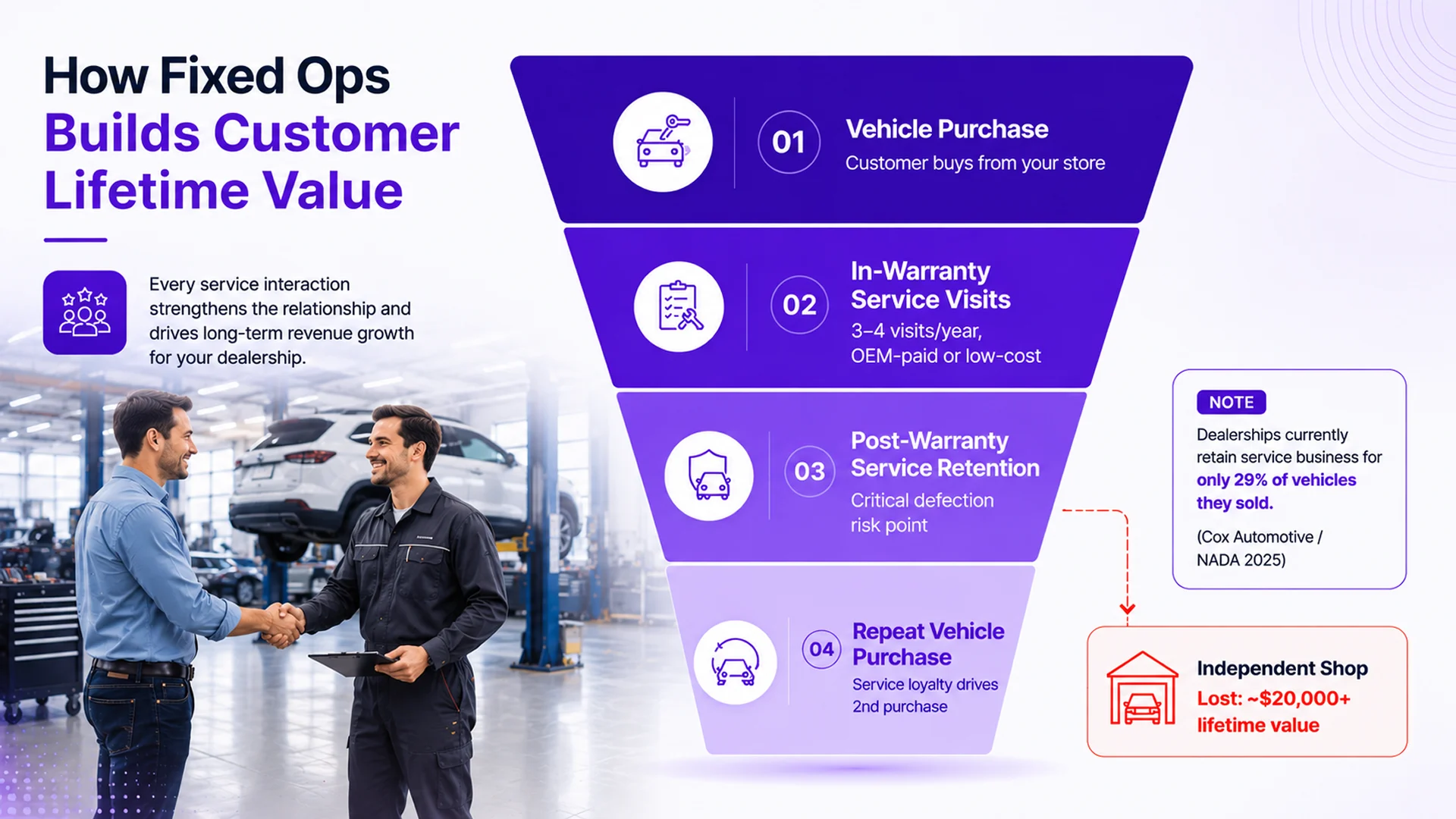
What makes fixed operations structurally different is the repeat-visit model. A buyer might purchase from you once every five to seven years. During those years, they return for oil changes, tire rotations, recall campaigns, and unexpected repairs. Each visit is both a revenue event and a relationship touchpoint.
How Does Fixed Ops Compare to Variable Ops Financially?
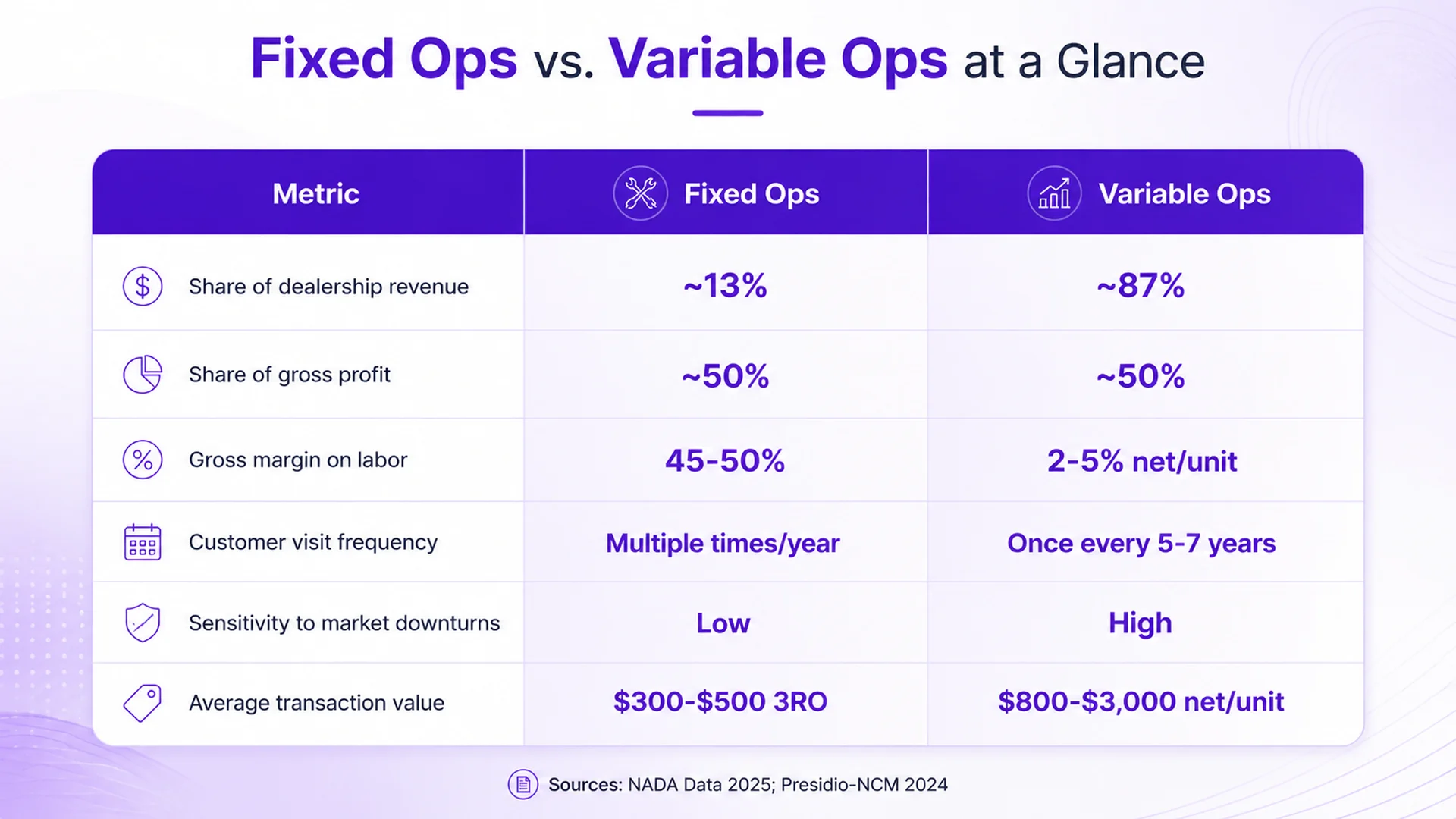
The margin difference is the entire story. Selling an hour of technician labor at $150, where your cost is $50, is structurally more profitable per dollar of revenue than selling a $45,000 vehicle and netting $1,500 to $2,500. Variable ops generate high revenue per transaction but thin margins. Fixed ops generates lower revenue per transaction but runs at 45 to 50% gross margin consistently.
During the inventory shortage of 2020 to 2022, inflated front-end margins temporarily obscured this. As inventory normalized through 2024, new vehicle gross dropped 33% to roughly $2,247 per unit. Fixed operations absorbed most of that damage. Dealers who had invested in strong service departments barely noticed. Dealers coasting on front-end margins had nowhere to turn.
That cycle repeats in every market disruption. Fixed ops is the cushion. It was true in 2008, and it is true in 2026.
Why Does Fixed Ops Generate Over 50% of Dealership Gross Profit?
There are three structural reasons behind this.
1. The margin math is heavily in ‘fixed ops’ favor
Service labor and parts sales consistently run at 45 to 50% gross profit margins. New vehicle sales rarely exceed 5% net at the store level. Fixed operations earn more per dollar of revenue even though it represents a smaller share of total revenue.
2. It covers the overhead
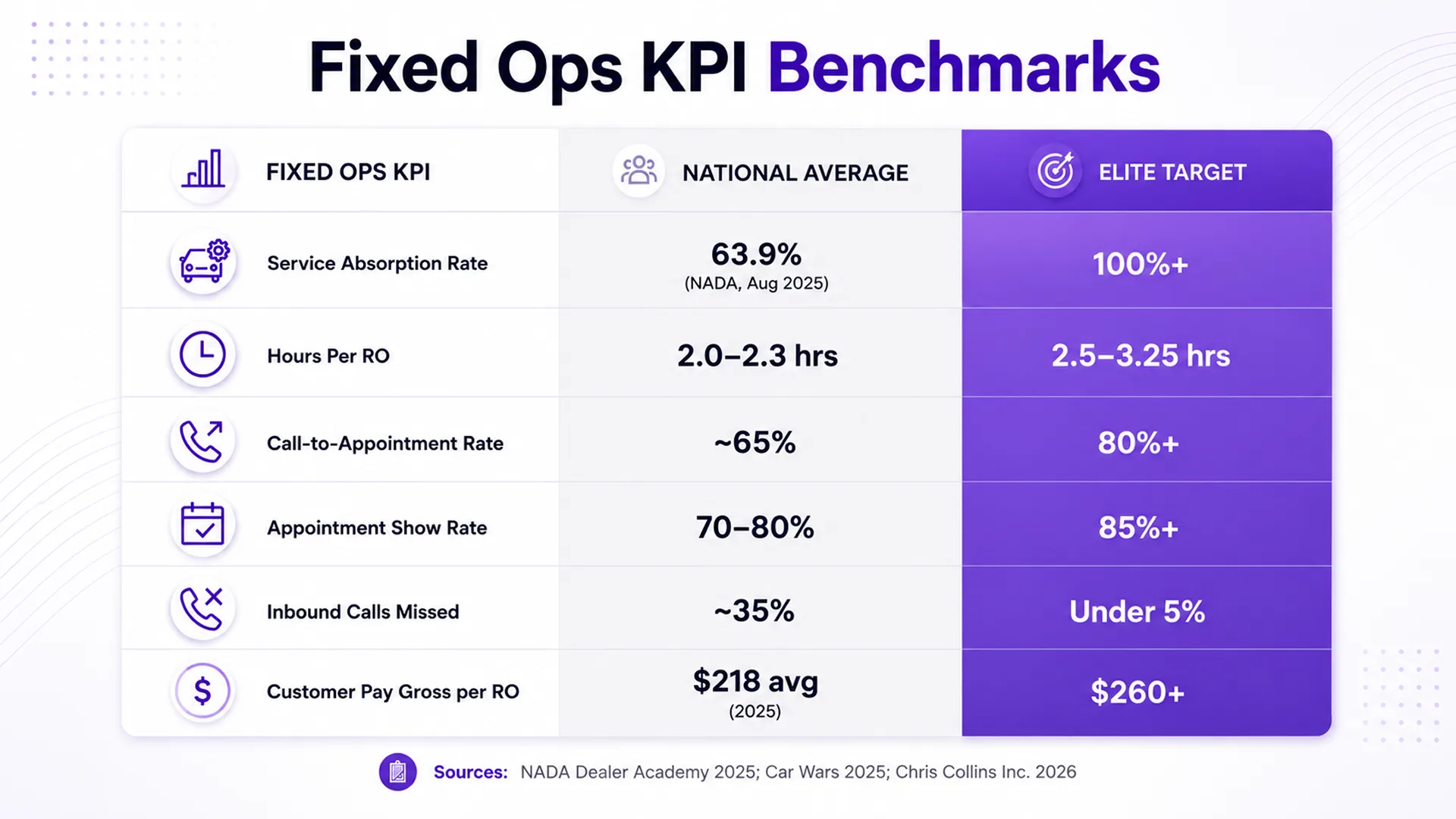
Service absorption measures the percentage of total dealership operating expenses covered by fixed ops gross profit alone. At 100% absorption, every dollar the front end earns is incremental profit. The national average absorption rate reached 63.9% in August 2025, up from 61% the prior year, according to NADA Dealer Academy data. Top-performing stores regularly exceed 100%. The gap between 64% and 100% represents hundreds of thousands of dollars in annual profit at an average-sized store.
3. It is the primary customer retention engine
A vehicle sale opens the relationship, and service visits sustain it. Customers who service at the dealership where they bought are significantly more likely to return for their next vehicle purchase, according to Cox Automotive. Every service customer you lose to an independent shop is a weakened relationship and, eventually, a lost vehicle sale. And fixed ops retention is only one lever in the broader picture of dealership profitability.
What Are the 3 Core Revenue Centers in Fixed Ops?
Fixed ops is not one department. It is three interconnected revenue centers. The three departments are interdependent. Parts supply service with components, service generates parts demand through every repair order, and body shops depend on parts for collision work.
When one underperforms, it creates drag on the others. If service runs behind, it pressures parts inventory. And when parts management is weak, it slows service throughput and frustrates technicians.
Service Department
It handles labor and parts for all vehicle maintenance and repair work. The service department runs on two revenue streams: labor billed at the shop’s labor rate and parts markup on installed components. Routine maintenance, warranty repairs, diagnostics, tires, recalls, and state inspections all flow through here. Service department profitability at a dealership is a product of three levers: utilization (how many billable hours are produced), effective labor rate (actual dollars collected per hour after discounting), and approval rate (how often multi-point inspection findings convert to approved work).
Parts Department
This department serves three customer groups: the internal service department (its largest customer), retail walk-in buyers, and wholesale accounts like independent shops. Gross margins on parts frequently exceed 50%. The operational challenge is inventory management. Low stock slows repair throughput while overstock ties up working capital. Wholesale parts sales are an underdeveloped channel at many stores. Local independents need reliable OEM parts suppliers and represent recurring monthly revenue with low acquisition cost.
Body Shop
It handles collision repairs, paintwork, and internal reconditioning for used inventory. Not every franchised dealership operates a collision center. For those that do, it adds a meaningful third revenue stream and plays an important role in customer lifecycle management. Handling a customer’s accident repair keeps the dealership central to the relationship at an emotionally significant moment.

Which Fixed Ops KPIs Actually Drive Profitability?
Most stores track the wrong things too slowly. The fixed ops KPIs listed below are the ones that separate high-absorption departments from average ones.
1. Service Absorption Rate
It is the percentage of total dealership overhead covered by fixed ops gross profit alone. The NADA target is 115%, and the national average is 63.9%. Every percentage point of improvement reduces the front end’s break-even obligation.
2. Hours Per Repair Order (RO)
This metric measures average billable labor hours on each work order. Low hours per RO typically signal a service advisor throughput problem: advisors are not conducting thorough multi-point inspections, inspection findings are not being communicated in a way that earns approval, or customers are not given enough information to feel confident saying yes. All three are process problems, not permanent ceilings.
3. Effective Labor Rate (ELR)
ELR is the actual dollar amount collected per labor hour after discounts and warranty rate shortfalls. Many stores with a posted door rate of $175 are collecting closer to $140 per hour in practice. Closing that gap does not require raising prices. It requires discipline in discount approvals and consistency in how advisors present work.
4. Call-to-Appointment Rate
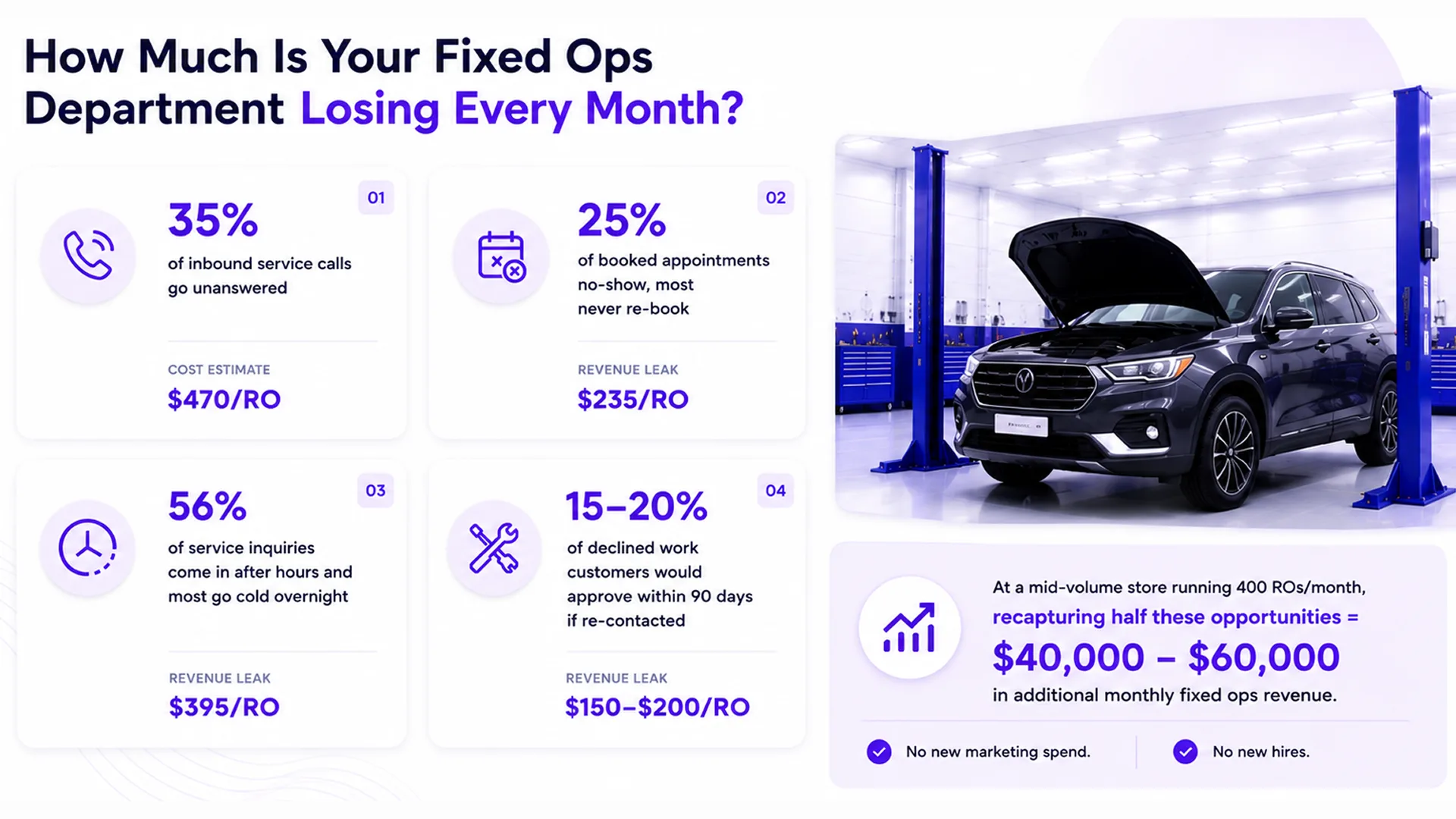
It is where a significant share of fixed ops revenue silently leaks. According to a 2025 study, around 36% of total inbound service calls were missed opportunities, meaning one in every three callers never reached a qualified person. That miss rate does not exist in isolation. It connects directly to outbound contact rate, lead-to-contact ratio, and other automotive BDC metrics worth tracking alongside it.
5. Appointment Show Rate
This metric typically runs at 70 to 80% industry-wide, meaning 20 to 30% of booked service appointments never arrive. Proactive confirmation workflows and re-engagement sequences for no-shows are direct revenue levers that many fixed ops departments leave unaddressed.
6. Customer Retention Rate
It is the metric with the longest financial tail. A 5% lift in retention, compounded over time, generates meaningful profitability gains and eventually flows back to the front end as additional vehicle purchases.
7. Customer Satisfaction Index (CSI)
This is the lagging indicator OEMs track and benchmark against. The factors that move CSI, including communication quality, transparency, and keeping pickup commitments, are the same factors that drive retention. They are measuring the same underlying service quality from different angles.
What Are the Biggest Fixed Ops Challenges in 2026?
Now, let’s talk about the biggest challenges dealerships face with fixed ops.
1. Post-Warranty Customer Defection
The pattern is consistent across fixed operations dealerships nationwide: a customer services through the factory warranty period, then quietly disappears the moment that coverage expires. According to a 2025 service study, only 54% of owners with vehicles two years old or newer went back to the dealer for service, down from 72% in 2023. Most of these defecting customers were not dissatisfied, but were simply not given a compelling reason to stay, and were not contacted proactively when their next service interval arrived.
2. Peak-Hour Call Failures
A 2025 survey tracked roughly 53 million inbound service calls across both dealership BDC lines and direct service drive numbers. About 19 million represented missed opportunities. Of the calls that did not connect, 53% went to voicemail. Another 29% of callers hung up after being put on hold too long. At an average RO value of $470 (NADA Midyear 2025), missed calls during a busy Monday morning add up fast.
3. After-Hours Demand Left Cold
More than 56% of dealership leads arrive after business hours. Customers sending text messages at 9 PM, submitting web forms on Sunday morning, and calling at 7 AM before the service drive opens are ready to book. By the time someone gets to those messages, many have already moved on. Research on dealership lead response time shows that intent drops sharply within minutes of first contact, and after-hours service inquiries follow the same pattern.
4. No-Show Leakage
Between 20 and 30% of booked service appointments result in a no-show or last-minute cancellation. Most stores overbook slightly to compensate and move on. The customers who cancel rarely get a re-booking offer. Many of them book elsewhere permanently.
5. Advisor Overload
Service advisor throughput collapses the moment an advisor is managing 15 active repair orders while simultaneously fielding calls and handling walk-in drop-offs. Multi-point inspection results do not get presented thoroughly. Declined work does not get followed up on. Hours per RO stay low, approval rates stagnate, and retention quietly erodes. Dealerships evaluating whether to restructure coverage should weigh how BDC companies for car dealerships compare to AI-native alternatives on cost per appointment and service-side set rate.
How Does Vini AI Close the Fixed Ops Engagement Gap?
The challenges above share a common root cause. Whether you run a dedicated dealership BDC or rely on advisors to handle inbound volume, your fixed ops department can only engage customers when a human is available to do it, in real time, during business hours. That model worked when call volumes were lower, and customer expectations were different. Neither condition holds in 2026.
Vini AI is Spyne’s conversational AI platform and one of the most purpose-built solutions for AI in fixed ops available to automotive dealerships today. In fixed ops, it functions as a permanent engagement layer between your inbound demand and your service team.
Vini does not replace service advisors. The high-value moments in fixed ops, such as an advisor walking a customer through a significant repair recommendation, a service manager handling a warranty dispute, require human judgment. Vini handles volume, coverage gaps, and follow-up cadences so your team can focus entirely on those moments.
That coverage shows up across four workflows where fixed ops revenue typically leaks the most.
1. Every inbound call answered, every time
Vini answers 100% of inbound service calls instantly, regardless of volume or time of day. Routine inquiries, including pricing, oil change scheduling, service interval guidance, and recall status, are handled fully and result in a booked appointment. Complex or high-value situations get routed to the appropriate advisor with full context already captured.
2. Automated confirmation and no-show recovery
Vini runs multi-channel confirmation sequences for every booked service appointment, by text, call, or WhatsApp, based on customer preference, without requiring advisor action. Customers who do not confirm get a follow-up. Customers who cancel get an immediate re-booking offer while their intent is still warm. The customers who come back through that sequence are the ones your team would otherwise have written off.
3. After-hours coverage without adding payroll
A customer who texts at 10 PM asking to schedule a tire rotation gets an immediate, natural response and a confirmed appointment. A customer who calls Saturday evening about a warning light gets answers and a Monday morning slot locked in before a competitor’s service drive even opens. Every overnight interaction syncs into your CRM in real time.
4. Declined-work recovery
When a customer declines recommended service work, Vini does not move on. Thirty, sixty, or ninety days later, it initiates an automated outreach referencing the specific work deferred and offering an easy path to book. The average dealership with a healthy RO volume has hundreds of open declined work items in its DMS at any given time. Most of those customers have not been asked again.

5 Fixed Ops Strategies That Move the Absorption Rate
Below are five proven strategies that improve the absorption rate for dealerships:
1. Build a proactive retention outreach cadence
Contact every customer at their next service interval before they book somewhere else. Use their specific vehicle’s maintenance schedule, not a generic reminder blast. Personalization at the vehicle level is what makes outreach feel like service rather than spam.
2. Make multi-point inspections non-negotiable
Every vehicle through your service lane gets a documented multi-point inspection every time. Digital vehicle inspections with photo and video walk-throughs consistently generate higher approval rates than verbal recommendations alone. When customers can see the worn brake pad on their phone screen, they say yes more often.
3. Build a declined-work recovery process
Declined service recommendations are deferred revenue, not closed losses. Track every declined item at the RO level. Schedule follow-up outreach at a consistent interval. A simple reminder tied to the specific work and an easy booking link convert a meaningful percentage. Stores deciding between building this capability in-house or outsourcing it can compare how automotive BDC companies handle service-side outreach against purpose-built AI platforms.
4. Capture tire revenue before it walks out
Franchise dealerships account for just 8% of tire sales despite often being price-competitive when total value, including OEM fitment, installation, disposal, and warranty alignment, is considered. Dealers winning tire business surface the conversation proactively during every visit and make the booking process frictionless.
5. Measure declined work recovery weekly, not monthly
Call-to-appointment rate, show rate, hours per repair order, and effective labor rate do not improve when reviewed quarterly. The fixed ops departments looking to widen their lead over competitors should adopt a weekly declined work recovery process where they review these numbers every week and adjust the process the same week.
Closing Thoughts
Fixed ops does not get the scoreboard attention that new vehicle sales do. It never has. But in the current scenario, when front-end margins continue to compress, the dealers treating their service department as a primary profit center and not a support function are the ones pulling away from the rest.
The gap between where most fixed ops departments are and where they could be is mostly an engagement infrastructure gap. Missed calls during peak hours. After-hours inquiries left cold. No-shows that never get re-engaged. Declined work that nobody followed up. These are not people problems. They are coverage problems.
Vini AI for fixed ops closes that coverage gap with 24/7 inbound handling, automated confirmation workflows, after-hours booking, and declined-work recovery running continuously in the background. If your store is missing one in three service calls, you are already funding your competitors’ RO volume. Book a demo to see how much Vini AI recovers in the first week.