

Dealerships running on manual BDC operations are losing leads they already paid to generate. According to Car Wars data, 41% of inbound dealership calls go unanswered after hours, and the first dealer to respond wins 78% of deals. Spyne’s Vini AI responds to inbound calls in under 5 seconds and handles lead qualification, appointment booking, and outbound follow-up without adding headcount. This guide covers who needs automotive BDC solutions, how traditional and AI-powered models compare, the top providers in the market, and what to look for before choosing one.
Who Needs Automotive BDC Solutions?
Every dealership wants more appointments, better lead conversion, and stronger customer retention. However, achieving these goals becomes difficult when sales teams are already managing showroom traffic, negotiations, deliveries, and administrative tasks. Automotive BDC solutions are particularly valuable for dealerships facing high lead volumes, staffing challenges, or inconsistent follow-up processes.
1. Multi-Location Dealership Groups
Large dealer groups often receive thousands of inquiries every month through websites, marketplaces, phone calls, and social media. And without having a dedicated system, managing these interactions falls through the cracks. This is where automotive BDC software helps centralize communication and maintain consistent customer engagement across locations.
2. Independent Dealerships
Independent dealerships typically operate with limited resources and a constrained budget. An outsourced BDC automotive provider or AI-powered solution allows these dealerships to deliver enterprise-level customer engagement without significantly increasing headcount and saving on budget.
3. High-Volume Dealerships
Dealerships handling large inventories generate substantial inbound inquiries every day. Managing inbound call handling, appointment scheduling, and lead qualification manually often leads to delayed responses and missed opportunities. A BDC ensures every inquiry receives prompt attention.
4. Service Departments
Modern BDC operations are no longer limited to vehicle sales. Many dealerships use automotive BDC software to schedule service appointments, send reminders, conduct maintenance follow-ups, and improve customer retention throughout the ownership lifecycle.
5. Dealerships Looking to Scale
Growth often creates operational complexity. A virtual BDC automotive solution helps dealerships scale communication efforts without constantly hiring and training additional staff, allowing teams to focus on higher-value customer interactions.

Traditional BDC vs AI BDC Solutions
The core operational difference between traditional and AI-powered BDC models comes down to availability, speed, and cost-to-scale. Traditional BDCs provide human interaction but are constrained by staffing capacity and business hours. AI-powered BDCs like Vini AI engage customers in under 5 seconds across calls, SMS, and chat, 24 hours a day, without adding headcount.
As lead volumes increase and customer expectations shift toward instant responses, many dealerships find it difficult to maintain efficiency using a purely human-operated model.
| Comparison Area | Traditional Automotive BDC | AI-Powered Automotive BDC |
| Response Time | Response times depend on agent availability, workload, and business hours. Leads may wait several minutes or even hours for a callback, increasing the risk of losing interest or choosing a competitor. | AI responds within seconds across calls, chat, SMS, and web inquiries. Immediate engagement helps dealerships connect with prospects while their purchase intent is still high. |
| Availability | Most traditional BDCs operate during scheduled business hours. After-hours inquiries are often routed to voicemail or queued for the next business day. | AI-powered BDCs operate 24/7, ensuring customers receive assistance anytime, including evenings, weekends, and holidays. |
| Lead Handling Capacity | Human agents can only manage one call or conversation at a time. During peak traffic periods, dealerships often experience missed calls, long hold times, and delayed follow-ups. | AI can manage hundreds of simultaneous conversations across multiple channels without affecting response quality or speed. |
| Inbound Call Handling | Incoming calls are answered by BDC agents who qualify leads, answer questions, and schedule appointments. Performance often varies based on agent training and workload. | AI voice agents answer calls instantly, qualify customers, provide inventory information, and book appointments while maintaining consistent service levels. |
| Outbound Call Handling | Agents manually perform follow-ups, appointment reminders, equity mining campaigns, and service outreach. The number of calls completed depends on available staff and working hours. | AI automates outbound engagement at scale, conducting follow-ups, reminders, lead nurturing, and reactivation campaigns without additional staffing. |
| Consistency of Customer Experience | Customer interactions can vary significantly depending on agent experience, communication skills, and adherence to dealership processes. | Every customer follows a predefined workflow, ensuring consistent messaging, lead qualification, and appointment-setting practices. |
| Scalability | Growth requires hiring, onboarding, and training additional agents, which increases operational complexity and costs. | AI scales instantly as lead volume increases, allowing dealerships to handle growth without adding headcount. |
| Operational Costs | Costs include salaries, benefits, training, management oversight, turnover expenses, and ongoing staffing requirements. | AI significantly reduces labor dependency and lowers operational costs while maintaining continuous customer engagement. |
| CRM Management & Data Accuracy | Agents manually update CRM records, which can lead to incomplete information, delayed updates, and data inconsistencies. | AI automatically logs conversations, updates customer records, tracks activities, and ensures data remains accurate and actionable. |
| Lead Reactivation | Older leads often receive limited follow-up because agents prioritize newer opportunities and active prospects. | AI continuously monitors CRM databases and automatically re-engages dormant leads based on inventory matches, pricing changes, trade-in opportunities, or service needs. |
| Reporting & Analytics | Reporting is often dependent on manual tracking and manager oversight, making it difficult to identify performance gaps quickly. | AI provides real-time analytics on response times, conversations, appointments, conversions, and customer engagement performance. |
| Appointment Generation | Appointment-setting success largely depends on agent skill, persistence, and availability. Results can vary significantly between team members. | AI follows optimized workflows that consistently qualify leads and guide customers toward scheduling appointments, improving conversion opportunities. |
| Business Continuity | Staff shortages, turnover, vacations, and sick leave can impact dealership responsiveness and customer experience. | AI operates continuously without disruptions, ensuring consistent customer engagement regardless of staffing challenges. |
| Best Use Case | Ideal for dealerships that prioritize highly personalized conversations and have the resources to maintain a dedicated BDC team. | Ideal for dealerships seeking faster response times, lower operating costs, higher scalability, and 24/7 customer engagement. |
| Overall Limitation | Limited by staffing capacity, operational costs, and inconsistent performance across agents. | May still require human involvement for complex negotiations, sensitive customer concerns, and deal-closing conversations. |
For most dealerships, the practical answer is a hybrid model. Vini AI handles intake, qualification, and routine follow-up. Human BDC staff focus on live buyers who are ready to negotiate. The result is higher throughput on the same payroll.
Top Automotive BDC Companies
An automotive BDC company plays a crucial role in managing inbound and outbound calls, nurturing leads, and improving overall dealership workflow. But to actually see results, it’s essential to partner with the right provider. Here are the top 10 automotive BDC companies:
AI BDC Software Provider
1. Spyne
Spyne is an AI-powered automotive retail platform that helps dealerships automate customer communication, lead engagement, and appointment generation. Unlike traditional BDC providers, it combines an AI conversational agent, omnichannel communication, and dealership workflows into a single platform, enabling dealers to operate scalable virtual BDC software alternatives.
Key Features:
- AI-powered inbound call handling and outbound call campaigns
- 24/7 lead qualification and appointment booking
- CRM and DMS integrations (VinSolutions, Tekion, and others)
- Omnichannel customer communication (calls, SMS, chat)
- Real-time AI call tracking and conversation analytics
Limitations: Best suited for dealerships prepared to deploy AI as their primary customer engagement layer. Deal-closing conversations still benefit from human involvement.
2. Volie
Volie is a dealership communication platform focused on improving customer engagement through texting, automation, and workflow management. It helps dealerships centralize customer interactions while improving lead response times and follow-up consistency.
Key Features:
- Automated text messaging and lead management workflows
- CRM integrations and communication tracking
- Team collaboration tools
Limitations: Limited voice automation capabilities. May require additional tools for full dealership BDC operations. Customization options vary by setup.
3. Strolid
Strolid provides AI-powered customer engagement solutions designed to help dealerships manage inquiries and improve lead conversion. The platform focuses on automating customer communication while reducing manual workloads for dealership teams.
Key Features:
- AI-driven lead engagement and automated appointment scheduling
- Lead qualification workflows and CRM connectivity
Limitations: Limited publicly available performance benchmarks. Integration support requirements vary by dealership. Advanced features depend on dealership setup.
4. BDC.AI
BDC.AI uses conversational AI to automate dealership customer interactions and appointment generation. Its platform is designed to reduce response delays and improve lead engagement across the sales process.
Key Features:
- Conversational AI agents with automated lead qualification
- Appointment scheduling and follow-up automation
Limitations: Human involvement is still required for complex inquiries. Feature depth varies by package. Custom integrations may require additional configuration.
5. Revmo
Revmo offers AI-powered communication tools that help dealerships improve customer engagement and streamline lead management. Its automation capabilities are designed to increase appointment rates while reducing manual follow-up efforts.
Key Features:
- AI customer engagement and automated follow-ups
- Appointment scheduling, lead nurturing, and CRM integrations
Limitations: Less comprehensive than end-to-end dealership automation platforms. Smaller ecosystem compared to larger automotive technology providers.
Outsourced BDC Providers
6. Better Car People
Better Car People is one of the most established outsourced automotive BDC companies, providing trained human agents to manage dealership communications. The company focuses on lead nurturing, appointment setting, and customer follow-up services.
Key Features:
- Dedicated human BDC agents for inbound and outbound handling
- Service retention campaigns and appointment scheduling
Limitations: Operating hours are limited compared to AI solutions. Scalability depends on staffing levels. Long-term operational costs are higher than those of AI alternatives.
7. Proactive Dealer Solutions
Proactive Dealer Solutions provides outsourced BDC services that help dealerships manage customer engagement and improve appointment generation. The company focuses heavily on sales and service follow-up processes.
Key Features:
- Appointment setting, lead nurturing, and service scheduling support
- Customer retention programs and human-agent engagement
Limitations: Dependent on agent availability. Limited 24/7 support capabilities. Scaling costs increase proportionally with volume.
8. Dealer Synergy
Dealer Synergy combines outsourced BDC services with dealership consulting and training programs. Its approach helps dealerships improve both customer engagement and internal sales processes.
Key Features:
- Outsourced BDC support with sales process consulting
- Appointment generation, customer follow-up, and staff training programs
Limitations: Less automation-focused than AI-first providers. Service costs increase at scale. Limited after-hours coverage.
9. The Cobalt BDC
The Cobalt BDC provides outsourced lead management and customer communication services for dealerships. The company focuses on consistent follow-up processes and improving appointment conversion rates.
Key Features:
- Lead qualification, appointment scheduling, and inbound customer support
- Outbound follow-up campaigns and CRM support
Limitations: Human-agent capacity constraints apply. Performance may vary across campaigns.
10. AutoAlert BDC Services
AutoAlert BDC Services focuses on customer retention, equity mining, and dealership outreach programs. The company helps dealerships identify sales opportunities within their existing customer base.
Key Features:
- Customer retention campaigns and equity mining support
- Sales opportunity identification and data-driven customer outreach
Limitations: Primarily focused on retention rather than full-funnel BDC operations. Requires quality customer data for best results. Limited AI-driven automation compared to newer platforms.
How to Choose the Right Automotive BDC Company
The right BDC partner should improve lead management, align with your dealership’s growth goals, and integrate cleanly with your existing CRM and DMS, not require you to rebuild your workflows around it.
1. Prioritize Automotive-Specific Expertise
Not every BDC provider understands the operational reality of automotive retail; trade-in conversations, financing questions, inventory availability, and service scheduling all require domain knowledge. A generic call center can handle volume; an automotive-specific BDC handles context. Dealers using systems that integrate with CRMs like VinSolutions, DealerSocket, or Tekion see faster deployment and fewer data gaps.
2. Evaluate Speed-to-Lead Performance
Speed determines outcome at the top of the funnel. Research consistently shows that leads contacted within 5 minutes are 3–4 times more likely to convert than those reached after 30 minutes. The longer a customer waits, the more likely they are to submit the same lead to a competing dealership. Evaluate any automotive BDC provider on their documented response time, not their claimed capability.
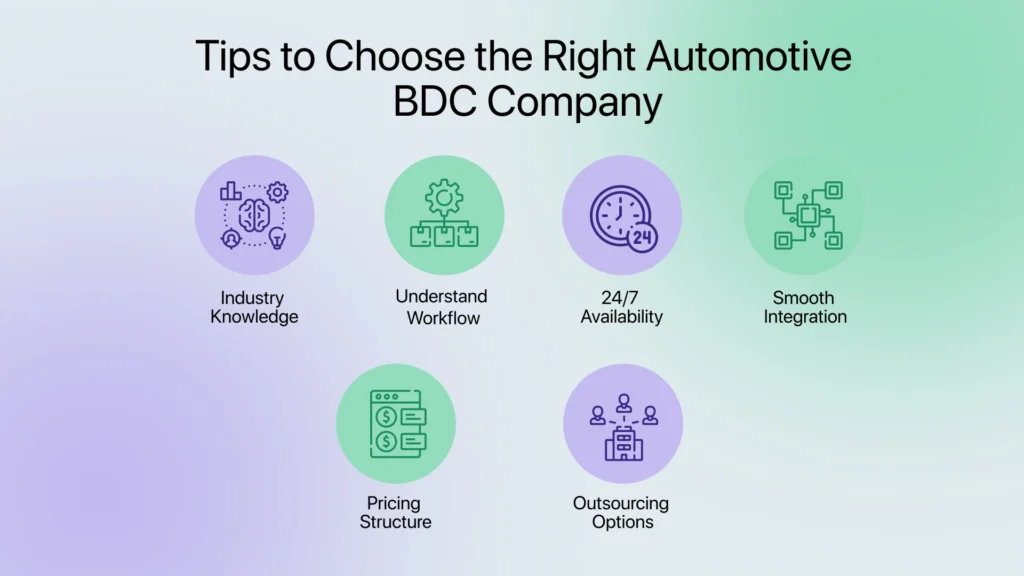
3. Verify Omnichannel Coverage
Customers reach dealerships through phone, SMS, website chat, email, and third-party marketplaces. A BDC that only handles phone calls creates gaps your team has to fill manually. Look for solutions that manage customer conversations across all touchpoints with consistent lead data flowing into the same CRM record.
4. Assess Automation Depth
The difference between basic and advanced BDC software often comes down to what happens without manual input. Strong automation covers: lead qualification from inbound calls, outbound follow-up sequences, appointment reminders, and dormant lead reactivation. For AI-powered BDC solutions, evaluate how they handle edge cases, uncommon customer questions, transfer protocols, and escalation logic, not just standard call flows.
5. Confirm Scalability Without Cost Spikes
A traditional outsourced BDC provider scales by adding agents, which adds cost linearly. AI-powered BDC software scales by processing more conversations on the same infrastructure. If your lead volume increases by 40%, your cost model should not increase by 40%. Understand the pricing structure before you need to scale.
6. Demand Real-Time Reporting
Reporting gaps are where BDC ROI disappears. The right provider gives you live visibility into response times, appointment set rates, lead conversion by source, and call-level outcomes. Without that data, you cannot identify which lead sources are being handled poorly or which follow-up sequences are underperforming.
7. Calculate Value, Not Just Price
A lower-priced BDC solution that generates poor appointment rates costs more in lost gross than a higher-priced platform that converts consistently. Run the math: if your store closes 20% of set appointments and your current BDC sets 30 per month, a 10-appointment improvement at $2,000 average gross is $20,000 in monthly revenue impact.

How Spyne Differs From Other Automotive BDC Companies?
Many automotive BDC companies help dealerships manage customer communication and appointment scheduling. However, Spyne takes a different approach by combining AI-powered automation, dealership-specific workflows, and omnichannel engagement into a unified platform. Instead of simply handling leads, Spyne’s Vini AI helps dealerships automate customer interactions, improve response times, and scale operations without increasing headcount.
1. 24/7 Coverage
Unlike traditional BDC services, Spyne’s AI operates beyond working hours, expanding coverage for dealerships. Our AI after-hours answering call service answers every call even outside business hours, ensuring no call goes ignored or unanswered, and no sales opportunities are lost.
2. Conversational AI
Spyne delivers dealerships a conversational AI voice agent, “Vini,” that handles every call like a real human. Vini runs on the most advanced Artificial technology. It understands customer behaviour, tone, requirement and delivers personalized responses every time. Our Vini AI engages with customers across calls, chat, SMS, and other communication channels. Our Vini also understands the automotive niche, products, services, and customers, and delivers 100% accuracy each time.
3. Automated Follow-Up
Through an outbound call center solution, our AI BDC software automates lead nurturing and customer outreach, ensuring every prospect receives timely communication without requiring manual intervention. From appointment reminders to re-engaging inactive leads, automated follow-ups help improve response rates and conversion opportunities.
4. AI Call Tracking
Spyne goes beyond basic inbound call handling and outbound call handling by providing detailed call intelligence. Every conversation can be tracked, analyzed, and evaluated to identify missed opportunities, customer intent, and performance trends. These insights help dealerships optimize communication strategies and improve overall BDC effectiveness.
5. Intelligent Lead Qualification & Routing
Our virtual bdc automotive automatically qualifies incoming leads based on customer responses, preferences, and engagement signals, then routes them to the appropriate sales or service team. This allows dealership staff to focus on high-intent opportunities while ensuring every customer receives the right level of attention.
6. AI Analytics & Insights
Spyne’s automotive BDC software provides actionable analytics that help teams understand lead sources, appointment performance, response times, conversion trends, and customer engagement patterns. These insights make it easier for dealerships to identify bottlenecks and continuously improve performance.
7. Seamless Integration
One of the biggest challenges with many automotive BDC software solutions is disconnected systems. Spyne integrates with dealership CRMs and existing workflows, automatically syncing customer conversations, lead data, appointments, and outcomes. This reduces manual data entry, improves visibility, and increases dealership BDC effectiveness.
Measured outcomes from Spyne’s dealer network:
- 67% increase in lead generation across dealership partners
- 70% reduction in operational costs from AI-driven workflows replacing manual processes
- $310K recovered at Paragon Honda within one week of deployment
- 35% lift in repair order volume when Vini AI is deployed on service scheduling
- 5× annual revenue growth reported across the Spyne platform

The Future of Automotive BDCs: AI BDC Automation
AI-driven BDC automation is redefining how dealerships manage customer engagement end-to-end. Instead of manual follow-ups and inconsistent response times, dealerships can now rely on real-time insights, intelligent lead routing, and always-on virtual assistants to streamline automotive lead management and boost conversions.
– Smarter Call Intelligence: AI-led call intelligence is getting better at catching cues humans miss like hesitation, urgency, objection patterns, and prompts reps in real time to recover conversations before they slip away.
– After-Hours Coverage Backed by Research: After-hours chat automation is becoming essential. A widely cited study shows dealerships that respond within five minutes are 21–100× more likely to convert a lead compared to slower responders.
– Seamless Human Handoffs: Smart chat systems now route complex queries back to human reps without breaking the flow, giving customers quicker answers.
– Predictive Lead Scoring for Better Prioritization: Predictive lead scoring has emerged as a priority tool, ranking prospects based on engagement signals and past outcomes so BDC teams invest their time where conversion odds are highest.
– Performance Boost for Modern Dealerships: Dealers adopting AI-supported BDC workflows report faster contact rates, tighter follow-ups, and fewer missed conversations.
Conclusion
Automotive BDC companies have become essential for dealerships looking to improve lead response times, customer engagement, and appointment generation. Whether you choose an outsourced BDC automotive provider or AI-powered automotive BDC software, the right solution can help streamline operations and maximize every sales opportunity.
As customer expectations continue to evolve, dealerships need faster, smarter, and more scalable ways to manage communication. Looking to modernize your dealership’s BDC operations? Book a demo with Spyne and discover how AI-powered automation can help you convert more leads into customers.