
The service department is the most profitable part of a franchise dealership. It is also the most structurally broken.
A service advisor’s job was built around the lane, write up the vehicle, coordinate with the technician, present the inspection, deliver the car. By month twelve, most advisors are managing 25+ active repair orders while fielding 30–50 inbound calls, texting status updates, chasing parts, and handling scheduling changes, every day, without additional staffing to absorb it.
More than 52% of weekly service booking calls land on Mondays and Tuesdays. Peak volume hits between 8 and 11:30 a.m., exactly when the service drive is already at capacity.
This post covers what is driving that overload, what it costs on the P&L, how AI removes the communication burden without disrupting lane operations, what changes for advisors once that load is gone, how dealerships measure the productivity impact, and a breakdown of the five AI platforms purpose-built for service advisor productivity in 2026.
What Is Service Advisor Overload, and Why Does It Keep Getting Worse?
Service advisor overload is the condition where the volume of communication tasks, inbound calls, status updates, outbound follow-up, appointment reminders, exceeds what an advisor can handle without degrading either their customer-facing performance or their own sustained capacity to do the job.
It is not a new problem. What has changed is the volume. CDK Global’s Dealership Workplace Study found that while dealership head count is essentially unchanged from two years ago, sales were up by approximately 2 million units in 2024 from 2022. More is getting done by the same number of people, but roughly a third of dealership employees surveyed said they were considering leaving within six months.
The five task categories eating the most advisor time:
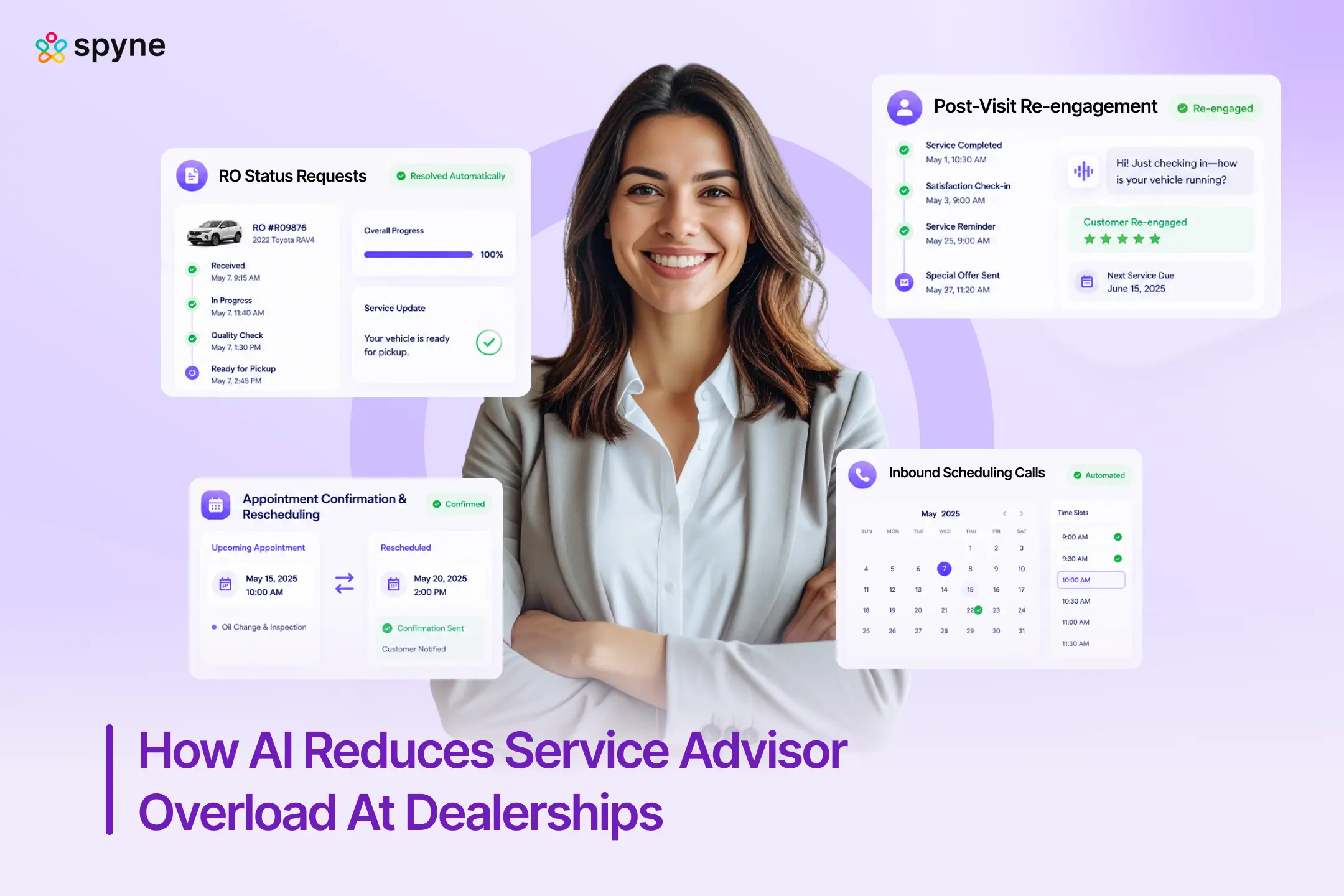
- Inbound scheduling calls, highest-volume task, peaking 8–11:30 a.m., when the service drive is already packed with walk-ins.
- RO status requests, the 2–5 p.m. call flood; customers with no proactive update calling to ask if their car is ready.
- Appointment confirmation and rescheduling, manual reminder chains, no-show recovery, and reschedule management.
- Declined-service follow-up, the deferred work from previous visits that rarely gets a callback when the floor is busy.
- Post-visit re-engagement, recall outreach, service due reminders, satisfaction check-ins
When one person owns all five categories across 25+ active ROs, something always slips. The calls that slip become missed revenue. The declined services that slip become lost gross. The advisors who slip into burnout become a turnover cost that shows up in HR, not on the Fixed Ops P&L where it actually lives.
What Does Service Advisor Overload Actually Cost a Dealership?
Most Fixed Ops Directors are tracking one number, missed calls. The real cost runs in three directions.
# Lost revenue from unanswered service calls
- At $450–$470 per RO (NADA 2024 average: $466), that translates to $853K–$1.17M in annual revenue exposure per store
- Car Wars’ 2024 report across ~3,000 dealerships found 31.8% of unconnected calls were customers who hung up on hold; average hold time: 3 minutes, 5 seconds
- 32.3% of non-connected calls went to voicemail, most never converted to a booked appointment
# Customer retention bleeding out
- Service departments have lost 12% of visits to competitors since 2018.
- In 2023, 72% of owners with vehicles two years old or newer returned to the dealer for service, by 2025 that number dropped to 54%
- Roughly 70% of customers who reach a voicemail call a competitor within 30 minutes
# Advisor turnover, the cost that doesn’t appear on the service report
- Service advisor turnover is hovering near 50% industry-wide (Autopeople, 2024)
- The 2025 NADA Workforce Study confirms service advisors carry the second-highest turnover rate in the dealership
- Replacing one advisor costs $50,000–$100,000 in recruiting, training, and lost productivity during ramp-up
- A five-advisor department losing two per year at $60K average replacement = $120K in direct turnover cost before the revenue lost during the coverage gap is calculated
- The burnout pattern is consistent: advisors don’t snap, they slow down, CSI drifts, Mondays go uncovered, then the exit interview says “compensation.” The real issue is unsustainable workload without structural support to absorb it
The combined exposure at a single rooftop:
| Cost Category | Annual Estimate |
| Missed service call revenue | ~$853K |
| Advisor replacement (2/year) | ~$120K |
| CSI drag and customer defection | Material, difficult to isolate |
| Total identified exposure | >$950K/year |
*Estimates based on industry averages; actual figures will vary by store size, market, and call volume.
How Vini AI Removes the Communication Load, Without Touching the Lane
The core problem is a role that was never designed to carry a communications queue on top of its lane responsibilities. The fix is not hiring another advisor, the economics of that break at scale. The fix is removing the tasks that should never have been the advisor’s job in the first place.
Vini AI operates as a dedicated service communications layer. It handles every task in the advisor’s communication queue automatically, runs 24/7, and integrates directly with the DMS, so appointments, availability, and RO status are always current. Here is what it takes off the plate:
- Inbound scheduling calls, Vini answers every service call in under 5 seconds with a conversational voice AI that confirms service type, checks live DMS availability, selects an appointment time, and logs it directly to the CRM. Not an IVR menu. Not a hold queue. A full booking conversation, end to end.
- Proactive status updates, Instead of waiting for the 3 p.m. status call flood, Vini sends automated outbound texts at DMS milestones: vehicle checked in, on the lift, inspection complete, ready for pickup. Customers who already know their car’s status stop calling to ask.
- Declined-service outreach, Every declined RO triggers a follow-up sequence automatically. The advisor who had no bandwidth to circle back at 4 p.m. gets coverage by default, without logging into a separate tool.
- No-show reduction, Multi-step appointment reminders (48h, 24h, 2h before) run without advisor action, reducing no-show rates measurably.
- Post-visit re-engagement, Recall outreach, service due notifications, and check-ins run in the background after each closed RO.
Every interaction is logged to the CRM and reviewed by Spyne’s human QA team daily. No call slips through unreviewed.
The direct throughput impact: advisors who previously spent 40–50% of their day on phone and text traffic can redirect that time to the lane. If each advisor handles two additional ROs per day at $450/RO, a five-advisor service department generates $2,250/day in incremental revenue from the same team, same payroll, same floor.

What Changes for Advisors When the Communication Queue Disappears
This is the question most Service Managers underinvest in thinking through. Removing communication overhead does not just add RO capacity, it changes how advisors perform the work they still own.
- More presence in the lane. An advisor not pulling out their phone to answer a status call is fully engaged with the customer at the write-up desk. That presence increases upsell acceptance and CSI simultaneously, the two metrics Fixed Ops Directors track most closely.
- Higher close rate on declined services. When AI initiates the outbound follow-up and warm-transfers the customer only when they are ready to book, the advisor enters the conversation at the decision point, not during a logistics chase. Conversion on declined work improves because the advisor is selling, not scheduling.
- Lower voluntary turnover. Burnout in the service lane comes from the feeling of never being caught up. When the communication queue runs automatically, the mental load drops. Lower mental load is a retention factor. An advisor who stays four years instead of eighteen months builds the customer relationships that generate repeat-visit revenue, and that relationship equity stays at the store when the advisor does.
How Dealerships Measure Service Advisor Productivity Improvement with AI
When AI is deployed on the service communication layer, these are the KPIs that shift first:
| Metric | Baseline (Industry Average) | Post-AI (Benchmark) |
| ROs per advisor per day | 20–22 | 24–26 |
| Missed call rate, service line | 25–35% | Near 0% |
| No-show rate | 18–22% | 10–14% |
| Declined-service contact rate | Ad hoc, advisor-dependent | Systematic, automated |
| Advisor voluntary turnover | ~50% annually | Measurably reduced |
AI Tools for Service Advisor Productivity: Platform Breakdown
The market has consolidated around a handful of purpose-built platforms. Here is an honest breakdown of what each does well and where it fits.
1. Vini AI, Spyne
Best for: Franchise dealerships that need a single AI platform covering service inbound calls, outbound follow-up, declined-service sequencing, and omnichannel coverage across voice, SMS, and chat, without managing separate point solutions.
Vini AI is Spyne’s conversational AI agent built specifically for automotive dealership operations. Unlike tools adapted from generic contact-center software, Vini is trained on real dealership conversations and handles the full communication stack, sales, service, BDC, parts, and F&I, from one deployment. Human QA reviews every call daily, which is a meaningful differentiator in a space where most platforms offer monitoring dashboards but no human oversight layer.
Capabilities:
- Full voice AI for inbound/outbound service scheduling (not IVR, a real booking conversation)
- 50+ DMS-integrated availability lookup and appointment creation (CDK, Reynolds and Reynolds, Tekion)
- Automated proactive status texts triggered by RO milestones
- Declined-service outbound follow-up with warm transfer to advisor
- Multi-step no-show reminder sequences (48h, 24h, 2h)
- Post-visit re-engagement: recall outreach, service due, satisfaction check-in
- 24/7 coverage across voice, SMS, and chat, all logged to CRM
- Handles sales, service, BDC, parts, and F&I from a single platform
Pricing: Custom.
2. Numa
Best for: Franchise dealerships where the primary gap is service call volume and status update automation, particularly those running Xtime for scheduling.
Numa is one of the earliest and most deployed AI communication platforms in automotive service. Numa built its reputation on rescuing missed service calls and eliminating the 2–5 p.m. status call flood. Its LiveCSI feature gives service managers real-time customer sentiment monitoring, a capability no other platform in this list offers. Integration depth with Xtime is a specific strength for dealers already on that scheduling stack.
Capabilities:
- AI voice agents for inbound service call handling and scheduling
- Automated proactive status texts connected to DMS
- Smart Inbox with sentiment analysis and prioritized message routing
- LiveCSI, real-time customer satisfaction monitoring
- Opportunities module, AI identifies revenue opportunities in live conversations
- Operator module, handles multi-step customer requests
- Recall outreach and follow-up campaigns
- DMS integrations: CDK, Reynolds, Tekion, Xtime
Pricing: Contact for pricing (custom, franchise dealership tier).
3. Toma
Best for: Dealers evaluating a voice-first AI that handles both inbound sales and service calls with strong customization capabilities and self-improving agents.
Toma focuses on what it calls an AI “operating system” for dealership conversations. Its differentiator is deep customizability and agents that learn from real calls over time, store-specific policies and escalation logic improve automatically without requiring manual rule updates. Toma handles inbound sales qualification and service scheduling from the same deployment, which matters for dealers who want one voice AI across both departments.
Capabilities:
- AI voice agents for inbound service scheduling and sales lead qualification
- Automated appointment reminders and dropped-call follow-up
- Full-store receptionist, routes to right department, alerts team for follow-up
- Recall detection and proactive recall campaign outreach
- Smart escalation routing, transfers to human when judgment is needed
- Self-improving agents that update from real call data over time
- DMS integrations: CDK, Reynolds, Tekion
Pricing: Subscription-based, custom tiers by dealership size.
4. Kenect
Best for: Dealerships prioritizing SMS-based service communication, reputation management, and payment collection, particularly those that acquired Auto Labs workflows post-2026.
Kenect serves 10,000+ dealerships and is one of the most widely deployed communication platforms in automotive. Its strength is text-based customer engagement, service updates, appointment reminders, and payment collection via SMS, combined with a robust reputation management layer (dealers using Kenect typically double or triple Google reviews within 90 days).
Capabilities:
- Voice AI and SMS-based inbound call handling and appointment scheduling
- AI-driven service update and status texts
- Video multi-point inspection (via Auto Labs acquisition)
- Automated recall mining and campaign outreach
- Text-to-pay for service invoice collection
- Reputation management and Google review automation
- Engage AI for post-visit follow-up and retention
- 600+ DMS and platform integrations
Pricing: Custom.
5. Pam AI
Best for: Dealerships that need a dedicated inbound receptionist AI and a separate outbound marketing agent, particularly stores with high after-hours call volume and active declined-service and recall recovery programs.
Pam AI is deployed across 800+ rooftops and positions itself as an “AI workforce” rather than a single tool, two purpose-built agents (Receptionist and Outbound Marketing) covering inbound call handling and outbound customer list activation respectively. Its fixed-ops depth is notable: Pam integrates with Xtime, DealerFX, MyKaarma, WiAdvisor, and Tekion for service scheduling, and its Outbound Marketing Agent specifically works declined-service, recall, retention, and lost-customer lists without advisor involvement. Farrish Automotive and Murgado Automotive (where Pam reportedly outperformed human agents on benchmarks) are among its public case study dealerships.
Capabilities:
- Receptionist Agent: inbound voice and SMS, 24/7 coverage including after-hours and peak overflow
- Full service appointment booking integrated with Xtime, DealerFX, MyKaarma, WiAdvisor, Tekion, CDK, and more
- Bilingual coverage: English and Spanish
- Outbound Marketing Agent: works declined-service, recall, retention, and lost-customer lists via voice and text
- Automatic follow-up texts post-booking, logged to service scheduler
- Pam Console: revenue analytics, real-time call logs, alerts, integrated texting
- Warm transfer to human with full call context when needed
Pricing: Custom.
| Platform | Service Inbound Voice AI | DMS Integration | Proactive Status Updates | Declined-Service Outreach | Human QA / Oversight | Multi-Department Coverage | CSI Monitoring |
| Vini AI (Spyne) | Full voice AI | CDK, R&R, Tekion | Yes | Yes, automated | Yes, daily human review | Sales + Service + BDC + Parts + F&I | Via CRM logs |
| Numa | Yes | CDK, R&R, Tekion, Xtime | Yes | Partial | Dashboard monitoring | Service-focused | LiveCSI (real-time) |
| Toma | Yes | CDK, R&R, Tekion | Limited | No | Dashboard monitoring | Sales + Service | Via reporting |
| Kenect | Voice AI + SMS | 600+ integrations | Yes (SMS) | No | Dashboard monitoring | Service + Sales (post-Auto Labs) | NPS via text |
| Pam AI | Full voice AI | CDK, Xtime, DealerFX, MyKaarma, Tekion | Partial (post-booking text) | Yes, Outbound Agent | Dashboard + Alerts console | Service + Sales | Via console analytics |

Closing Thoughts
$853K in missed service revenue. $100K+ in advisor replacement costs. CSI scores that drift and stay down. These are not staffing problems, they are structural ones, and they have a structural fix.
Advisors stay when the communication load is manageable. ROs go up when calls get answered. Retention compounds when burnout stops.
If your service department is absorbing any part of that exposure, book a demo with Spyne and see what Vini AI recovers in the first 30 days.