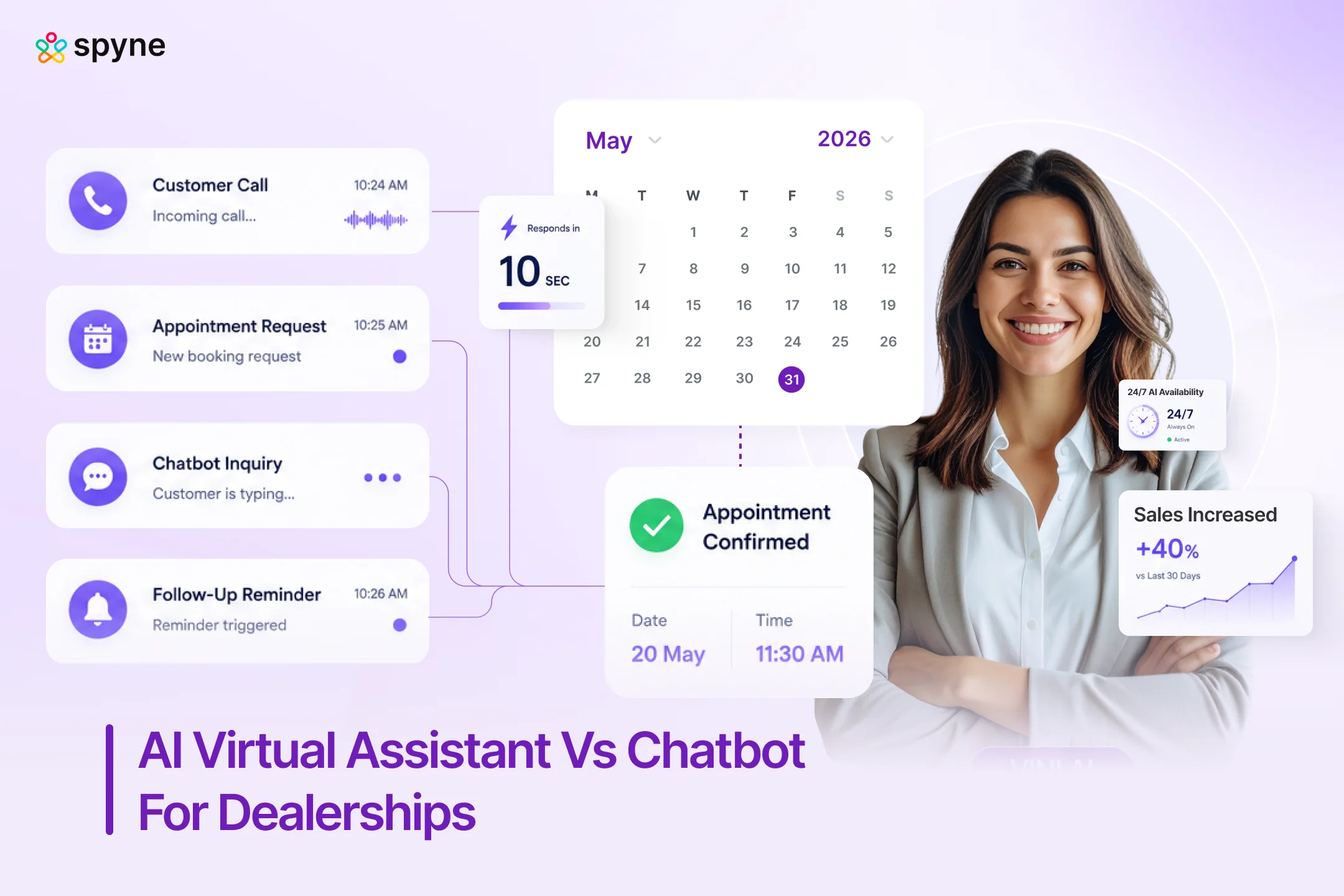

Most dealerships still treat conversational AI as a website widget that answers questions while staff are off the clock. That framing is outdated. In 2026, the real revenue leak is not on the website, it is on the phone, where industry data shows the average dealership misses roughly 23% of inbound calls and connects on only about 65% of service calls. A chatbot cannot fix that. An AI virtual assistant can. This article covers the operational difference between the two, why it matters in 2026, and how dealers should evaluate the shift from chatbot to virtual assistant.
Key Takeaways
|
What Is the Difference Between a Dealership Chatbot and an AI Virtual Assistant?
A dealership chatbot is a text-based tool that operates on the website and follows defined or AI-generated conversation paths to answer visitor questions. An AI virtual assistant operates across voice, SMS, web chat, and email simultaneously, uses natural language understanding to adapt to each conversation, and executes transactions inside the dealership’s systems. The chatbot answers questions. The virtual assistant completes work.
For a dealership operator, the distinction is operational, not theoretical. A chatbot can collect a name and a phone number from the website at 9 PM. A virtual assistant can answer the same buyer’s call at 9 PM, qualify them, check service-lane availability in the DMS, book a Wednesday appointment, send a confirmation text, and log the entire interaction in the CRM before the night manager closes out the day.
The Capability Divide at a Glance
| Capability | Standard Dealership Chatbot | AI Virtual Assistant (Like Spyne’s Vini AI) |
|---|---|---|
| Inbound phone calls | Not supported | 24/7 natural voice answering |
| Outbound text follow-up | Not supported | Automated sequences across the lead lifecycle |
| Real-time DMS scheduling | Form submission only | Direct DMS write-back into the service lane |
| Channel coverage | Website chat only | Phone, SMS, web chat, and email in one inbox |
| Lead qualification | Basic capture: name and contact | Intent, budget, timeline, and trade qualification |
| Language understanding | Keyword and intent matching | Conversational NLP trained on automotive retail |
| Handoff to human staff | Limited or none | Full transcript and context passed to advisor |
| CRM logging | Manual export typical | Automatic logging of every interaction |
| Bilingual capability | Rarely supported | Native English and Spanish |
| After-hours functionality | Limited to chat scope | Identical to business hours |
Why the Distinction Matters in 2026: The Phone Gap at Dealerships
The reason the chatbot-versus-virtual-assistant question is no longer academic is that the dealership’s biggest revenue leak in 2026 is on the phone, not on the website. Customers who call have already done their online research and are at the bottom of the funnel. Industry data confirms how much revenue is leaving through unanswered phones.
None of these problems can be solved by a chatbot. A chatbot cannot answer the phone. It cannot return a voicemail. It cannot recover a caller who abandoned it after 3 minutes on hold. This is the structural limitation that makes the virtual assistant category necessary, and it is why dealerships evaluating conversational AI in 2026 are no longer comparing chatbot vendors against each other, but evaluating full-stack AI call handling systems that can manage inbound calls, missed-call recovery, voicemail callbacks, and real-time customer conversations across every touchpoint.
How Is a Virtual Assistant Different from a Chatbot Technically?
Technically, the two products differ on three dimensions: channel architecture, language model, and system integration. A chatbot is a single-channel tool with intent-matching logic and shallow integrations, usually limited to writing leads into a CRM. A virtual receptionist acts as a multi-channel orchestrator with conversational natural language processing and deep two-way integration with the DMS, CRM, and phone system.
1. Channel Architecture
Chatbots are built for one input surface, typically a website widget. The architecture assumes a typed conversation in a session that lasts a few minutes and then ends. Virtual assistants are built for concurrent channels. The same customer who texts in the morning, calls in the afternoon, and opens a chat window in the evening is recognized as a single entity, with conversation history shared across surfaces.
2. Language Model
Most legacy chatbots run on intent-classification models that map an utterance to a predefined intent and respond with a templated answer. When the customer says something the model has not been trained on, the conversation breaks or routes to a human. Virtual assistants use larger conversational language models that handle off-script questions, multi-turn dialogue, and ambiguity. The customer who says “I want to bring my car in sometime next week for an oil change, maybe Wednesday afternoon if you have it” gets a real response, not a fallback message.
3. System Integration
This is where most chatbots actually fail dealership workflows. A chatbot may write a lead into the CRM, but it cannot read DMS availability, write a real appointment, or update an open repair order. A virtual assistant connects to the DMS through standard APIs and operates against live data. The difference shows up in the customer experience: a chatbot tells a buyer “we’ll get back to you with available times,” and a virtual assistant tells the same buyer “Wednesday at 2:30 PM or Thursday at 9 AM, which works better?”.
Can an AI Virtual Assistant Handle Inbound Dealership Phone Calls?
Yes. An automotive AI virtual assistant answers inbound phone calls using a conversational voice interface, identifies the caller’s intent through natural dialogue, and completes the transaction. Spyne VINI answers within two rings, greets returning customers by name when there is a CRM record, and books service appointments directly into the DMS during the call. The customer hangs up with a confirmation text already on their phone.
What Happens on a VINI Call, Step by Step:
- Step 1: Ring detection. VINI picks up on the second ring with a dealership-branded greeting.
- Step 2: Caller recognition. If the inbound number matches a CRM record, VINI references the customer’s vehicle and prior visit history.
- Step 3: Intent identification. The caller states what they need in natural language. VINI does not require menu navigation or keyword matching.
- Step 4: Resolution. For a service appointment, VINI checks live DMS availability and proposes specific times. For a sales inquiry, VINI qualifies budget, timeline, and trade, then routes to a human or books a test drive.
- Step 5: Confirmation. VINI sends a text confirmation before the call ends and logs the full interaction in the CRM with a transcript.
What Tasks Can a Dealership AI Virtual Assistant Automate?
A dealership AI virtual assistant automates the high-volume, repeatable communication work that consumes BDC and receptionist time. The tasks below represent the operational scope of Spyne VINI in a typical franchise dealer deployment, covering both sales and fixed operations.
#1- Inbound Communication
- 24/7 answering of inbound phone calls, including overflow during peak Monday morning hours.
- Service appointment booking with direct DMS write-back.
- Sales lead qualification: budget, timeline, vehicle interest, and trade-in details.
- Parts and accessories inquiries, hours, directions, and routine FAQs.
- Web chat and SMS conversations handled in the same unified inbox.
#2- Outbound Communication
- Automated text follow-up sequences for uncontacted internet leads.
- Appointment reminders at 48 and 24 hours before scheduled visits.
- Post-service follow-up messages with CSI prompts and review requests.
- Missed call recovery: when a call goes to voicemail, VINI texts the caller and offers to complete the request via SMS.
- Re-engagement campaigns for service customers with overdue maintenance.
#3- CRM and DMS Operations
- Automatic CRM logging of every call, text, and chat with full transcripts.
- Appointment booking written directly into the service-lane schedule, not as a form submission.
- Lead routing to the correct salesperson or service advisor based on store rules.
- Tagging of inbound sources so marketing attribution stays clean.
How Does a Dealership AI Virtual Assistant Connect to the DMS for Scheduling?
Spyne VINI acts as an AI scheduling assistant and integrates with major dealership management systems through standard APIs, giving the assistant real-time access to service appointment availability, customer vehicle records, service history, and open repair orders. This live DMS connection is what allows the assistant to book appointments that actually appear correctly in the service lane schedule, rather than creating shadow bookings that the BDC has to reconcile manually the next morning.
Why Real-Time DMS Access Matters
A virtual assistant without DMS integration is functionally a phone-based chatbot. It can take messages, but it cannot book. The result is the same friction the customer was trying to avoid by calling: they are told someone will call them back to confirm a time. Phone callers convert at high rates because they are ready to act now. Booking the appointment at the moment is the entire point of answering the call.
Measurable Operational Impact: What Dealers Are Seeing
The operational case for moving from a chatbot to a virtual assistant rests on a small number of metrics that translate directly to revenue: answer rate, appointment booking rate, after-hours capture, and CRM data completeness. Industry data and dealer case studies in 2025 and 2026 show consistent patterns.
| Operational Metric | Chatbot Baseline | Virtual Assistant Outcome(Like Vini AI) |
|---|---|---|
| Inbound call answer rate | Not applicable (text only) | Approaching 100% with zero hold time |
| After-hours lead capture | Web chat fragments only | Full appointment booking on phone, SMS, and chat |
| Appointment-to-call conversion | Industry-wide variable ops average: 22% | Documented dealer cases: 75% to 88% |
| Service-lane scheduling | Web form submission, manual confirmation | Direct DMS write-back, confirmed during call |
| Voicemail return rate | Not addressed | Eliminated, callbacks recovered via text |
What Is VINI AI and What Does It Do for Dealerships?
VINI AI is Spyne’s automotive-native conversational AI. It operates as a full-capability AI member of the dealership team across phone, SMS, web chat, and email. VINI is purpose-built for automotive retail, which means the conversational model, the integrations, and the workflows are designed around dealer operations rather than retrofitted from a general-purpose chatbot platform.
Spyne VINI is built for franchise and independent dealers who want the operational capability of a 24/7 BDC without the cost structure or coverage gaps of a human-only team. It is part of the broader Spyne platform that also includes Studio AI for inventory photography, video tours, car walkaround videos, and visual merchandising automation. Dealers running both products consolidate their visual buyer experience and conversational buyer experience under a single vendor.
How Long Does It Take to Deploy an AI Virtual Assistant at a Dealership?
Spyne VINI is pre-trained on automotive retail conversations, so deployment is a configuration process rather than a training process. The work involves connecting VINI to the dealership’s phone system, DMS, and CRM, configuring escalation paths for different inquiry types, customizing the assistant persona with the dealership’s name and service offerings, and testing the full conversation flow before go-live. Most dealerships complete this process in two to three weeks.
Standard Deployment Sequence
- Week 1: Phone system, DMS, and CRM integrations are configured. Escalation rules and store hours are loaded.
- Week 2: Service menu, pricing rules, and outbound message templates are customized. Internal team training begins.
- Week 3: Live shadow mode followed by full go-live. The dealership monitors call quality and adjusts persona settings.

How to Evaluate an AI Virtual Assistant for Your Dealership?
Evaluating an AI receptionist for car dealerships is operationally different from evaluating a chatbot. The questions that matter are integration depth, automotive specificity, and measurable outcomes, not feature lists. The checklist below maps to the criteria most franchise dealer leaders use in 2026 procurement.
Evaluation Checklist:
- Does the assistant answer inbound voice calls, or is it text-only? Anything text-only is a chatbot regardless of how it is marketed.
- Does the assistant write directly to the DMS service schedule, or does it submit a form that staff have to reconcile manually?
- Is the conversational model trained on automotive retail conversations, or is it a general-purpose model with a thin automotive layer?
- Does the platform handle outbound communication (text follow-up, reminders, missed-call recovery), or only inbound?
- Does every interaction log to the CRM automatically with a full transcript, or does the BDC have to manually export?
- How long is the deployment? Multi-month timelines are a sign that the product is not pre-trained on automotive workflows.
- What are the documented outcomes at comparable stores? Look for specific appointment booking rates, not general claims.
Closing Thoughts
The chatbot-versus-virtual-assistant question is not a software comparison. It is a question of which technology actually captures the revenue the dealership is already generating demand for. A chatbot works the website during business hours. A virtual assistant works every channel the customer uses, every hour the phone rings, and writes the appointment into the DMS before the call ends.
The data is settled. Roughly one in three service calls never reaches a live person. Phone leads convert at nearly double the rate of internet leads. Consumer expectations for AI in the buying process are already running ahead of dealer readiness. The dealers moving from chatbot to virtual assistant in 2026 are not adding a feature. They are closing the largest unaddressed operational leak in retail automotive. Book a demo to see how VINI would handle your store’s call volume, after-hours leads, and service bookings.