
78% of car buyers purchase from whichever dealership responds first. That single statistic explains why speed-to-lead has become the most important metric in automotive retail, and why AI tools built for instant lead response are now essential infrastructure for any competitive dealership.
The data is unambiguous. Leads contacted within five minutes are 9x more likely to convert compared to leads contacted after 30 minutes. Responding within the first minute can lead to a 391% increase in lead conversions. Yet 78% of automotive leads receive their first response after 30 minutes, and 32% never receive any response at all.
That gap, between what buyers expect and what dealerships deliver, is where AI lead response tools create the most measurable revenue impact.
In this blog, you’ll learn:
- Why speed-to-lead is the #1 growth lever for dealership revenue
- Five essential features to look for in an AI lead response tool
- The 8 best AI platforms for instant car lead response in 2026
- How to choose the right tool for your dealership’s channels and size
- Step-by-step implementation playbook to maximize ROI
- Measurable ROI metrics and results you can expect within 60–90 days
Why Speed-to-Lead Is the #1 Growth Lever for Dealerships
Before evaluating tools, it’s worth understanding the economics. This isn’t theoretical, the numbers translate directly into revenue.
A research found that internet leads contacted within five minutes convert at rates of 25–32%. That same lead, contacted after one hour, converts at just 3–5%. After 24 hours, conversion rates drop below 1%. The difference isn’t marginal. It’s the difference between closing one in four leads and closing one in twenty.
And it’s not just about phone calls. About 57% of dealership staff now report using AI tools in some part of their work, reflecting how quickly AI is becoming embedded in the lead response process. But most dealerships still have a structural problem: leads arrive through phone calls, website forms, third-party marketplaces, social media ads, and chat, often simultaneously, often after hours, and human teams simply can’t cover every channel at all times.
Roughly 56–60% of dealership leads arrive outside business hours, which means the majority of your leads first try to reach you when nobody is there to respond. AI doesn’t just make responses faster. It makes 24/7 coverage possible without adding payroll.
Features To Look for in an AI Tool that Responds to Car Leads
Not every AI tool that “responds” to leads actually converts them. Sending an automated “We received your inquiry” email within seconds is better than silence, but conversion comes from actual meaningful contact, a phone call, a personalized text, an inventory-specific answer, within that five-minute window.
An effective AI lead response tool for car dealerships needs to do more than acknowledge the inquiry. It needs to engage the customer in a real conversation, answer their specific question (which usually involves inventory, pricing, availability, or financing), qualify their intent and timeline, and move them toward a concrete next step, typically booking a test drive or appointment.
Five capabilities separate effective tools from glorified autoresponders:
- First, automotive-specific intelligence: the AI must understand vehicle terminology, access live inventory data, and provide accurate answers about specific cars.
- Second, omnichannel coverage: leads arrive via phone, text, web chat, email, and marketplace platforms, the tool needs to respond on whatever channel the customer used.
- Third, deep CRM/DMS integration: every response, qualification detail, and appointment must sync bidirectionally with your CRM.
- Fourth, intelligent handoff: when a lead is qualified and ready for a human closer, the AI should transfer with full conversation context so the customer never repeats themselves.
- Fifth, 24/7 availability: after-hours, weekends, and holidays are when the majority of leads arrive and when competitors are asleep.
Which Are the Best AI Tools to Respond to Car Leads in 2026?
1. Spyne (Vini AI)
Best for: Dealerships that want a single AI platform handling instant lead response across phone, chat, text, and email, with inventory-aware conversations and full department coverage.
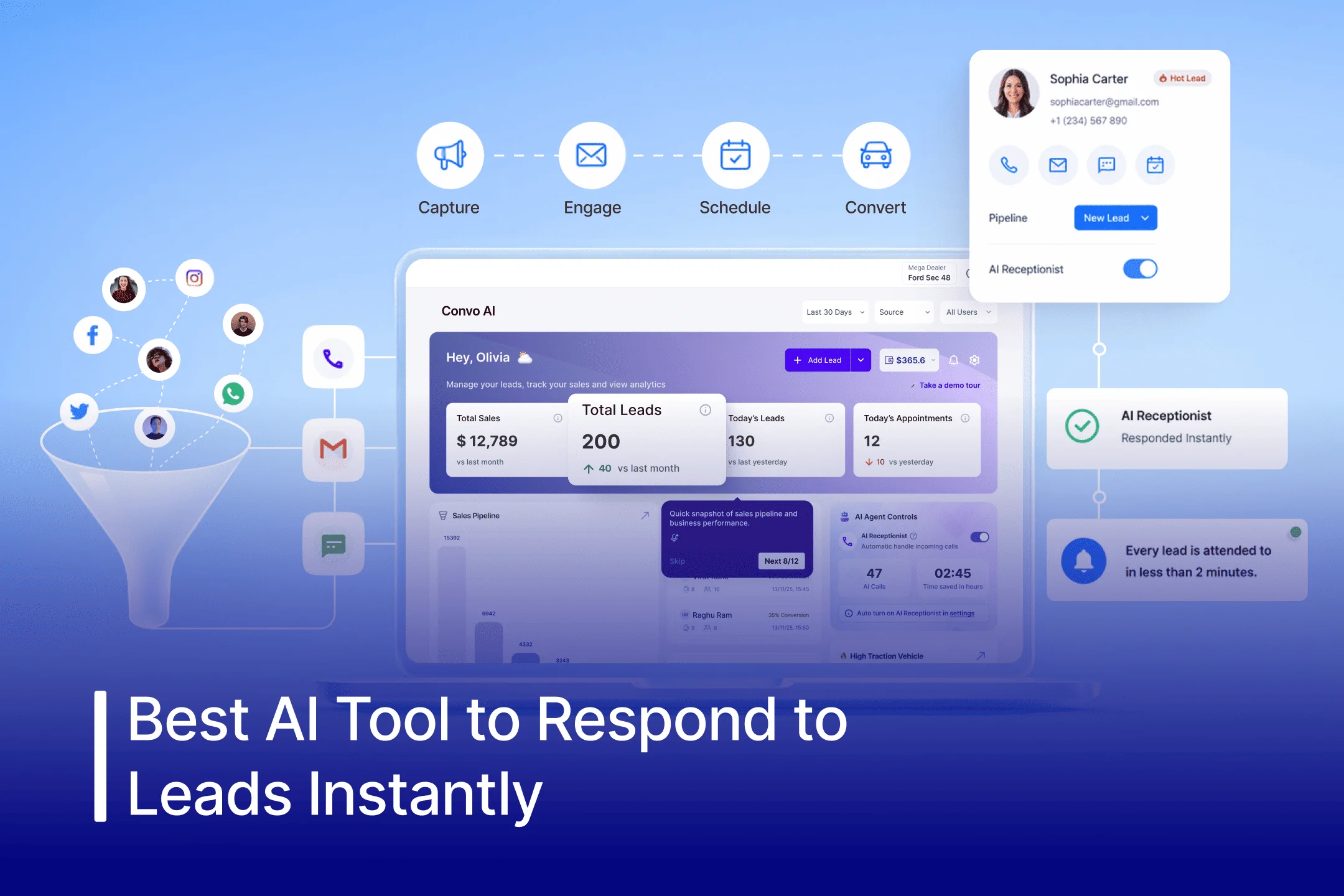
Spyne’s Vini AI is purpose-built conversational AI for dealerships to tackle the speed-to-lead problem from every angle. The moment a lead arrives from any source, website form, marketplace listing, phone call, social media ad, or walk-in inquiry, Vini responds instantly with a personalized, contextual conversation, not a generic auto-reply.
What makes Vini particularly effective for instant lead response is its direct integration with the dealership’s VDP, inventory management system, and CRM. When a buyer asks about a specific vehicle, Vini pulls live data, pricing, availability, mileage, Carfax history, trim details, and provides an accurate, vehicle-specific answer in real time. It doesn’t just say “a team member will get back to you.” It actually answers the question, qualifies the buyer’s intent and timeline, and nudges them toward booking a test drive or appointment.
Vini operates across 20+ customizable AI agent types, covering sales, service, BDC, receptionist, parts, and finance. This means the same platform that instantly responds to a sales lead at 10 PM also books a service appointment at 7 AM and handles a parts inquiry at noon. Every interaction is logged in the CRM with full context: customer intent, vehicle interest, source attribution, and recommended next steps.
On the outbound side, Vini also re-engages cold CRM leads, follows up on no-shows, and runs recall/retention campaigns, ensuring that speed-to-lead extends beyond the initial response to the full customer lifecycle.
Key capabilities: Sub-minute response across phone, chat, SMS, and email; live inventory and VDP-connected conversations; automated lead qualification and appointment booking; multilingual support; 24/7 coverage; outbound follow-up and cold lead re-engagement; TCPA compliance.
Integrations: VinSolutions, DealerSocket, CDK, Salesforce, and other major CRM/DMS platforms.
Best-fit dealership profile: Mid-size to large dealer groups that want one AI platform handling instant lead response, ongoing follow-up, and full department coverage. Especially strong for dealerships with high inbound lead volume across multiple channels and after-hours coverage gaps.
2. Podium (AI Employee / Jerry)
Best for: Dealerships that want an AI BDC employee handling lead response across text, web chat, phone, and email with deep customization.
Podium’s AI Employee (“Jerry”) responds instantly to leads from any channel, using CRM data and live inventory to provide accurate, personalized answers. Jerry qualifies leads, recommends specific vehicles based on customer preferences, and books test drives and service appointments, all autonomously.
What sets Podium apart is customizability. Dealerships can shape Jerry to handle specific scenarios (ICOs, deposits, test-drive holds, service requests) and match their brand’s tone. Jerry learns instantly from guidance, no scripting or coding required. With 4.6/5 on G2 and roughly 2,000 reviews, it has strong market validation.
Podium also handles outbound, proactively mining the CRM for lease expirations, trade-in opportunities, and service follow-ups.
Key capabilities: Instant multi-channel lead response, inventory-informed conversations, customizable talk tracks, CRM integration, proactive outbound lead mining, appointment booking into Xtime.
Best-fit dealership profile: Medium to large dealerships looking for a proven AI BDC with strong customization controls and a large dealer community. Particularly effective for stores already using Podium’s broader messaging platform.
3. Gubagoo
Best for: Dealerships that want a hybrid AI + human-managed chat solution with strong conversion focus on website leads.
Gubagoo takes a slightly different route compared to fully autonomous AI platforms. It blends automation with live agents, ensuring that conversations don’t stall when nuance or persuasion is required. When a lead comes in through the website, Gubagoo can initiate the conversation instantly via AI, then seamlessly transition to a trained human agent when needed.
This setup works well for dealerships that aren’t fully comfortable handing over the entire customer journey to AI but still want fast response times. Gubagoo is deeply embedded in automotive retail, with tight integrations across dealership websites, digital retailing tools, and CRM systems.
Its strength shows up in handling high-intent website traffic, answering vehicle questions, nudging users toward trade-in valuations, and pushing for appointment bookings while maintaining a conversational flow that feels less scripted.
Key capabilities:
- Instant website chat engagement with AI + live agent handoff
- Lead qualification and appointment setting
- Integration with dealership websites and digital retail tools
- Conversion-focused chat workflows
- Real-time conversation monitoring and escalation
Best-fit dealership profile:
Dealerships that want faster response on inbound website leads but still value human involvement in closing conversations, especially high-ticket or negotiation-heavy interaction.
4. Matador AI
Best for: Dealerships where SMS/text is the dominant lead engagement channel and rapid text response is the priority.
Matador connects text, calls, emails, social messages, and web chat into one AI-managed conversation stream. Its strength is text-first instant response, when a lead comes in from AutoTrader, CarGurus, Facebook, or the dealership website, Matador engages via SMS within seconds.
The Sales Autopilot feature automates follow-up sequences, and the pre-built automation library includes workflows for common dealership scenarios (unsold showroom follow-up, lease renewal, recall outreach).
Key capabilities: Instant SMS/text lead engagement, multi-channel conversation unification, pre-built automation workflows, broadcast messaging, CRM integration (DealerSocket, VinSolutions, CDK, Reynolds).
Best-fit dealership profile: Dealerships in markets where text messaging drives the majority of customer engagement and where rapid SMS response is the primary speed-to-lead strategy.
5. Numa
Best for: Service-heavy dealerships needing instant response on inbound calls with strong team collaboration tools.
Numa’s Smart Inbox answers inbound calls instantly via voice AI, identifies customer intent, and routes or resolves the conversation, all while logging it for the team. For sales leads that come in via phone (which still convert at significantly higher rates than digital leads), Numa ensures no call goes to voicemail.
Numa converts 31% of cold messages into booked appointments and is used by 1,200+ dealerships. Its service marketing engine also handles outbound lead generation for service departments.
Key capabilities: Instant voice AI call answering, real-time intent detection and routing, Smart Inbox for team visibility, service marketing outbound campaigns, CSI monitoring.
Integrations: CDK, Reynolds, Tekion, Xtime.
Best-fit dealership profile: Dealerships where phone-based leads are a major revenue channel and service department communication needs improvement. Less focused on text/chat-first lead response.
6. STELLA Automotive AI
Best for: Franchise dealerships with high inbound call volume that need an AI receptionist to capture every phone lead instantly.
STELLA answers inbound calls and texts instantly, qualifies leads, books appointments, and routes complex inquiries. It’s built by automotive industry veterans and focuses specifically on converting inbound phone opportunities into scheduled appointments.
STELLA also runs outbound voice and SMS campaigns via Catalyst. Its franchise-store clients report strong appointment conversion rates from inbound call handling.
Key capabilities: AI receptionist for instant phone response, SMS engagement, outbound campaign execution, scheduler integration, intelligent call routing.
Best-fit dealership profile: Franchise stores with heavy phone traffic and a need to ensure 100% call answer rates across sales and service.
7. AutoRaptor (AI Sales Assistant)
Best for: Smaller dealerships wanting an automotive CRM with built-in AI lead response capabilities.
AutoRaptor combines CRM functionality with an AI Sales Assistant that responds to inquiries within 60 seconds, qualifies leads, schedules appointments, and triggers automated follow-up sequences. It’s designed for dealerships that want a single system handling both lead management and AI-powered response.
At four Colorado dealerships, AutoRaptor’s suite increased lead response rates from 18% to 72% in just 30 days. One dealership achieved a 75% reply rate, converting 30% of its leads.
Key capabilities: Under-60-second lead response, AI-powered qualification and follow-up, CRM with lead scoring and pipeline management, SMS and email automation.
Best-fit dealership profile: Independent and small franchise dealerships that want CRM + AI lead response in a single affordable platform without the complexity of enterprise solutions.
8. DealerAI
Best for: Tech-forward dealerships wanting generative AI-powered chat with multi-agent architecture.
DealerAI integrates with OpenAI’s ChatGPT and layers dealership-specific data on top. It uses a multi-agent architecture, specialized agents for inventory, service, finance, and parts, to handle complex conversations that require different domain knowledge. The AI provides vehicle recommendations, answers detailed product questions, and books appointments.
DealerAI also offers REACH for automated cold-lead re-engagement and Fuse Inventory for cross-store vehicle matching.
Key capabilities: Generative AI chat with inventory awareness, multi-agent conversation architecture, cross-store inventory search, automated cold-lead sequences, voice AI (newer feature).
Best-fit dealership profile: Canadian and North American dealerships that want cutting-edge generative AI chat and are comfortable with a newer, rapidly evolving platform.
Comparison: How These Tools Stack Up on Speed-to-Lead
| Capability | Spyne (Vini) | Podium | Gubagoo | Matador | Numa | STELLA | AutoRaptor | DealerAI |
| Phone Lead Response | Instant | Instant | Strong | Limited | Instant | Instant | Callback | Limited |
| Text/SMS Response | Instant | Instant | Yes | Instant (primary) | Yes | Yes | Yes | Yes |
| Web Chat Response | Instant | Instant | Yes | Yes | Yes | Limited | Yes | Instant |
| Email Response | Yes | Yes | Yes | Yes | Yes | No | Yes | Yes |
| Inventory-Aware Answers | Yes (VDP) | Yes (CRM) | Yes | No | Limited | No | Limited | Yes |
| Lead Qualification | Yes | Yes | Yes | Yes | Limited | Yes | Yes | Yes |
| Appointment Booking | Yes | Yes | Yes | Yes | Yes | Yes | Yes | Yes |
| After-Hours Coverage | 24/7 | 24/7 | 24/7 | 24/7 | 24/7 | 24/7 | 24/7 | 24/7 |
| CRM/DMS Integration | Deep | Deep | Deep | Deep | Deep | Yes | Built-in | Yes |
| Outbound Follow-up | Yes | Yes (CRM mining) | Yes (CRM mining) | Yes (automation) | Yes (service) | Yes (Catalyst) | Yes (sequences) | Yes (REACH) |
| Parts/Finance Coverage | Yes | Limited | Limited | No | No | No | No | Yes |
| Multilingual | Yes | Limited | Limited | Yes | Limited | Limited | No | Limited |
How Do You Choose the Right AI Tool for Your Dealership?
- If you need a full-funnel instant response across phone, chat, text, and email: Spyne (Vini) and Podium offer the broadest channel coverage with the deepest automotive intelligence. Spyne covers more departments (sales, service, BDC, parts, finance) from one platform; Podium has the strongest market presence in text-first engagement.
- If your leads are primarily phone-based: Numa and STELLA are the strongest voice AI options for ensuring every phone lead gets an instant, intelligent response. Both are proven at scale with 1,000+ dealership deployments.
- If text/SMS is your primary lead channel: Matador is built for text-first engagement with the deepest automation library for SMS-based workflows.
- If you want lead response + CRM in one system: AutoRaptor provides both in a single platform, which simplifies the tech stack for smaller dealerships.
- If you want VIN-specific, inventory-aware conversations: Spyne, Podium, all pull live inventory data into responses.
- If you have a large database of cold/dormant leads: Spyne, Podium, all offer outbound re-engagement capabilities. Podium’s CRM mining feature specifically target this use case.
How Do You Implement an AI Tool to Respond to Car Leads Successfully?
Getting the tool is step one. Implementing it correctly is what actually drives results.
Step 1: Connect every lead source. Map all the places leads arrive, website forms, third-party marketplaces (AutoTrader, Cars.com, CarGurus), Google/Meta ads, phone lines, social media DMs, walk-in follow-ups, and ensure every source feeds into the AI platform. Leads that bypass the AI create the same coverage gaps you’re trying to fix.
Step 2: Configure inventory and CRM integration. The AI should have real-time access to your inventory (so it can answer “Is the blue Civic still available?” accurately) and your CRM (so it knows if this is a returning customer or a brand-new lead). Bidirectional sync is essential.
Step 3: Set qualification criteria. Define what “qualified” means for your dealership, budget range, purchase timeline, trade-in situation, vehicle preferences, and configure the AI to ask these questions naturally during the conversation. This ensures your sales team receives warm, pre-qualified leads rather than raw inquiries.
Step 4: Define handoff rules. Determine when the AI transfers to a human (hot lead ready to negotiate, complex financing question, escalated customer) and ensure the handoff includes full conversation context. The customer should never repeat themselves.
Step 5: Track and optimize. Monitor response time (target: under 60 seconds), contact rate, lead-to-appointment conversion, and appointment show rate. These four metrics tell you whether the AI is actually driving revenue or just sending faster auto-replies.
What Results Can You Expect from Using AI for Car Lead Response? (ROI Metrics)
The ROI from AI lead response tools is measurable and predictable. Most dealerships see results within 60–90 days of implementation.
- Contact rate typically improves 20–30%. If your dealership currently reaches 40% of inbound leads, AI-powered instant response can push that to 60–70% simply by eliminating response delays and after-hours gaps.
- Lead-to-appointment conversion increases 15–25%. Leads that receive intelligent, personalized responses within 60 seconds convert to appointments at significantly higher rates than those getting slow or generic replies. This is where speed-to-lead translates directly into dealership revenue.
- Appointment show rate climbs 10–15%. When the AI qualifies the lead and confirms the appointment during the initial conversation, buyers are more likely to show up because they’ve already invested in the interaction.
- BDC productivity gains of 25–40% emerge naturally. Your team stops spending time on routine qualification and appointment booking, freeing them to focus on complex negotiations and relationship-building with hotter leads.
- Time-to-first-response drops from 30–60 minutes (industry average) to under 60 seconds. This alone shifts your dealership from reactive to proactive in the market’s eyes.
The cumulative effect: dealerships with high inbound lead volume and poor current response times typically recoup their AI investment within 3–4 months and scale revenue per lead by 20–35%.

Final Take
Speed-to-lead is no longer optional, it’s the primary competitive lever in automotive retail. The dealerships winning in 2026 aren’t just responding faster; they’re responding intelligently, with AI that understands inventory, qualifies intent, and books appointments without human delay. The tools outlined here span different channel strengths and dealership sizes, but they all solve the same core problem: capturing and converting the leads your competitors miss. The question isn’t whether to implement AI lead response, but which tool fits your dealership’s channels and scale. Book a demo with Spyne to see how Vini AI responds to your leads in real time and transforms your speed-to-lead into measurable revenue.