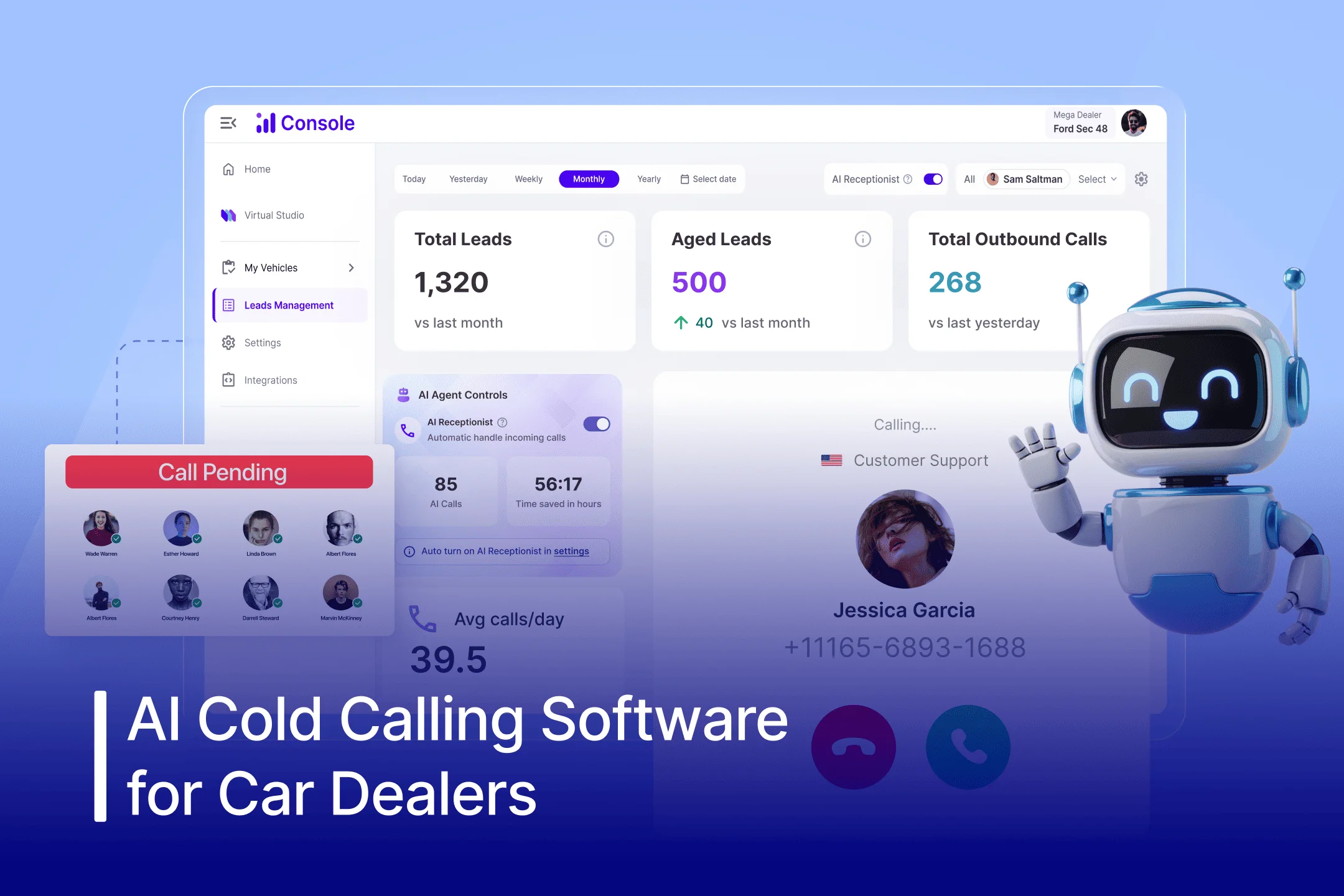

Cold calling in automotive retail has changed fundamentally. The traditional model, a BDC rep manually dialing through a lead list, leaving voicemails, and hoping for callbacks, is extinct. AI voice agents now call leads within seconds of submission, hold natural conversations, qualify buyers, and book test drives. All without a single human making a dial.
The gap is real. Dealers drop 30–40% of inbound calls. Another 43% of leads go untouched or receive only one contact with zero follow-up. For most dealerships, this isn’t a conversion problem, it’s a contact problem. The leads are in your database. They’re just never being reached.
AI cold calling software closes that gap: first contact within seconds, consistent follow-up across every lead, and outreach that scales without adding payroll. But choosing the right tool is harder than it should be. The market now includes automotive-specific AI agents, general-purpose autonomous platforms, and AI-powered power dialers that amplify human reps. Each solves a different problem.
In this blog, we’ll cover:
- The 8 best AI cold calling platforms for dealerships (and which to choose)
- Key features that separate production-grade tools from adequate ones
- Common implementation mistakes dealerships make (and how to avoid them)
What Are the Different Types of AI Cold Calling Tools for Dealers?
Before comparing tools, it’s important to distinguish between three fundamentally different approaches to AI-powered outbound calling.
Autonomous AI voice agents handle calls end-to-end without human involvement. The AI dials the lead, holds a natural conversation, answers questions using live inventory and CRM data, qualifies the buyer, books an appointment if appropriate, and logs the outcome. The human team only gets involved when a prospect is qualified and ready for a deeper conversation.
AI-assisted power dialers make human BDC reps more efficient. The AI handles the mechanical parts, dialing multiple numbers simultaneously, detecting voicemails, skipping dead lines, while the human handles the actual conversation. These tools multiply a rep’s call volume by 3–5x but still require a human for every live connection.
Conversational AI platforms with outbound capabilities sit somewhere in between. They’re primarily built for inbound engagement (answering calls, chat, and messages) but also handle outbound campaigns, following up on cold leads, sending recall notifications, confirming appointments, and re-engaging dormant CRM contacts. For most dealerships, this category delivers the broadest value because it addresses both inbound coverage and outbound outreach from a single platform.
The right choice depends on whether your primary need is high-volume outbound prospecting, making your existing BDC team faster, or building a full-coverage AI communication layer that handles both inbound and outbound.
Best AI Cold Calling Software for Car Dealers in 2026
1. Spyne (Vini AI)
Category: Full-stack automotive conversational AI with inbound + outbound voice capabilities.
Best for: Dealerships that want a single AI platform handling both inbound coverage and outbound cold calling/follow-up across sales, service, BDC, and parts.
Spyne’s Vini AI is purpose-built conversational AI for dealerships and handles both sides of the calling equation. On the outbound side, Vini runs large-scale calling campaigns with consistent quality, re-engaging cold leads, recovering no-shows, following up on dormant CRM opportunities, and proactively reaching out for recall campaigns, service reminders, and trade-in prompts. On the inbound side, it answers every call instantly, qualifies leads, books appointments, and routes high-value conversations to the right person with full context.
What makes Vini different from generic cold calling tools is automotive-specific intelligence. It understands dealership terminology, pulls live inventory data into conversations, provides accurate pricing and availability, and handles both sales and service workflows from the same platform. It connects directly to CRM, DMS, and IMS systems so every outbound call starts with context and every outcome is logged automatically.
Key outbound capabilities: High-volume outbound campaigns across voice, SMS, and email; cold lead re-engagement and no-show recovery; recall and service reminder outreach; automated scheduling and follow-ups with 20–35% higher show-up rates reported; smart lead filtering that passes only sales-ready prospects to reps; 3–5x higher outreach capacity vs. manual dialing; TCPA compliance built in.
Key differentiator: Vini isn’t just an outbound dialer, it’s an always-on communication layer. The same AI that cold calls your CRM leads also answers your inbound phone line at 10 PM, qualifies web chat leads, and books service appointments. For dealerships, this eliminates the need to stitch together separate tools for inbound, outbound, and scheduling.
Integrations: VinSolutions, DealerSocket, CDK, Salesforce, and other CRM/DMS platforms. Direct VDP and inventory integration.
Best-fit dealership profile: Mid-size to large dealer groups that want one AI platform for both inbound coverage and outbound outreach. Particularly strong for dealerships with large CRM databases of cold or dormant leads that aren’t being worked consistently.
2. STELLA Automotive AI (+ STELLA Catalyst)
Category: Automotive AI voice agent with outbound campaign capabilities
Best for: Dealerships that want AI-powered outbound voice and SMS campaigns that book directly into schedulers.
STELLA’s core product is an AI receptionist for inbound calls, but its Catalyst feature extends into outbound. STELLA Catalyst runs interactive voice and SMS outbound campaigns, contacting hundreds of customers in minutes for recall notifications, service reminders, and re-engagement. Dealers using STELLA for outbound campaigns report an average 36% callback rate on outbound calls.
STELLA’s approach is campaign-based rather than continuous: you define the audience, the message, and the goal, and Catalyst executes the outreach and books appointments directly into your scheduler.
Key outbound capabilities: Voice and SMS outbound campaigns at scale, direct appointment booking from campaign calls, service recall and retention outreach, 36% average callback rate reported.
Integrations: Major automotive scheduling and CRM systems.
Best-fit dealership profile: Franchise stores that run periodic outbound campaigns (recall blasts, seasonal service pushes, lease-end outreach) and need a proven automotive AI voice platform to execute them.
Consideration: STELLA’s outbound is campaign-oriented rather than continuous lead follow-up. For daily CRM cold calling workflows, a platform with always-on outbound engagement may be a better fit.
3. Mia
Category: AI phone agent with growing outbound capabilities.
Best for: Large dealer groups seeking an AI phone agent that handles both inbound coverage and outbound follow-up campaigns.
Mia is a dedicated AI phone agent focused on natural-sounding voice conversations. It handles inbound calls across sales and service departments and is expanding its outbound capabilities, proactively calling customers for recall campaigns, service reminders, and follow-ups. Mia claims to help dealerships capture an additional $50K+ in monthly revenue by eliminating missed calls and adding after-hours coverage.
Mia has raised $29M in funding and is used by some of the largest dealer groups in the country. Its emphasis is on voice quality and low latency, making the AI sound human rather than robotic.
Key outbound capabilities: Outbound recall and service campaigns, proactive follow-up on missed opportunities, multilingual support (auto-detects customer language), natural voice quality with low-latency responses.
Integrations: DMS and CRM integrations for appointment booking and lead logging.
Best-fit dealership profile: High-volume dealer groups where voice quality and natural-sounding AI are top priorities, and where outbound is primarily service retention and recall-focused rather than aggressive sales cold calling.
4. Matador AI
Category: Conversational AI for automotive (text/messaging-dominant with call AI)
Best for: Dealerships running outbound campaigns primarily through text/SMS with call AI as a supplement.
Matador connects calls, texts, emails, social messages, and website chats into one AI-managed system. Its Sales Autopilot automates outbound engagement, following up with leads, running lease-renewal campaigns, re-engaging unsold showroom visitors, and executing recall outreach. The Call AI feature handles voice conversations, but Matador’s real strength is text-based outbound engagement.
Matador’s pre-built automation library includes ready-made workflows for common dealership outbound scenarios: unsold showroom takeover, sales-to-service handoff, and lease expiration campaigns.
Key outbound capabilities: Text-first outbound campaigns at scale, pre-built automotive automation workflows, call AI for voice conversations, CRM integration (DealerSocket, VinSolutions, CDK, Reynolds), broadcast messaging to large audiences.
Best-fit dealership profile: Dealerships where SMS/text is the primary customer communication channel and where outbound campaigns are structured around specific events (lease expiration, recall, seasonal promotion) rather than continuous cold calling.
5. Podium (AI Employee / Jerry)
Category: AI BDC with outbound lead mining capabilities.
Best for: Dealerships that want an AI employee to proactively mine the CRM for outbound opportunities while also handling inbound.
Podium’s AI Employee (“Jerry”) doesn’t just wait for leads, it proactively follows up for lease expirations, trade-ins, and service appointments, mining the CRM for potential sales opportunities. Jerry handles outbound engagement across text, phone, and email, qualifying leads and booking appointments autonomously.
With a 4.6/5 rating on G2 and approximately 2,000 reviews, Podium has strong market validation. Jerry is trained on 10+ years of automotive dealership conversation data and adapts to match each dealership’s tone and workflows.
Key outbound capabilities: Proactive CRM mining for outbound opportunities (lease expirations, trade-ins, service), AI-driven follow-up across phone, text, and email, inventory-informed conversations, appointment booking into Xtime, customizable talk tracks.
Best-fit dealership profile: Dealerships already in the Podium ecosystem or looking for an AI BDC that combines strong inbound handling with proactive outbound lead mining.
6. Numa
Category: AI communication platform (primarily inbound, with outbound service marketing).
Best for: Service-dominant dealerships that want AI-powered outbound recall and service marketing campaigns.
Numa’s primary strength is inbound, its Smart Inbox and voice AI answer calls and manage conversations across the dealership. But Numa has expanded into outbound with its service marketing and recall engine, which uses AI to create outbound leads and convert them into booked appointments without human intervention.
Key outbound capabilities: AI-generated service marketing and recall outbound campaigns, cold message-to-appointment conversion, automated follow-ups via Smart Inbox.
Integrations: CDK, Reynolds, Tekion, Xtime.
Best-fit dealership profile: Service-heavy stores where the primary outbound use case is reactivating service customers, running recall campaigns, and filling service bays, rather than aggressive sales cold calling.
7. General-Purpose AI Calling Platforms (Bland AI, Synthflow, Air.ai)
Category: Autonomous AI voice platforms (not automotive-specific).
Best for: Tech-savvy dealerships or dealer groups with development resources that want to build highly customized outbound calling workflows.
These platforms aren’t built for automotive, they’re general-purpose AI voice engines that can be configured for any industry. Bland AI is developer-focused, allowing custom voice agent creation. Synthflow is more user-friendly with no-code agent building. Air.ai is suited for very high-volume enterprise campaigns.
The advantage is flexibility and potentially lower per-minute costs. The disadvantage is that none of them understand automotive terminology, inventory systems, or DMS/CRM integrations out of the box. You’ll need to build and maintain those integrations yourself, which requires technical resources most dealerships don’t have.
Best-fit dealership profile: Large enterprise dealer groups with in-house tech teams that want maximum customization control. Not recommended for single rooftops or mid-size groups without dedicated development resources.
8. AI-Assisted Power Dialers (Orum, Nooks)
Category: AI-enhanced tools for human BDC reps.
Best for: Dealerships with existing BDC teams that want to multiply call volume without replacing human callers.
Orum and Nooks aren’t autonomous callers, they’re power dialers that use AI to make human reps dramatically more productive. The AI dials multiple numbers simultaneously, detects voicemails and dead lines, and connects the rep only when a live human answers. This can multiply a rep’s effective call volume by 3–5x. Nooks adds a “virtual sales floor” for remote BDC team collaboration and coaching.
Key capabilities: Parallel dialing with AI-powered voicemail detection, live connect for human reps (eliminates dead time), team collaboration and coaching tools (Nooks), CRM integration for call logging.
Best-fit dealership profile: Dealerships that have invested in a BDC team and want to increase their output without adding headcount or replacing them with AI. Works well as a complement to (not replacement for) autonomous AI callers.
How Do AI Cold Calling Tools Compare for Automotive Use Cases?
| Capability | Spyne (Vini) | STELLA | Mia | Matador | Podium | Numa | Generic AI Callers | Power Dialers |
| Autonomous Outbound Calls | Yes | Campaign-based | Growing | Limited (text-first) | Yes | Limited | Yes | No (human required) |
| Inbound Call Handling | Yes | Yes | Yes | Yes | Yes | Yes | No | No |
| SMS/Text Outbound | Yes | Yes | Yes | Yes (primary) | Yes | Yes | Varies | No |
| Inventory-Aware Conversations | Yes | No | Yes | No | Yes | Limited | No | No |
| CRM/DMS Integration | Deep | Yes | Yes | Deep | Deep | Deep | DIY | Basic |
| Cold Lead Re-engagement | Yes | Campaign | Growing | Yes | Yes (CRM mining) | Limited | Yes | Manual |
| Recall/Service Campaigns | Yes | Yes | Yes | Yes | Yes | Yes | DIY | Manual |
| Appointment Booking | Yes | Yes | Yes | Yes | Yes | Yes | DIY | Manual |
| TCPA Compliance | Built-in | Built-in | Built-in | Built-in | Built-in | Built-in | Varies | Varies |
| Automotive-Specific | Yes | Yes | Yes | Yes | Yes | Yes | No | No |
| Works Without Dev Team | Yes | Yes | Yes | Yes | Yes | Yes | No | Yes |
Key Features to Look for in AI Cold Calling Software for Car Dealers
When evaluating AI cold calling platforms, not all features are created equal. A tool that works brilliantly for logistics might fail in automotive dealerships because it doesn’t understand your specific workflows, compliance requirements, or customer expectations. Here’s what separates production-grade automotive AI from adequate alternatives.
Automotive-Specific Training and Inventory Integration
Generic AI voice agents are trained on general business conversations. They fumble when customers ask, “What’s the best deal on a 2024 Honda CR-V?” or “Can you check if that silver sedan is still available?”. Purpose-built automotive AI is trained on thousands of real dealership conversations and connects directly to your inventory management system. It pulls live pricing, availability, and trim details into conversations in real time.
Full-Duplex Audio and Natural Conversation Flow
Half-duplex audio (where the AI waits for you to finish speaking before responding) creates an unnatural cadence that triggers immediate hang-ups. Full-duplex audio allows overlapping speech, natural interruptions, and real conversational rhythm. When evaluating demos, listen for latency, responses should come in under 500ms. If there’s noticeable delay between the customer speaking and the AI responding, the call experience will feel robotic and customers will disconnect.
Deep CRM and DMS Integration
An AI that calls but doesn’t update your CRM is just theater. It creates work instead of eliminating it. Look for platforms that read from your CRM before dialing (so context is available during the call), and write back detailed call outcomes, qualification flags, next-step recommendations, and appointment bookings automatically. Platforms that integrate with major DMS systems (VinSolutions, CDK, DealerSocket) also eliminate the need to maintain separate databases for inventory, customer history, and scheduling.
TCPA and Compliance Automation
Cold calling is a regulated activity. The tool you choose must handle Do Not Call list management, calling hour restrictions, consent verification, and opt-out processing automatically. If compliance is left to manual processes, you’re one missed DNC check away from a six-figure FTC fine. Purpose-built automotive platforms (Spyne, STELLA, Mia, Podium, Numa) have compliance built into the calling engine itself, they check DNC lists before dialing, log consent, and restrict calling to legal hours automatically.
Adaptive Objection Handling and Knowledge Retrieval
Not all objections are created equal. “I’m not interested” requires a different response than “What’s your best price on a trade-in?” The best AI cold calling platforms use trained automotive response frameworks, they understand dealership terminology, common objections, and how to redirect conversations toward qualification. They can also retrieve live data to answer questions accurately: inventory availability, current promotions, financing options, service specials.
Callback and Voicemail Handling
Not every call connects on the first try, and the best platforms handle voicemails intelligently. Can the AI leave a natural, non-robotic voicemail? Does it intelligently schedule callbacks for leads who don’t answer? Does it flag high-priority prospects for immediate human follow-up? Spyne’s Vini, for example, leaves contextual voicemails based on the lead source and dealership messaging, and can intelligently retry at optimal times. This multiplies outreach effectiveness without multiplying human effort.
Human Handoff and Warm Transfer Capabilities
The best AI cold calling isn’t AI-only calling, it’s AI that knows when to get a human involved. Can the platform detect when a prospect is qualified and ready for a deeper conversation, then route them to the right person with full context? Does it support warm transfers where the AI briefs the human before disconnecting? Can it schedule time with a specific salesperson rather than just booking a generic appointment? These handoff capabilities are what turn AI efficiency into actual closed deals.
What AI Cold Calling Can and Cannot Do? (Reality Check)
AI cold calling tools have matured significantly, but it’s important to set accurate expectations about where they excel and where humans still matter.
What AI does well: First-touch outreach at scale (calling leads within seconds of submission), consistent follow-up on cold and dormant CRM leads, routine qualification (budget, timeline, vehicle interest, trade-in status), appointment booking and confirmation, recall and service reminder campaigns, after-hours and weekend outreach, logging every interaction into the CRM with full context.
What still requires humans: High-ticket negotiations (pricing, trade-in valuation, financing terms), complex or emotional customer situations, building deep rapport with returning customers, handling objections that require creative problem-solving or authority to offer concessions. The best implementations use AI for the first touch and qualification, then hand off warm, qualified prospects to human closers with complete conversation context.
How to Choose the Right AI Cold Calling Software for Your Dealership?
Define your primary use case first. If your biggest problem is that CRM leads go untouched for hours or days, you need an autonomous AI caller that triggers outbound calls the moment leads arrive. If your BDC team is productive but capacity-limited, a power dialer might be sufficient. If you need both inbound coverage and outbound outreach, a full-stack conversational AI platform eliminates the need for multiple tools.
- Prioritize automotive-specific platforms: Generic AI calling platforms can make calls, but they can’t discuss your inventory, check appointment availability, or handle automotive-specific objections without significant custom development. Purpose-built automotive platforms (Spyne, STELLA, Mia, Matador, Podium, Numa) come pre-trained on dealership conversations and pre-integrated with automotive CRM/DMS systems.
- Evaluate voice quality carefully: AI cold calling only works if customers don’t immediately hang up. The best platforms use full-duplex audio (allowing natural interruptions), low-latency responses, and automotive-trained voice models. Request live demos with your actual call scenarios before committing.
- Check TCPA and compliance features: Cold calling is heavily regulated. Any AI calling tool you deploy must handle Do Not Call (DNC) list management, consent verification, calling hour restrictions, and opt-out processing. Purpose-built automotive platforms typically have these built in; generic platforms may leave compliance to you.
- Think about the full customer journey: The most effective dealerships don’t treat outbound cold calling as a standalone activity. They connect it to inbound coverage, appointment scheduling, service follow-up, and CRM data enrichment. Platforms that handle the full communication lifecycle (like Spyne’s Vini, Podium, or Matador) eliminate data silos and create a unified view of every customer interaction.
Common Mistakes Dealerships Make When Using AI Cold Calling Tools (And Ways to Avoid Them)
Even the best AI cold calling platform will underperform if it’s deployed without strategy. Here are the most common implementation mistakes we see, and how to sidestep them.
Mistake #1: Treating AI Cold Calling as a Replacement for Your Entire BDC
Use AI for high-volume first-touch outreach and qualification, then route warm prospects to human closers. Dealerships that frame AI as a force multiplier see 3–5x better results than those trying to go fully autonomous.
Mistake #2: Deploying AI Without Clear Lead Quality Standards
Define what ‘sales-ready’ means for your dealership before go-live: minimum lead age, lead source, budget threshold, vehicle type fit. Spyne’s Vini includes smart lead filtering that preserves calling capacity for high-probability opportunities.
Mistake #3: Ignoring Integration Setup and Data Quality
An AI cold caller disconnected from your CRM creates double work. Audit and clean your lead database before deployment, verify CRM, DMS, and scheduling integrations are complete, with no duplicate records or outdated phone numbers.
Mistake #4: Setting Unrealistic Expectations on Conversion Rates
Industry benchmarks: 10–20% of cold calls connect with a live person, 25–40% of those convert to appointments. AI’s strength is speed-to-lead and follow-up consistency, not conversion rate magic. Set benchmarks around appointments per 100 calls and show-up rates.
Mistake #5: Inconsistent Messaging and Talk Tracks
If your AI is saying something different than your sales team or ads, you’ll confuse prospects. Before deployment, align your team on messaging: vehicle positioning, pricing presentation, tone, and promotional angles. Use Spyne’s customizable talk tracks to ensure consistent brand voice.
Mistake #6: Not Monitoring Compliance Continuously
Compliance isn’t a one-time setup. Set up monthly audits with your AI provider to verify DNC checks, calling hour restrictions, opt-out processing, and consent records. Spyne’s dashboards flag potential issues before they become FTC fines.
Mistake #7: Abandoning AI Too Quickly When Results Don’t Spike Immediately
Real ROI emerges in weeks 3–4, not week one. Dealerships that commit to 30–60 days of continuous deployment typically see 20–35% improvement in appointment show rates and consistent outreach to previously untouched CRM leads.
Mistake #8: Failing to Brief Your Sales Team on AI Context
Ensure call transcripts and AI-captured details are visible in your CRM so your sales team knows when a prospect had a prior AI interaction. This prevents restarting qualification and losing credibility with the customer.
Mistake #9: Not Segmenting Campaigns by Use Case
Cold lead outreach, no-show recovery, and recall campaigns require different talk tracks, call timing, and success metrics. Spyne’s Vini supports campaign-level customization so you can optimize each workflow independently.
Mistake #10: Underestimating the Value of Always-On Inbound Coverage
Dealerships using full-stack solutions report that inbound call capture generates more appointments than outbound cold calling at higher conversion rates. Don’t reduce AI to just cold calling, use it as your always-on communication layer.

Final Take
AI cold calling has matured from an interesting experiment to operational necessity. The dealerships winning in 2026 aren’t the ones debating whether to use AI, they’re the ones who’ve solved how to use it effectively. They’ve chosen purpose-built automotive platforms that understand their inventory, integrate with their systems, and handle compliance automatically.
The gap between dealerships using AI cold calling strategically and those still relying on manual outreach has never been wider. The ROI is measurable: 3–5x more outreach capacity, 20–35% higher appointment show rates, and consistent contact with every cold and dormant lead in your database. Most importantly, you’re capturing customers in the moment they’re interested, often before a competitor even calls.
If you’re ready to transform how your dealership handles outbound prospecting and inbound customer engagement, Book a demo with Spyne to see how Vini AI can handle both sides of the conversation: the high-volume first touch and qualification, while your team focuses on closing.