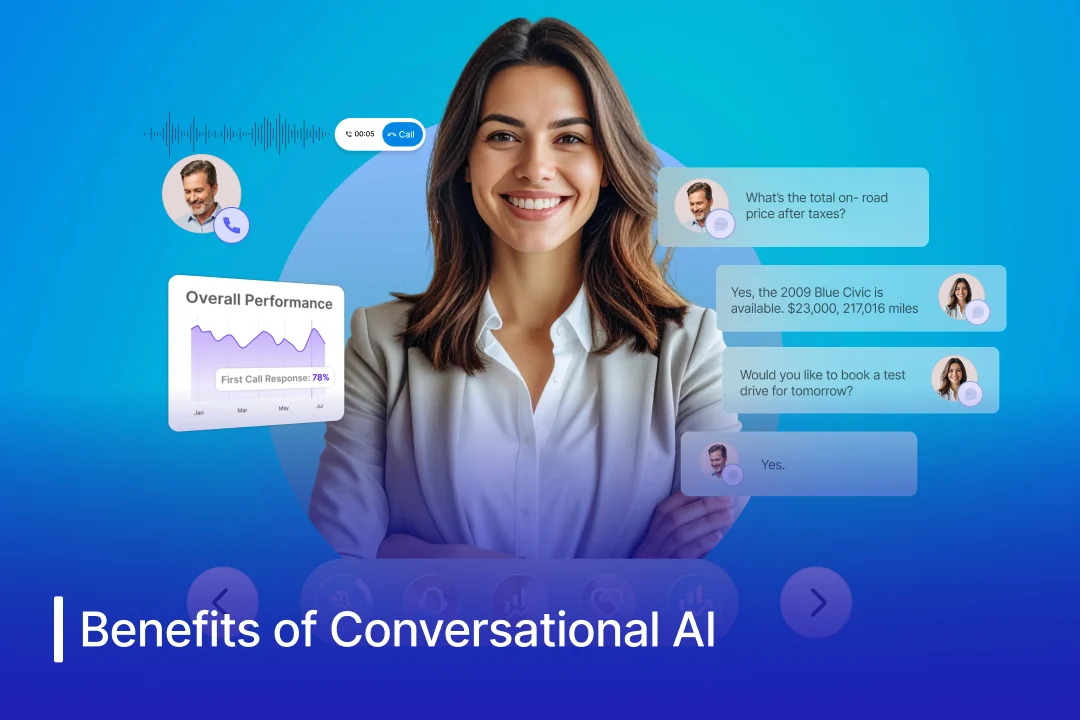

Customer expectations have changed, and the benefits of conversational AI are now impossible to ignore. Buyers expect instant responses, smooth conversations, and consistent support across calls, chat, and messaging, without delays or handoffs.
Beyond faster replies, conversational AI helps businesses improve efficiency, capture more revenue, and respond at scale. This guide breaks down how conversational AI benefits customers and how high-moving businesses like automotive retailers are using it to drive measurable ROI.
What is Conversational AI?
Conversational AI is a form of artificial intelligence that enables systems to understand, interpret, and respond to human language naturally across voice and text. It powers chatbots, virtual assistants, and AI call agents that handle real conversations instead of rigid scripts.
Unlike rule-based systems, conversational AI adapts to how people speak and improves with every interaction, making it ideal for customer service, sales, and support workflows.
Top Benefits of Conversational AI
Conversational AI benefits businesses and users through enhanced customer experience (24/7 support, personalization, instant answers), increased efficiency (automating tasks, freeing staff for complex issues, reducing costs), and scalability to handle high volumes of requests.
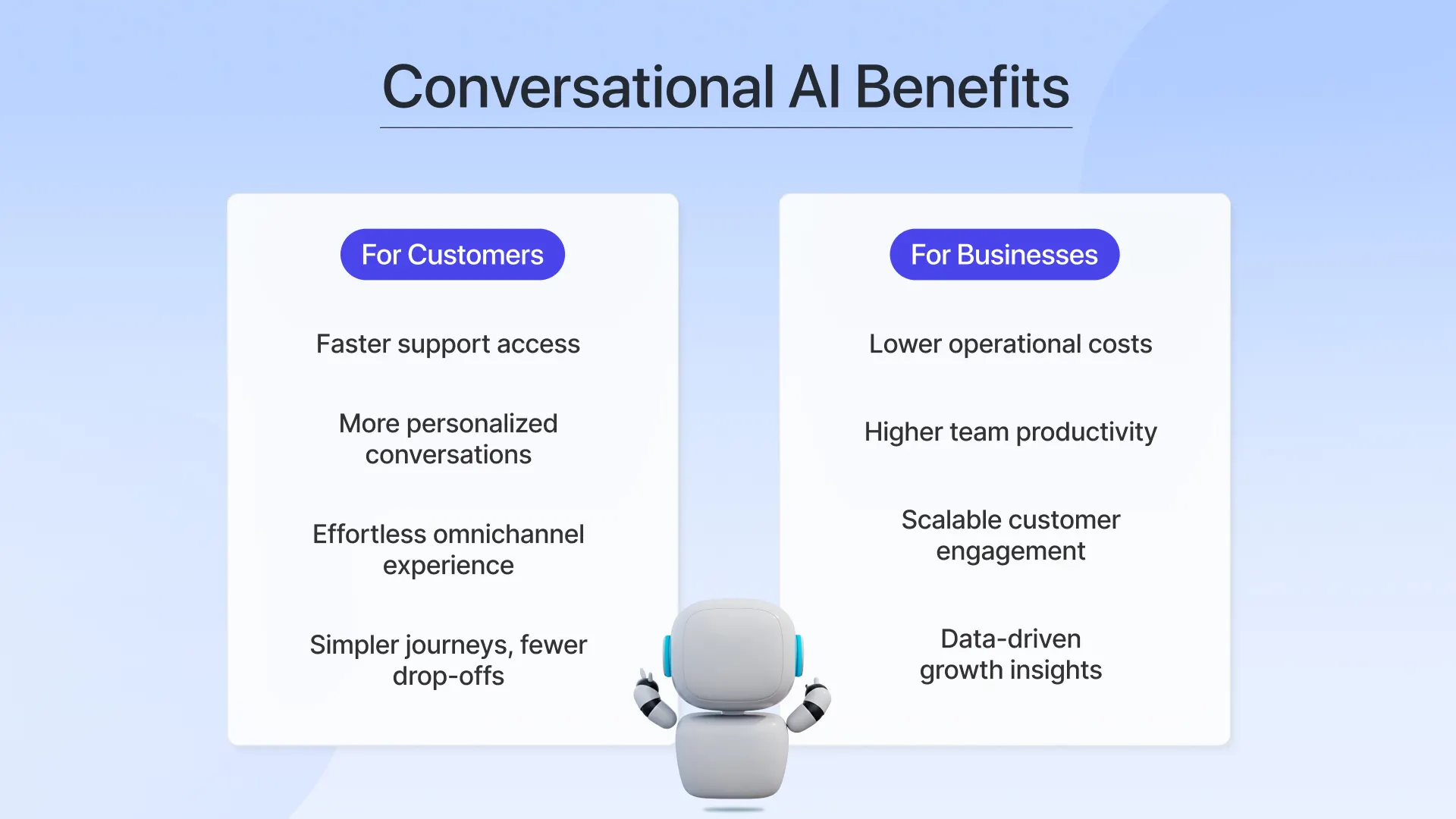
It improves accessibility, gathers valuable data for insights, drives sales through recommendations, and streamlines internal processes like HR and IT support. Let’s break down these benefits first from the customer perspective before looking at how businesses gain value.
Benefits of Conversational AI for Customers
At a customer level, conversational AI simplifies everyday interactions by making support faster, more personal, and easier to navigate across channels, one of the most visible benefits of Conversational AI for modern customers.
- Instant 24/7 support: One of the clearest benefits of conversational AI in customer service is availability. Conversational AI responds immediately, regardless of time zones, business hours, or incoming volume. This cuts down long wait times and ensures customers can get help when they actually need it, and not just when support teams are available.
- Personalized interactions: Among the most impactful conversational AI benefits, personalization stands out. Conversational AI understands intent and context, not just keywords. By factoring in past interactions, preferences, and behavior, it delivers responses that feel relevant and less repetitive.
- Improved omnichannel and multilingual accessibility: It’s another key benefit is flexible communication. Customers aren’t limited to a single channel, as conversational AI works across voice, chat, and messaging platforms while supporting multiple languages, reducing friction across touchpoints.
- Seamless guidance across complex processes: One of the practical benefits of Conversational AI for customers is simplified navigation. Whether booking an appointment, completing a purchase, or submitting a service request, conversational AI guides users through multi-step processes naturally, without confusion or manual effort.
Together, these customer-facing benefits highlight why conversational AI has become essential for businesses seeking measurable impact.
Benefits of Conversational AI for Businesses
Conversational AI helps businesses reduce costs, scale conversations, and improve efficiency while maintaining consistent customer experiences.
- Cost efficiency through automation: One of the biggest conversational AI business benefits is lower operational cost. By automating routine inquiries and repetitive tasks, businesses reduce dependency on large support teams without sacrificing service quality.
- Increased efficiency and team productivity: Conversational AI benefits human agents by freeing them from handling basic questions and allowing them to focus on complex, high-impact interactions. This improves overall productivity while enabling teams to deliver better outcomes.
- Scalable customer engagement: A major benefit of Conversational AI is its ability to scale effortlessly. Unlike human teams, conversational AI can handle thousands of conversations simultaneously, ensuring consistent engagement during peak demand, seasonal spikes, or after-hours support.
- Actionable data and customer insights: One of the strategic conversational AI business benefits is access to real-time insights. Every interaction generates valuable data that helps businesses analyze customer intent, identify trends, and refine sales and support strategies.
- Consistent and brand-safe communication: Conversational AI ensures uniform tone, accuracy, and professionalism across all interactions and channels. This consistency strengthens brand trust and eliminates variability that often occurs with manual processes.
- Streamlined internal operations: Beyond customer-facing use cases, another important benefit is operational efficiency. Conversational AI automates internal workflows such as onboarding, scheduling, and IT support, reducing administrative overhead and improving agility.
These capabilities provide a bridge to fast-moving businesses like automotive retail, where conversational AI addresses unique dealership challenges.

Benefits of Conversational AI for Automotive Businesses
Automotive retail operates under different conditions than most industries. Buyers expect immediate answers and often switch channels quickly, while dealerships juggle long buying cycles, complex inventory, and ongoing customer relationships.
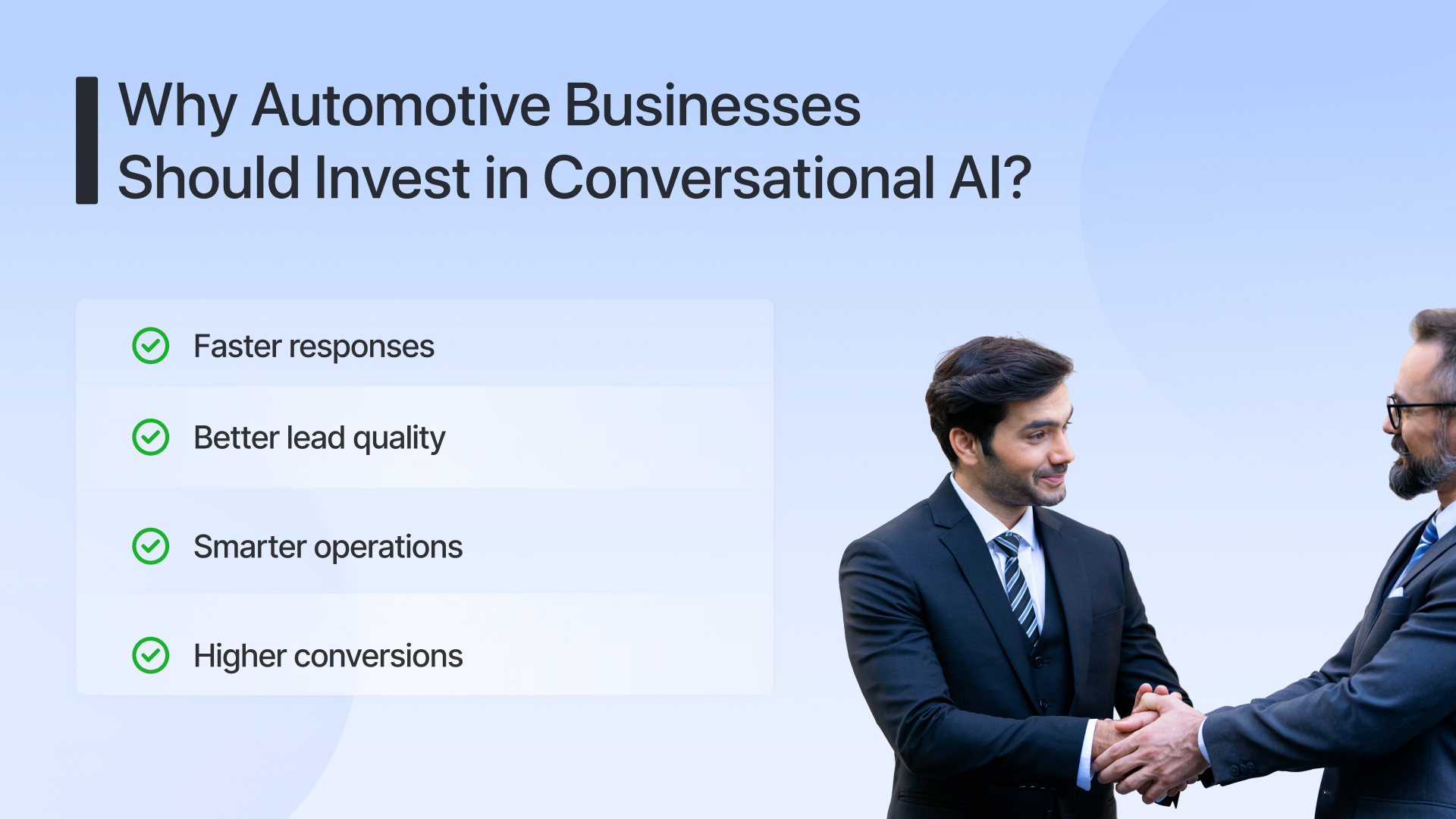
In this environment, conversational AI for automotive helps manage conversations at scale. Here is what conversational AI facilitates for automotive businesses:
- Enhanced Customer Experience: 24/7 responses to inventory, pricing, financing, and test drive inquiries through an always-on automotive answering service.
- Increased Sales and Lead Conversions: Real-time lead qualification and follow-ups powered by an AI call bot.
- Streamlined Dealership Operations: Automates routine calls and inquiries, reducing staff workload.
- Data-Driven Sales Insights: Analyzes conversations to optimize sales workflows.
- Better Inventory Management: Tracks interest in vehicles to plan smarter inventory.
- Post-Purchase Support & Retention: Manages service bookings, warranty questions, and maintenance reminders.
These automotive-specific benefits pave the way for providers like Spyne to bring these capabilities to life for dealerships through its end-to-end automotive sales solutions.
How Spyne’s Automotive Conversational AI Benefits Automotive Businesses?
Spyne’s conversational AI assistant, Vini, is a specifically-built AI for the automotive industry that supports dealerships, dealer groups, OEM networks, and service centers across sales and service workflows. These conversational AI benefits help automotive businesses respond faster, operate efficiently, and scale conversations without increasing headcount.
From first inquiry to post-sale engagement, Spyne delivers measurable conversational AI benefits across every customer touchpoint.
1. Instant Lead Capture and Smart Qualification
Vini engages website visitors and inbound calls the moment they arrive. It asks qualifying questions, captures lead details, and routes high-intent buyers to the right sales or service teams using an AI receptionist built for automotive businesses.
2. Always-On Virtual Automotive Showroom
Vini acts as a virtual showroom assistant, answering questions about vehicle features, availability, pricing, and comparisons. This keeps buyers engaged across new, used, and fleet inventory, even outside showroom hours.
3. Automated Test Drive and Service Scheduling
Vini books test drives, service visits, and inspections in real time across phone, chat, and messaging. This reduces drop-offs, eliminates manual follow-ups, and keeps customer journeys moving forward.
4. Faster, Frictionless Service Support
Vini handles common service queries, manages scheduling and rescheduling, sends reminders, and follows up after visits, keeping service operations efficient and customers informed at every step.
5. Unified Conversations Across Every Channel
Vini maintains context across phone, chat, SMS, and email so customers never repeat themselves. It integrates with automotive CRM and DMS systems, syncing conversations, lead data, and customer history in real time.
6. 24/7 Availability Without Added Headcount
Late-night inquiries, weekend calls, or after-hours service requests, Vini responds instantly in the customer’s preferred language, ensuring no opportunity is missed.
By connecting conversations across the entire automotive customer lifecycle, Spyne amplifies the benefits of conversational AI, helping automotive businesses convert more leads, streamline operations, and drive measurable growth.

Conclusion
The benefits of conversational AI go beyond automation, delivering faster responses, better engagement, and scalable customer service. From conversational AI customer service benefits to broader conversational AI business benefits like efficiency and consistency, it has become essential for modern customer interactions.
For car dealerships, the advantages of conversational AI are even more pronounced. High-intent buyers expect immediate answers across calls, chat, and messaging. Platforms like Spyne help dealerships meet that demand by ensuring every inquiry is handled, every lead is guided forward, and customer conversations translate into measurable sales outcomes.
Book a demo to see how Spyne’s Vini delivers the benefits of conversational AI for your car dealership.