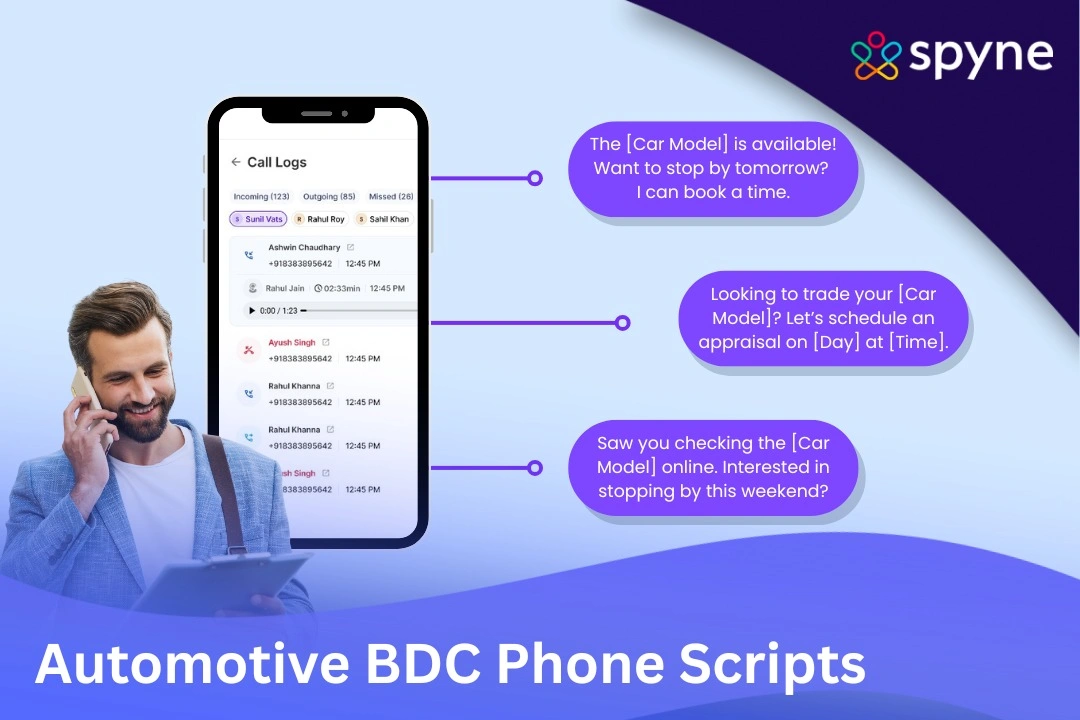

Automotive BDC phone scripts are that extra nudge your dealership’s team can use to talk clearly and confidently with customers. These scripts are built with the knowledge of your dealership and your customers, so they help you answer questions and book appointments easily. Not to mention, they really help in keeping customers satisfied, as they train your team along the way and tell them exactly what they should say. This blog talks about the importance of these scripts with BDC tips, lists the example templates you can use, covers the key benefits, and goes into detail about how automotive solutions like Spyne help keep your conversations professional.
What are Automotive BDC Phone Scripts?
Automotive BDC phone scripts are pre-written conversations that your Business Development Center (BDC) team can use while speaking with customers over the phone. These scripts help guide the conversation, so your team knows exactly what to say during a conversation and provides customers with the most honest and detailed information. Hence, successful BDC scripts are good for all conversations, whether they’re handling inquiries, setting appointments, or following up on leads. This structure keeps the message clear, professional, and consistent every time someone calls.
Using phone scripts also makes it easier to ask the right questions and collect important details about each customer, like what kind of car they’re looking for or their budget for their vehicle. Knowing this information makes sure your team can offer the right solution at the right time. So, if you are new to phone sales or need help managing a busy dealership, these scripts save time, improve communication, and help your team close more deals.

Top 10 Automotive BDC Phone Scripts for Successful Sales
Automotive BDC phone scripts help your team handle calls easily. They help in booking appointments, answering questions, and following up. They guide conversations with clear intros, customer needs, helpful information, and smooth closings. Here are ten BDC phone scripts you can use for your conversations.
1. Inbound Sales Inquiry
When a customer calls to ask about a car, your car sales cold call script should help answer them clearly, build trust, and guide them to visit your dealership.
You: Hi, thank you for calling [Dealership Name]. This is [Your Name]. How may I assist you today?
Prospect: Hi, I was just calling to check if the [Vehicle Model] is still available.
You: You’re just in time! It’s available, and it’s a great choice. Would you like to stop by and take a look? I can set up a time that works for you.
Prospect: Sure, I’m free tomorrow.
You: Perfect. I’ll schedule you for [Time] tomorrow. We’ll have the car ready for you. See you then!
2. Outbound Internet Lead Follow-Up
You can use this car dealership script when someone fills out a form or checks out a car on your website’s listings.
You: Hi [Prospect’s Name], this is [Your Name] from [Dealership Name]. I saw you looking at the [Vehicle Model] on our website. Just wanted to follow up and see if you had any questions.
Prospect: Yeah, I was looking, but I’m still deciding.
You: I understand. That’s smart. You should take your time. Meanwhile, I’d be happy to set up a quick visit so you can see it in person. Would that help?
Prospect: Maybe, yeah.
You: There’s no pressure. You can check it out whenever. Actually, how about you come by this weekend? That way you can take a closer look and see if it’s the right fit.
3. Missed Appointment Follow-Up
This is one of the best automotive BDC phone scripts you can use when you need to follow up with a customer who didn’t show up for their scheduled visit.
You: Hi [Prospect’s Name], this is [Your Name] from [Dealership Name]. I noticed you missed your appointment earlier, just checking in.
Prospect: Yeah, something came up.
You: That’s okay! Would you like to reschedule? I can find a time that works better for you.
Prospect: Yes, that would be good.
You: Great! How about tomorrow or the weekend?
4. Service Appointment Reminder
Reach out first and remind customers of their upcoming service to ensure they don’t miss or skip appointments.
You: Hi [Prospect’s Name], this is [Your Name] from [Dealership Service]. I’m just calling to remind you about your service appointment on [Day] at [Time]. Hope we’ll be seeing you!
Prospect: Thanks for the reminder!
You: Of course. If anything changes, feel free to call us. We’ll be ready for you.
5. Trade-In Offer Call
This can even be used as a virtual BDC automotive script, as it’s good for making the first move to encourage a visit from customers interested in trading their car.
You: Hi [Prospect’s Name], this is [Your Name] from [Dealership]. I saw that you’re looking to trade in your [Car Model]. Is that correct?
Prospect: Yes, I am.
You: We’d love to take a look and give you an offer that suits you. Can we schedule a time for a quick appraisal?
Prospect: Sure, when?
You: How about [Day] at [Time]? I’ll get you booked.
6. Calling a Referral
Sometimes, a customer or contact tells you someone might want a new car. When calling them you should not mention to them who gave you their name to respect privacy. This is how you should talk to them without naming your source:
You: Hello, [Prospect’s Name]?
Prospect: Yes.
You: I’m [Name] from [Dealership]. I recently worked with a [friend/neighbor/coworker] of yours who bought a [Vehicle Name]. Have you seen it?
Prospect: I don’t remember / Yes, it’s nice.
You: I heard you might want a similar vehicle. Since many of our customers come from referrals like yours, I wanted to learn about your needs. Are you looking for a car?
If yes, reply: “Great! Would you like to set up a meeting?”
7. Expressing Gratitude to the Referral
After calling the referral, thank the customer who gave you their contact and update them on the progress. This builds trust and may lead to more referrals.
You: Hi [Customer’s Name], this is [Name] from [Dealership]. Thanks for the contact you shared. We’ve talked, set an appointment, and will help them soon. If you know anyone else I can help, please let me know.
8. Calling an Existing Customer
Follow up with customers a few days after their purchase to show you care, not just to sell.
You: Hi [Customer’s Name], this is [Name] from [Dealership]. Thanks for buying your car from us. Do you have any questions about your warranty or insurance? I’ll also send a survey soon to hear how your experience was.
9. The Post Feedback Call
After customers fill out your survey, call to thank those who gave high scores or address concerns if the score was low.
You: Hi, this is [Name] from [Dealership]. Thanks for the perfect survey score! If you need anything, call me anytime.
Or, if the score was low:
You: Hi, I’m sorry to hear about your concerns. I want to help fix any issues and answer questions. When would you like to schedule your next service?
10. Car Sales Script to Ask for a Referral
Sometimes, you can call prospects directly and ask for referrals. Use this BDC call script to make sure the conversation goes smoothly, and you get all the necessary details.
You: Hi [Prospect’s Name], is now a good time? I’m [Name] from [Dealership]. If you or your family needs a car, I’d like to help. Can I ask, how many drivers are in your household? Who might buy next?
Top 6 Benefits of Automotive BDC Phone Scripts: Why They’re Essential for Your Conversations
Automotive BDC phone scripts help your team stay confident, clear, and on the same page during calls. These customer communication tools help in getting more leads, converting customers faster, and offering better help to your buyers. Tools like car dealership BDC scripts and BDC templates make calls faster, smoother, and more helpful for customers.
1. Every Customer Gets the Same Message
Phone scripts in automotive BDC keep conversations clear and consistent. Customers always get the same information, whether it’s coming from one agent or many. This is how great car dealership script examples should work.
2. Makes Calls Easier and More Confident
Car sales scripts give your team a set roadmap they can work with. This reduces stress and helps reps speak clearly, even when your employees may be nervous or unsure. Whereas, you can always hire AI employees with Spyne.
3. Saves Time and Gets to the Point
Good scripts map out the whole call; they basically set the path for it, so your team can qualify leads faster. You don’t waste your minutes and are able to book appointments faster, making every car sales pitch successful.
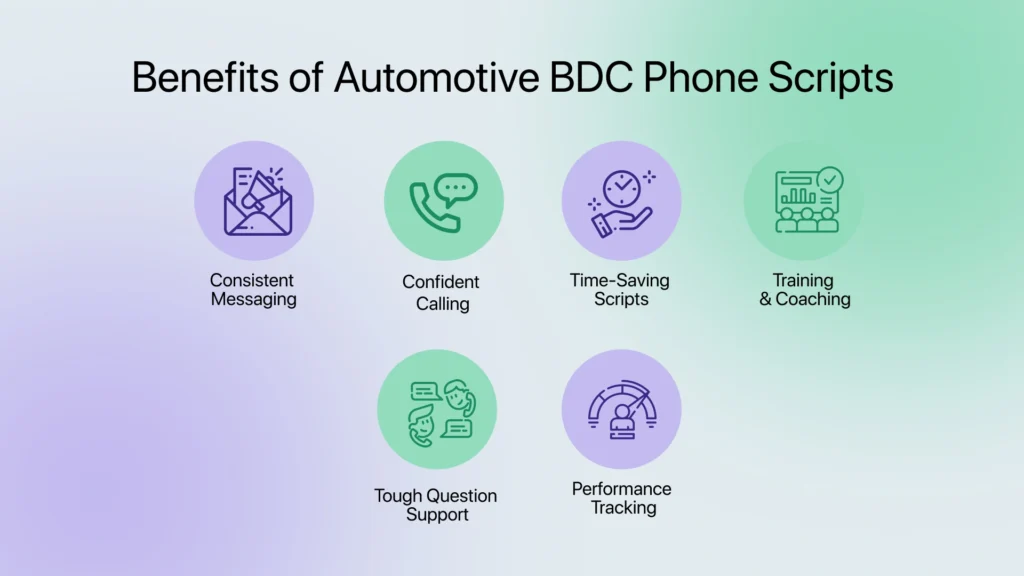
4. Great for Training and Coaching
BDC Scripts help new reps get started without any added stress. Your new employees can refer to existing scripts to train. Additionally, over time, they also help teams grow and improve with a steady BDC call script process.
5. Helps Handle Tough Questions
Your team is always well-prepared with automotive BDC phone scripts. Good cold calling scripts for car sales help your team be ready to answer objections and close the sale.
6. Tracks What’s Working and Where to Improve
Using the same car sales phone scripts lets you compare calls and find what works best. It’s also a great way to build better car sales pitch examples and improve your approach over time.
6 Key Components of Well-Written Automotive BDC Phone Scripts
Automotive BDC phone scripts are a support system for successful calls. They should engage the customer well, be concise, and give the customer all the information they need. These scripts can also act as automotive BDC email templates and help you build trust, set appointments, and close more deals.
1. Start with a Strong First Impression
Your automotive BDC scripts should help you begin each call with a warm greeting. You should always make your customers feel comfortable with your presence. Say your name, your dealership, and why you have called them. If you are offering a special deal or promotion, mention it early. Then, you can ask an open question like, “What kind of car are you looking for?”
2. Match Their Needs
Listen carefully to what your customers say. They want to feel heard and so you should listen well to them. Once you understand their needs, share simple, clear information about cars that fit. It’s best to focus on features that matter to them.
3. Handle Complexities the Right Way
Sometimes customers can be unsure about how much they’re willing to spend, timing, or options. You should not push or force any decision on them. Instead, note down their concern and offer easy solutions like financing or alternatives.
4. Make It Easy to Say Yes
Be clear on what’s next. Offer a test drive or follow-up, confirm details, and thank them for their time. Good car sales script examples always include a clear next step.
5. Make It Real, Not Robotic
Use their name. If you want to know how to answer the phone professionally, engaging your customer personally is the answer. Adjust your tone. Don’t just read from a script, talk, adapt, and make it your own. The best automotive BDC phone scripts feel natural, not rehearsed.
6. Practice, Track, Improve
Use a mix of your own or automotive BDC phone scripts for free download. Role-play often, learn what works, and keep improving as a team.
Top 8 Automotive BDC Phone Scripts Templates That Help in Car Sales
Automotive BDC phone scripts can help dealerships respond faster, confirm appointments, and follow up with customers more effectively. These ready-to-use templates are designed for your team to handle everyday dealership scenarios. You can even consider these as a helpful car sales cold call script. So, use these short and easy car sales script examples to become a professional at contacting your customers.
1. First Response: Confirming Inventory
This is a good example of a car sales email template to reply to a customer who clicks on a car listing online.
Subject Line: [STOCK NUMBER @ DEALERSHIP NAME] – [SALESPERSON NAME]
Dear [FIRSTNAME],
I’m emailing you to confirm that the car you clicked on, [STOCK#], is here at the dealership.
I have some availability today at [HOUR:15pm] and[ HOUR:45pm]. Are you okay with those times, or should we set something else?
If you come by within 72 hours, we’ll lower the price to [LOWERED PRICE].
My name is [NAME], and I’ve been with [DEALER NAME] for [YEARS]. Here’s my Yelp link so you can see my reviews.
Thanks again for your interest,
[SALESPERSON NAME].
2. Confirming an Appointment
This is one of the car dealership scripts that can be used to confirm the customer’s scheduled time and give directions.
Subject Line: Your Appointment at [DEALERSHIP NAME]
Dear [FIRSTNAME],
Thanks! Looking forward to our appointment for [TIME and DATE].
Our address is: [STREET ADDRESS] (Google Map link).
Here’s a photo of me so you know who to look for.
Let me know if you need to confirm or reschedule.
Thanks,
[SALESPERSON NAME].
3. Asking for a Yelp/Google Review
Send this to customers who gave you a perfect survey score.
Subject Line: Quick Favor, [FIRSTNAME]. A Review Would Be Great!
Hi FIRSTNAME,
Thanks again for your recent purchase!
If you use Yelp or Google Reviews, I’d really appreciate your support. It helps me grow my business:
[YELP LINK]
[GOOGLE LINK]
Thanks again!
4. Lease End: Payment Waived Offer
You can send this when a customer is close to the end of their lease term.
Subject Line: Skip Your Remaining Lease Payments
Dear [FIRSTNAME],
Because you have 4 payments left on your Audi, you may qualify to walk away from them and get into a new one today.
You could take advantage of our Summer Upgrade sales event now!
Let’s connect to go over the details; some conditions apply.
Best,
[SALESPERSON NAME].
5. Missed Appointment Follow-Up
Use this if a customer didn’t show up for a scheduled time.
Subject Line: Let’s Reschedule Our Appointment
[FIRSTNAME],
We missed you today and totally understand. Things happen.
I’m available tomorrow at 10:15 am and later in the afternoon. Let me know what works best.
Thanks,
[SALESPERSON NAME].
6. Cancelled Appointment Reconnect
If a customer cancels their appointment, this BDC appointment setting script helps get them back on the calendar.
Subject Line: No Worries – Let’s Pick a New Time
[FIRSTNAME],
That’s no problem!
I’m free tomorrow at 10:15 am and later in the day. Would either time work?
Let me know if there’s anything else I can help you with.
Thanks,
[SALESPERSON NAME].
7. Just Spoke: Send Contact Information
You can send this after a first phone conversation that didn’t lead to a booking. It can even be used as an AI phone call script if your team is too busy to send an email manually.
Subject Line: Had a Great Chat With You [FIRSTNAME]! Here’s My Info
[FIRSTNAME],
Just spoke to you on the phone! Here’s my contact info in case you want to follow up.
If you’d like to check out the car in person, reply or give me a call to set a time.
Thanks,
[SALESPERSON NAME].
8. One-Year Anniversary Check-In
Send this automatically one year after the customer’s purchase.
Subject Line: One Year Later – How’s the [MAKE]?
Hi [FIRSTNAME],
Hope you’re doing well! Just wanted to check in and see how you’re liking your [MAKE].
If you’re ever near the dealership, feel free to drop by and say hello.
Thanks,
[SALESPERSON NAME].
Why You Should Choose Spyne?
Top-performing dealerships trust Spyne because our automotive BDC phone scripts give their team everything they need to turn phone calls into closed deals. Spyne’s conversational AI tools are fast, simple to use, and powerful enough to grow your sales. Here’s why your dealership should choose our free automotive BDC phone scripts.
1. Built-In Scripts That Save You Time
Spyne’s automotive BDC comes with proven phone scripts for car sales. Your team doesn’t have to start from scratch, but they have the liberty to add to those scripts with their own improvisations during customer conversations. They’re designed for every step, whether it’s follow-ups, first calls, missed leads, or more.
2. Smart Lead Tracking That’s Personal at Every Stage
Our automotive lead response software helps your team see lead details during calls, making it easier to hold real conversations. With a live view of every customer your team is interacting with, even cold calling scripts for car sales sound warmer when reps know who they’re talking to.
3. Automated Follow-Ups That Close More Deals
If someone doesn’t answer, Spyne’s automated lead follow up system sends a follow-up email or text instantly. Your messages are sent out in bulk to a preset list of customers made using data from your CRM integrated with BDC. This keeps leads engaged and helps you close more without chasing them manually.
4. Real Conversations That Win Trust
Our automotive BDC phone scripts are designed to support natural, helpful talk. We believe that pressure calling doesn’t work and just turns buyers away from your dealerships. Hence, with us, your car sales pitch sounds friendly, not forced, just like the best car sales pitch examples.
5. Connects to Your Website and Internet Leads
Spyne’s auto dealer lead generation captures website leads and connects them directly to the right BDC call script. The inquiry could have come from anywhere, such as the internet or a trade-in form, but your team will still be able to respond quickly.
6. Built for Sales, Service, and Everything Between
You can use Spyne for sales calls, service updates, or reminders, and view all the call data in a single dashboard. It works for any automotive service follow-up call script, from test drives to thank-you calls.
7. Keeps Getting Smarter as You Use It
Our automotive answering service gives you smart analytics that help you see which car sales phone scripts are resonating with customers the most. You can identify your strong communication points and also see areas in which you may need to refine your strategy. Spyne helps you improve with data from every call and message.
8. Helps Your Team Speak with Confidence on Every Call
Spyne gives live suggestions during calls to help agents say the right thing at the right time. So, if they’re trying to get a customer to close a deal or handling a complex inquiry, they can answer confidently and know just what to do.
9. Reach Customers Anywhere, Not Just by Phone
Spyne.ai sends messages through SMS, WhatsApp, and email to follow up faster. No matter how leads prefer to chat, your successful BDC scripts can be consistent across every automotive chat channel and give all your customers honest and reliable information.

Conclusion
Using well-crafted automotive BDC phone scripts helps your team connect better with customers and turn calls into sales. They help you understand your customers and also work on your own communication skills, so it’s a win-win situation for everyone involved! This blog was about how important it is to implement these scripts, lists out some of the best examples to use in your conversations, and tells you how Spyne boosts your customer communication and helps you grow your business. So, book a demo today and start closing more deals!