
Executive SummaryA dealer CRM for lead scoring ranks every incoming prospect by buying intent, so sales teams call the shopper closest to purchase first instead of working leads in arrival order. Cox Automotive’s AI Readiness in Auto Retail Study (October 2025, 537 dealership leaders) found 81% of dealers believe AI is here to stay, yet only 15% have embedded it into daily workflows. Lead scoring is one of the fastest wins inside that gap, using signals like VDP visits, finance applications, and trade-in requests to separate hot leads from cold ones automatically. |
A rep with 40 open leads cannot tell which three are ready to buy today just by scrolling a list. Cox Automotive’s AI Readiness in Auto Retail Study found only 15% of dealerships have AI embedded into daily workflows, which means most sales floors are still guessing at priority instead of scoring it. A dealer CRM for lead scoring fixes that by ranking prospects on real buying signals, not gut feel or arrival order. Here is how scoring actually works inside a dealer CRM, how to build a model that fits your store, and where AI-powered scoring changes the picture.
What Is Lead Scoring in a Dealer CRM?
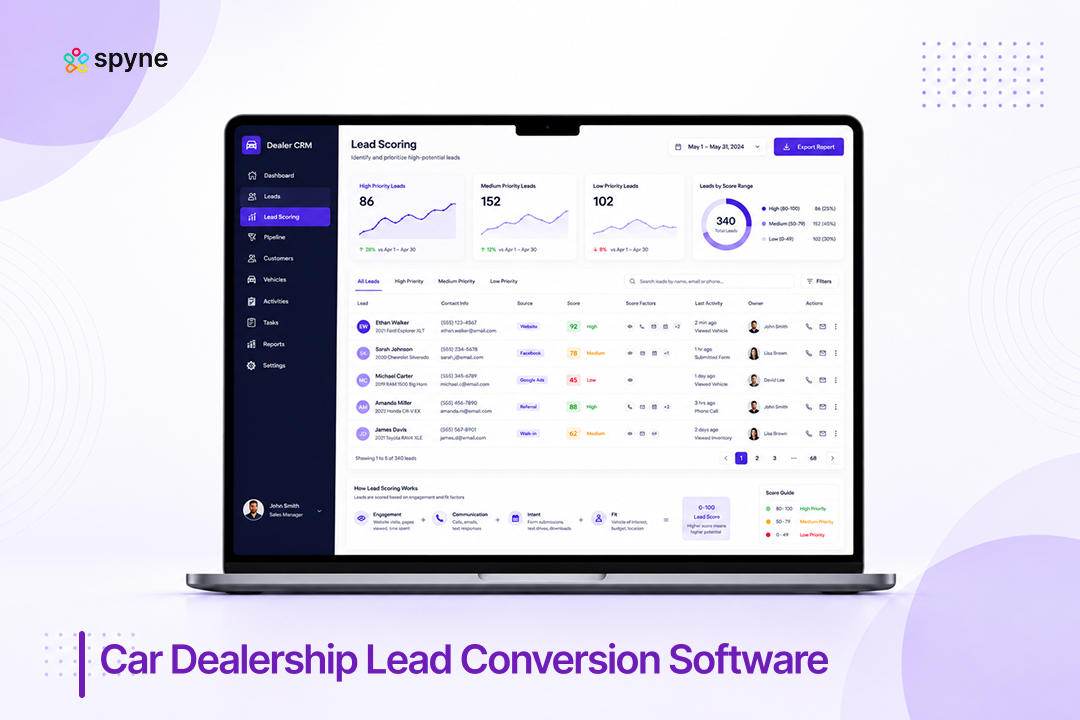
Lead scoring in a dealer CRM assigns a numeric score to every incoming prospect based on explicit data and behavioral signals, so the CRM can rank leads by how close they are to buying. Explicit data includes information the shopper provides directly. Budget range, preferred vehicle, trade-in status, and purchase timeline. Behavioral data includes what the shopper does: which vehicle detail pages they revisit, whether they start a finance application, whether they request a trade-in valuation, and how quickly they respond to outreach.
Most dealer CRM platforms group scored leads into simple tiers, commonly hot, warm, and cold, so reps know instantly where to spend time first. A shopper who visits one vehicle page once might score low. A shopper who returns three times in a week, starts a finance application, and requests a trade-in valuation scores much higher, because that combination of actions signals real purchase intent rather than casual browsing.
A complete dealer CRM for lead scoring model usually pulls from five categories of data. Behavioral signals like configuring a trim or revisiting a VDP multiple times; engagement recency, since automotive intent decays fast and a ten-minute-old test-drive request should outscore a three-week-old brochure download; trade-in and financing indicators, which raise intent sharply the moment they appear; source and channel quality, since a direct inventory search typically converts higher than a newsletter signup; and data validation, the basic filters that catch invalid phone numbers or out-of-territory shoppers before a scored lead reaches a rep’s queue.
The scoring itself happens continuously. Every new action, a return visit, an opened text, a missed call, updates the lead’s score in real time, so the ranking a manager sees on Monday reflects what actually happened over the weekend, not a snapshot from when the lead first came in.
How to Score Leads in Automotive CRM: A Step-by-Step Model
Building a working model for how to score leads in automotive CRM starts with your own closed-deal data, not a generic template borrowed from another industry.
Step 1: Pull the data that already exists
Your CRM, website analytics, and call tracking already hold the behavioral history for every past lead. Before assigning a single point value, export the actions that happened before your last 50 to 100 closed deals.
Step 2: Identify the actions that actually preceded a sale
Look for patterns: how many closed buyers visited a VDP three or more times, started a finance application, or requested a trade-in valuation before they came in. These are your real signals, not assumptions about what should matter.
Step 3: Assign point values by signal strength
A common starting structure. VDP revisit (5 to 10 points), finance application started (15 to 20 points), trade-in valuation requested (10 to 15 points), test drive booked (20 to 25 points), phone call completed (10 to 15 points), on-road price request (10 to 15 points), and a stated purchase timeline under 30 days (10 to 20 points). Weight whatever your own data shows as the strongest predictors more heavily.
Step 4: Set score thresholds
Decide the point range that triggers immediate outreach versus automated nurture. A four-tier breakdown many setups use: 90 to 100 as buy-now, routed straight to a BDC call; 70 to 89 as high intent, contacted the same day; 40 to 69 as nurture, handled by automated follow-up; and 0 to 39 as low intent, held for marketing rather than a rep’s queue.
Step 5: Test the model against real outcomes
Run the new scoring model alongside your existing process for 30 to 60 days. Compare which scoring tier actually converted, and adjust point values for signals that turned out weaker or stronger than expected.
Step 6: Rebuild the model as inventory and channels shift
A scoring model built around sedan buyers will misfire once your lot shifts toward trucks and SUVs. Revisit point values at least quarterly.

What to Look for in a Dealer CRM for Lead Scoring
Four capabilities separate a scoring model that changes rep behavior from one that just adds a number to a lead card. Automated routing that alerts a rep the moment a score crosses a threshold rather than waiting for a manager to check a report, dynamic re-scoring that updates the moment a lead reopens a text or returns to the website, DMS and inventory integration so the engine knows whether the vehicle a shopper viewed is still on the lot, and omnichannel tracking that reads calls, texts, WhatsApp, and showroom check-ins instead of website behavior alone.
Lead Scoring Strategies for Car Dealers by Funnel Stage
Lead scoring strategies for car dealers work best when the model changes what it measures at each funnel stage, rather than applying one static rule set to every lead regardless of where they are in the process.
- Top of funnel: early-stage shoppers comparing vehicles show interest, not urgency. Score browsing, reviews, and brochure downloads lightly, since scoring them too heavily inflates a lead’s rank before it has earned it.
- Middle of funnel: repeat visits to one VDP, a payment calculator, or an availability request show the shopper has moved from browsing to evaluating a specific vehicle, so score these more heavily.
- Bottom of funnel: a finance application, trade-in valuation, or test drive request should carry the highest point values, since these most directly precede a sale.
- Cross-channel weighting: a lead engaging across website, text, and phone within a short window should score higher than the same activity spread across a month. Recency and channel convergence signal urgency a single-channel view misses, and these strategies only work when applied consistently across every rep.
AI Lead Scoring for Dealer CRM: What Changes When AI Runs the Model
AI lead scoring for dealer CRM platforms replaces fixed point values with a model that learns from outcomes and adjusts its own weighting, rather than relying on a manager to guess which signals matter most.
Traditional rule-based scoring assigns the same point value to an action every time. A finance application always earns 20 points, whether it came from a shopper who closed within a week or one who never returned. AI-based scoring studies the full pattern behind past conversions instead, updating its weighting as new leads convert or go cold, and combining signals like vehicle segment, time of day, and channel together rather than scoring each in isolation.
This matters most for dealerships without the bandwidth to rebuild a scoring model every quarter. AI scoring adjusts continuously, catching shifts like a new model launch changing which VDP visits predict a sale, without someone manually rewriting the point system. It does not remove human judgment. A low AI score does not mean a lead is worthless, and a manager should still see why a lead scored the way it did, not just the number.
There is a more important distinction than AI versus rule-based scoring. AI lead scoring versus AI lead response. A CRM that only assigns a hot, warm, or cold label still leaves a rep to act on it manually. One that scores the lead, generates a reply, and offers to book the appointment before handing off to a salesperson is doing the harder half of the job. When evaluating AI lead scoring for dealer CRM platforms, ask whether the score triggers an action on its own or just sits waiting for a human to notice it.
Best Dealer CRM for Lead Scoring
The best dealer CRM for lead scoring depends on lead volume, whether the dealership runs one rooftop or several DMS platforms, and how much of the buying conversation happens outside a website form.
1. High-volume digital leads
Platforms built around predictive intent scoring, like LeadSquared Automotive, handle heavy paid-social and aggregator traffic well, routing hot leads before they cool off.
2. Purpose-built automotive AI scoring
An engine built specifically for vehicle retail scores VDP revisits, finance starts, and trade-in requests natively. Spyne Automotive CRM fits here, applying the same logic regardless of which DMS a rooftop runs.
3. Call- and text-heavy dealerships
Operations where most conversations happen over phone and messaging need scoring tied to call duration and reply frequency, not website analytics alone.
4. Large enterprise dealer groups
Networks running deep, customizable predictive models across massive inventories, like Salesforce Automotive Cloud, trade simplicity for scale.
5. Multi-rooftop groups on different DMS platforms
Groups that grew through acquisition and now run two or three DMS systems need scoring that is not rebuilt at every rooftop. Spyne’s DMS-agnostic scoring applies one standard across every store, independent of vAuto, Reynolds ERA, or CDK underneath it.
Best Automotive CRM With AI-Powered Lead Scoring
The best automotive CRM with AI-powered lead scoring depends on whether the scoring needs to tie into a specific ecosystem, like Cox Automotive or Reynolds and Reynolds, and on whether the platform stops at scoring or carries the lead through to a response.
VinSolutions is the platform most consistently named for AI-powered lead scoring, since its predictive scoring draws on behavioral and transactional data from across the Cox Automotive ecosystem, including Autotrader and Kelley Blue Book. That ecosystem depth is real, and it is also the trade-off. The scoring is strongest for dealers already committed to Cox properties, and thinner for anyone running a different DMS. The table below compares six automotive CRM platforms on lead scoring specifically.
| CRM | Lead Scoring Approach | Key Signals Used | Best For |
| Spyne Automotive CRM | AI-based scoring, native to the CRM, DMS-agnostic, scoring tied directly to automated follow-up | VDP revisits, finance application starts, trade-in requests, multi-channel engagement | Dealer groups running multiple DMS platforms, independent dealers wanting AI scoring without an ecosystem lock-in |
| VinSolutions CRM | Predictive scoring tied to Cox Automotive ecosystem data | Anonymous website browsing history matched via VinLens, showroom and appointment history, vehicle and price-range interest | Franchise dealers already inside the Cox Automotive ecosystem |
| DealerSocket CRM | Predictive scoring through Revenue Radar | Equity position, lease-end timing, engagement history | Dealer groups on the Solera DealerSuite stack |
| Elead CRM | Scoring tied to Reynolds ERA deal data and automated lead response | DMS activity, desk and deal record signals, response timelines | Dealers running Reynolds ERA as their DMS |
| DriveCentric | AI and automation-focused scoring with a simplified rep interface | Engagement strength, workflow activity, response patterns | Sales teams prioritizing adoption and a modern, low-friction interface |
| AutoRaptor | Rule-based scoring keyed to activity | Call and text frequency, response patterns, visual heatmap | Independent used-car dealers wanting a fast, simple setup |
Other AI and Enterprise CRM Options for Automotive Lead Scoring
Two other categories of platforms come up often enough to name directly. Cross-industry enterprise tools bring heavier predictive modeling without being built around vehicle buying behavior. Salesforce Automotive Cloud’s Einstein AI trains on a dealership’s own closed deals and scales well for large networks and OEM deployments, at a higher implementation cost than a purpose-built automotive CRM. HubSpot’s AI scoring layer suits marketing-heavy dealer groups already running HubSpot campaigns. LeadSquared Automotive is the platform most often named for high-volume digital lead scoring specifically. All three are general-purpose or semi-automotive tools adapted for dealerships, not platforms built natively around VDP behavior, trade-in valuation, and DMS-tied inventory data.
Dealerships relying heavily on WhatsApp and phone-based lead handling, in the US or elsewhere, evaluate a different set of tools. Groweon Automobile CRM markets itself as purpose-built for vehicle retail, ranking prospects alongside service and warranty lifecycle tracking, a positioning close to what Spyne offers DMS-agnostic dealer groups. TeleCRM and Funnel IQ focus on telecalling and WhatsApp-heavy lead handling, scoring call duration and reply frequency rather than website behavior alone. Confirm any platform scores omnichannel activity and not just website visits, since that gap is where most models understate real buying intent.
Dealer CRM Lead Scoring Tips to Increase Conversion
These dealer CRM lead scoring tips separate scoring models that actually change rep behavior from ones that get ignored after a month.
- Score behavior, not just source: A website lead who requested a trade-in valuation is a stronger signal than a phone lead who asked one pricing question. Score the action, not just where the lead originated.
- Build negative scoring into the model: Remove points when a lead provides an invalid phone number, repeatedly misses appointments, or unsubscribes, so dead leads do not sit at a misleadingly high score.
- Keep the score visible to reps, not just managers: A scoring model only changes behavior if the rep sees it ranked at the top of their queue, not buried in a monthly report.
- Pair scoring with a response-time standard: A high score means little if the lead sits untouched for six hours. Tie the setup to an alert that flags hot leads going untouched past a set window.
- Review score accuracy against real sales: A lead can look highly engaged and still not buy. Compare scoring tiers against actual closed deals monthly, not just click and visit counts.
Common Mistakes to Avoid With CRM Lead Scoring
Most mistakes that break a dealer CRM for lead scoring setup happen after launch, once the model stops matching how buyers actually behave.
- Copying a template from another industry: A generic B2B scoring model built for software trials does not translate to vehicle buying behavior. Trade-in requests, finance applications, and VDP visits need automotive-specific point values.
- Scoring weak signals too heavily: A single email open should never carry the same weight as a finance application. Overweighting weak signals inflates scores for leads that were never seriously engaged.
- Never revisiting the model after launch: Inventory mix, marketing channels, and buyer behavior shift throughout the year. A model built in January and left untouched will misfire by the fall selling season.
- Letting the score replace judgment: A low score is a prioritization signal, not a verdict. Reps should still be able to override a score when they have direct knowledge the model does not.
- Scoring without a plan for what happens next. A high score that does not trigger an alert, a call task, or a priority queue placement is just a number sitting on a lead record.
Spyne Automotive CRM: Dealer CRM for Lead Scoring Built for Dealership Workflows
Spyne Automotive CRM treats lead scoring as a native part of managing leads, not a feature bolted onto an existing system. For dealerships prioritizing which of dozens of active leads deserve a call first, Spyne’s dealer CRM for lead scoring works directly on the data the CRM already captures from calls, texts, chats, and web activity.
1. Real-Time Scoring From Every Channel
Spyne pulls lead activity from the website, chat, calls, texts, and marketplace leads into one record, then scores it continuously rather than on a delay. A rep opening a lead sees a current score reflecting everything up to that moment, including activity from earlier the same day.
2. DMS-Agnostic Scoring Across Rooftops
Because Spyne’s scoring is not tied to a specific DMS, dealer groups running different systems at different rooftops get one consistent scoring logic across every store. A GM comparing lead quality across three rooftops on three DMS platforms sees the same standard applied at each one.
3. Behavioral Signal Weighting Tuned to Automotive Buying
Spyne weighs automotive-specific actions, VDP revisits, finance starts, trade-in requests, test drive bookings, more heavily than generic engagement like email opens, keeping the score focused on signals that actually precede a sale rather than ones borrowed from unrelated industries.
4. Conversational Follow-Up Tied to Score Changes, Not Just a Ranked List
Spyne does not stop at ranking a lead. When a lead’s score crosses into a higher tier, Spyne triggers a specific follow-up sequence, including a conversational AI reply and an appointment offer, rather than leaving a rep to notice the score and act on it manually. A lead who just started a finance application receives a different next message than one who only revisited a vehicle page, because the scoring model recognizes those as different levels of intent and the response changes accordingly.
5. Multi-Channel Inbox Tied to the Same Score
Calls, texts, WhatsApp, email, and chat land in one inbox attached to the same lead record and score. A rep does not need to check four systems to see why a lead scored the way it did.
6. Manager Visibility Into Score Composition
Managers can see which specific actions contributed to a lead’s current score, not just the final number, making it possible to coach reps on which signals to watch and catch leads that scored high on weak signals needing reweighting.
7. Aging Alerts on High-Scoring Leads
A lead that reaches a high score but goes untouched past a set window triggers an alert to a manager, not just the assigned rep, closing the gap between a lead scoring correctly and a rep acting on it in time.
8. Reporting Tied to Closed Deals, Not Just Scores
Spyne’s reporting compares scoring tiers against actual closed deals, so a dealership can see whether its model is still predicting real sales or needs its point values adjusted, keeping the model tied to outcomes rather than assumptions set once at launch.

Conclusion
A dealer CRM for lead scoring only works if the model reflects how your own dealership’s buyers actually behave before they purchase, not a generic template pulled from another industry’s CRM. The dealer CRM lead scoring tips above matter less than the habit of revisiting them. Start with your closed-deal data, weight automotive-specific signals like finance applications and trade-in requests heavily, and revisit the model every quarter as inventory and channels shift.
Whether the platform is a Cox Automotive or Reynolds ecosystem tool, an enterprise system like Salesforce, or a DMS-agnostic option like Spyne, the same test applies: does the score just rank the lead, or does it trigger a response that reaches the buyer while they are still in-market? Whether that scoring runs on fixed rules or an AI model that adjusts itself, the goal stays the same: make sure the lead closest to buying gets the first call, not just the newest one.