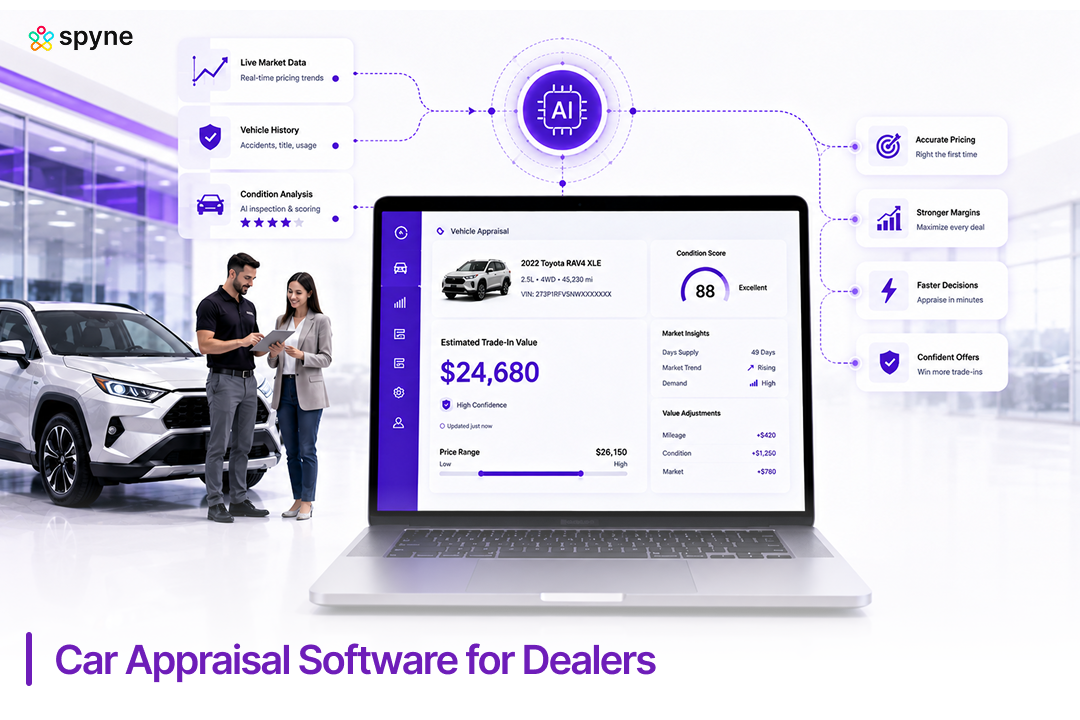

Executive SummaryCar appraisal software for dealers combines live market data, vehicle history, and AI condition scoring to generate an accurate trade-in or acquisition value in minutes rather than hours. Used-vehicle supply stayed tight at 49 days as of January 2026, and inventory priced under $15,000 sat at just 38 days’ supply, according to Cox Automotive (2026). Every underpriced trade-in or overpriced acquisition eats directly into that thin margin, which is why appraisal software now sits at the center of dealership acquisition strategy. |
A customer rolls onto your lot on a Friday afternoon with a trade-in, and your appraiser is stuck between three book values while the deal cools off. That guess costs money either way: underappraise and you lose the deal, overappraise and you eat the loss at resale. Cox Automotive (2026) puts used-vehicle supply at 49 days, with sub-$15,000 units running 11 days tighter than average, so every acquisition decision counts more. This guide covers what car appraisal software for dealers does, how to use it, and a best car appraisal software comparison worth reading first.
What Is Car Appraisal Software for Dealers?
Car appraisal software for dealers is a purpose-built tool that pulls live market data, sales comps, and vehicle history into one workflow, so a dealer can generate a defensible trade-in or acquisition value without relying on one book value. Unlike a static pricing guide, it updates as the local market moves, factors in condition and recon cost, and often plugs into the DMS, CRM, or car dealer inventory software a store already runs.
Most platforms combine three data layers: book and guide values (NADA, KBB, Black Book, MMR) for a baseline, live retail and wholesale comps from recent sales, and condition data captured through photos, VIN scans, or an AI-assisted inspection. The output is a number an appraiser or online shopper can trust, backed by data instead of instinct.
Features Dealers Typically Look for in Car Appraisal Software
The right car appraisal software for dealers should cover the full path from VIN to offer, not just a single book value lookup. Most dealers evaluating a purchase check for these capabilities:
- VIN barcode scanning and decoding to pull build data, options, and mileage without manual entry.
- AI-assisted condition reports with photo capture that flag damage, wear, or missing equipment automatically.
- Live market pricing and auction data, not just a monthly guide value.
- Reconditioning cost estimates built into the offer before it goes out, not added afterward.
- Trade-in offer generation that produces a branded, presentable number for the customer.
- CRM/DMS integration with platforms such as CDK, Reynolds & Reynolds, Dealertrack, or Tekion, so appraisal data does not have to be re-entered.
- Digital customer self-appraisals for shoppers who want to submit photos and vehicle details online before visiting the lot.
- Mobile apps for lot and service-drive walkarounds, so appraisers are not tied to a desktop.
- Inventory acquisition pipeline management that tracks a vehicle from offer to reconditioning to listing.
A tool missing more than one or two of these usually turns into a partial solution that still requires a second system to fill the gaps.
Why Appraisal Accuracy Is the Real Profit Lever Right Now
Getting the trade-in number right matters more when inventory is scarce, and margins are thin. Cox Automotive (2026) reported used-vehicle days’ supply at 49 as of early January, over 10 days tighter than 2019, and Cox Automotive’s independent-dealer research recommends a cost-to-market ratio of 80 to 85 percent to protect gross. Miss that window on one acquisition, and the vehicle either sits past its ideal 30-day window or sells at a discount just to move it.
Three consequences show up fast when accuracy slips: lost deals, when a lowball offer sends the customer to a competitor; margin leakage, when an inflated offer leaves the car underwater before reconditioning starts; and aging inventory, since mispriced units sit longer and add carrying cost every extra day. Car appraisal software for dealers closes that gap between gut feel and market reality, on every unit, not just the ones an experienced appraiser eyeballs correctly.

How to Use Car Appraisal Software: A Step-by-Step Workflow
Knowing how to use car appraisal software well is the difference between a tool that saves time and one that adds another screen to check. Dealerships that get consistent results follow the same core workflow:
- Scan or enter the VIN. This pulls build data, options, and mileage automatically and cuts entry errors.
- Capture condition. Photos or a guided inspection flag dents, wear, and issues before a number is generated.
- Pull live market data. The software blends book values with real local comps, not national averages.
- Review the recon estimate. A realistic cost gets subtracted before the offer is finalized, protecting margin.
- Generate the offer. A branded appraisal sheet gives the customer a transparent, data-backed number.
- Route the decision. Approved trades move into inventory; declined ones get logged so the team can spot patterns.
Dealerships that see the biggest gains treat this as a workflow, not a one-off lookup.
Best Car Appraisal Software for Dealerships: How the Top Tools Compare
A best car appraisal software comparison for dealerships usually comes down to a short list of purpose-built platforms, each with a different strength. The table below lines up the tools dealers compare most often.
| Software | Best For | Key Features |
| Spyne Inventory Management | Appraisal-to-listing acquisition workflow for connected dealer groups | Multi-source live valuation, AI condition capture, VIN-level acquisition scoring, recon-aware price floors, automatic syndication after acquisition |
| AccuTrade (Cars Commerce) | Service-drive and online acquisition at scale | OBD-II diagnostic scanning, live market data, Cars.com and Dealer Inspire integration |
| vAuto Provision / Stockwave (Cox Automotive) | Franchise and large-volume inventory pricing | Local supply-and-demand market calibration, retail/wholesale/auction guidance, ProfitTime GPS scoring |
| KBB Trade-In Advisor / Instant Cash Offer | Consumer-facing trade-in trust and lead generation | Recognized consumer brand, website and showroom offer capture, Cox Automotive DMS integration |
| Black Book | Wholesale valuation and residual forecasting | Daily wholesale market updates, physical and digital auction data feeds, API integration for CRM/DMS |
| Carbly | Fast mobile appraisals for independent dealers | 10-plus data source aggregation (Black Book, J.D. Power, CARFAX), mobile-first VIN scanning |
| ACV Max ClearCar | Consumer self-appraisal acquisition funnels | AI photo-based condition capture, website and service-lane offer widgets, rooftop-specific pricing |
| Dealerslink FastBook | Combined appraisal and market research | Multi-book valuations, competition view, auction run lists |
Pricing for most of these platforms is not published; vendors route serious buyers to a sales call to scope cost per rooftop, so confirm what is actually included before comparing. Beyond this list, dealers also evaluate TradePending and CarOffer for website trade-in capture and wholesale sourcing, Laser Appraiser and EvalExpert for fast mobile VIN-to-offer appraisals, and Carketa for reconditioning-linked inspection workflows. Each fits a narrower use case than the platforms in the table above.
Recommendations by Dealer Type
- Large franchise dealerships: vAuto Provision or Stockwave for inventory-wide pricing, often paired with KBB for consumer-facing trade-ins.
- Independent used-car dealerships: Carbly or Dealerslink FastBook for fast, affordable appraisals without enterprise-level pricing.
- High-volume trade-in acquisition: AccuTrade for service-driven and online sourcing at scale.
- Multi-location dealer groups: A connected platform such as Spyne Inventory Management, so appraisal data feeds straight into group-wide pricing and merchandising instead of staying siloed per store.
Best Appraisal Software That Helps Dealers Price Vehicles Accurately
The best appraisal software that helps dealers price vehicles accurately shares three traits: it blends multiple data sources instead of one book value, it adjusts for real condition, and it accounts for recon cost before the offer goes out. Skipping any of these tends to mean overpaying on rough units or underpaying on clean ones.
Use this framework when evaluating pricing accuracy claims:
- Data breadth: Does it combine guide values, live comps, and auction data, or rely on one source?
- Condition weighting: Does it adjust pricing from actual photos or inspection data, not a generic dropdown?
- Recon transparency: Is a realistic estimate subtracted before the final offer, or added after the fact?
- Local sensitivity: Does pricing reflect your market and days’ supply, the same local-calibration approach vAuto’s Provision tool is built around, or a flat national average?
Scoring a tool against these four criteria beats trusting any single accuracy claim on a vendor’s homepage.
Car Appraisal Software Tips for Getting More Out of Every Appraisal
These car appraisal software tips come from how top-performing used car departments run acquisitions day to day.
- Standardize inspection steps. Every appraiser captures the same photos and data points, so numbers stay consistent across shifts.
- Recheck stale valuations. A number pulled three days ago on a fast-moving segment may be off, so refresh before finalizing a deal.
- Track win rate by appraiser. Comparing accepted-offer rates across appraisers surfaces coaching opportunities fast.
- Feed recon actuals back in. If estimates keep running low, adjust the assumptions instead of absorbing the surprise.
- Use the service drive. Appraisal software that captures leads from service customers taps inventory competitors never see.
Dealers who treat these car appraisal software tips as standard practice see the fastest gains in acquisition margin.
Car Appraisal Software Strategies for Multi-Location Dealer Groups
Car appraisal software strategies look different once a dealer group runs more than one rooftop, since a single-store playbook does not scale across markets with different demand.
- Centralize the data, localize the offer. Pull from one shared market feed, but let each store’s pricing reflect its own local days’ supply.
- Set group-wide cost-to-market guardrails. A shared acquisition ceiling, near the 80 to 85 percent range, keeps every store disciplined without micromanaging deals.
- Route hot units across stores. If one location is overstocked on a segment another needs, appraisal data should flag the transfer before the vehicle gets wholesaled.
- Standardize appraiser training. Consistent inspection steps make performance data comparable store to store.
These car appraisal software strategies work because they treat appraisal data as a shared group asset, not a tool each manager runs alone.
Common Mistakes Dealers Make With Car Appraisal Software
The most common mistake is treating car appraisal software as a replacement for judgment rather than a data input for it. Recurring patterns: relying on one book value instead of live local comps, skipping condition capture when the lot gets busy, ignoring recon cost until after the deal is written, never auditing accepted versus declined offers, and letting every appraiser follow a different process.
Fixing these costs nothing beyond a process change, and it is often the fastest way to improve margin.
Spyne Inventory Management: Car Appraisal Software for Dealers
Spyne Inventory Management gives dealerships an appraisal-to-listing workflow instead of a standalone valuation tool. Because appraisal, reconditioning, pricing, and syndication run inside one system, a vehicle’s appraised value stays connected to how it gets priced and merchandised the moment it enters inventory, closing the gap between what a dealer offers on a trade-in and what that unit is worth once it reaches the lot.
1. Multi-Source Live Market Valuation
Spyne Inventory Management pulls live retail and wholesale comps alongside guide values, so an appraiser is never working off a single stale number. A used car manager pricing a three-year-old crossover can check local comps next to book value before finalizing an offer, instead of defending a number from one source.
2. AI-Assisted Condition Capture
Photos and video captured during appraisal feed directly into an AI-assisted condition assessment that flags visible damage or wear. A trade-in with hail damage or worn upholstery gets priced with that condition already factored in, rather than adjusted manually afterward.
3. VIN-Level Acquisition Scoring
Every VIN gets scored against current inventory needs and local demand before an offer goes out. This helps a used car manager avoid buying a fourth silver sedan when the lot already has three sitting past 30 days.
4. Reconditioning-Aware Price Floors
Recon cost estimates get built into the acquisition number instead of discovered after the deal closes. A trade-in needing new tires and a paint touch-up shows a price floor that already accounts for that cost, protecting gross before it reaches the shop.
5. Inventory Health Monitoring After Acquisition
Once a vehicle is acquired, Spyne Inventory Management tracks its age, pricing position, and reconditioning status against benchmarks. A unit approaching 30 days on the lot surfaces automatically, so pricing action happens before it becomes aged inventory.
6. Fast Syndication and Listing Publication
As soon as an acquired vehicle clears reconditioning, its appraisal and condition data carry into the listing, so photos, pricing, and history sync to the website and syndication partners without re-entering data.
7. Segment-Level Acquisition Insights
Dealership groups can see which vehicle segments turn fastest and which age, informing which trade-ins to prioritize next. A store seeing three-row SUVs turn in 18 days versus 45 for sedans can weigh upcoming appraisals accordingly.

Conclusion
Car appraisal software for dealers has moved from a nice-to-have to a core acquisition tool because the margin for error on every trade-in has gotten thinner. With used-vehicle supply still constrained, per Cox Automotive (2026), dealers who blend live market data, condition capture, and recon cost into every appraisal consistently outprice competitors relying on one book value. Whether the goal is faster appraisals, fewer mispriced trade-ins, or a tighter process across rooftops, the right car appraisal software for dealers pays for itself in avoided margin loss alone.