
| Executive Summary: The best AI for car dealership service departments in 2026 depends on the workflow being automated. Vini AI, Impel, Toma, Numa, STELLA Automotive AI, myKaarma, and Tekion cover different combinations of inbound calls, service scheduling, outbound retention, customer communication, and service-lane operations. This matters as dealerships fight for service retention: Cox Automotive reports dealer service-and-parts revenue averages $9.23 million, yet dealerships capture only 29% of service visits. Dealers should compare AI platforms by completed appointments, DMS and scheduler connectivity, inbound and outbound coverage, human escalation, and measurable service outcomes rather than conversational quality alone. |
Service AI is becoming an operational decision for U.S. dealerships, not simply another customer-service tool. Cox Automotive’s 2026 Fixed Ops and Ownership Study found that 80% of new-vehicle buyers want to service at the selling dealership, yet only 30% have their first appointment scheduled. The opportunity exists, but dealerships still have to convert customer intent into completed service visits.
This guide compares seven automotive AI platforms across service calls, scheduling, retention, outbound engagement, DMS-connected workflows, and service-lane operations. It also explains which capabilities matter when choosing AI for your dealership service department.
Why Are Dealerships Using AI in Service Departments?
Dealerships are using AI in service departments to handle routine customer communication, capture more appointment opportunities, and reduce repetitive work for advisors. The strongest use cases are scheduling, inbound calls, reminders, recalls, declined-service follow-up, and customer re-engagement.
The opportunity is significant. Cox Automotive’s 2026 Fixed Ops and Ownership Study found that 80% of new-vehicle buyers want to service at the selling dealership, but only 30% have their first service appointment scheduled. It also found dealerships capture only 29% of consumer service visits, leaving substantial retention opportunity after the vehicle sale.
AI can help close that execution gap by making service communication more consistent and available beyond advisor capacity. A dealership dealing primarily with unanswered calls, for example, can use an AI receptionist for car dealerships for routine conversations and appointment requests, while outbound AI can support recalls, declined work, reminders, and customer win-back.
Best AI for Car Dealership Service Departments Compared
The best dealership service AI platforms solve different problems. Some primarily automate customer conversations and appointment booking. Others specialize in retention outreach or embed AI directly into scheduling, technician, advisor, and repair-order workflows.
| Platform | Best for | Core service strength |
| Vini AI by Spyne | Inbound + outbound service conversations | Calls, appointments, follow-up and re-engagement |
| Impel Service AI | Service retention | Proactive outreach and customer win-back |
| Toma | Inbound service automation | Calls and appointment scheduling |
| Numa | Scheduling and communication | DMS-connected scheduling |
| STELLA Automotive AI | Voice service automation | Inbound booking + outbound campaigns |
| myKaarma | Fixed-ops workflows | Service calls, scheduling and pre-diagnosis |
| Tekion Service AI | AI-native service operations | Scheduling, advisors and technicians |
Dealers should verify each platform against their actual DMS, scheduler, telephony environment, OEM requirements, and rooftop workflows before buying.
1. Vini AI by Spyne
Best for: Dealerships looking to automate inbound and outbound service conversations from one automotive AI platform.
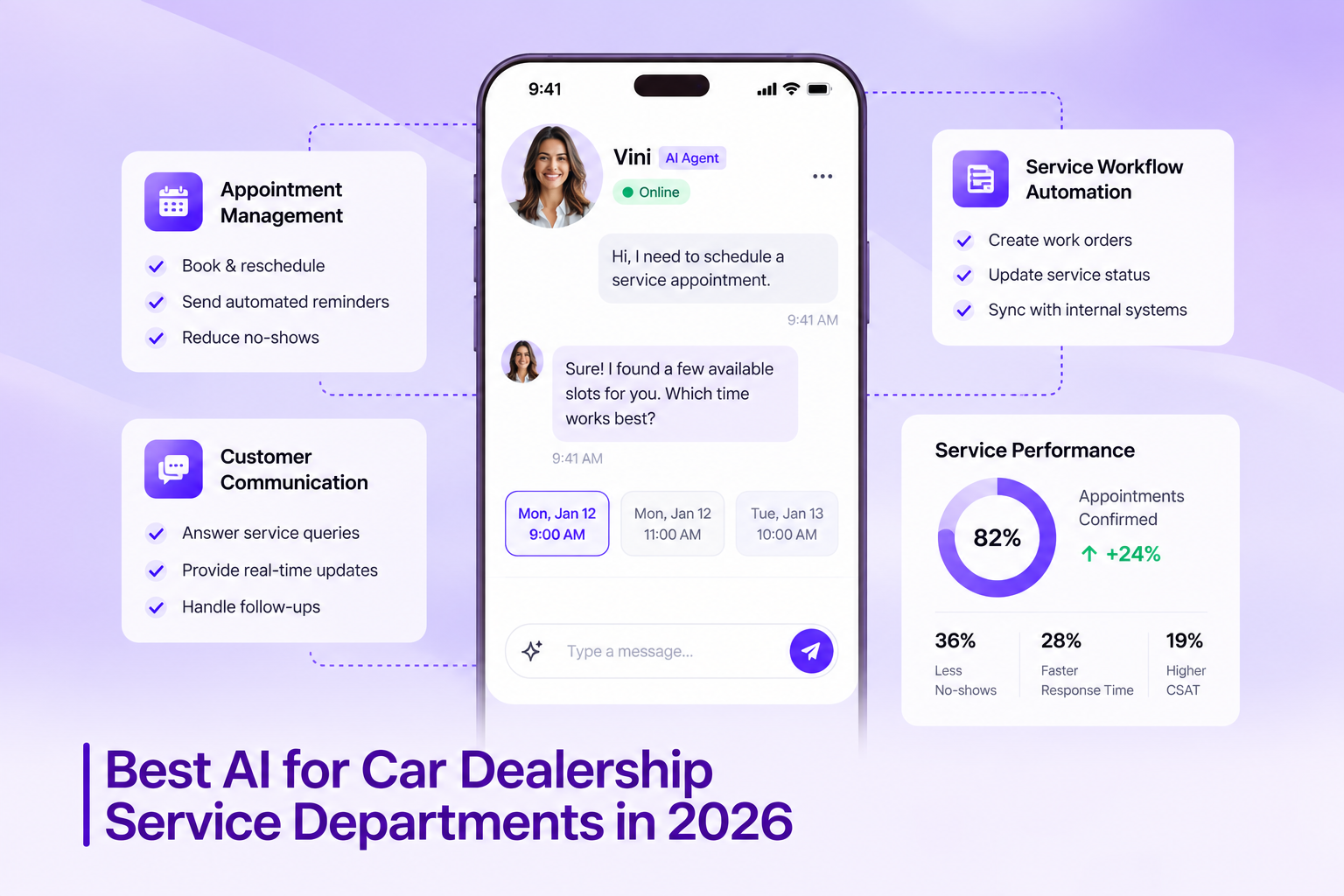
Vini AI is Spyne’s conversational AI platform for automotive dealerships. It handles customer conversations across service, sales, and BDC workflows while supporting appointment handling, customer follow-up, re-engagement, and contextual human handoffs.
Key service capabilities
- 24/7 inbound call coverage
- Service appointment conversations
- Outbound service engagement
- Recall and follow-up workflows
- After-hours and overflow coverage
- Context-aware routing and escalation
- Multilingual conversations
- Voice and digital engagement
The AI platform for car dealerships achieves a 99.9% connection rate, helping service teams turn customer conversations, reminders, and follow-ups into confirmed service appointments.
Vini is particularly relevant when the dealership’s problem extends beyond answering calls. Service teams can use the same conversational layer for proactive outreach, appointment handling, and follow-up rather than adding separate systems for each workflow.
Consider Vini AI if: You need AI to work across inbound and outbound service communication while preserving context when customers move between AI and dealership employees.
2. Xtime Brooke.ai
Best for: Dealership service departments already using Xtime Schedule and looking to automate inbound service calls and appointment booking.
Brooke.ai is Xtime’s digital voice assistant built specifically for dealership service departments. It answers inbound service calls around the clock and connects directly with Xtime Schedule, allowing appointments created by the assistant to flow into the dealership’s existing scheduling and reporting environment.
Key service capabilities
- 24/7 inbound service call handling
- Automated service appointment scheduling
- Integration with Xtime Schedule
- Access to shop capacity and pricing
- Appointment records connected with reporting and the DMS
- Consistent handling based on dealership processes
The direct scheduling connection is the main reason Brooke.ai belongs in this comparison. Xtime says appointments created by the assistant are identified within Xtime Schedule and cascade into dealership reporting and DMS workflows.
It also sits within Xtime’s broader service platform, which combines scheduling, capacity management, customer communication, service retention, declined-service marketing, and service-lane analytics.
Consider Xtime Brooke.ai if: Your dealership already relies on Xtime and wants to automate inbound service calls without introducing a separate scheduling workflow.
3. Toma
Best for: Dealerships prioritizing inbound service calls and appointment scheduling.
Toma builds automotive AI agents that handle dealership conversations across phone, SMS, and email. Its service use cases focus heavily on answering customer requests, scheduling appointments, and reducing routine communication reaching dealership employees.
Key service capabilities
- Inbound service call automation
- Appointment scheduling
- Rescheduling and cancellations
- SMS and email interactions
- Appointment reminders
- Customer routing
- DMS and scheduler connectivity
Toma documents integrations with automotive systems including CDK, Dealer-FX, myKaarma, PBS, Tekion, Xtime, Affinitiv, and Total Customer Connect. Its Xtime integration allows the AI assistant to work with appointment availability exposed through the dealership’s scheduling environment.
Consider Toma if: Inbound phone volume and appointment handling are the main sources of service-department workload.
4. Numa
Best for: Dealerships that want AI scheduling connected with broader customer communication.
Numa combines voice AI, dealership scheduling, messaging, and communication workflows. Its fixed-ops scheduling system reads real-time bay and advisor availability from the DMS and matches requested work with appropriate appointment durations.
Key service capabilities
- Voice AI
- DMS-connected scheduling
- After-hours booking
- Appointment confirmations
- Reminder workflows
- Status communication
- Customer follow-up
- Multi-channel coordination
Numa reported that a multi-rooftop Toyota group using its scheduling system increased its kept appointment rate by 28% over six months, while its BDC handled twice the confirmed appointment volume without increasing headcount. This is a vendor-reported customer result rather than an independent industry benchmark.
Consider Numa if: Your service operation needs appointment automation combined with communication before and after the booking.
5. STELLA Automotive AI
Best for: Dealerships looking for voice-led service booking plus outbound customer engagement.
STELLA Automotive AI separates inbound and outbound service automation across its product portfolio. STELLA Service handles inbound service calls and appointments, while STELLA Catalyst supports proactive voice and SMS campaigns.
Key service capabilities
- 24/7 service call handling
- Appointment booking and management
- Scheduler and DMS connectivity
- Customer routing
- Outbound voice and SMS
- Recall outreach
- Maintenance reminders
- Declined-service campaigns
STELLA says its service agent answers calls on the first ring and can book and manage appointments in under two minutes while integrating with a dealership’s scheduler or DMS.
Consider STELLA if: Your dealership wants a voice-first service agent with both inbound appointment handling and outbound campaign capabilities.
6. myKaarma
Best for: Dealerships looking for AI inside a broader fixed-ops workflow platform.
myKaarma’s ServiceConcierge is a service-specific AI voice agent built around dealership call handling and scheduling. It also connects with Service Pre-Diag, which collects information about vehicle concerns before the customer arrives.
Key service capabilities
- 24/7 service call handling
- Appointment booking and updates
- Call routing
- Human escalation
- Pre-visit customer questions
- Photo and video collection
- Service workflow integration
myKaarma says ServiceConcierge can book more than 20% of a dealership’s monthly appointments and save dealership teams 25+ hours per month. These figures come from myKaarma’s own product data and should be evaluated against individual dealership call volume and workflow design.
Its 2026 documentation also confirms that the system can book or modify appointments and escalate complex cases to the BDC.
Consider myKaarma if: You want AI connected to a broader service-lane workflow rather than primarily adding a standalone conversational layer.
7. Tekion Service AI
Best for: Dealerships that want AI embedded deeply into service operations and the dealership operating platform.
Tekion approaches service AI differently from a standalone voice agent. Its Service AI includes separate capabilities for scheduling, advisors, and technicians within Tekion’s automotive retail platform.
Key service capabilities
- Service Scheduler AI
- Automated appointment booking
- Technician AI
- Service Advisor AI
- Repair-order automation
- Repair recommendations
- Customer-ready explanations
- Service workflow automation
Tekion says Service Scheduler AI automates booking and fills available slots, while Technician AI surfaces relevant repair opportunities. Service Advisor AI converts technician notes into customer-ready recommendations designed to make repair decisions easier to understand.
Tekion currently reports 90%+ dealer adoption across service teams and 88%+ AI recommendation acceptance for its Service AI. These are Tekion-reported platform metrics.
Consider Tekion if: Your dealership already operates within, or is evaluating, an AI-native dealership platform and wants AI embedded deeper into advisor, technician, scheduler, and RO workflows.
How Should Dealers Choose AI for Their Service Department?
The right dealership service AI should be selected against a measurable operational problem. Dealers should evaluate whether the platform completes the workflow, integrates with the authoritative dealership systems, handles exceptions correctly, and produces outcomes managers can verify.
1. Verify DMS and Service Scheduler Integration
An integration logo does not explain what an AI can actually do. Determine whether the platform can read live availability, create an appointment, modify it, cancel it, and confirm that the final booking reached the dealership’s system of record.
This distinction between basic connectivity and workflow completion is also important when evaluating broader AI for car dealerships.
2. Separate Inbound AI From Retention AI
Inbound AI handles customers already contacting the dealership. Retention AI creates conversations the customer may not have initiated.
For service, outbound workflows can include:
- Recalls
- Declined services
- Maintenance reminders
- No-show recovery
- Lapsed-customer reactivation
- Appointment reminders
Cox Automotive found 89% of consumers who service at a dealership consider returning, making repeat engagement particularly valuable after the dealership wins that first visit. Dealers building proactive campaigns can evaluate these workflows further through AI outbound calling for car dealerships.
3. Test Human Escalation
Service calls contain exceptions that automation should not force through a scripted workflow. During a demo, test warranty questions, transportation requests, unusual repairs, existing appointments, complaints, and customers asking for a particular advisor. The handoff should preserve context so the customer does not have to restart the conversation.
4. Measure Completed Service Outcomes
Managers should look beyond “calls answered.”
Track:
- Appointments created
- Appointment show rate
- Completed ROs
- Calls resolved without employees
- Human escalation rate
- Booking failures
- Recall appointments
- Declined-service recovery
- Lapsed-customer win-back
- Incremental customer-pay ROs
This matters because service experience influences retention. J.D. Power’s 2025 CSI Study found that 12% of repairs were not completed correctly on the first visit. Among those customers, only half said they returned or planned to return to that dealership. Four of the study’s ten most influential KPIs were communication-related.
What Should Dealers Ask During a Service AI Demo?
A convincing voice demonstration does not prove the platform can operate reliably inside a dealership. Fixed ops leaders should test workflow completion using their real scheduling rules, systems, customer scenarios, and escalation requirements.
Ask:
- Can you create an appointment inside the scheduler we currently use?
- Can the AI modify and cancel an existing appointment?
- What happens when a customer already has a booking?
- How does it handle recalls and declined-service conversations?
- What happens when a customer asks something the AI cannot resolve?
- Does the employee receive the complete context after escalation?
- Can we attribute conversations to completed appointments and ROs?
- What tasks will our advisors still perform manually?
For dealer groups, also test whether service workflows, routing, permissions, and reporting can differ by location. Spyne’s dealer group AI governance guide explains why integration and workflow requirements should be tested at rooftop level rather than assumed to work uniformly across every store.

Which AI Is Right for Your Dealership Service Department?
Service AI should be evaluated by the work it completes, not how impressive the demo sounds. Vini AI, Impel, Toma, Numa, STELLA, myKaarma, and Tekion address different parts of the service operation, ranging from calls and scheduling to retention and technician workflows. The right platform should fit your DMS and scheduler, reduce repetitive advisor work, handle exceptions safely, and produce measurable appointments or ROs. For dealerships that need inbound and outbound conversational AI across service calls, follow-up, scheduling, and customer re-engagement, Vini AI provides an automotive-focused option built around dealership workflows. Book a demo with Spyne.