
Executive SummaryA CRM for high-volume car dealerships needs real-time lead routing, cross-channel deduplication, and rooftop-level reporting. Automotive News’ 2026 Top 150 Dealership Groups report found the top 10 groups sold 1.8 million new vehicles in 2025, 11.1% of total industry volume, and 62 of the 150 groups grew sales without adding a single store. That kind of growth runs on process, not headcount. This article covers what to look for, which platforms target this segment, and where standard CRMs fall short. |
Your BDC clears 200 leads by lunch, and by closing time a dozen have gone cold because nobody circled back. That is not a staffing gap. It is what happens when a store built for heavy volume runs on a CRM sized for average traffic. DAS Technology’s 2025 lead response study, presented at NADA 2025, found 19% of dealerships still take over an hour to respond to a lead. This article covers what a CRM for high-volume car dealerships needs to do, which platforms target this segment, and how to evaluate the ones that hold up under real load.
What Is a High-Volume Car Dealership?
A high-volume car dealership is a store, or a rooftop within a dealer group, that consistently sells well above the industry average unit count and manages a proportionally larger flow of leads across sales, service, and marketing channels. NADA’s 2025 mid-year data puts the average franchised dealership at 477 new-vehicle sales in the first six months of the year, on pace for roughly 950 to 1,000 units annually. A high-volume operation typically runs past that pace, often 100 or more units a month at a single rooftop, or several rooftops each running close to that number. CRM for large car dealerships is a related but distinct question, since “large” can mean high unit volume, a large multi-rooftop footprint, or both, and the CRM requirements shift depending on which one applies.
Lead volume does not scale in a straight line with unit volume. A store selling three times the average unit count often fields five or six times the leads, because more inventory means more listings, more marketing spend, and wider marketplace syndication.
Markers of a high-volume dealership worth checking against your own store:
- 100+ new and used units sold per month at a single rooftop, or multiple rooftops near that pace
- A dedicated BDC team of three or more reps handling inbound leads
- Leads arriving from five or more channels: phone, text, chat, email, and third-party marketplaces
- Multiple physical locations sharing one brand, inventory pool, or ownership group
- Peak-hour lead spikes that regularly outpace available staff
This is the segment where a CRM for high-volume car dealerships stops being a nice-to-have and starts being the difference between a deal closed and one lost to whoever called back first.
What CRM Handles High Lead Volumes for Large Dealerships?
The direct answer: a CRM that handles high lead volumes for large dealerships needs real-time routing that rebalances during spikes, cross-channel deduplication, DMS-integrated lead scoring, and reporting broken out by rooftop. The realistic shortlist splits into two groups.
Enterprise and franchise platforms
Dominate this shortlist for large, established dealer groups, largely on DMS and OEM data integration depth: VinSolutions (Cox Automotive) and DealerSocket for large franchise groups, Tekion Automotive Retail Cloud for groups moving to a unified cloud-native CRM-and-DMS architecture, CDK Elead for groups already on CDK’s DMS, and Salesforce Automotive Cloud, now also marketed as Agentforce Automotive, for the largest multi-brand operations.
Speed-and-adoption-focused platforms
DriveCentric and AutoRaptor, get named when the priority is sales-floor engagement over enterprise-wide reporting.
Spyne Automotive CRM sits in the enterprise-and-franchise tier on capability, combining the real-time routing and BDC automation the speed-focused platforms are known for with the multi-rooftop reporting the larger incumbents provide. No single CRM for high-volume car dealerships is universal; the right fit depends on whether volume comes from one rooftop or many.
What to Look for in a CRM for High-Volume Car Dealerships
The direct answer: real-time lead routing, cross-channel deduplication, BDC automation, inventory-tied scoring, DMS and OEM integration, equity mining, multi-rooftop visibility, and accountability reporting that holds up at scale.
1. Real-Time Lead Routing and Distribution
Leads should move to whichever available rep can respond fastest, based on capacity and shift, not a fixed rotation.
2. Multi-Channel Lead Capture and Deduplication
Phone, text, chat, email, and marketplace leads should land in one pipeline with automatic duplicate flagging, so reps are not working the same person twice.
3. BDC Workload Balancing and Automation
Automate the repetitive follow-up, reminders, and after-hours responses so BDC reps spend time on conversations that move deals forward, one of the more effective high-volume automotive CRM strategies available.
4. Inventory-Tied Lead Scoring
A lead on an in-stock, competitively priced vehicle should score differently than one tied to a vehicle already sold.
5. DMS and OEM Integration
Lead, deal, and inventory data should sync with the DMS and OEM feeds directly, not through manual re-entry, with open APIs for data portability as the tech stack evolves.
6. Equity Mining and Service-to-Sales Opportunities
The CRM should flag customers nearing lease-end, sitting on trade-in equity, or overdue for service, turning the existing database into a pipeline rather than a closed file.
7. Multi-Rooftop and Dealer Group Visibility
For dealer groups, performance should show rooftop by rooftop and rep by rep, not one blended average.
8. Manager Accountability Dashboards
Track response time, contact rate, appointment rate, show rate, and sold rate by rep and rooftop, not just as a company-wide mean.

Why Standard Dealership CRMs Break Down at High Volume
Most dealership CRMs assume one rep per queue, manual deduplication, and single-location routing. At scale, those assumptions turn into lost deals, which is exactly the gap a CRM for high-volume car dealerships is designed to close.
- Static lead routing: Fixed rules cannot rebalance when one rep falls behind during a rush.
- No cross-channel deduplication: The same shopper contacting Marketplace, the website, and the phone line gets worked by three reps at once.
- Response time decay at peak hours: DAS Technology’s 2025 lead response study (presented at NADA 2025, 1,700 responses analyzed across Q3-Q4 2024) found 61% of dealers respond within 15 minutes, up from 55% in 2022, but 19% still take over an hour.
- BDC overtime and burnout: Cox Automotive’s October 2025 AI Readiness study (537 dealership leaders) found reducing BDC overtime is a direct trigger for adopting automation.
- Rooftop-blind reporting: Dashboards built for one store cannot isolate where leads are actually being dropped.
- Inventory-blind scoring: Every lead looks equally urgent regardless of whether the vehicle is still on the lot.
A dealership CRM for high lead volume redistributes a 60-lead Friday rush automatically instead of letting it sit.
How to Decide: Single High-Volume Store vs. Multi-Rooftop Dealer Group
A CRM for high-volume car dealerships built for a single store needs to absorb lead spikes and automate BDC workload. A multi-rooftop group needs all of that plus rooftop-level visibility, and the two situations call for different high-volume automotive CRM strategies even on the same software.
A store running 150 units a month has one problem: keeping response times flat as volume rises. A group running four rooftops at 80 to 100 units each has a second layer, since the CRM also has to show which location is underperforming without a manager stitching together four reports by hand. This mirrors Automotive News’ 2026 finding that 62 of the top 150 dealer groups grew sales in 2025 without adding a store: growth increasingly comes from existing rooftops, not new ones.
A quick test: ask any vendor to show a live, rooftop-level dashboard in the demo. A blended number only is a sign the platform was not built for multi-location scale.
A Few High-Volume Dealer CRM Tips Worth Acting On This Quarter
- Audit lead sources for duplicates over one week before assuming headcount is the problem.
- Ask for a rooftop-level dashboard in the demo, not a sample screenshot.
- Track leads answered after 15 minutes, not just the average, since that slower tail is where deals are lost.
- Review after-hours and weekend lead volume, since marketplace leads do not stop when the BDC clocks out.
Best CRM for High-Volume Automotive Dealers in the US
The direct answer: the best CRM for high-volume automotive dealers in the US is whichever platform scores well across seven factors, not whichever brand is most recognizable, and there is rarely one single best CRM for high-volume auto dealers across every dealership. Evaluate any CRM for large car dealerships against:
- Lead ingestion and routing: speed, source coverage, rule- or skill-based assignment.
- BDC automation: automated responses, appointment setting, escalation.
- Multi-rooftop management: centralized BDC, shared records, rooftop-level reporting.
- AI lead prioritization: identifying which leads, out of thousands, deserve attention first.
- DMS and OEM integrations: eliminating duplicate data entry.
- Manager accountability: response time through sold rate, by rep and rooftop.
- Data portability and open APIs: important for a broader, evolving tech stack.
Top 7 CRM for High-Volume Automotive Dealers in the US
The table below scores Spyne Automotive CRM against six platforms consistently named in CRM comparisons for CRM for large car dealerships in the US market.
| Platform | Best Known For | High-Volume / Lead-Scale Handling | Multi-Rooftop Support | AI / Automation Layer | Pricing |
| Spyne Automotive CRM | High-volume single stores and multi-rooftop dealer groups | Real-time routing tied to live inventory, with rep- and rooftop-level accountability dashboards | Native rooftop-by-rooftop and rep-by-rep visibility | Built-in BDC automation and inventory-tied lead scoring | Customized |
| VinSolutions CRM (Cox Automotive) | Large franchise groups deep in the Cox ecosystem | Automated follow-up and AI purchase-likelihood scoring, tied to vAuto and Autotrader data | Multi-rooftop consolidated reporting | AI shopper prioritization, personalized engagement automation | Connect with Sales Team |
| DealerSocket CRM (Solera) | Multi-rooftop enterprise dealer groups | Configurable BDC workflows; a customer case study (DealerSocket) reports a $750,000 revenue increase from a virtual BDC plus CRM | Group management tier, plus RevenueRadar equity-mining | Virtual BDC, automated credit-prequalification | Connect with Sales Team |
| Tekion Automotive Retail Cloud | Cloud-native groups moving off legacy DMS-CRM integrations | Unified CRM-and-DMS database, removing sync lag and duplicate entries | Real-time data shared across rooftops in one database | Open APIs, AI-driven lead qualification and deduplication | Connect with Sales Team |
| CDK Elead | Dealer groups already running CDK’s DMS | Lead routing with escalation rules, deep CDK/DMS integration | Multi-rooftop support built into group accounts | BDC call-tracking integration | Connect with Sales Team |
| Salesforce Automotive Cloud (Agentforce Automotive) | Very large, multi-brand dealer groups and OEM-linked operations | Enterprise-grade scale with agentic AI, heavier implementation | Rooftop-level insight for OEM and group reporting | AI-assisted engagement, automated sales concierge | Connect with Sales Team |
| DriveCentric | Dealers prioritizing sales-floor adoption | Configurable routing focused on usability over enterprise reporting depth | Multi-store reporting available | AI-assisted messaging and engagement | Connect with Sales Team |
Common Mistakes Dealerships Make When Scaling CRM Usage
Most scaling mistakes come from adding people instead of automation, and from treating a multi-rooftop operation as one undifferentiated pipeline, a pattern that shows up repeatedly once a dealership actually needs a CRM for high-volume car dealerships rather than a general-purpose one.
- Hiring more BDC reps before fixing routing: More people working a broken process means more people working duplicate or stale leads.
- Ignoring cross-channel duplicates: Response-time metrics look worse than reality because reps burn hours on leads three others already have.
- Treating multi-rooftop like one pipeline: Blended reporting hides which specific rooftop is dropping leads.
- Skipping after-hours coverage: Marketplace leads arrive around the clock even when many CRMs only route well during staffed hours.
- Benchmarking against the smallest store in a group: What works at 40 units a month rarely scales to 150; benchmark against the highest-volume rooftop.
- Assuming any CRM becomes scalable with enough configuration: Workarounds layered onto a single-store platform tend to break again the next time volume climbs.
Spyne Automotive CRM for High-Volume Car Dealerships
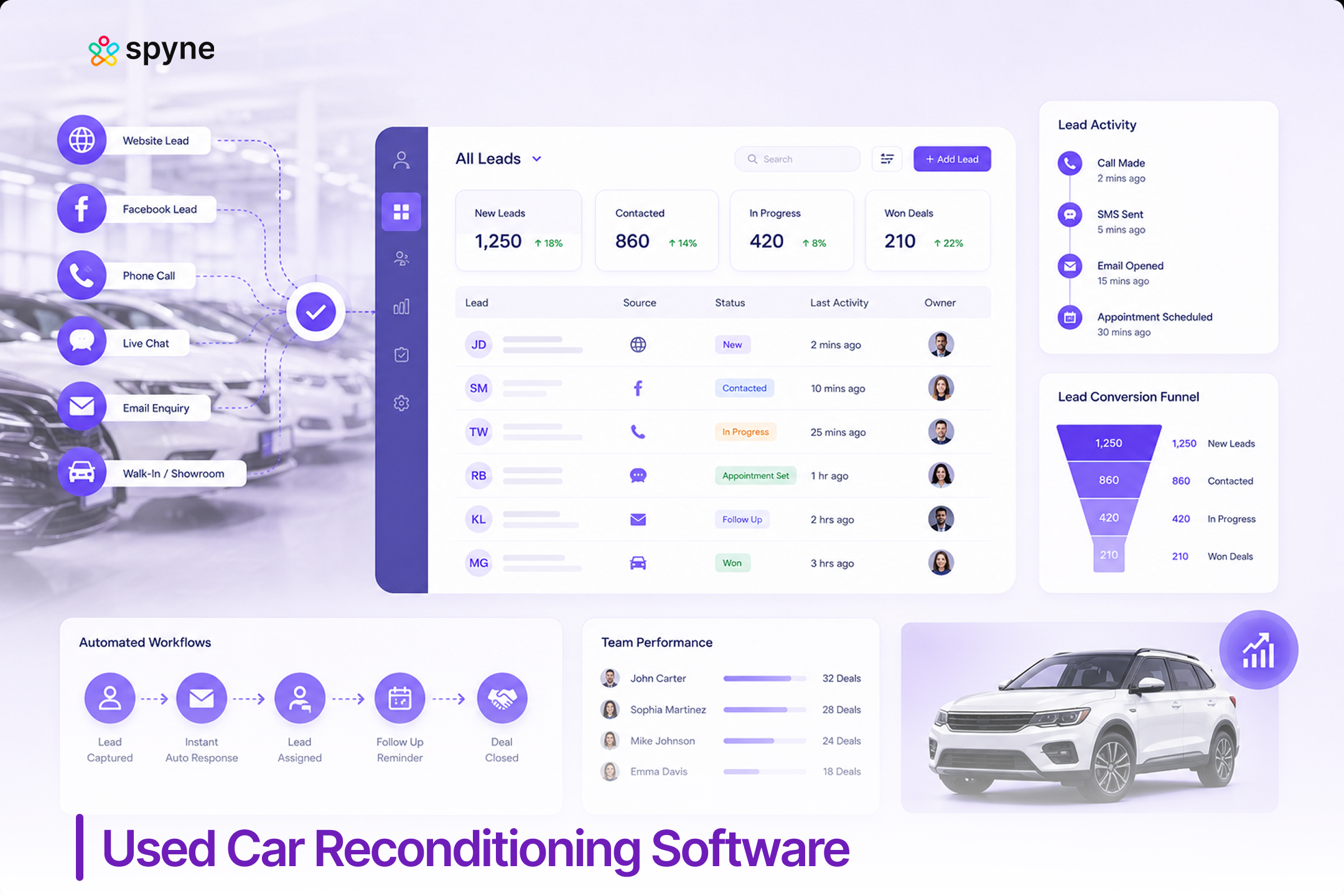
As a CRM for high-volume car dealerships, Spyne Automotive CRM is built to handle the lead volume and multi-location complexity standard dealership CRMs were not designed for. It centralizes leads from every channel, automates the routing and follow-up work that overwhelms BDC teams during peak hours, and gives dealer groups rooftop-level visibility instead of one blended average.
1. Real-Time Automated Lead Routing
Leads are assigned by rep availability and capacity as they arrive, not a fixed rotation. During a weekend sale event this keeps leads moving to whoever can respond fastest. Managers can adjust routing rules on the fly when a rep calls out or a promotion drives an unplanned spike.
2. Inventory-Tied Lead Scoring
Every lead is matched against live inventory and pricing, so a rep on an in-stock, competitively priced vehicle knows to prioritize it. This closes the gap generic CRMs leave open, where every lead looks equally urgent. It is one of the features that separates a genuine best CRM for high-volume auto dealers from a general CRM with an automotive skin.
3. DMS and OEM Data Sync
Lead, deal, and inventory data sync with the DMS and OEM feeds instead of requiring manual re-entry. This closes a common gap in a dealership CRM for high lead volume, where scoring runs on stale inventory data. Open API access also matters for groups running other tools alongside the CRM.
4. Equity Mining and Service-to-Sales Signals
The CRM flags customers approaching lease-end, sitting on trade-in equity, or overdue for service, turning past buyers into a pipeline instead of a closed file. For a high-volume store, this repeat-business layer is often a larger source of deals than new lead volume alone. It is one of the high-volume automotive CRM strategies that gets overlooked when a dealership focuses only on inbound leads.
5. Multi-Channel Lead Capture and Deduplication
Phone, text, chat, email, and marketplace leads land in one pipeline, with automatic flagging when the same shopper reaches out more than once. This cuts down on reps working the same person twice. For a group running one promotion across several rooftops, this matters even more.
6. BDC Workload Balancing Dashboard
Managers see lead distribution across the BDC team in real time and rebalance before any rep falls behind. This directly targets the overtime that Cox Automotive’s 2025 study found is pushing dealerships toward automation. It reflects fixing distribution before adding headcount to work around it.
7. Multi-Rooftop Group Visibility
Dealer groups get rooftop-by-rooftop and rep-by-rep data, not one blended number, making it possible to see which location needs attention that same week. A general manager overseeing several stores can catch a slipping rooftop early instead of at quarter’s end. For a CRM for large car dealerships, this is often the single feature that most separates it from a single-rooftop platform.
8. Automated Follow-Up Sequences
Structured follow-up continues outside business hours, so a 9 p.m. lead gets an initial response before the next morning’s rush. This matters most for after-hours marketplace leads that standard CRMs leave untouched overnight.
9. Manager Accountability Dashboards by Rep and Rooftop
Response time, contact rate, appointment rate, show rate, and sold rate break down by rep and location, surfacing outliers instead of hiding them in a store-wide average. This is the best CRM for high-volume auto dealers feature to demand proof of before signing, not after. One of the high-volume dealer CRM tips worth repeating: check this reporting depth before it takes a slow quarter to reveal it is missing.

Conclusion
A CRM for high-volume car dealerships is only useful if it holds up under the exact conditions that break standard platforms: lead spikes, multiple channels, multiple rooftops, and BDC teams running at capacity. The dealerships getting this right are not the ones adding headcount to compensate for a slow CRM, they are the ones with routing, deduplication, and reporting built for the volume they actually run. Match the platform to your highest-volume rooftop, not your average one, and confirm it can show you exactly where leads are getting dropped before you commit.