
Executive SummaryAn auto dealership stocking tool is software that tells a dealer which used vehicles to acquire, based on local market demand, competitor supply, and projected turn time, rather than gut instinct. Cox Automotive reported used-vehicle days’ supply at 47 days in June 2026, up from 45 days in May 2026, while NADA’s 2026 benchmark guide sets a 30-day supply target and 12 turns per year. Dealers who stock against live demand data close that gap faster than dealers who stock by feel. |
A used car manager walks the lot on a Monday morning and finds six units past 45 days, still not sold, still costing money every single day they sit. That is not bad luck. It is a stocking decision made weeks earlier without the right data. Cox Automotive put used-vehicle days’ supply at 47 days in June 2026, the highest reading since spring. An auto dealership stocking tool exists to prevent that exact scenario. Here is how the right one works, how to use it, and what to look for before you buy.
What Is a Dealership Stocking Tool?
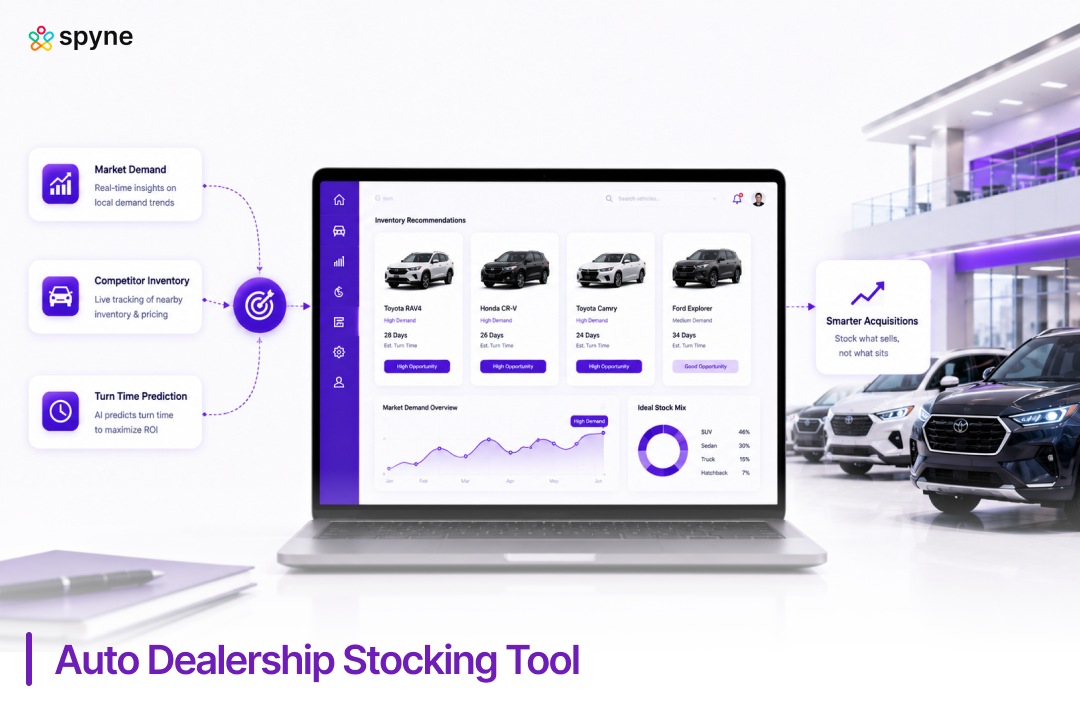
A dealership stocking tool is software that recommends which vehicles a dealer should acquire and keep in inventory, using live market data instead of guesswork. It pulls in local sales velocity, competitor listings, auction activity, and price-to-market trends, then scores potential acquisitions by how fast they are likely to sell and how much gross they are likely to hold.
“Stocking tool” gets used loosely, and dealers researching the term usually mean one of four related but distinct categories:
- Inventory management software that tracks VINs, pricing, photos, and status once a vehicle is already in stock.
- Stocking and acquisition tools built specifically to recommend what to buy, such as vAuto Stockwave, based on demand and profitability before a purchase happens.
- Dealer management systems (DMS) like CDK, Reynolds and Reynolds, or Dealertrack, managing inventory alongside sales, finance, and accounting.
- Lot management tools, such as Lotlinx and Rapid Recon, tracking where vehicles are parked, how they move, and reconditioning status.
This article focuses on the second category, tools built to answer the acquisition question directly, though the strongest platforms increasingly blend all four.
A stocking tool looks outward, at the whole local market, and answers a forward-looking question that a DMS or a single-vehicle appraisal tool does not: if I buy this unit today, will it move, and at what price.
Most auto dealership stocking tool platforms combine three data layers: what similar vehicles are selling for nearby, how many days those vehicles typically sit before selling, and how much wholesale or auction supply is coming into the market. NADA’s 2026 formulas guide defines used days’ supply as inventory dollars divided by average monthly cost of sale, multiplied by working days in the month, and sets a target of 30 days for a healthy used department. A good stocking tool is built to help a dealer hit that number consistently, not just once.
A typical stocking tool feature set includes:
- VIN decoding and vehicle acquisition recommendations
- Inventory aging reports and demand forecasting
- Market pricing analysis versus local competitors
- Reconditioning workflow and photo management
- CRM integration and auction integration, such as Manheim or ADESA
- Website and marketplace syndication
- An analytics dashboard covering turn rate, gross profit, and days-to-sale
Why Auto Dealership Stocking Strategies Fail Without the Right Tool
Auto dealership stocking strategies fail most often because they rely on last month’s sales pattern instead of this week’s market. A used car manager who restocks based on what sold well 30 days ago is reacting to a market that has already shifted, and Cox Automotive’s own inventory tracking shows how fast that shift happens: days’ supply moved from 45 to 47 in a single month during 2026.
Three patterns show up again and again in stores without a real stocking tool:
- Buying by feel at the auction: A manager likes a truck, bids on it, and finds out three weeks later that the local market is saturated with that trim and body style.
- Ignoring price segment supply: Cox Automotive’s 2026 reporting shows vehicles under $15,000 running a tighter 33-day supply than the broader market, meaning that segment turns faster and rewards dealers who stock into it deliberately.
- No feedback loop: Aging reports get pulled monthly instead of daily, so a slow-moving unit sits for two extra weeks before anyone acts.
Auto dealership stocking strategies built around a live data tool close each of these gaps, because the recommendation engine is watching the market every day, not once a month.
How to Use a Dealership Stocking Tool
Knowing how to use dealership stocking tool software matters as much as which one you buy. The tool only helps if it becomes part of the daily acquisition routine, not a report someone checks occasionally.
- Set your target mix first: Before opening the tool, define how many units you want in each price band and body style, based on your store’s actual sales history and local demand.
- Run the recommendation engine before every purchase decision: Whether you are bidding at auction, evaluating a trade, or buying wholesale, check the tool’s demand score for that vehicle in your market before committing.
- Cross-check against your used-to-new ratio: NADA’s 2026 guidance points to a 1.25-to-1 used-to-new retail ratio as a healthy benchmark. Use the tool’s output to keep your acquisitions aligned with that target instead of overbuying one category.
- Review aging alerts daily, not weekly: NADA’s benchmark flags no used units over 60 days as a maximum age threshold. A stocking tool should surface units approaching that line early enough to act.
- Feed sales results back into the strategy: After a unit sells, note the actual days-to-sell and gross against what the tool predicted, and adjust your buying criteria over time.
Dealers who treat the tool as a daily habit, not a monthly audit, see the biggest shift in turn rate. That single workflow, covering how to use dealership stocking tool software from initial setup through the weekly feedback review, is what separates dealers who actually lift turn rate from dealers who bought a tool and never changed how the team buys.

Best Dealership Stocking Tool: How to Compare Your Options
There is no single best dealership stocking tool for every store. The right choice depends on store size, whether you are franchised or independent, and how deep your reconditioning and merchandising needs go. Before comparing platforms, agree internally on how to use dealership stocking tool software day to day, since that shapes which features actually matter to your team versus which ones sound good in a demo but never get opened. A useful way to compare is by what each platform is actually best at, based on how the market positions them:
- Best overall for used car stocking and pricing: Platforms in the vAuto (Cox Automotive) mold, built around market-based valuation and stocking recommendations, are widely treated as the industry benchmark for franchise stores.
- Best for enterprise and multi-location groups: DMS-bound platforms like Dealertrack and Reynolds and Reynolds suit large dealer groups that need inventory tightly connected to accounting and service.
- Best for independent and budget-conscious lots: Lighter platforms built for smaller used car lots prioritize essential stock tracking without enterprise-level cost or complexity.
- Best for a connected stocking-to-listing workflow: A smaller group of platforms, including Spyne Inventory Management, are built to carry one vehicle record from acquisition scoring through reconditioning, merchandising, and syndication, instead of treating stocking as a separate module.
Weigh these four profiles against your actual stocking pain point, whether that is slow turn, thin gross, or inconsistent buying across multiple locations. Inside any profile, judge specific platforms on data depth (local numbers, not just national averages), speed to a usable recommendation at the auction lane, real integration with your existing DMS, and fit with your store’s actual price segment, since a tool tuned for franchise near-new inventory will not serve a sub-$15,000 independent lot well, and the reverse is also true.
Best Auto Dealership Stocking Tool for Optimizing Used Car Inventory
The best auto dealership stocking tool for optimizing used car inventory is the one that matches your acquisition volume and gives your team a clear, fast recommendation at the point of purchase, whether that is an auction lane, a trade-in desk, or a wholesale marketplace. The table below compares platforms dealers are actively evaluating for used car stocking decisions in 2026.
| Stocking Tool | Best For | Key Stocking Features | Pricing |
| Spyne Inventory Management | Dealers who want stocking, merchandising, and reconditioning tracking in one connected workflow | Market-demand acquisition scoring, aging and health alerts, AI-assisted merchandising, syndication to listing sites | Customized |
| vAuto (Provision/Stockwave, ProfitTime GPS) | Franchise stores wanting the industry-benchmark stocking and appraisal guidance | Market-based valuation, live market view, wholesale sourcing marketplace, ROI-based inventory scoring | Connect with Sales Team |
| DealerSocket Inventory+ | Medium to large dealerships wanting stocking tied to an “ideal inventory” model | Absolute Sourcing buy and sell lists, group trade across rooftops, Profit Per Day tracking | Connect with Sales Team |
| Dealertrack DMS | Enterprise and multi-location groups wanting stocking bound to accounting and service | Real-time inventory tracking, third-party app integrations, DMS-wide vehicle visibility | Connect with Sales Team |
| DealerCenter | Independent dealers wanting stocking bundled with DMS and marketing | Auction run-list sourcing, book-value and market-demand pricing, listing syndication to 30-plus sites | Connect with Sales Team |
| Dealerslink | Independent dealers wanting stocking tied directly to sourcing | Automated stocking recommendations by local gross and turn speed, VIN-scan appraisals, no-fee sourcing marketplace | Connect with Sales Team |
| CDK Vehicle Inventory Suite | Franchise groups wanting stocking data unified across a single DMS | Predictive sale-price data for appraisals, AI-assisted merchandising, cross-store inventory visibility | Connect with Sales Team |
None of the platforms above publish list pricing, which is typical for dealership software sold on a per-rooftop basis, so every vendor listed uses a “connect with sales” quote model except where noted. Two narrower tools worth knowing by name: Lotlinx focuses on AI-driven risk monitoring rather than acquisition scoring, and Frazer DMS is a frequently cited budget option for small independent lots.
When evaluating any platform from this table, look for these core capabilities rather than a feature list alone:
- Predictive sourcing and acquisition guidance, not just a record of what you already own
- Dynamic pricing and profitability scoring by vehicle, not a single market-average number
- Reconditioning tracking from purchase to front-line ready
- DMS and CRM integration so stock, pricing, and leads stay in sync
A tool built around those four capabilities, which is what most comparisons mean by the best auto dealership stocking tool for a given segment, is built to answer the exact questions a stocking decision comes down to: which models to buy this week, which units to wholesale instead of retail, which units need a price reduction now, and what the ideal stocking mix looks like by price band and body style. The dealers who see the fastest turn improvement tend to pick a platform that carries that same vehicle data from the stocking decision through the listing that finally reaches a buyer, rather than one that hands off to a separate login for reconditioning and merchandising.
Dealership Stocking Tool Tips for Better Turn Rate and Gross
These dealership stocking tool tips apply no matter which platform you choose, because they address how the tool gets used, not just what it can do.
- Tie stocking decisions to your actual turn rate, not a gut number. NADA’s 12-turns-per-year benchmark works out to roughly 30 days per unit. Measure your real average against it monthly.
- Segment your stocking strategy by price band. Cox Automotive’s 2026 data shows sub-$15,000 units moving in 33 days against a 47-day market average, so treat that segment with tighter buying discipline and faster reorder cycles.
- Set a hard age ceiling and enforce it. NADA’s 60-day maximum age threshold is a ceiling, not a target. Build a markdown or wholesale-out rule at 45 days so units never reach it.
- Recheck your used-to-new ratio quarterly. Market conditions shift the ideal mix; a 1.25-to-1 ratio that worked last quarter may not fit this quarter’s demand.
- Let the tool flag reconditioning bottlenecks, not just acquisition targets. A vehicle that scores well on demand but sits in recon for ten days loses the advantage the data gave you.
These dealership stocking tool tips hold regardless of which platform from the comparison table above you choose.
Common Mistakes Dealers Make When Stocking Used Inventory
Dealers repeat a handful of avoidable mistakes when they skip a structured auto dealership stocking tool and rely on instinct instead.
- Buying units the sales team likes rather than units the market is asking for. Personal preference at the auction lane is not a demand signal.
- Treating every trade-in as a stocking decision instead of an appraisal decision first. A trade should clear an appraisal and demand check before it goes to the front line.
- Overbuying a single body style because it sold well once. One fast sale is a data point, not a trend.
- Letting aging inventory sit past 60 days without a markdown plan. Every extra week past NADA’s threshold erodes gross faster than the previous week did.
- Ignoring wholesale exit options. Some units are more profitable moved to wholesale quickly than held for a retail sale that may never come.
- Comparing tools on features alone, not on fit. A long feature list means little if the team never learns how to use dealership stocking tool software in the way each feature was designed to be used.
Most of these mistakes trace back to the same root cause: a stocking decision made without a current read on local demand. Fixing that one input tends to fix several of the mistakes above at once.
Spyne Inventory Management: The Auto Dealership Stocking Tool Built for Data-Driven Acquisition
Spyne Inventory Management gives dealers a single workspace to decide what to stock, track how it ages, and get it front-line ready without juggling separate appraisal, pricing, and merchandising logins. It applies live market signals to the stocking decision itself, then carries that same vehicle through reconditioning, listing, and syndication.
1. Market-Demand Acquisition Scoring
Before a vehicle is purchased at auction, trade-in, or wholesale, Spyne scores it against local sales velocity and competitor supply for that make, model, and trim. A used car manager sees the projected days-to-sell and expected gross before bidding, instead of after the fact. This turns a spur-of-the-moment auction bid into a scored decision the whole buying team can stand behind.
2. Inventory Health Monitoring
Every unit on the lot gets a live health score based on age, price-to-market position, and merchandising quality. A used car manager can see at a glance which units are drifting toward the 60-day danger zone and act before they become a write-down.
3. Aging Alerts Tied to Action
Rather than a passive report, aging alerts come with a recommended next step, whether that is a price adjustment, a wholesale exit, or a merchandising refresh. This turns a monthly aging report into a daily task list. Managers act on a single alert instead of digging through a separate spreadsheet to find the same information.
4. AI-Powered Merchandising
Once a vehicle is confirmed for stock, Spyne generates optimized photos and listing descriptions automatically, cutting the time between acquisition and a live, front-line-ready listing. The listing itself reflects the same demand data that justified the original stocking decision.
5. Reconditioning Workflow Tracking
Spyne tracks each unit through reconditioning steps, flagging units that are stuck in recon longer than their demand score would justify, so a well-scored stocking decision does not lose its edge sitting in the shop. That visibility keeps the shop and the used car desk working from the same timeline instead of two separate ones.
6. Real-Time Syndication
Once a unit is ready, Spyne pushes the listing to major marketplaces and the dealer’s own website simultaneously, so the demand advantage identified at stocking time turns into actual buyer traffic without a manual posting delay.
7. Segment-Level Reporting
Spyne breaks down inventory performance by price band and body style, making it straightforward to check whether a store’s stocking mix matches NADA’s 1.25-to-1 used-to-new benchmark or needs rebalancing. That view flags an overstocked price band before it turns into aging inventory.
8. Multi-Location Visibility
For dealer groups, Spyne shows stocking and aging data across every rooftop in one view, so a slow-moving unit at one store can be identified as a strong fit for another location before it ages further. That cross-store view turns a slow-moving unit into an opportunity, not a write-down.

Conclusion
Choosing the right auto dealership stocking tool comes down to one question: does it help your team make a better acquisition decision at the moment they are making it, whether that is an auction lane, a trade desk, or a wholesale marketplace. NADA’s 2026 benchmarks of 30-day supply, 12 turns a year, and a 60-day age ceiling give you a clear target. Cox Automotive’s 2026 data shows how fast that target can slip when stocking decisions are not data-driven. An auto dealership stocking tool that ties acquisition scoring to aging alerts and merchandising, like Spyne Inventory Management, keeps that target within reach instead of a once-a-quarter fix.