
Executive SummaryThe right CRM for independent car dealers skips franchise-scale modules and focuses on fast lead capture, texting, and DMS integration built for a smaller team. NIADA’s 2025 Used Car Industry Report shows independent dealers sold 9.8 million vehicles in 2025, their third straight year of growth. Yet Cox Automotive’s 2025 Buyer Journey Study found the average dealership takes 17 hours to respond to an internet lead, a gap a properly set up CRM closes in minutes. |
A lead comes in from Facebook Marketplace at 6 p.m. Nobody replies until the next morning, and by then the buyer has already texted three other lots. This is the daily reality for independent dealers running on spreadsheets and a shared inbox. A CRM for independent car dealers fixes this without forcing you into franchise-grade complexity or pricing. Here is what actually works, what it costs, and a set of CRM for independent car dealers tips that keep setup from wasting a month of onboarding.
Why CRM for Independent Car Dealers Looks Different Than Franchise CRM
A CRM for independent car dealers has to solve a narrower, sharper problem than a franchise platform. Franchise stores need OEM lead compliance, co-op advertising tracking, and multi-rooftop reporting across brands. Independent and BHPH dealers do not carry that overhead. Instead, the priorities are speed, simplicity, and cost control.
Three things separate an independent-dealer CRM from a franchise one:
1. Team size. Most independent lots run with one to five salespeople, so the CRM needs to work without a dedicated administrator.
2. Financing mix. NIADA’s 2025 data shows BHPH, deep subprime, and subprime segments account for 34% of independent dealer originations, so many independent dealers need CRM fields for in-house financing and payment tracking.
3. DMS pairing. Independent dealers commonly run Frazer, DealerCenter, or Wayne Reaves, and the CRM has to sync cleanly with one of those instead of a franchise-grade DMS like CDK or Reynolds.
A CRM built for independent car dealers should reflect all three, not a scaled-down version of an enterprise tool.
Best CRM for Independent Car Dealers in the US
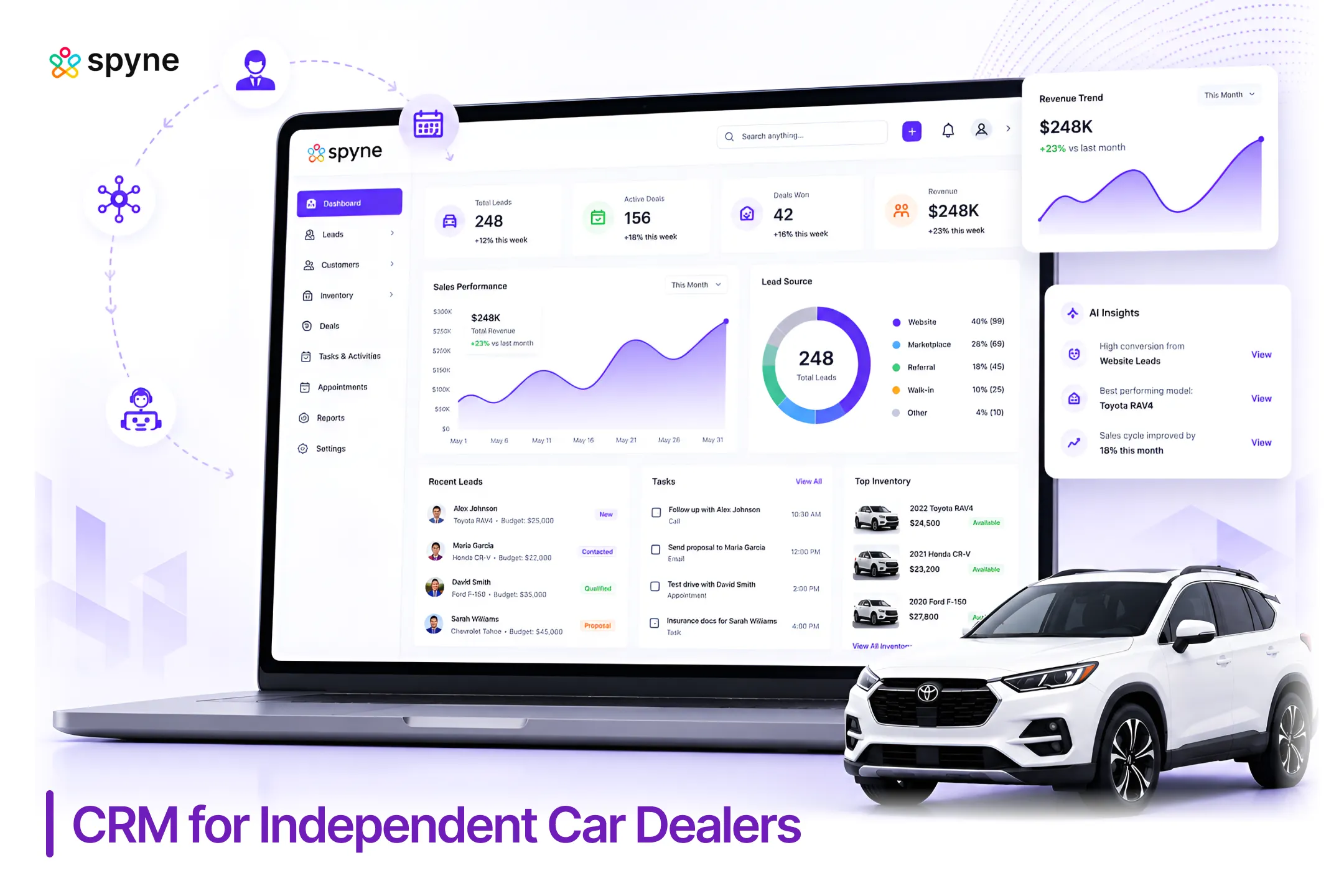
The best CRM for independent car dealers in the US does three things well: captures leads from marketplaces like AutoTrader and Facebook Marketplace automatically, texts buyers back within minutes instead of hours, and syncs cleanly with an independent DMS like Frazer or DealerCenter without manual re-entry. Spyne Automotive CRM is built around that exact definition, pairing a unified lead inbox with automated first-response texting and DMS-agnostic sync in a platform sized for a five-person sales team rather than a fifty-person BDC.
Beyond Spyne, several platforms serve this segment well depending on what a dealer prioritizes. AutoRaptor is built for independent and BHPH lots and centers on texting and VIN scanning. Selly Automotive pairs closely with Frazer for tight DMS syncing. DealerCenter combines CRM, DMS, and financing in one system for dealers who want a single platform instead of two. DealerSocket’s independent edition adds equity mining for growing multi-rooftop groups, and Bigin by Zoho or Capsule CRM suit solo lots that would rather customize a general CRM than pay automotive-specific pricing.

Affordable CRM for Independent Dealers: What “Affordable” Should Buy You
The most common mistake independent dealers make is choosing a generic CRM like base Zoho, HubSpot, or Pipedrive because the sticker price looks like an affordable CRM for independent dealers on day one. It usually isn’t. A generic CRM was not built to handle VIN data, inventory sync, or lead ingestion from AutoTrader and Facebook Marketplace, so someone on your team ends up building custom fields and manual workarounds just to make it function like a dealership tool.
An automotive-specific CRM built for the segment, like Spyne Automotive CRM, costs more on the invoice but removes that hidden labor: no manual re-entry between the CRM and your DMS, no custom-building a VIN or trade-in field from scratch. That gap is where an affordable CRM for independent dealers actually gets decided, not on the monthly price alone.
Automotive-specific platforms built for independent dealers typically price in the $150 to $600 per month range depending on seats and modules. General CRMs like Bigin or Zoho start closer to free for one user, but the real comparison isn’t the fee, it’s what a workaround-heavy system costs in missed leads. One missed sale outweighs a year of CRM fees.
Before comparing price, check three things: does it handle VIN and inventory data natively, does it sync with your DMS without manual re-entry, and does your team actually open the mobile app. These CRM for independent car dealers tips matter more than the sticker price on any single platform.
How to Set Up a CRM as an Independent Auto Dealer
Setting up a CRM as an independent auto dealer is a process, not a software install. Follow these steps in order.
1. Map your sales pipeline first: Before touching the software, write out your actual stages: new lead, contacted, appointment set, test drive, financing, sold, or lost. Build the CRM pipeline to match this, not a generic template.
2. Connect every lead source: Hook up your website, Facebook Marketplace, and listing sites like AutoTrader and Cars.com so leads land in the CRM automatically instead of a shared inbox.
3. Import and clean existing contacts: Export old spreadsheets or paper logs into a CSV, remove duplicates, and confirm every contact has a phone number.
4. Set up automated first-response texts: Configure an instant acknowledgment for every new lead, especially after hours, so no buyer waits until morning.
5. Build follow-up sequences: Create reminders at 24 hours, 3 days, and weekly until a lead closes or is marked lost with a reason.
6. Sync your DMS: Connect the CRM to Frazer, DealerCenter, or whatever DMS you run so inventory and customer data avoid double entry.
7. Train your team on one rule: If it is not logged in the CRM, it did not happen. Every call, text, and walk-in gets recorded the same day.
A CRM for independent car dealers only works if the setup mirrors how your lot actually sells, not how a software vendor assumes every dealership operates.
CRM for Independent Car Dealers Strategies for Protecting Every Lead
Buying the software is the easy part. These CRM for independent car dealers strategies are what actually protect revenue once it is running, and they matter more than which platform logo is on the login screen.
1. Respond inside the first 15 minutes, every time: Cox Automotive’s 2025 Buyer Journey Study found the average dealership takes 17 hours to respond to an internet lead. Independent dealers who beat that by hours, not minutes, convert noticeably more of the same lead volume.
2. Give every lead an owner: Unassigned leads in a shared queue are the single most common way independent dealers lose sales they already paid for.
3. Track lost-lead reasons, not just closed deals: A CRM for independent car dealers should show why deals fall through, whether it is price, financing, or inventory, so you can fix the pattern.
4. Use trade-in equity data proactively: Flag past customers whose vehicles gained resale value and reach out before they shop a competitor.
5. Review pipeline weekly, not monthly: Small teams catch stalled leads faster with a five-minute weekly review than a full monthly report, and this habit is one of the simplest CRM for independent car dealers strategies to put in place.
Best CRM for Small Car Dealers: Tips for Choosing Without Overpaying
Finding the best CRM for small car dealers means resisting features built for teams three times your size. These CRM for independent car dealers tips help narrow the list fast.
1. Count your actual monthly volume before shopping: A lot moving 15 cars a month does not need the same platform as one moving 150. Match the tool to your real pipeline, not an aspirational one.
2. Test the mobile app before you buy: If reps cannot log a call in under 10 seconds, they will stop using it within a week.
3. Ask about contract length: Many “affordable” platforms lock dealers into 12-month terms. Month-to-month options exist and are worth a small premium when testing a new system.
4. Confirm DMS compatibility in writing: Do not take a sales rep’s word that it “integrates” with your DMS. Ask for a reference dealer running the same combination.
5. Avoid CRMs sold primarily to franchise groups: Their pricing and feature roadmap are built around rooftop counts and OEM requirements that do not apply to a small lot, which is why the best CRM for small car dealers rarely shares a shortlist with franchise-group platforms.
Spyne Automotive CRM for Independent Car Dealers
Spyne Automotive CRM is built for dealerships that need fast lead response and clean pipeline visibility without paying for OEM compliance modules they will never use. It fits independent, BHPH, and small multi-rooftop dealers who want one system for leads, follow-up, and reporting instead of stitching together a DMS, a texting app, and a spreadsheet. For a dealer choosing a CRM for independent car dealers today, it is built to handle the exact workflow described above, from first lead to closed deal.
1. Conversational AI. Handles inbound calls, outbound calls, and text or chat conversations automatically, answering routine questions on availability, pricing, and financing, qualifying leads, and confirming appointments any time of day, then handing off to a rep the moment a conversation needs a human.
2. Unified omnichannel inbox. Leads from your website, Facebook Marketplace, AutoTrader, calls, and texts land in one inbox instead of four separate tools, so nothing gets missed between systems.
3. Lead scoring and routing. Leads are ranked by engagement and vehicle interest so your team calls the hottest prospects first instead of working the queue in the order it arrived.
4. Deal pipeline tracking. Every lead moves through clear stages, from new lead to test drive to financing to sold, so managers can see exactly where a deal is stuck without asking a rep for an update.
5. DMS-agnostic integration. Spyne Automotive CRM connects to independent DMS platforms so inventory and customer records stay in sync without manual re-entry.
6. Mobile-first access. Reps can log calls, send texts, and update pipeline stages from the lot on a phone, without returning to a desk between customers.
7. Follow-up automation. Built-in cadences handle 24-hour, 3-day, and weekly follow-ups automatically, so no lead goes cold from a missed reminder.

Conclusion
None of this works without picking a system that matches how your lot actually sells and setting it up the way this guide walks through, not the way a vendor’s default template assumes. A CRM for independent car dealers earns its cost back the first month it stops a lead from going cold. If you are ready to see how fast lead response and clean pipeline tracking work in practice, book a demo and walk through your own lead sources.