
Executive SummaryUsed car inventory software helps independent and BHPH dealers track vehicles from acquisition to sale, price against a tightening market, and control holding costs that run $35 to $55 per vehicle per day, according to NIADA. Used-vehicle days’ supply fell below 40 days in March 2026, per Cox Automotive, so lots still running spreadsheets are losing ground to dealers on dedicated software. This guide ranks the best used car inventory software for 2026, compares DealerCenter, Frazer, AutoManager, and vAuto, and shares tips independent dealers use to turn units faster. |
A used vehicle sitting on your lot an extra week does not just look stale. It costs $35 to $55 a day in holding expenses, according to NIADA, and by March 2026, used-vehicle days’ supply had dropped below 40 days nationwide, per Cox Automotive, so the market is punishing slow lots faster than ever. Independent and BHPH dealers running spreadsheets or a bare-bones DMS feel this first. The right used car inventory software fixes that. Here is how to pick one, what the top platforms actually do, and how to run it well.
What Used Car Inventory Software Actually Does for Independent Dealers?
Used car inventory software is the system that tracks every vehicle on your lot from the moment you buy it to the moment it sells. For an independent or BHPH dealer, that means recording VIN, purchase price, and auction source at acquisition, logging reconditioning costs as a technician works on the car, pricing it against ACV, MMR, KBB, and Black Book data, and pushing the listing to your website and marketplaces like Autotrader, Cars.com, CarGurus, and Facebook Marketplace the moment it is frontline ready.
The difference between this and a general DMS module is focus. Franchise dealers manage new and used inventory side by side, often tied to OEM data feeds. Independent and BHPH dealers need software built around acquisition, reconditioning, and collections, since most used inventory comes from auctions or trade-ins rather than a factory allocation. If your current setup was built for franchise stores, you are probably paying for modules you do not need and missing the ones you do. For a broader look at inventory software across dealer types, see our guide to automotive inventory management software.
Best Used Car Inventory Software for Independent Dealers
Ranking the best used car inventory software 2026 has to offer starts with independent-dealer fit, not enterprise feature bloat. Here is a used car inventory software comparison of what each one actually does, who it fits, and what it costs, based on pricing published on each vendor’s own site as of 2026.
| Platform | Best For | Key Features | Pricing |
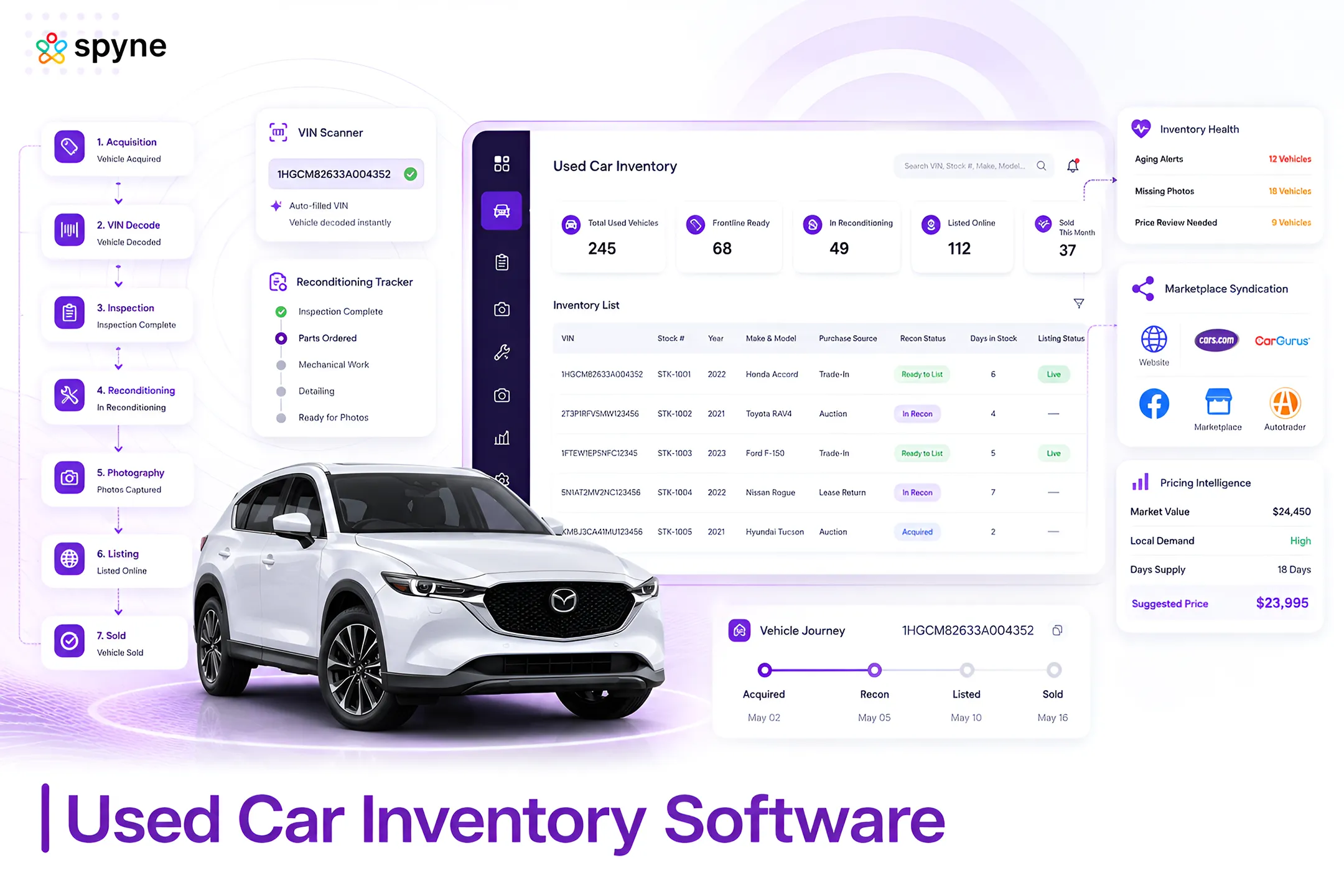
| Spyne Inventory Management | Independent and multi-rooftop used car dealers who want AI-powered merchandising and inventory health tracking | VIN-based data population, reconditioning status tracking, automated listing syndication, inventory aging reports | Customized |
| DealerCenter | Independent and BHPH dealers who want inventory, CRM, and financing in one system | Inventory management, BHPH and collections, lender integrations (Dealertrack, RouteOne), KBB/NADA/Black Book valuation feeds | Modular, starting around $60/month |
| Frazer | Independent used car dealers who want a straightforward, no-contract DMS | Inventory and cost tracking, accounting, BHPH support, state-specific DMV forms and FTC Buyers Guides | $129/month |
| AutoManager | Independent dealers focused on web marketing and multi-marketplace syndication | Inventory management, syndication to 250+ marketplaces, dealer websites, CRM | DeskManager DMS from $88/month |
| vAuto | Dealers who prioritize live market pricing data for acquisition and stocking | Live Market View pricing, appraisal guidance, stocking recommendations | Connect with Sales Team |
Use this used car inventory software comparison as a starting point, not a final answer. A single-location BHPH lot and a five-rooftop independent group have different priorities even when they are looking at the same four platforms. If pricing and appraisal accuracy matter most, vAuto’s market data carries weight. And if you need financing and collections in the same system, DealerCenter and Frazer both build for that. If merchandising speed and inventory health are the bottleneck, that is where Spyne Inventory Management fits.

Which Used Car Inventory Software Fits Your Dealership?
The right used car inventory software depends on your dealership’s priorities, whether that’s managing BHPH operations, improving pricing decisions, streamlining inventory workflows, or expanding online visibility. Instead of choosing the platform with the longest feature list, focus on the one that solves your biggest operational challenge and fits the way your dealership operates.
Many dealerships also combine their core DMS or inventory software with specialized tools to fill workflow gaps. Once you’ve selected the platform that best meets your operational needs, a solution like Spyne Inventory Management can enhance your existing setup with AI car merchandising, inventory health tracking, VIN-based workflows, and automated listing syndication, without requiring you to replace your current system.
How to Manage Used Car Inventory With Software?
Managing used car inventory with software comes down to six stages, and the software should touch every one of them instead of tracking stock numbers on a spreadsheet.
1. Acquisition
Record VIN, stock number, purchase price, mileage, and auction or trade-in source the day the vehicle arrives. This is also where ACV and MMR data should inform what you paid.
2. Inspection and reconditioning
Build a checklist, assign parts and labor to a technician, and track total reconditioning cost against the vehicle’s true cost basis so a salesperson cannot discount away your margin later.
3. Pricing
Combine purchase price, reconditioning cost, and fees into total vehicle cost, then set an asking price against live KBB, Black Book, and local market data.
4. Merchandising and syndication
Upload photos, write descriptions, and push the listing to your website and marketplaces like Autotrader, Cars.com, and Facebook Marketplace in one action instead of five logins.
5. Sales and financing
Track inquiries, test drives, and offers, and for BHPH deals, connect financing and collections directly to the vehicle record.
6. Reporting
Monitor days in stock, inventory aging past 60 and 90 days, gross profit per unit, and turn rate by model.
These used car inventory software strategies work whether you run 15 cars or 500, because the stages do not change, only the volume does. The dealers who struggle usually skip a stage rather than choosing the wrong software. A common pattern: acquisition and pricing get tracked carefully, but reconditioning costs live on a separate whiteboard or in a technician’s head, which is exactly where margin disappears.
Used Car Inventory Software Tips and Strategies for Independent Dealers
These used car inventory software tips come from what actually moves the needle for independent and BHPH lots, not generic best practices copied from franchise playbooks.
1. Price Vehicles Based on Local Market Demand
Price against local days’ supply, not just national averages. National used-vehicle days’ supply sat under 40 days in March 2026, per Cox Automotive, but your zip code’s supply for a specific trim, sometimes labeled Market Day Supply (MDS) inside pricing tools, can run 20 days tighter or 60 days looser.
2. Control Reconditioning Costs Early
Set a hard reconditioning cost ceiling per vehicle before repairs are approved, so a $200 detail job does not turn into an $800 mechanical rebuild without a manager sign-off.
3. Integrate Your CRM With Inventory Management
Sync your CRM with your car dealer inventory management system, especially for BHPH or used car dealers, where a missed follow-up with a subprime buyer often means the vehicle sits another week.
4. Monitor Inventory Aging Every Week
Review inventory aging weekly, not monthly. A car crossing 60 days on the lot needs a price cut or a wholesale decision, not another week of hoping.
5. Keep All Vehicle Data in One System
Use one system of record for VIN, cost, and status. Splitting acquisition data in one tool and reconditioning in another creates the exact blind spot that hides margin loss.
Common mistakes independent dealers make with used car inventory software:
- Using inventory software only for listings: Treating the software as a listing tool only, and never using its reporting to catch aging inventory early.
- Ignoring reconditioning costs before pricing: Letting reconditioning invoices arrive after a vehicle is already priced, so the asking price no longer reflects true cost.
- Choosing software that’s too complex: Buying enterprise-grade software built for franchise volume when a lighter, independent-focused platform would cost less and fit better.
- Skipping staff training: Skipping staff training on the software’s mobile app, so VIN scanning at auction never actually happens.
VIN Tracking and Acquisition Data
VIN decoding is the first data point in every used car inventory software workflow, and it matters more for used vehicles than new ones, since a used VIN carries a full history of prior owners, accidents, and service records that a factory VIN does not yet have. Scanning the VIN at intake, whether at auction or during a trade-in appraisal, should automatically populate year, make, model, trim, and factory options, then pull a Carfax or AutoCheck report and a Black Book or KBB valuation without manual entry.
This single step removes hours of data entry per vehicle and reduces the listing errors that cost sales later. VIN tracking deserves its own deep dive, since dealers managing 100 or more units a month run into title, lien, and multi-source VIN reconciliation issues that go beyond what a general inventory guide can cover. We walk through this in a dedicated guide to VIN-based inventory management.
Spyne Inventory Management Software Built for Used Car Dealerships
Spyne Inventory Management is a dealership software solution built for the merchandising and inventory health side of used car operations. It fits into the workflow after acquisition and reconditioning, at the point where a vehicle needs to go from data entry to a live, sellable listing. For independent and multi-rooftop dealers comparing used car inventory software, Spyne focuses specifically on the inventory health, photo, and syndication problems that generic DMS platforms often treat as an afterthought. It works alongside an existing DMS or CRM rather than requiring a full system replacement.
1. AI-Powered Vehicle Merchandising
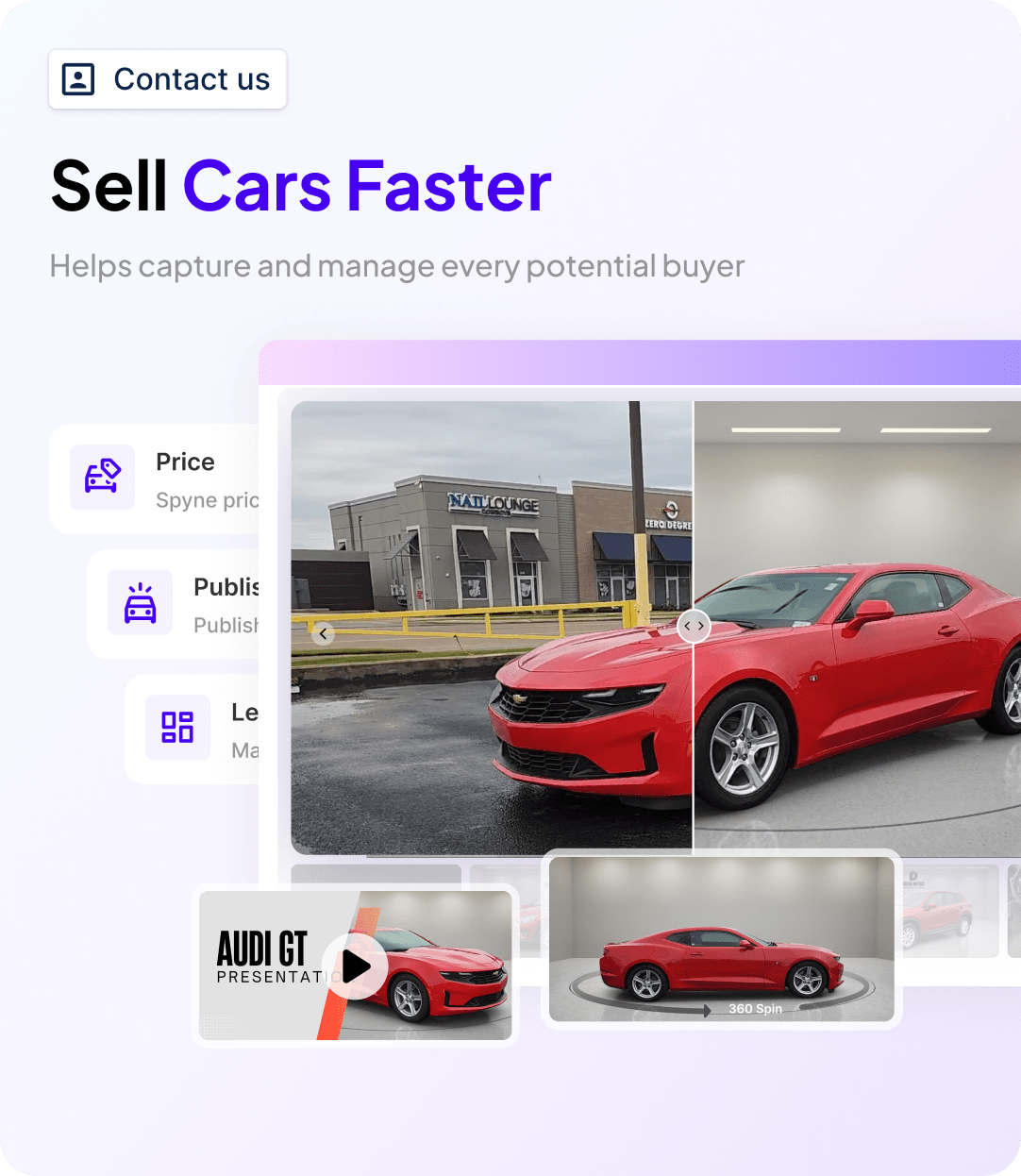
Generates clean, consistent vehicle photos and car virtual tours using AI background correction, so a used vehicle photographed on a crowded lot still looks showroom-ready online. A dealer running 40 used units a week can standardize photo quality without hiring a dedicated photographer.
2. Inventory Health Scoring
Flags vehicles that are aging, missing photos, missing pricing, or sitting without a description, so a used car manager can act before a unit crosses 60 days on the lot instead of discovering it in a monthly report.
3. VIN-Based Data Population
Scans or accepts a VIN and pulls year, make, model, and trim automatically, cutting manual entry time during high-volume acquisition periods like post-auction intake days.
4. Reconditioning Status Tracking
Tracks where each vehicle sits in the recon process and flags delays, so pricing reflects true cost before a listing goes live rather than after a sale is already booked.
5. Multi-Marketplace Listing Syndication
Publishes vehicle listings to your website and third-party marketplaces in one action, and removes them automatically once a vehicle is marked sold, so your team is not fielding calls on inventory you no longer have.
6. Inventory Aging and Turn Reports
Surfaces days in stock, aging by 60- and 90-day thresholds, and turn rate by model, giving used car managers the reporting layer that spreadsheets and basic DMS modules often lack.
7. Multi-Rooftop Inventory Visibility
Gives dealer groups a single view across locations, so a vehicle aging at one rooftop can be transferred or cross-shopped to a location where it is more likely to sell.

Conclusion
Choosing used car inventory software is not about finding the platform with the longest feature list. It is about matching the software to how your lot actually acquires, reconditions, and sells vehicles, whether that is a single BHPH location or a five-rooftop independent group. DealerCenter, Frazer, and AutoManager solve a different piece of that workflow. vAuto solves the pricing and appraisal piece, and Spyne Inventory Management solves the merchandising and inventory health piece that keeps vehicles from quietly aging past 60 days. With used-vehicle days’ supply this tight, the dealers who treat used car inventory software as core infrastructure, not an optional add-on, are the ones turning units faster and protecting gross. Book a demo to see Spyne’s used car inventory management solution in action.