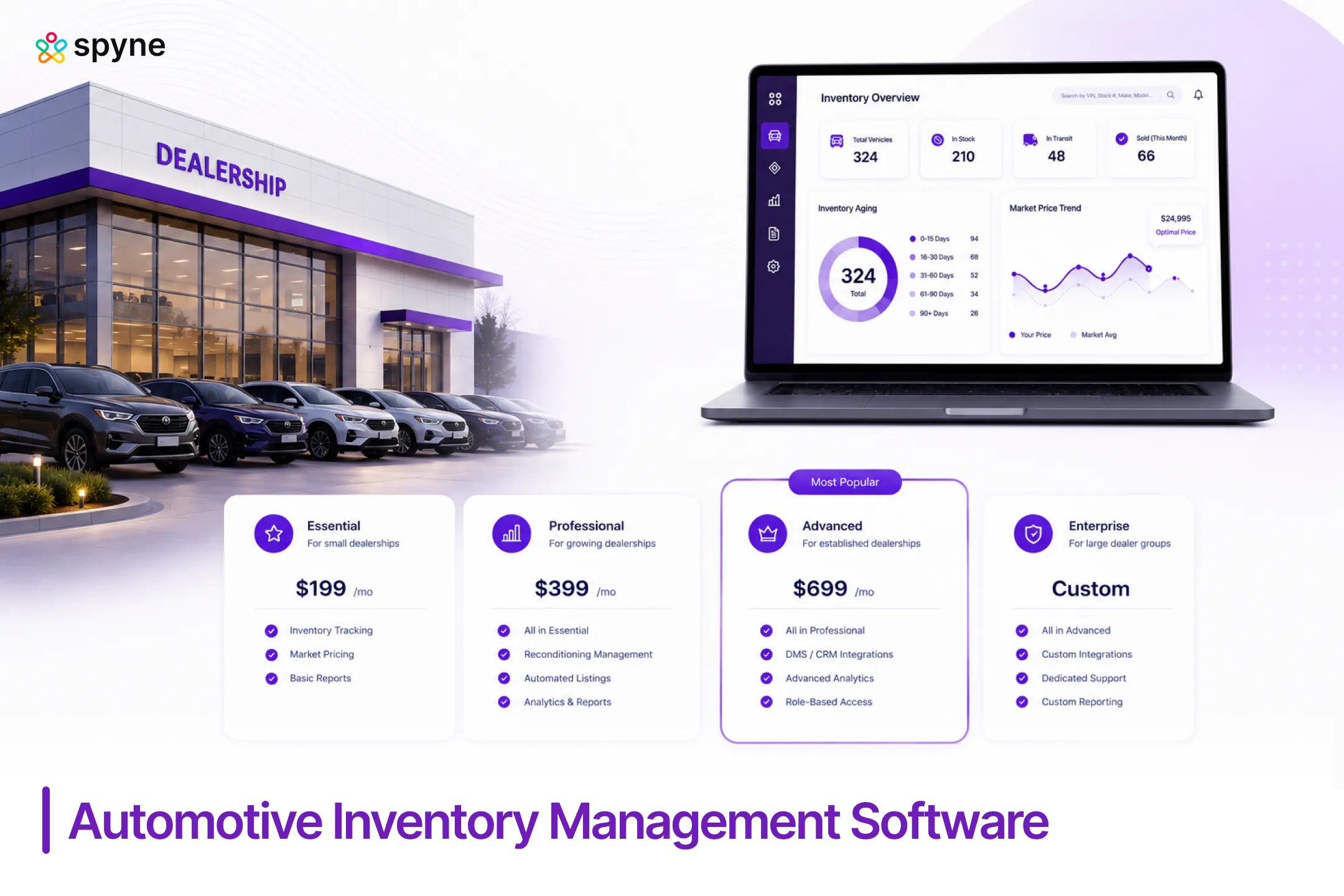

Executive SummaryAutomotive inventory management software helps dealerships track vehicles from acquisition to sale, price them against the live market, manage reconditioning, and publish listings, all to cut days in inventory and protect gross profit. With used-vehicle days’ supply near 49 days and holding cost around $32 per vehicle per day (Cox Automotive and NCM Associates, 2025-2026), faster turn directly improves profit. This guide explains how the software works, compares the leading platforms, breaks down pricing models, and shares the best practices and tips dealers use to sell units sooner. |
Every car on your lot is a clock running against your gross. The longer it sits, the more it costs, and the math is unforgiving. Cox Automotive (January 2026) put used-vehicle days’ supply near 49 days, and NCM Associates estimates each vehicle costs about $32 a day to hold. Most dealers still fight this with spreadsheets and instinct. The stores pulling ahead run automotive inventory management software that prices to the live market, speeds reconditioning, and turns units faster. With 63% of dealers investing in AI (Cox Automotive, 2025), here is how the software works and how to choose.
What is automotive inventory management software?
Automotive inventory management software is a tool that pulls all vehicle stock data into one place and links it to pricing, merchandising, reconditioning, and sales work. Instead of tracking units in a spreadsheet, the dealership gets one live record per vehicle that updates the moment something changes on the lot.
A typical record holds the VIN, year, make, model, trim, mileage, acquisition cost, reconditioning spend, current price, days in inventory, and listing status. The software then adds live market data, photo and description tools, and reporting, so managers can see turn rate, days’ supply, and gross profit by unit without building reports by hand.
This fits how the wider industry is moving. The Cox Automotive Car Buyer Journey Study (January 2026), its 16th annual edition surveying about 2,300 recent buyers, found overall dealership satisfaction at 76% and reported that 84% of shoppers who used AI-powered online tools were highly satisfied. Clean, well-merchandised inventory data is what feeds those buyer-facing experiences. For a Used Car Manager, the software means walking the lot through a dashboard instead of a clipboard. For a Dealer Principal, it means seeing aging risk across every rooftop in one view.
How does automotive inventory management software work?
Automotive inventory management software works by saving each vehicle as structured data, then automating the steps that move that car from intake to a priced, published, sale-ready listing. Here is the workflow most U.S. dealerships follow.
- Acquisition and intake: A unit enters through trade-in, auction, or wholesale. The software decodes the VIN, pulls vehicle specs and history, and builds the inventory record automatically.
- Inspection and reconditioning: The vehicle moves into recon. The software tracks each step and flags hold-ups. Digital Dealer (2016), citing NCM Associates, notes the time-to-line goal is 3 to 5 days, yet many stores still take 8 to 15 days or longer, with holding cost building the whole time.
- Pricing against the market: The platform compares the car to similar vehicles listed nearby and suggests a price based on local supply and demand. Pricing each car to how fast it sells, known as velocity pricing, is now standard across the U.S. market.
- Merchandising: Photos, descriptions, and feature notes are added so the listing is complete and competitive before it goes live.
- Publishing and syndication: The listing pushes to the dealership website and third-party marketplaces, keeping price and availability the same everywhere.
- Sales tracking and reporting: As units sell, the record closes and feeds reporting on turn rate, days’ supply, and gross profit, which guides the next stocking decision.
The payoff is measurable. Cox Automotive’s vAuto reports that dealers using its iRecon recon module alongside Provision sell used vehicles roughly 2.8 days sooner than Provision-only users, and that ProfitTime GPS users saw a 17.3% lift in front-end gross profit versus Provision alone (vAuto, data since 2019). Faster recon plus market pricing is where the gains come from.
Best automotive inventory management software for dealers
The best automotive inventory management software for dealers depends on store type, inventory mix, and how much of the workflow you want in one system. Here is a comparison of widely used platforms:
| Platform | Best for | Features | Pricing |
| Spyne | Dealers wanting inventory health and merchandising in one place | AI-assisted merchandising, recon tracking, listing syndication, lifecycle visibility, multi-rooftop reporting | Customized |
| vAuto | Franchise and high-volume used operations | Live Market View pricing, ProfitTime GPS, appraisal and sourcing tools, iRecon | Connect with Sales Team |
| VinSolutions | Stores wanting inventory tied to CRM | Cox ecosystem integration, single customer record, CRM and inventory tools | Connect with Sales Team |
| DealerSocket | Independent and franchise dealers wanting an integrated stack | Inventory plus CRM, marketing, desking, and DMS in one ecosystem | Connect with Sales Team |
| CDK Global | Large, multi-rooftop dealer groups | Enterprise DMS depth, deep OEM and accounting integration | Connect with Sales Team |
There is no single winner. A franchise group standardizing pricing across rooftops may lean toward vAuto or CDK Global, while an independent dealer focused on faster merchandising may prefer a lighter platform. Match the tool to your turn goals, not the longest feature list.

Automotive inventory management software comparison: how to evaluate platforms
A useful automotive inventory management software comparison tests how a platform performs against your real workflow, not against a feature checklist. Use these criteria when you shortlist.
- Market pricing accuracy: Does it price against local supply and demand, or just add a flat margin? Live market pricing is what protects gross, and Cox Automotive’s 2025 AI Readiness Study ranked it the top AI use case for profit.
- Reconditioning visibility: Can you see where a unit is stuck in recon and how many days it has cost you? At $32 per vehicle per day in holding cost (NCM Associates via Digital Dealer), this is where money leaks.
- Syndication reach: Does it push clean, consistent listings to your website and the marketplaces your buyers use?
- Reporting depth: Can a manager pull days’ supply, turn rate, and gross by unit in seconds?
- Integration fit: Does it connect cleanly to your DMS, CRM, and website so data is not re-entered? Reviewer complaints on G2 and Capterra most often involve integration and support, not features.
- Implementation and support: How long until the team is live, and who answers when something breaks?
A common mistake during an automotive inventory management software comparison is focusing too much on price. The cheaper platform that slows your turn by ten days will cost far more in carrying expense than the difference in subscription fees.
Automotive inventory management software pricing: what dealers actually pay
Automotive inventory management software pricing is almost always quote-based. Most vendors set a price after a call about your rooftop count and volume. Pricing usually follows one of these models:
- Per-rooftop subscription: a flat monthly fee per location.
- Per-vehicle or per-unit fees: cost scales with inventory volume.
- Tiered plans: priced by store size or feature level.
- Modular add-ons: pricing, merchandising, and syndication billed separately.
None of the major platforms (vAuto, VinSolutions, DealerSocket, CDK Global) publish prices on their own sites, so confirm directly with each vendor.
Judge cost against carrying expense, not the sticker. Key context:
- Holding cost runs about $32 per vehicle per day (NCM Associates via Digital Dealer).
- The 16,990 franchised dealers sold 16.2 million vehicles on more than $1.3 trillion in sales in 2025 (NADA Data, 2025), and days in inventory is the biggest profit lever.
- Cutting average days’ supply even a little can save more in holding cost across a full lot than the subscription costs.
Three questions to ask on any quote: Is it priced per rooftop or per unit? What is included versus an add-on? What is the contract term? Those answers tell you the real cost of automotive inventory management software pricing better than any headline figure.
Automotive inventory management best practices
Strong automotive inventory management best practices come down to moving units faster while protecting margin. The software is only as good as the discipline around it. Use these as your operating standard.
- Price to the live market, not to a fixed margin: Local supply changes weekly. Cox Automotive (January 2026) data showed used vehicles priced under $15,000 at just a 38-day supply, far tighter than the broader market, so demand and turn vary sharply by segment.
- Set aging triggers: Color-code units by days in inventory and act the moment a vehicle crosses 30, 45, and 60 days, instead of waiting for a monthly review.
- Photograph and merchandise within 24 hours of recon: A complete listing with strong photos sells faster than a bare VIN, and merchandising quality feeds the buyer satisfaction Cox Automotive tracks.
- Recon with a stopwatch: Track time-to-line against the 3-to-5-day benchmark. vAuto data shows recon software can cut roughly 2.8 days off time to sell, which is real money at $32 per unit per day.
- Review days’ supply weekly: Stock to demand. If a segment is moving, buy more of it; if it is sitting, slow acquisition.
Among automotive inventory management best practices, the most overlooked is consistency. Stores that run the same aging and pricing review every week beat stores that do it well once a quarter.
Automotive inventory management software tips for faster turn
These automotive inventory management software tips help dealerships get more out of whatever platform they run.
- Automate VIN intake: Let the software decode and fill in records so staff spends time selling, not typing.
- Build alerts for aging units: Push a daily or weekly flag to managers the moment a vehicle hits a risk threshold.
- Sync pricing across every channel: A mismatched price between your website and a marketplace breaks buyer trust and stalls the deal.
- Use reporting to guide acquisition: Stock the trims and price bands your own turn data says move, not the ones that feel right.
- Connect your systems, then add AI: Cox Automotive’s 2025 AI Readiness Study found dealers’ top worries were accuracy and data trust, so clean, connected inventory data is what makes AI pricing and merchandising reliable.
The best automotive inventory management software tips share one theme: let the system handle the repetitive work, so your team can focus on pricing, merchandising, and selling.
Spyne Inventory Management: Automotive Inventory Management Software for Dealerships
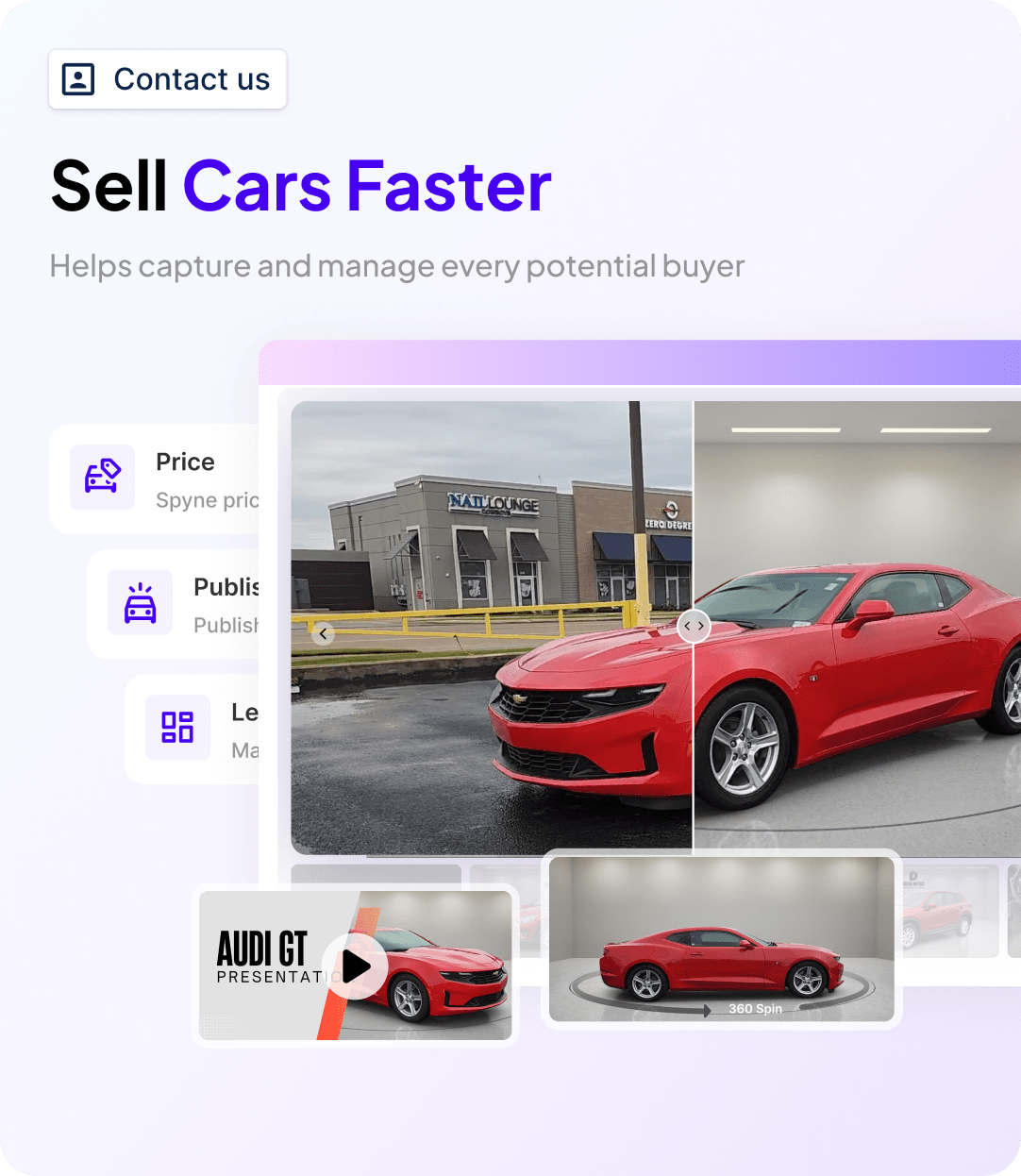
Spyne’s car dealer Inventory Management helps dealerships manage inventory across the full vehicle lifecycle, from acquisition and inspections to merchandising, pricing, publishing, and sales tracking. It sits at the center of lot operations, giving managers a live view of inventory health and where each unit stands on its path to the frontline. The goal is practical: move vehicles faster, keep listings clean and consistent, and cut the days that quietly drain gross profit. Here is how it supports day-to-day dealership work.
1. Inventory health dashboard
See every unit, its days in inventory, and its status in one view. A Used Car Manager can spot aging risk across the lot in seconds and decide what to reprice or promote before a unit becomes a problem.
2. Reconditioning workflow tracking
Follow each vehicle through recon and catch hold-ups early. With holding cost near $32 per vehicle per day (NCM Associates via Digital Dealer), clearing recon delays directly protects margin.
3. AI-assisted merchandising
Produce clean, consistent vehicle photos and complete listings quickly so units go live sale-ready. A store that merchandises within a day of recon starts drawing buyers while the vehicle is still fresh.
4. Listing publishing and syndication
Push consistent listings to the dealership website and sales channels so price and availability stay aligned everywhere a shopper looks.
5. Market-aware pricing support
Compare units against the local market to guide pricing, helping managers protect margin on in-demand vehicles and move slow segments before carrying costs pile up.
6. Lifecycle visibility and reporting
Track turn rate, days’ supply, and unit-level performance so acquisition decisions rest on the store’s own data, not guesswork.
7. Multi-rooftop oversight
For dealer groups, roll up inventory health across locations so leadership can compare store performance and shift stock where it sells.

Conclusion
Automotive inventory management software has moved from a nice-to-have to a requirement for any dealership serious about turn and gross. With used-vehicle days’ supply near 49 days and holding cost around $32 per unit per day (Cox Automotive and NCM Associates, 2025-2026), the stores that win are the ones that price to the live market, merchandise fast, and act on aging the moment it shows up. Adoption is already underway: 63% of dealers are investing in AI per Cox Automotive’s 2025 research, and dynamic pricing is the top area producing returns.
Whether you manage one rooftop or twenty, Spyne’s AI-powered inventory management solution minimizes days on lot. Book a demo now and see Spyne in action.