
The average U.S. dealership answers 65% of its inbound service calls. The other 35% reach voicemail, abandon on hold, or dial the next store on Google. At $470 per repair order, NADA’s 2025 benchmark, that gap isn’t a customer experience problem. It’s a fixed ops revenue problem.
Phone callers convert to appointments at 74%. Internet leads convert at 40%. Your phone is your highest-intent channel, and most stores are running it at two-thirds capacity.
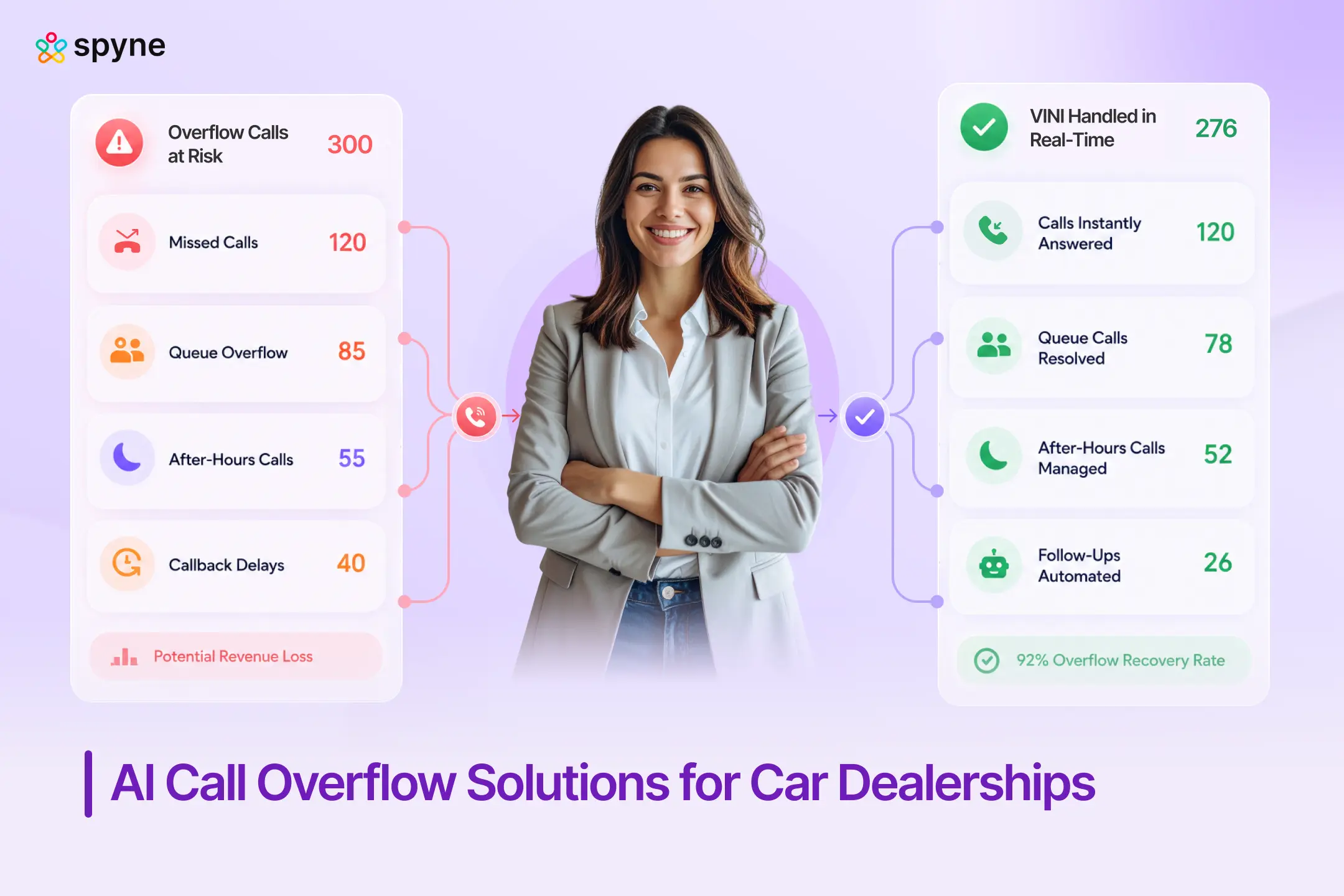
AI call overflow technology exists to close that gap, not by replacing your team, but by ensuring every call that comes in at 7 PM on a Friday gets answered the same way as one that comes in Monday morning.
This blog covers how it works in practice, which deployment model fits your operation, what to demand from vendors, and where Vini AI by Spyne fits in the stack.
The Call Coverage Problem Dealers Are Measuring Wrong
Most dealerships undercount missed calls. Their phone systems only flag calls that rang unanswered, but a call that ends in voicemail, a two-minute hold, or a failed transfer is also a missed call. The customer just didn’t complete what they called to do.
The scale of the problem, by the numbers:
- 1 in 3 U.S. dealerships miss at least 20% of inbound calls, some miss up to half
- 25% of leads go without follow-up for 24 hours
- 13% of leads are never logged into a CRM at all
- 154 missed calls per month, per dealer, STELLA Automotive, 2025
- $2M+ in potential revenue lost annually from unanswered calls and disconnected workflows
What dealers should actually be tracking:
- Total inbound call volume vs. connected calls
- Voicemails that were never returned
- Calls abandoned after being placed on hold
- Calls answered but failed to produce an appointment offer
- After-hours calls with zero resolution
This isn’t a staffing problem. Peaks, breaks, service rush, and after-hours are predictable gaps. Headcount alone can’t solve them without ballooning payroll.
Why the Phone Is Still Your Highest-Converting Channel
Dealers over-invest in digital lead generation while running their highest-converting channel at two-thirds capacity. The data makes the asymmetry hard to ignore:
- 74% of phone leads convert to appointments vs. 40% for internet leads, Car Wars, Q4 2024–April 2025
- 64% of service customers still book appointments over the phone, CDK 2025
- Gen Z books by phone at 65%, higher than millennials at 54%
The assumption that younger buyers prefer digital scheduling isn’t holding up.
CDK data also shows customers now prefer AI-powered scheduling over being sent to voicemail. Tolerance for “we’ll call you back” is gone.
Service retention makes this more urgent. In 2025, only 54% of owners with vehicles two years old or newer returned to the selling dealership for service, down from 72% in 2023. A missed call isn’t a one-time loss. It’s often the first step toward losing that customer to an independent shop permanently.
The Three Deployment Models for AI Call Overflow
Not every dealership needs the same configuration. The three operating models below represent a spectrum from low operational resistance to full-coverage automation.
Model 1: Overflow-Only (Lowest Resistance, Fastest Deployment)
AI activates only when all staff lines are busy. Human staff answer first. The AI catches the second and third ring when volume spikes.
Best for: Stores where call volume has identifiable peaks (Monday 10 AM to noon is the most active window, according to Car Wars 2024 data). Fastest path to ROI with minimal workflow disruption.
What dealers typically see: Captured overflow calls during service rush and lunch gaps, periods that previously went to voicemail.
Model 2: After-Hours Mode (Strong ROI, Easy to Justify)
AI handles all inbound calls evenings, weekends, and holidays. Books service appointments directly into the scheduling system. Human staff take over at opening with a clean appointment sheet.
Best for: Any dealership with significant call volume outside operating hours. One California multi-franchise group (3 stores) saw after-hours appointments climb from near zero to 38% of total bookings after deploying hybrid after-hours coverage, generating $120,000+ in annual gross profit from recaptured leads.
Why this is the standard entry point: It’s additive. The existing team is undisturbed. ROI shows up in the first billing cycle.
Model 3: AI Receptionist / BDC Front-End (Full Coverage Architecture)
AI answers all inbound calls as the first point of contact, routes intelligently, books where it can, and transfers to a live agent when the conversation requires it.
Best for: High-volume dealer groups where BDC headcount costs are rising and CRM attribution is inconsistent. AI handles the 70% of calls that are routine (directions, hours, appointment availability, status updates) so the team focuses on engaged buyers and negotiations.
The handoff problem: Pied Piper’s 2025 study found AI-handled calls at dealerships successfully scheduled appointments 86% of the time (versus 90% for human-handled calls), and handled the call successfully 91% of the time overall. The critical failure point: when AI couldn’t handle a request and attempted to transfer, those handoffs failed 56% of the time.
Handoff design, not voice quality, is the variable that separates functional deployments from expensive demos.
Why Most AI Call Tools Fail in Production (And What Doesn’t)
DMS/CRM integration depth, warm transfer quality, and appointment booking reliability are the make-or-break factors. Voice quality is table stakes.
Dealers who have deployed AI call systems consistently report the same failure modes:
- Robotic voice erodes trust, not because callers object to AI, but because they object to being obviously mishandled
- Generic AI breaks on automotive specifics, VIN lookup, recall questions, trade-in routing, parts availability, service advisor handoff
- Poor transfer logic frustrates staff, if the handoff arrives with no context, the advisor starts from scratch
- Integration gaps kill attribution, if the appointment isn’t logged in the CRM with source data, the ROI is invisible
Feature Checklist: What Dealers Actually Need
| Feature | Why It Matters |
| DMS Integration (CDK, Reynolds, Tekion, DealerSocket) | Appointment booking requires live access to schedules and RO data |
| CRM Auto-Logging | Every call needs to be captured with lead source, intent, and disposition |
| Warm Transfer with Context Summary | Advisor or BDC rep gets a brief before picking up, no cold starts |
| VIN Lookup | Enables accurate service history pulls and recall status |
| Service Appointment Scheduling | Core function, must connect to Xtime, CDK, or equivalent scheduler |
| Natural-Language Voice | Customers should not feel handled by a script |
| Multi-Lingual Support | Critical for dealerships in markets with Spanish, Mandarin, or other language-dominant customer bases |
| After-Hours and Overflow Modes | Must be configurable without IT involvement |
| Lead Recovery from Missed Calls | Automated callback or SMS within seconds of a missed call |
| Recall Campaign Outreach | Proactive call handling for open recall notifications |
The AI Call Overflow Landscape: Leading Platforms in 2026
The category has matured fast. Below is a working map of the major platforms currently operating in automotive AI call overflow.
1. Vini AI by Spyne
Best for: Dealer groups that need full-lifecycle coverage, from inbound call to confirmed CRM appointment, across sales and service
Vini AI handles 100% of inbound calls, chats, and web inquiries in real time, 24/7. It qualifies leads, checks live DMS/inventory data, books appointments directly into the scheduling system, and logs every interaction into the CRM with full lead source and intent data. Roughly 70% of routine interactions are handled without human transfer. Complex queries route to staff with a context summary already prepared. Multi-lingual support is built in.
Pro: Only platform in this list that covers the full communication loop, voice, chat, web leads, and CRM attribution, within a broader dealership operations platform that also includes inventory merchandising (Studio AI).
Con: Not a generic AI, trained exclusively on automotive dealership workflows, which means setup requires dealership-specific onboarding rather than a quick plug-and-play deployment.
Pricing: Custom pricing. Book a demo at spyne.ai.
2. Viova
Best for: Single-rooftop and mid-size dealerships looking for a purpose-built voice overflow solution
Viova is an AI voice agent built specifically for automotive dealerships. It answers every inbound call 24/7, books service appointments directly into the DMS, and schedules sales callbacks, covering both peak-hour overflow and after-hours gaps. It also handles warm transfers and SMS/email follow-up post-call.
Pro: Automotive-native from the ground up, not a generic voice bot retrofitted for dealerships. Con: Focused primarily on voice; limited information available on broader omnichannel or chat coverage.
3. Mia
Best for: Dealerships replacing traditional phone trees with intelligent call routing
Mia is an AI receptionist that answers every inbound call, routes callers to the right department without phone menus, books appointments, captures after-hours leads, and handles multiple languages, all 24/7/365. Calls that need a human are transferred with full context already prepared.
Pro: Conversational routing without “press 2 for service”, callers get handled based on what they actually say.
Con: Newer platform with limited publicly available deployment data or case studies.
4. Clearline
Best for: Dealerships wanting a unified AI front office across calls, lead follow-up, and appointment booking
Clearline positions itself as an “AI front office”, one platform that answers every call, follows up every lead, and books sales and service appointments around the clock. The platform includes a real-time analytics dashboard tracking calls handled, appointments booked, and average answer time.
Pro: Broad front-office coverage, calls, lead follow-up, and booking in one platform rather than stitched-together point solutions.
Con: Relatively new entrant; long-term DMS integration depth is not fully documented publicly.
5. MORI Automotive AI
Best for: Dealerships prioritizing a natural-sounding voice experience with live transfer capability
MORI is a virtual AI agent that answers every inbound call, handles routine requests, books service appointments, and connects customers with the right team member when escalation is needed. It integrates with multiple DMS and CRM platforms trusted by North American dealerships.
Pro: Strong emphasis on natural conversation quality and smooth human handoff with context. Con: Primarily voice-focused, no clear documentation of chat or web lead handling on the public site.
6. Dealer Surge AI
Best for: Dealer groups scaling inbound call handling and appointment generation across multiple rooftops
Dealer Surge AI combines voice AI, SMS, and lead nurturing in one platform, built for dealer groups that need conversation infrastructure at scale. It answers every call, engages every inbound lead, and books appointments 24/7 without adding headcount.
Pro: Multi-channel from the start, voice, SMS, and lead nurturing rather than voice-only.
Con: Limited publicly available case study data; integration depth with specific DMS platforms is not documented on the site.
Note: Platform comparisons shift fast in this category. Always request a live pilot using your actual DMS and call routing, not a sandbox environment.
How Vini AI Handles the Full Call Lifecycle
Most AI call platforms answer the phone. Vini AI is built to close the loop, from the first ring to a confirmed appointment in the CRM.
What Vini AI does:
Spyne’s conversational AI, Vini handles 100% of inbound calls, chats, and web inquiries across both sales and service departments, instantly, around the clock. It qualifies the lead, checks live DMS inventory or scheduling data, books the appointment, and logs the full interaction (including lead source and intent signals) directly into the CRM. Complex queries route to a human with a contextual summary already prepared.
Where Vini AI operates in the dealership:
Vini AI is deployed across five operational areas, not just overflow, and not just service.
- Service Department: Answers overflow and after-hours calls, books appointments directly into CDK or Xtime, handles recall questions, status update requests, and routine service inquiries without advisor involvement.
- Sales BDC: Handles inbound sales inquiries across phone, chat, and web. Qualifies on vehicle interest, budget range, and purchase timeline, then logs the enriched lead to CRM before a human rep ever picks up the conversation.
- BDC Overflow: Acts as an always-on extension of the BDC team. During peak hours, lunch windows, and after close, Vini catches every call the team can’t reach, books, qualifications, and logs without the lead going cold.
- Parts Department: Routes inbound parts inquiries, fleet service requests, and order status questions. Routine queries are handled end-to-end; complex or pricing-sensitive calls transfer to the counter with full context.
- Finance Department (Pilot): Currently in pilot deployment for F&I-adjacent queries, credit application status, document follow-ups, and financing availability questions, freeing up finance managers for in-deal work.
Vini AI Performance Benchmarks:
| Metric | Typical Result |
| Inbound Coverage | 100% of calls and chats answered instantly |
| Response Time | Under 60 seconds for 95% of inquiries |
| Lead-to-Appointment Conversion | +20–25% improvement |
| Routine Call Automation | ~70% of interactions handled without human transfer |
| ROI Timeline | 5–10x within the first 90 days |
| CSI Impact | +10–15% improvement reported by deployments |
| Advisor / Rep Productivity Gain | +15–25% efficiency lift |
The Spyne difference: Vini is not a standalone voice bot. It is the communication layer of Spyne’s broader dealership operations platform, the same platform that powers Studio AI for inventory merchandising. Dealer groups get unified lead data, unified CRM attribution, and a single vendor for both inbound communications and inventory presentation.
A Spyne survey of nearly 1,200 dealership executives found that 76% plan to increase their AI budgets for 2026, with 74% citing AI voice agents as their top investment priority for lead response, inbound call management, and service scheduling.

How to Evaluate AI Call Overflow Vendors: The Operator’s Framework
The right proof-of-concept KPI is missed-call recovery rate, not demo call quality. Run a 30-day pilot in the service department and measure the gap between calls received and appointments booked.
KPIs That Actually Predict Operational Value
| KPI | What It Measures | Benchmark to Beat |
| Missed-Call Recovery Rate | % of previously dropped calls now resulting in a callback or booking | >80% |
| Service Appointments Booked (AI-attributed) | Incremental appointments vs. baseline | +15–25% in first 90 days |
| Speed-to-Answer | Time from first ring to live engagement | Under 3 seconds |
| Appointment Show Rate | Quality of AI-booked appointments | >65% show rate |
| Human Transfer Accuracy | % of transfers that successfully connect with context | >90% |
| CRM Attribution Rate | % of AI-handled calls correctly logged | 100% target |
| After-Hours Booking Share | Appointments booked outside operating hours | Track against pre-deployment baseline |
The Right Deployment Sequence
Start here, not with full front-desk replacement:
- Week 1–2: Deploy in after-hours mode only. Measure appointment bookings vs. prior baseline.
- Week 3–4: Add overflow coverage during service rush hours (Monday–Tuesday, 10 AM–noon peak).
- Month 2: Expand to sales chat and web lead response.
- Month 3+: Evaluate full BDC front-end with data from first two phases.
This sequence generates measurable ROI quickly and builds internal confidence before broader rollout. Most dealer groups that start with after-hours coverage expand to full BDC automation within six months because the data is self-evident.
Closing Thoughts
The phone gap in automotive retail is not new. What is new is that the tools to close it have matured past the demo stage. The dealerships that are pulling ahead in service retention and appointment volume are not staffing their way to coverage, they’re deploying AI that handles the predictable, high-volume work so their teams can focus on the buyer standing in front of them.
Missed calls are a solvable problem in 2026. The math has been there for years. What changes now is execution.
If you want to see how Vini AI handles inbound coverage for a dealership your size, from the first ring to a confirmed appointment in your CRM, book a demo with Spyne.