
Most dealerships don’t lose the sale at the desk. They lose it before a buyer ever clicks through. Vehicle detail pages receive 75% of a dealership’s website traffic, and the difference between a click and a scroll is almost always the first photo. CDK research found that multiple custom photos increased VDP views by 349% over a single stock photo. Yet most used inventory still goes live with incomplete angle coverage, inconsistent backgrounds, and missing interior shots that quietly suppress lead volume every day.
This guide covers everything you need to standardize your listing photography in 2026: the complete 12-angle shot list and how to shoot each one, how many photos your listing actually needs, what Cars.com and AutoTrader reward, how Spyne’s Studio AI redefines post-production, what incomplete coverage actually costs, and how to make sure every lead your better listings generate gets captured.
Why Missing Photo Angles Cost Dealerships Real Money
A vehicle listed late or listed badly ages on the lot. At a benchmark holding cost of $46 per car per day, a five-day delay in publishing a complete listing burns $230 in gross per unit, before the lead-volume lift complete coverage delivers. Missing angles suppress VDP views, increase bounce rate, and push qualified buyers to a competitor’s listing within the same hour.
Cox Automotive’s 2025 Car Buyer Journey Study confirms that “mostly digital buyers”, those completing over 50% of the process online, report the highest satisfaction. Third-party platforms like Cars.com, AutoTrader, and Kelley Blue Book are increasingly the first and last stop in the shopping journey. The listing is the dealership.
A 2024 Redline survey of online vehicle shoppers found that 95% of consumers believe professional photographs increase a vehicle’s perceived value, 94% click professional-looking images first, and 57% feel less need to negotiate when listings show high-quality imagery. Photo quality is now a pricing lever, not just a marketing asset.
Most dealerships still take two to four days to move a vehicle from acquisition to a live, fully-merchandised listing. Incomplete angle coverage is one of the most common reasons listings get pulled for rework, adding three to five more days to the timeline.
How Many Photos Should a Used Car Listing Have in 2026?
A used car listing needs a minimum of 11 photos to compete on AutoTrader, Cars.com, and CarGurus. The operational standard for high-volume dealers is 20 to 30 photos covering all 12 required angles plus condition close-ups, feature highlights, and any visible wear. CDK Global research found that adding multiple custom photos increased VDP views by 349% compared to a single stock photo. More angles, more views, more leads, the relationship is linear within the 11–30 range.
The Industry Benchmark Data
| Photo Count | VDP Views Impact | Lead Volume Impact | Source |
| 1 stock photo | Baseline | Baseline | CDK Global |
| 1 custom photo | +166% vs. stock | Significant lift | CDK Global |
| Multiple custom photos | +349% vs. stock | Highest lift | CDK Global |
| 11+ photos (used) | +205% vs. ≤10 photos | +185% vs. ≤10 photos | AutoTrader |
| 11+ photos (new) | +211% vs. ≤10 photos | +167% vs. ≤10 photos | AutoTrader |
| 20+ photos | Highest engagement tier | Highest engagement tier | Industry consensus |
Important nuance: more photos only outperform when they show different things. Twelve photos of the same front three-quarter angle do not stack benefits. The shot list below exists because each angle answers a specific buyer question. Skip one and that question lives unanswered in the buyer’s head, and unanswered questions kill deals.
The Complete 12-Angle Shot List Every Dealer Listing Needs
The required photo angles for a car dealership listing aren’t a creative choice anymore. Every angle on the list below exists because it answers a specific buyer question that, left unanswered, becomes a bounce. Miss one and you don’t just have an incomplete gallery. You have a listing that’s actively losing qualified buyers to a competitor who answered the question you didn’t. The required photo angles for a car dealership listing in 2026 are:
1. Front Three-Quarter, The Hero Shot
The front three-quarter is the primary listing image and the single highest-traffic frame in any VDP carousel. It captures the car’s face, side length, and stance in one composition, the shot buyers form their first opinion from before they even click through.
How to shoot it:
- Position at the driver-side front corner, camera at hubcap height
- Turn front wheels 15–20 degrees outward to expose rim depth
- Use a 35–70mm focal length to avoid wide-angle distortion
- Shoot on a bright overcast day, direct midday sun creates harsh roof shadows on dark paint
2. Passenger-Side Front Three-Quarter
The mirror of the hero shot from the passenger side. Gives buyers a complete front-end read across both flanks and confirms there’s no damage the hero angle was hiding.
How to shoot it:
- Same geometry as the hero shot, opposite corner
- Match the hubcap-height position for visual consistency across the pair
- Ensure both three-quarter shots use the same background for a coherent gallery
3. Driver-Side Profile
The full broadside of the vehicle, the angle that communicates proportions, roofline, wheelbase, and panel condition in a single, unambiguous frame.
How to shoot it:
- Position the camera perfectly perpendicular to the car at 90 degrees
- Keep the wheels straight for a clean, symmetrical silhouette
- Step back and use a longer focal length (70–100mm) to avoid body distortion
- Capture all four wheels and the full roofline without cropping
4. Passenger-Side Profile
The mirror of the driver-side profile. Together, both profiles give buyers a full-vehicle condition read on both flanks, and confirm the body lines match end to end.
How to shoot it:
- Use the same distance, height, and focal length as the driver-side profile
- Consistency between the two profiles is what makes the pairing credible
5. Rear Three-Quarter
The rear three-quarter completes the exterior story. It shows tail lights, exhaust tips, bumper condition, and rear quarter panels, the angle buyers specifically check for reverse-parking damage and rear styling on SUVs and trucks.
How to shoot it:
- Position at the passenger-side rear corner, camera at hubcap height
- Use a 50–85mm lens to keep rear proportions realistic
- Ensure tail lights, badging, and exhaust tips are sharp and fully in frame
6. Front Straight-On
The centered, symmetrical front view. Buyers use this to confirm trim-specific details, grille design, headlight signatures, badge placement, and to assess front-end condition at a glance.
How to shoot it:
- Shoot perfectly centered, camera at headlight height
- Ensure both headlights are evenly framed and the grille is fully visible
- Keep wheels pointing straight to maintain symmetry
7. Rear Straight-On
The direct rear view. Confirms tail light design, badge, exhaust configuration, bumper condition, and trailer hitch presence, the last of which triggers a high volume of BDC inquiries when missing from truck and SUV listings.
How to shoot it:
- Center the frame on the badge and exhaust outlets
- Camera at tail light height for natural proportions
- Include the full rear bumper and tow hitch area in the frame
8. Dashboard and Infotainment
The most-viewed interior shot across every major listing platform. Buyers evaluate technology level, trim grade, and overall interior condition almost entirely from this single frame.
How to shoot it:
- Shoot from the driver’s seat with the door open wide
- Capture the full instrument cluster, steering wheel, center stack, and infotainment screen in one frame
- Turn on the infotainment display for a more complete, professional result
9. Front Seat Interior
The front cabin angle. Shows seat material, color, bolster condition, and door panel detail, the shot that tells buyers whether the interior matches what the listing describes.
How to shoot it:
- Capture both driver and passenger seats with the door panel visible in frame
- Use natural light from the open door; avoid flash, which flattens texture
- For leather interiors, angle to reveal any wear or stitching condition
10. Rear Seat Interior
The rear cabin view. Family buyers and multi-passenger vehicle shoppers look for this specifically, it communicates legroom, headroom, upholstery condition, and whether the vehicle is worth bringing in for a test drive.
How to shoot it:
- Shoot from outside the open rear door, capturing the full bench or captain’s chairs
- Include headrests, floor, and door panel in the frame
- For three-row SUVs, a second shot of the third row adds significant buyer confidence
11. Cargo Area or Trunk
The cargo view answers one of the most practically decisive questions in the used car buying process, especially for SUVs, wagons, and trucks where load capacity drives the purchase.
How to shoot it:
- Open the trunk or tailgate fully before shooting
- Capture from a position that shows the full cargo depth and floor condition
- Include tie-down hooks, cargo cover, and spare tire well if visible
12. Odometer Reading
The odometer close-up is the cheapest trust signal in the entire shot list. One frame eliminates a full category of mileage-inquiry calls and signals to every buyer that the listing has nothing to hide.
How to shoot it:
- Close-up of the instrument cluster with mileage clearly readable
- Shoot with the ignition on to ensure the display is fully lit
- Keep the frame tight, the mileage reading should dominate the shot
What Do Cars.com, AutoTrader, and CarGurus Actually Require?
None of the major U.S. marketplaces mandate a fixed shot list, but their search ranking algorithms reward listings with more photos. AutoTrader data shows used inventory listings with 11+ photos receive 205% more VDP views and 185% more leads than listings with 10 or fewer. CarGurus’ Deal Rating system factors photo coverage into listing visibility. Facebook Marketplace’s algorithm visibly favors clean-background imagery in its visual feed.
AutoTrader’s official guidance is 20+ photos minimum, with up to 100 supported per listing. Their merchandising research confirms that 75% of consumers consider multi-angle photos useful when evaluating a vehicle.
CarGurus’ Deal Rating algorithm controls placement in its national search results, and incorporates listing completeness including photo count and variety. Cars.com works on similar logic. A 5-photo listing can still appear, but it consistently ranks below a 20-photo competing listing at the same price.
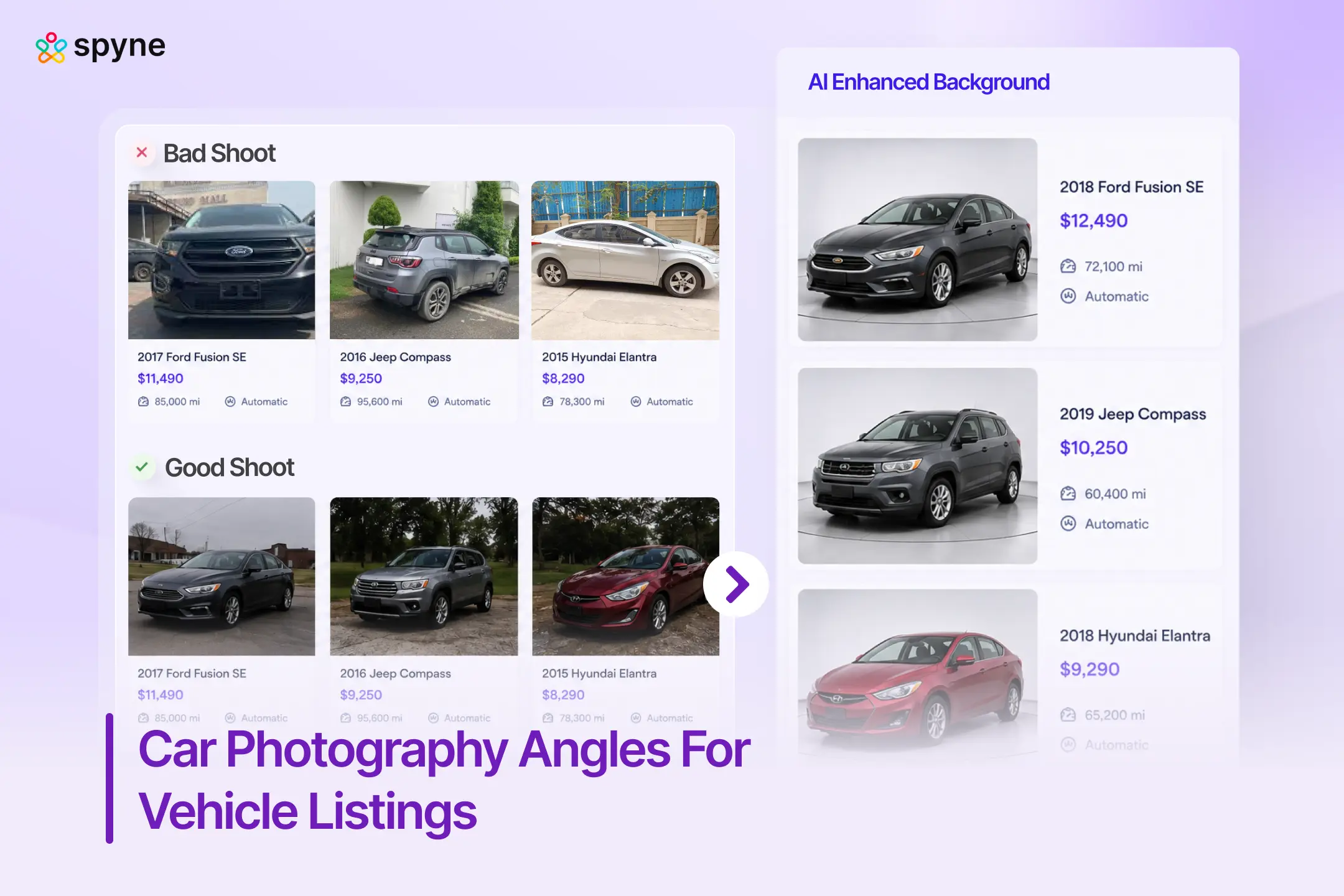
For Facebook Marketplace, listings with AI-edited professional backgrounds outperform organic-background captures, exactly the output Spyne’s Studio AI produces from standard smartphone captures, without requiring a dealership photo studio.
How Do You Get Consistent Car Photos Across Large Dealership Inventory?
Consistency at scale requires removing photographer dependency. When three staff members shoot the same vehicle and produce three different results, different framing, lighting, background, color cast, the inventory looks inconsistent online. The fix is enforcement: a guided capture workflow any staff member can follow, paired with AI post-processing that standardizes every output regardless of who shot it.
Lot photography is rarely owned by one person. Some days the porter shoots inventory. Some days the BDC supervisor steps in. Each operator has their own eye and willingness to wait for better light. The result: inventory that looks like it came from five different stores.
Spyne’s Studio AI removes that variance at two points. At capture, the mobile app guides any user through the 12-angle checklist with on-screen prompts. At post-processing, AI normalizes backgrounds, exposure, color, and shadowing so every vehicle looks like it came from the same studio, even when shot by five different people across three rooftops.
How Spyne’s Studio AI Enforces Photo Angle Compliance Automatically
Spyne’s Studio AI uses computer vision to identify which of the 12 required angles are present in each uploaded vehicle set. If any are missing, the system flags the vehicle before publication, eliminating the rework cycle of publishing, receiving complaints, pulling the listing, reshooting, and republishing. This pre-publication validation compresses time-to-line from 2–4 days to under 30 minutes per vehicle.
The standard dealership photography problem is not that staff don’t know the shot list. It is that under pressure, busy drop-off mornings, staff turnover, peak inventory weeks, shots get missed and nobody catches it until a buyer notices. Spyne fixes this at the point of capture.
Manual Workflow vs. Spyne-Enforced Workflow
| Operational Metric | Manual / Standard Process | Spyne Studio AI Enforced |
| Pre-publication angle check | None, discovered after listing | Flags missing angles before upload |
| Time-to-line (full coverage) | 2–4 days average | Under 30 minutes per vehicle |
| Output consistency | Varies by photographer | Standardized across rooftops |
| Missing angle detection | After buyer complaint | Before listing publishes |
| Background standardization | Manual edit or outsourced | AI background replacement included |
| Multi-marketplace export | Manual file management | One-click to Cars.com, AutoTrader, CarGurus |
| Interior lighting correction | Requires reshoot or editing | AI normalizes automatically |
| Cost per vehicle (avg.) | $18–$35 (third-party/in-house) | Built into platform pricing |
The economics are straightforward. If your store moves 80 used vehicles per month and shaves an average of 2 days off time-to-line, you recover roughly $7,360 in monthly holding cost, using the $46/day benchmark. Add the lift in lead volume from complete angle coverage and the math compounds. Studio AI is not a photography upgrade. It is an inventory throughput intervention.

3 Questions Every Used Car Manager Should Be Asking About Their Car Listings
Most dealerships treat inventory photography as a one-time task. Shoot it, upload it, move on. The operational consequences of incomplete coverage rarely get traced back to the listing, they show up instead as slow turns, price drops, and missed calls. Here’s what the data actually shows.
Do Missing Car Listing Photos Affect Time on Lot?
Yes, and the cost is specific. The 2025 industry average for used vehicles is 34 days on lot. Vehicles with weak or incomplete photography routinely exceed that by 10–20 days. At $46 per day in holding cost, every 10-day extension costs roughly $460 in gross per unit. Across a 150-car used inventory, that’s not a rounding error.
The compounding problem: under-photographed vehicles tend to be the ones that get repriced first. The dealer assumes the vehicle isn’t moving because of price, drops it $500, and the lead volume still doesn’t move, because the listing was never being viewed in the first place.
Does a Complete Car Tour Replace Standard Listing Photos?
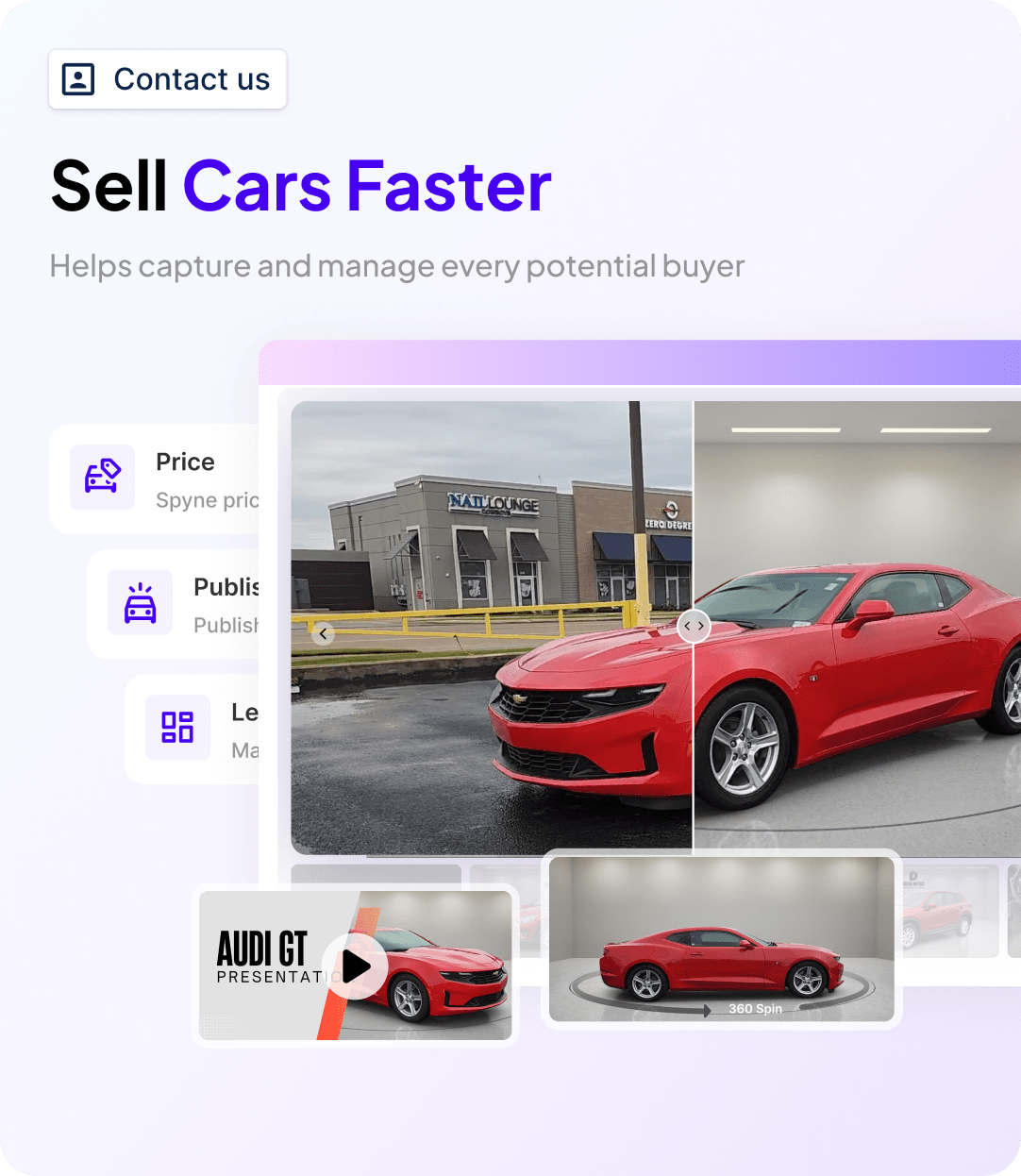
No. A Car tour complements the standard photo set; it does not replace it. Search result thumbnails and marketplace ranking algorithms still rely on standard 2D images for indexing. The car tours adds engagement depth on the VDP itself, it does not get the vehicle into search results in the first place.
Top-performing dealers use both: full 12-angle 2D coverage for search visibility, and a car tour for VDP dwell time and buyer confidence. Spyne supports both formats from the same capture workflow, the same five-minute shoot produces both deliverables, without doubling the photographer’s time.
Is Your Photo Workflow Consistent Enough to Scale Across Your Full Inventory?
Inconsistency is the silent killer of large-lot merchandising. One photographer frames the hero shot at eye level. Another shoots from the hip. A third skips the rear straight-on entirely because the lot was busy. The vehicle count stays the same, but the listing quality varies wildly, and buyers notice before dealers do.
Consistency at scale requires removing photographer dependency from the equation entirely. Spyne’s Studio AI guides any staff member through the 12-angle checklist via the mobile app, then normalizes backgrounds, exposure, and color in post-processing, so every vehicle across every rooftop looks like it came from the same studio shoot.
Closing Thoughts
The dealerships compounding the biggest gains in 2026 are not the ones with the best cameras or the largest in-house photo teams. They are the ones treating merchandising the way they treat reconditioning, as a process discipline with measurable inputs, enforced standards, and zero tolerance for variance across the rooftop.
If your team is still managing photo workflows the old way, porter shoots, marketing edits, marketplace upload, fingers crossed, there’s a faster, more consistent path. Book a demo with Spyne to see how Studio AI enforces angle coverage automatically and how Vini AI captures every lead the better listings generate.