
Phone leads convert to appointments at roughly 75%, nearly double the rate of internet form submissions. Yet most dealership BDCs run at 35–45% appointment set rates because their scripts are generic, their response times are slow, or their agents have no structured objection path. This guide covers the scripts that actually move buyers toward a commitment, the follow-up cadence that captures appointments competitors miss, and the AI tools that execute all of it when no human agent is available.
Why Phone Calls Still Drive Dealership Appointments in 2026?
A CDK Global survey published in April 2025 found that 64% of service customers still choose to call to book their appointment, while only 19% book online. For sales, phone and web booking are closer, 44% vs. 39%, but the phone still leads. Pied Piper’s 2025 Service
Scheduling Effectiveness study confirmed the same finding: two-thirds of service customers rely on the telephone, even as online scheduling options have expanded significantly. The stakes on that telephone call are enormous. NADA data shows U.S. dealerships wrote 270 million-plus repair orders in 2024, with service and parts sales exceeding $156 billion. Every one of those repair orders started with someone trying to reach the store.
Getting through is harder than it sounds. A Car Wars analysis across nearly 3,000 dealerships found that 31.8% of unconnected calls were customers hanging up while on hold, not going to voicemail, not asking for a callback, just leaving. Average hold time before the hang-up: three minutes and five seconds. That is an eternity when a buyer has three other dealerships to call with one tap.
The Monthly Math on Missed Calls and Weak Scripts
One missed call is not a missed call. It is a missed lifetime value event. Velocify research shows responding to a lead within 60 seconds boosts conversion by 391%. The average dealership takes over 90 minutes to respond to an internet inquiry (Pied Piper, 4,000-dealership study). Most stores are not losing on product or price. They are losing on the phone.
| Metric | Conservative Estimate |
| Internet leads per month | 150 |
| Close rate | 12% |
| Leads lost to slow response + weak scripts (est.) | 25–30% |
| Front gross per deal | $3,200 |
| F&I gross per deal | $2,100 |
| Service lifetime value per lost customer (5 yrs) | $5,200 |
| Total lifetime value per lost deal | $10,500 |
| Monthly recoverable gross (conservative 1/3 of losses) | $40,500–$48,000 |
That math does not account for referrals or repeat purchases. A BDC that moves from 40% to 65% appointment set rate on 100 monthly connected leads produces an estimated 25 additional appointments. At a 50% show rate and 24% close rate, that is three extra deals, $9,600 in front gross alone. Same leads, same staff, better words.
What Is a BDC at a Car Dealership?
A Business Development Center (BDC) is the department that handles all inbound and outbound customer communications before a buyer walks onto the sales floor. Specifically, the BDC:
- Answers inbound sales calls about inventory, pricing, and availability
- Responds to digital leads from the dealership website and third-party platforms
- Conducts outbound follow-up with unsold leads, be-backs, and declined service customers
- Makes outbound service reminder and retention calls
- Sets confirmed appointments for both the sales floor and service drive
A productive BDC agent handles 40–60 calls per day and targets 9–12 set appointments per shift, with individual calls averaging under three minutes. The BDC functions as the dealership’s lead qualification engine. The sales floor closes deals. The BDC fills the board.
How to Structure Every Dealership BDC Call?
Eighty percent of BDC scripts can be built from the same skeleton. Whether it is a service call or a sales call, the structure is identical.
| Step | Action | Key Phrase |
| 1 | Branded greeting + identity | “Thanks for calling [Dealership], this is [Name]. How can I help today?” |
| 2 | Clarify the goal | “Are you looking for a specific vehicle, or still comparing options?” |
| 3 | Capture contact while you work | “So I can text you the confirmation, what’s the best number?” |
| 4 | Answer the question, then bridge | “It’s available right now. The best way to make sure you don’t waste a trip is to set a time.” |
| 5 | Two-option close | “Would today at 5:15 or tomorrow at 10:30 work better?” |
| 6 | Confirm + next step | “I’ve got you for [day] at [time]. I’ll text you the confirmation now.” |
| 7 | Graceful escalation if needed | “Let me bring in [Advisor]. I’ll summarize so you don’t have to repeat anything.” |
Knowing which checkpoints your reps skip is half the coaching battle. Steps 5 and 6 are where most BDC calls break down, the agent provides good information but never makes the appointment ask.
Script #1: Inbound Sales Inquiry (“Is It Still Available?”)
This is the highest-converting call type in the BDC. The buyer has already self-qualified by submitting an inquiry or calling in. Do not re-qualify them. Assume interest and move directly toward an appointment.
Opening
“Thanks for calling [Dealership]. This is [Name]. You were looking at the [Year Make Model], it’s available right now. Do you have about two minutes?”
Referencing the specific vehicle confirms the agent reviewed the inquiry before calling. This immediately differentiates the call from generic outreach and earns the next 60 seconds of attention.
Appointment Ask
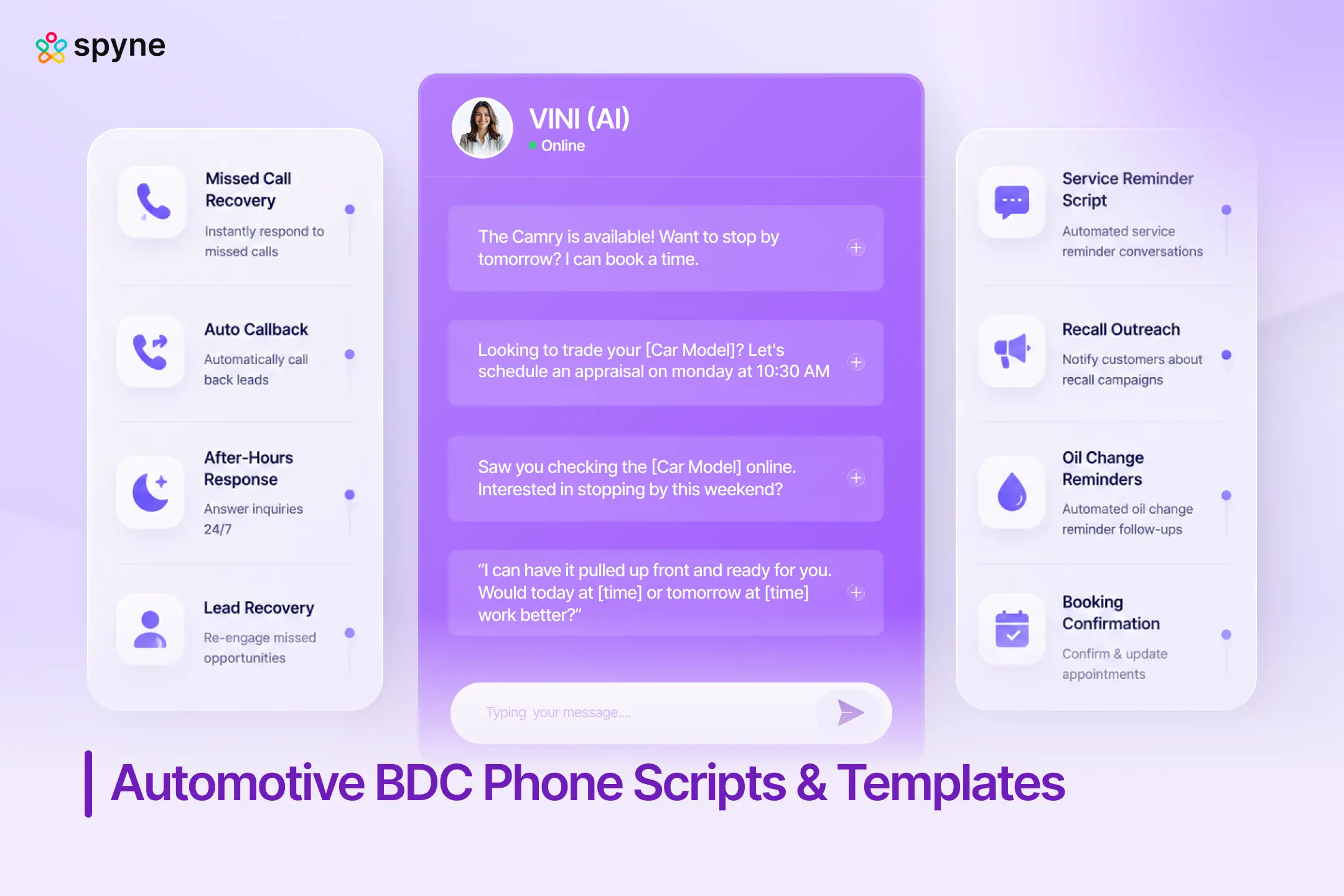
“I can have it pulled up front and ready for you. Would today at [time] or tomorrow at [time] work better?”
The two-option close (the alternative close) assumes the visit is happening and asks only about timing. Buyers who decline both options almost always counter with their own time, which is an implicit yes to the visit.
Objection: “I’m just browsing”
“Totally fair, most people start that way. Can I ask what matters most to you in your next vehicle? I want to make sure we have the right options ready when you come in.”
Validating the objection rather than arguing keeps the buyer in conversation. Buyers who feel pushed into a corner disengage. Buyers who feel helped self-convert to an appointment when their timeline advances.
Objection: “Just send me your best price”
“I want to give you real numbers, not a range that changes when you arrive. That takes 15 minutes in person and I can have everything ready for you. I’ve got time at [time] today, does that work?”
Treat price inquiries as the appointment setup they are. Answering honestly, adding context about what affects pricing, then pivoting to the visit preserves trust and removes the price-only comparison dynamic.
Script #2: Service Department Call, Oil Change and Routine Maintenance
Service calls carry a structural advantage over sales calls: the customer already has a relationship with the dealership. The script should use it. The non-negotiables for every service call: name, phone number, vehicle year/make/model, services needed, and transportation preference.
REP: Thanks for calling [Dealership] Service, this is [Name]. How can I help today?
CUSTOMER: I need an oil change.
REP: Perfect, we can take care of that. And who am I helping today?
CUSTOMER: [Name]
REP: Thanks [Name]. What’s the best number to text you your appointment confirmation?
CUSTOMER: [Phone]
REP: What vehicle are we servicing?
CUSTOMER: [Vehicle]
REP: Got it. For the oil change, are you also due for a tire rotation or multi-point inspection, or keeping it simple today?
REP: I can get you in [Day] at [Time A] or [Day] at [Time B]. Which works better?
REP: You’re set for [Day] at [Time]. Pull up to the service drive and we’ll get you checked in. Do you need a waiting appointment, shuttle, or loaner?
REP: Great. I’m texting you the confirmation now. Anything else before I let you go?
Starting with the day-part preference (morning vs. afternoon) rather than a specific time slot lowers the commitment threshold. Once the customer names a preference, narrowing to a specific time is much easier.
Script #3: Outbound Service Reminder Call
Opening
“Hi [Name], this is [Rep] from [Dealership]’s service department. Your [Year Model] is due for its [service type], and I wanted to get that scheduled before things fill up. Does morning or afternoon work better for you this week?”
Personal, specific, and creates mild urgency without manufactured pressure. ‘Before things fill up’ is factually accurate during busy service cycles and gives the customer a practical reason to decide now.
Script #4: Unsold Lead Follow-Up Sequence
The biggest mistake in outbound follow-up is leading with an appointment ask on the first contact. Buyers who feel chased on the first call disengage from all future attempts. The goal of the first contact is to keep the door open, not to close.
Day 1: First Contact
“Hi [Name], it’s [Rep] from [Dealership]. You were looking at the [Vehicle] and I wanted to see if you have any questions I can answer.”
Day 4 to 7: Be-Back Nurture
“Hi [Name], it’s [Rep] from [Dealership]. The [Vehicle] you were looking at is still here, I held it for you. Want to come take a look? I’ve got time this afternoon at [time] or tomorrow at [time].”
Adding specificity, the vehicle name, a concrete time offer, and the idea that the agent held it, activates reciprocity. The buyer feels the agent did something for them rather than following a mechanical cadence.
No-Show Recovery
“Hey [Name], something come up? No problem at all. The [Vehicle] is still here. Would tomorrow or Saturday work? I’ll have it pulled up front.”
Do not shame the no-show. Acknowledge, pivot immediately to rescheduling, and provide a concrete vehicle reference. Buyers who feel judged for missing an appointment rarely reschedule.

How to Write a BDC Voicemail Script for Car Dealerships
An ineffective voicemail is a missed follow-up attempt. An effective one is a pre-call that primes the buyer to answer or call back. Structure every voicemail in three parts:
- Who you are and why you are calling, name, dealership, specific vehicle or service
- One actionable piece of information the buyer can use before calling back, confirmed availability, price range, or an available slot
- Your callback number, stated twice
“Hi [Name], [Rep] at [Dealership]. The [Year Make Model] you asked about is still available, I can have it ready for you today or tomorrow. Call me back at [number] and I’ll give you a time. Again, that’s [number].”
Keep it under 30 seconds. Never leave a generic callback request. Research from Ringlead shows that leaving a voicemail followed immediately by a text gets 40% higher response than a voicemail alone, the text gives the buyer a second, frictionless channel to respond without committing to a live call.
How Many Times Should a BDC Call a Lead Before Stopping?
The accepted standard is a 14-day sequence of six to eight contact attempts across calls, texts, and email. Research from BDC practitioners consistently shows the majority of appointments are set on attempts four through seven, not on the first call. Stopping after one or two attempts captures only the most immediately ready buyers.
| Day | Contact Type | Goal |
| Day 1, within 5 minutes | Call + Text | First contact, confirm interest, soft appointment ask |
| Day 2 | Provide useful info, price context, vehicle comparison | |
| Day 4 | Call | Direct appointment ask with two time options |
| Day 7 | Call + Text | Stronger push, introduce alternative vehicles if needed |
| Day 10 | Long-form nurture, value-add content | |
| Day 14 | Call | Graceful close, move to long-term nurture |
| Monthly (ongoing) | Low-frequency brand touchpoint |
Speed matters as much as persistence. Leads contacted within five minutes convert at roughly three times the rate of leads contacted after an hour. At 30 minutes, lead-to-appointment conversion drops by more than 20%. The script does not matter if the call arrives too late.
What Is the Best Time of Day to Call Car Sales Leads?
Research on outbound call answer rates identifies two consistent high-performance windows:
- 8:00 AM to 9:00 AM, buyers are in pre-workday transition with elevated phone availability
- 4:00 PM to 6:00 PM, end-of-workday window, highest answer rates on weekdays
- 9:00 AM to 11:00 AM on weekends, buyers who submitted weekend inquiries are typically in active shopping mode
The lowest-performing window is 11:00 AM to 1:00 PM on weekdays. Answer rates drop significantly and voicemail rates are highest. Note that TCPA compliance rules prohibit calls before 8 AM or after 9 PM in the recipient’s time zone, with penalties up to $1,500 per violation. The 2025 TCPA rule update also requires specific dealer consent documentation for third-party leads.
For AI-powered BDC tools, immediate response, within five minutes of lead submission, consistently outperforms any time-of-day optimization. A perfectly timed call from an AI in the first five minutes outperforms a well-scripted human call an hour later.
How to Train BDC Agents for Better Appointment Set Rates
Script discipline alone does not produce high set rates. The training systems that close the gap between 40% and 65% share three characteristics: they use real calls as teaching material, they rehearse objection paths before the shift starts, and they make coaching a daily event rather than a quarterly review.
The Morning Meeting Drill
Effective BDC managers run 10–15 minute script drills at the start of every shift. One agent plays the buyer, one plays the rep. Rotate every three scenarios. Focus on the two decision points where calls break down: the appointment ask and the top two objections (just browsing, send me a price). Agents who have rehearsed an objection path three times that morning handle it naturally on a live call.
Call Recording and AI Scoring
AI call scoring tools now flag specific failure patterns: appointment ask skipped, price quoted without a pivot, call exceeding four minutes without a commitment. Rather than reviewing 100% of calls manually, managers review flagged calls only, typically 15–20% of volume. This compresses coaching cycles from monthly to weekly, which is the difference between catching a pattern after one agent and catching it before it spreads to the team.
The Two-Point Script Check
Every BDC call should pass two checks before it ends. First: did the agent make a specific appointment ask with a day and time, not just ‘when would you like to come in?’ Second: if the customer declined, did the agent offer an alternative time and confirm a next contact date? These two checkpoints separate high-performing BDC operations from average ones.
BDC Appointment Set Rate Benchmarks for 2026
| Metric | Average BDC | High-Performing BDC |
| Appointment set rate (connected calls) | 35–45% | 60–70% |
| Inbound call conversion (trained agents) | 40–50% | 60%+ |
| Lead response time | 90+ minutes | Under 5 minutes |
| Follow-up attempts before stopping | 1–2 attempts | 6–8 over 14 days |
| Leads with no 24-hr follow-up | ~25% | < 5% |
| Leads never logged in CRM | ~13% | < 2% |
The single most significant variable separating average from high-performing BDCs is response speed. Script quality is the second variable. Follow-up persistence is the third. Fixing response speed while keeping weak scripts still leaves money on the table.
Can AI Replace BDC Phone Agents at Car Dealerships in 2026?
AI can fully handle the highest-volume, most time-sensitive BDC tasks: first-touch lead contact, appointment scheduling, outbound text follow-up sequences, and service reminder calls. These tasks have strict performance requirements, sub-five-minute response, 24/7 availability, consistent execution, where AI’s structural advantages over human agents are measurable.
| Task | Advantage with AI (Like Vini) | Human Advantage |
| First-touch lead response | Sub-60 seconds, 24/7, no queue delay | None, speed favors AI |
| Appointment scheduling | No bandwidth limits, CRM auto-sync | Complex rescheduling or special requests |
| Outbound text follow-up | Full cadence executed consistently | Personalized negotiation follow-up |
| Service reminder calls | Zero drop rate, high volume | None for routine reminders |
| Standard objection handling | Trained on thousands of real dealer calls | Nuanced tone for relationship-sensitive calls |
| High-context conversations | Limited | Credit issues, negative equity, long-consideration buyers |
The highest-performing BDC operations in 2026 use AI for volume work and human agents for relationship-sensitive escalations. That is not a compromise, it is the optimal division of labor.
How Spyne Vini AI Applies These Scripts at Scale?
The scripts above work when they are executed consistently. The operational problem in most BDCs is not script quality, it is execution gaps. Shift schedules end. Call queues back up. Agents have variable energy. The most perfectly written script is worth nothing at 9 PM on a Saturday when no one picks up.
Vini AI eliminates those execution gaps for the tasks where they matter most:
- Responds to 100% of inbound calls, chats, and web inquiries within 60 seconds, including after hours and weekends when most BDC teams are offline.
- Checks live DMS and inventory data in real time before confirming vehicle availability, eliminating the trust-breaking experience of a buyer arriving for a vehicle that was already sold.
- Executes the full 14-day follow-up sequence automatically across calls, texts, and email, no missed contacts, no queue delays, no fatigue.
- Books confirmed appointments and syncs directly to the CRM, eliminating manual logging and the data gaps that make attribution reports unreliable.
- Handles 70% of routine inbound interactions automatically, freeing human agents to focus on high-context conversations where relationship matters.
Dealers using Vini AI see a 20–25% lift in lead-to-appointment conversion and typically achieve 5–10x ROI within the first 90 days, driven primarily by recovered opportunities that previously slipped through during off-hours and peak-volume windows.

Phone Compliance: What BDC Teams Need to Know in 2026
Compliance is not optional, and the 2025 TCPA rule changes tightened requirements significantly.
- No calls before 8 AM or after 9 PM in the recipient’s local time zone, violations carry penalties up to $1,500 per call
- The 2025 TCPA rule requires specific, documented dealership consent for leads sourced through third-party platforms, generic consent forms from lead aggregators no longer satisfy the requirement
- Texts require the same consent documentation as calls, do not assume form submission equals text consent
- Maintain a do-not-call list and honor opt-outs within 30 days
When in doubt, document consent at every touchpoint. The cost of a single TCPA class action dwarfs the operational inconvenience of a cleaner consent workflow.
Closing Thought
A BDC phone script is not a magic solution. It is a decision path with required checkpoints. The stores that consistently outperform on appointment set rates are not using dramatically different language. They are executing consistently: fast first contact, structured objection handling, persistent follow-up cadence, and two-option closes instead of open-ended questions.
The scripts in this guide are field-tested. They work. The harder operational question for most dealerships is not what to say, it is whether those words get said, at the right speed, at every hour of the day, on every lead, without gaps.
That is exactly where Spyne’s Vini AI changes the math. First-touch response in under 60 seconds. Full follow-up cadence executed automatically. Appointments booked and synced directly to your CRM. Your BDC team focused on the conversations that actually need a human, not burning capacity on routine contacts that AI handles better.
If your store is missing leads after hours, losing buyers to slow follow-up, or logging 13% of leads nowhere at all, it is worth seeing what the numbers look like with coverage gaps closed. Book a demo with Spyne and see exactly how Vini AI performs against your current BDC metrics.