
Executive SummaryDealerships lose roughly 30–40% of after-hours call volume to unanswered phones, and many of those buyers contact another store before the next business day. An AI-powered answering agent closes that gap by responding instantly to calls, texts, and chat, qualifying leads, and logging conversations directly into the CRM. This guide compares the 10 best AI call bots based on voice quality, integrations, scalability, pricing, and automation capabilities to help dealerships and businesses choose the right solution. |
Every missed business call can mean a lost lead, appointment, or sale. As customer expectations continue to rise, businesses can no longer afford long wait times or unanswered calls. In fact, 92% of customer service leaders say AI has improved their customer service operations, while 75% of customers are willing to spend more with businesses that deliver excellent customer experiences. AI call bots help businesses answer every call, automate routine conversations, qualify leads, and provide 24/7 support.
In this blog, you will learn about AI call bots and explore the top 10 leading call answering solutions for businesses. So, let’s dive deeper into the blog and explore it ASAP!
What is an AI Call Bot?
An AI call bot is a software application that automatically handles inbound and outbound phone calls through natural, human-like conversations. Powered by AI, Natural Language Processing (NLP), Natural Language Understanding (NLU), speech recognition, and text-to-speech technology, it understands customer intent, responds in real time, and performs tasks such as answering queries, qualifying leads, scheduling appointments, and routing calls. AI voice agents help businesses deliver 24/7 customer support, ensuring every call is answered without relying solely on human agents.
Traditional IVR vs AI Call Bot
Traditional IVR systems route callers through fixed menus like “Press 1 for Sales” or “Press 2 for Support.” AI call bots take a different approach by understanding natural language, engaging in human-like conversations, completing tasks, and escalating calls only when human assistance is needed.
Here’s how they compare:
| Feature | Traditional IVR | AI Call Bot |
| Interaction | Customers navigate pre-recorded menus using keypad inputs or simple voice commands. | Customers speak naturally, and the AI understands conversational language. |
| Intent Recognition | Recognizes menu selections or predefined keywords. | Understands customer intent, context, and follow-up questions using AI and NLP. |
| Conversation Flow | Follows fixed, rule-based call paths. | Adapts dynamically based on the conversation and customer responses. |
| Workflow Automation | Primarily routes calls or performs basic lookups. | Qualifies leads, books appointments, updates CRM records, sends confirmations, and automates business workflows. |
| Personalization | Delivers the same scripted experience to every caller. | Personalizes conversations using CRM data, customer history, and business context. |
| Integrations | Limited integrations for basic call routing. | Connects with CRMs, calendars, inventory systems, APIs, and other business applications. |
| Call Handoff | Transfers callers with little or no conversation context. | Seamlessly transfers calls along with the full conversation history, so customers don’t have to repeat themselves. |
| Best For | Basic call routing and simple self-service. | Customer support, lead qualification, appointment booking, sales, and end-to-end business automation. |
Key takeaway: While traditional IVR is designed to route calls efficiently, AI call bots are built to resolve customer requests. They combine conversational AI with business integrations to automate routine interactions, improve customer experiences, and reduce the workload on support and sales teams.
How does an AI Call Bot work?
Understanding how an AI call bot works helps you maximize utilization of its capabilities. AI phone agent picks up every call, recognizes customer voice, converts it into text, understands buyer intent, and delivers natural, human-like responses in real-time. This entire process happens almost instantly, allowing conversations to feel smooth and natural.
1. Telephony Infrastructure Connects the Call
Every conversation begins when a customer initiates a call. The AI voice agent is connected to the business’s telephone network or cloud telephony platform, which securely receives the call and streams the audio to the AI system. This enables the bot to answer calls 24/7 without needing a live agent.
2. Speech Recognition Converts Voice into Text
Once the customer starts speaking, Automatic Speech Recognition (ASR) technology transcribes the spoken words into text in real time. A modern AI Voice call bot can accurately understand different accents, speaking styles, and natural pauses, ensuring conversations remain accurate and uninterrupted.
3. AI Understands the Customer’s Intent
The transcribed text is then processed by a Large Language Model (LLM) and Natural Language Processing (NLP) engine. Instead of simply detecting keywords, the AI Conversation call bot analyzes the meaning, context, and intent behind the conversation. This allows it to answer follow-up questions, understand complex requests, and respond just like a human representative.
4. The Bot Retrieves Relevant Business Information
To provide accurate answers, the Call AI Bot connects with business systems like CRM software, inventory databases, calendars, appointment scheduling software, and knowledge bases. It can instantly retrieve customer information, check product availability, verify appointment slots, or access account details before generating a response.
6. It Completes Tasks During the Conversation
A modern AI Bot Call Center goes beyond answering questions by performing real business actions during the call. Depending on the use case, it can:
- Schedule appointments
- Qualify sales leads
- Book test drives or service visits
- Send SMS or email confirmations
- Update CRM records
- Route calls to the right department
- Trigger follow-up workflows
This helps businesses automate repetitive tasks while improving efficiency and customer satisfaction.
7. Handover Calls to Human Agents When Required
While an AI call bot online can handle a large percentage of routine conversations, it also knows when human expertise is needed. If a customer has a complex issue, requests a manager, or the conversation becomes sensitive, the AI agents can transfer the call to the appropriate representative along with the full conversation context. This ensures customers never have to repeat their information and receive the right level of support.
Top 8 Benefits of Using an AI Call Bot
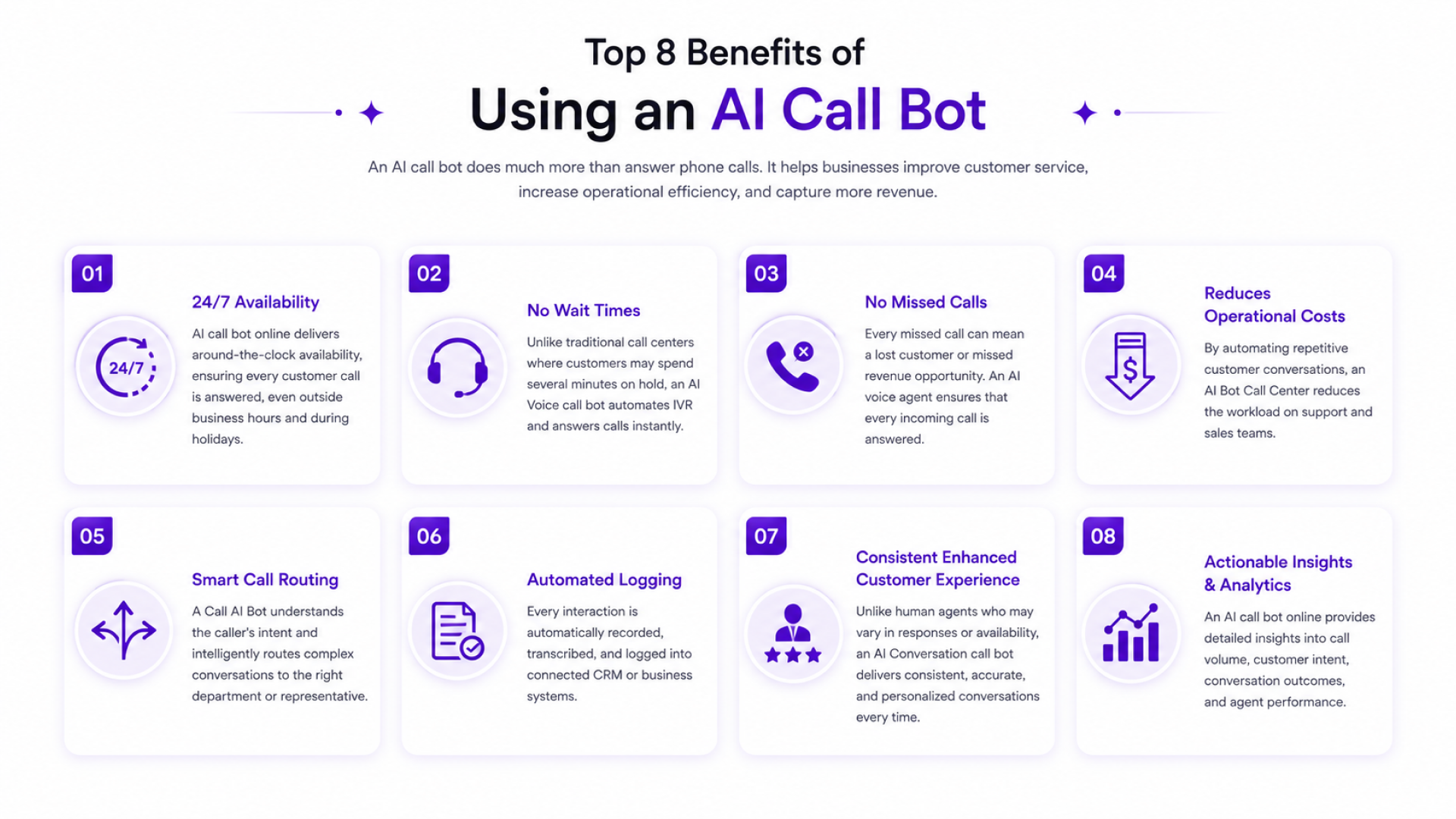
An AI call bot does much more than answer phone calls. It helps businesses improve customer service, increase operational efficiency, and capture more revenue by automating conversations that would otherwise require human intervention. Here are the top benefits businesses can expect from implementing an AI-powered calling solution.
1. 24/7 Availability
AI call bot online delivers around-the-clock availability, ensuring every customer call is answered, even outside business hours and during holidays. This allows businesses to capture leads and assist customers anytime without expanding support teams.
2. No Wait Times
Unlike traditional call centers where customers may spend several minutes on hold, an AI Voice call bot automates IVR and answers calls instantly. Immediate responses improve customer satisfaction, reduce abandonment rates, and create a smoother support experience.
3. No Missed Calls
Every missed call can mean a lost customer or missed revenue opportunity. An AI voice agent ensures that every incoming call is answered, helping businesses capture more leads, schedule appointments, and prevent opportunities from slipping away.
4. Reduces Operational Costs
By automating repetitive customer conversations, an AI Bot Call Center reduces the workload on support and sales teams. Businesses can handle higher call volumes without significantly increasing staffing costs, improving overall operational efficiency.
5. Smart Call Routing
A Call AI Bot understands the caller’s intent and intelligently routes complex conversations to the right department or representative. Smart call routing minimizes unnecessary transfers and helps customers reach the right person faster.
6. Automated Logging
Every interaction is automatically recorded, transcribed, and logged into connected CRM or business systems. This eliminates manual data entry, keeps customer records up to date, and provides teams with complete conversation history.
7. Consistent Enhanced Customer Experience
Unlike human agents who may vary in responses or availability, an AI Conversation call bot delivers consistent, accurate, and personalized conversations every time. Customers receive reliable support regardless of when they call.
8. Actionable Insights & Analytics
An AI call bot online provides detailed insights into call volume, customer intent, conversation outcomes, response quality, and agent performance. These analytics help businesses identify trends, optimize workflows, and continuously improve customer interactions.

Evaluation Criteria for Comparing the Best AI Call Bots
The need for careful evaluation is growing as Gartner predicts that by 2029, agentic AI will autonomously resolve 80% of common customer service issues, reducing operational costs by up to 30%. As AI becomes central to customer interactions, choosing the right platform is more important than ever.
1. Voice Quality and Realism
The best AI voice call agent should sound natural, conversational, and engaging, just like a real human. We evaluated voice clarity, pronunciation, pacing, emotional tone, and whether conversations felt human rather than robotic or repetitive.
2. Intent Recognition and Context Awareness
A perfect AI call bot should accurately understand customer intent, even when requests are vague or change mid-conversation. We assessed how well each platform retained context, remembered previous responses, and delivered relevant answers throughout the call.
3. Conversation Flexibility and Edge-Case Handling
Real customer conversations are unpredictable. We evaluated how effectively each AI Conversation call bot handled interruptions, background noise, incomplete information, slang, unexpected questions, and complex conversation flows without breaking the user experience.
4. Ease of Deployment and Integrations
Deployment speed plays a major role in adoption. We compared how easy it was to configure each platform and integrate it with CRMs, calendars, telephony providers, help desk software, APIs, and other business tools.
5. Customization and Workflow Control
Every business has unique processes. We assessed how much flexibility each platform offered for customizing conversation flows, selecting voices, configuring prompts, defining business rules, and managing fallback scenarios with minimal development effort.
6. Reliability and Customer Support
An AI Bot Call Center should perform consistently under real-world conditions. We considered platform uptime, call stability, product reliability, documentation quality, and the availability of customer support and technical resources.
7. Latency and Response Speed
Fast responses create better customer experiences. We evaluated how quickly each Call AI Bot processed customer queries and generated replies, ensuring conversations remained smooth without noticeable delays.
8. Security, Compliance, and Data Protection
For businesses handling sensitive customer information, security is essential. We reviewed each platform’s support for data privacy regulations, call recording controls, encryption standards, and compliance frameworks such as GDPR and HIPAA where applicable.
9. Pricing, Scalability, and Long-Term Value
Cost should remain predictable as businesses grow. We compared pricing structures, potential hidden costs, usage-based billing, and each platform’s ability to scale efficiently from small businesses to enterprise-level deployments without compromising performance.
10 Best AI Call Bots: At a Glance
| Tool | Best For | Standout Feature | Key Integrations | Pricing |
| Spyne AI | Automotive dealerships | End-to-end AI for Sales, Service, Parts, Finance & BDC | 50+ DMS, CRM, IMS & dealership platforms | Custom quote |
| Retell AI | Developers & enterprises | Low-latency conversational voice agents with extensive API support | Twilio, SIP providers, CRMs, APIs | From $0.07/min |
| Bland AI | High-volume inbound & outbound calling | Developer-first programmable voice workflows | CRMs, APIs, Webhooks, Calendars | Usage-based |
| Synthflow AI | No-code business automation | No-code AI voice builder with ready-made templates | Salesforce, HubSpot, Zapier, Twilio | From $29/month |
| Toma AI | Automotive dealerships | AI voice agents for service scheduling & dealership support | DMS, CRM & service scheduling platforms | Custom quote |
| Lindy AI | SMBs & operations teams | AI agents for voice, email & workflow automation | Salesforce, HubSpot, Slack, Gmail, Google Calendar | Free plan; paid from $49/month |
| Numa | Local businesses & dealerships | AI phone and SMS automation for customer communication | DMS, CRM, Scheduling software | Custom quote |
| Podium | Multi-location businesses | AI Employee for calls, messaging & lead management | CRM, DMS, Google Business Profile | Custom quote |
| Cognigy | Enterprise contact centers | Omnichannel conversational AI with enterprise orchestration | Salesforce, ServiceNow, Genesys, NICE | Custom quote |
| Vapi AI | Developers & SaaS teams | Modular voice AI with support for multiple LLMs and voice providers | OpenAI, Anthropic, Twilio, ElevenLabs, Deepgram | From $0.05/min |
Top 10 AI Voice Call Bots
Here is our top 10 leading AI bot call solutions list based on the criteria we have discussed above.
1. Spyne AI
Spyne’s AI agent “Vini AI” is built specifically for automotive dealerships. Unlike general-purpose voice AI platforms, it understands dealership workflows, customer journeys, inventory inquiries, service bookings, financing questions, and CRM processes. It helps dealerships answer every call, qualify leads, schedule appointments, and automate customer engagement 24/7.
Best for: Franchise and independent automotive dealerships looking to automate inbound and outbound customer conversations while increasing lead conversions, appointment bookings, and operational efficiency.
Pros:
- Built specifically for automotive dealerships with AI workflows for sales, service, BDC, finance, and parts.
- Automates lead qualification, appointment scheduling, follow-ups, and CRM updates to improve team productivity.
- Integrates with dealership CRMs, DMS platforms, and telephony systems for seamless operations.
Cons: Primarily trained on dealership workflows to act as AI for car dealerships.
Features:
- AI-powered inbound and outbound voice agents
- Lead qualification and appointment scheduling
- Intelligent call routing and warm transfers
- Automated CRM and DMS updates
- Multi-department conversational AI (Sales, Service, Parts, Finance)
- Real-time call summaries and analytics
- 24/7 customer support automation
Integrations: Spyne seamlessly integrates with 50+ dealership systems, including leading DMS, CRM, inventory management systems (IMS), website platforms, and online marketplaces. It synchronizes customer data, inventory, conversations, and appointments in real time, allowing dealerships to automate workflows without disrupting their existing tech stack.
Pricing: Spyne pricing offers custom pricing based on dealership size, call volume, and implementation requirements. Book a demo or contact the sales team for a personalized quote.
2. Retell AI
Retell AI is one of the most popular developer-first AI voice platforms for building highly customizable voice agents. It combines low-latency speech recognition, LLM-powered conversations, and real-time function calling, making it suitable for customer support, healthcare, fintech, logistics, and enterprise automation.
Best For: Developers, enterprises, and SaaS companies looking to build customizable AI voice agents with extensive API support and enterprise-grade scalability.
Pros:
- Extremely low voice latency (around 600 ms)
- Supports real-time function calling and API integrations
- Strong documentation and developer ecosystem
Cons: It is highly developer-focused, so businesses without technical expertise may require engineering support for implementation and customization.
Features:
- Low-latency conversational voice AI
- Real-time speech recognition and synthesis
- Function calling and workflow automation
- Human-like voice models
- Call recording and analytics
- Knowledge base integration
- SIP trunking and telephony support
Integrations: Retell AI integrates with Twilio, SIP providers, CRMs, APIs, webhooks, calendars, and custom backend systems. Its developer-first architecture makes it easy to connect AI agents with existing enterprise workflows and business applications.
Pricing: Retell AI offers a Pay-as-you-go plan starting at $0.07 per minute, along with free trial credits. Enterprise customers can choose custom pricing with dedicated support and higher concurrency limits.
3. Bland AI
Bland AI is a developer-first AI voice platform designed to build scalable voice agents for both inbound and outbound phone calls. It enables businesses to create highly customizable conversational AI workflows using APIs, making it a popular choice for sales, customer support, healthcare, and enterprise automation.
Best For: Developers, startups, and enterprises looking to build highly customizable AI voice agents for large-scale inbound and outbound calling.
Pros:
- Offers highly realistic AI voices with fast response times.
- Supports large-scale outbound calling and programmable voice workflows.
- Provides flexible APIs and enterprise-grade infrastructure for custom integrations.
Cons: Bland AI is designed primarily for developers, making it less suitable for businesses seeking a no-code or plug-and-play AI calling solution.
Features:
- AI-powered inbound and outbound voice agents
- Real-time speech recognition and text-to-speech
- Custom conversation workflows
- API and webhook support
- Call recording and transcripts
- Function calling and workflow automation
- Multilingual voice support
Integrations: Bland AI integrates with CRMs, APIs, webhooks, telephony providers, calendars, and custom business applications, allowing organizations to automate complex voice workflows across their existing technology stack.
Pricing: Bland AI follows a usage-based pricing model, with pricing based on call duration and AI usage. Businesses can contact the sales team for enterprise pricing and volume discounts.
4. Synthflow AI
Synthflow AI is a no-code conversational AI platform that enables businesses to create AI voice agents without writing code. It focuses on helping sales, customer support, healthcare, real estate, and service businesses automate phone conversations using pre-built templates and workflow automation.
Best For: Small businesses, agencies, and non-technical teams looking for a no-code AI voice agent that can be deployed quickly.
Pros:
- No-code platform that makes AI voice agent creation quick and easy.
- Offers ready-to-use templates for common business workflows.
- Supports multilingual conversations with CRM and automation integrations.
Cons: While easy to deploy, Synthflow AI offers less flexibility for highly customized enterprise workflows compared to developer-first voice AI platforms.
Features:
- No-code AI voice agent builder
- Inbound and outbound call automation
- Appointment scheduling
- CRM synchronization
- Workflow automation
- Multilingual voice support
- Conversation analytics and reporting
Integrations: Synthflow AI integrates with Salesforce, HubSpot, GoHighLevel, Zapier, Make, Twilio, Google Calendar, and other business applications, enabling businesses to automate customer communication without extensive technical setup.
Pricing: Synthflow AI offers subscription-based pricing, with paid plans starting at approximately $29/month, while higher-tier plans provide additional call minutes, advanced features, and enterprise capabilities. Custom pricing is also available for larger organizations.
5. Toma
Toma is an AI voice agent platform built specifically for the automotive industry. It helps dealerships automate inbound phone calls, schedule service appointments, answer customer inquiries, and manage high call volumes, allowing dealership staff to focus on delivering better customer experiences.
Best For: Automotive dealerships looking to automate service scheduling, customer support, and inbound call handling with industry-specific AI.
Pros:
- Purpose-built for automotive dealership workflows and service departments.
- Automates appointment booking, call handling, and routine customer inquiries.
- Integrates with dealership systems to streamline operations and improve efficiency.
Cons: Toma is primarily designed for automotive dealerships, making it less suitable for businesses in other industries or those requiring broader conversational AI use cases.
Features:
- AI-powered inbound call handling
- Automated service appointment scheduling
- Customer inquiry resolution
- Intelligent call routing
- Real-time conversation summaries
- CRM and dealership system integration
- After-hours call automation
Integrations: Toma integrates with dealership management systems (DMS), service scheduling platforms, CRM software, and telephony solutions, enabling dealerships to automate customer interactions while keeping data synchronized across systems.
Pricing: Toma does not publicly disclose its pricing. Businesses need to contact the sales team for a custom quote based on dealership size and operational requirements.
6. Lindy AI
Lindy AI is a no-code AI automation platform that enables businesses to create AI agents for phone calls, emails, meetings, and workflow automation. Its AI phone agents can answer calls, qualify leads, book appointments, and integrate with hundreds of business applications, making it a flexible solution for teams across multiple industries.
Best For: Small businesses, startups, and operations teams looking for a no-code AI platform to automate phone calls and business workflows.
Pros:
- No-code platform that makes building AI phone agents simple and fast.
- Supports voice calls, emails, scheduling, and workflow automation from a single platform.
- Integrates with hundreds of popular business applications through native integrations and automation tools.
Cons: While highly versatile, Lindy AI is a general-purpose automation platform and may require additional configuration for industry-specific workflows and complex enterprise use cases.
Features:
- AI phone call automation
- Lead qualification and appointment scheduling
- Email and meeting automation
- Workflow builder with AI agents
- Knowledge base integration
- Conversation memory and context retention
- Multi-channel automation
Integrations: Lindy AI integrates with Salesforce, HubSpot, Slack, Gmail, Google Calendar, Zoom, Notion, Zapier, Make, and hundreds of other business applications, enabling businesses to automate customer communication and internal workflows from a single platform.
Pricing: Lindy AI offers a Free plan, with paid plans starting at $49/month. Higher-tier plans provide additional AI credits, premium integrations, and advanced automation capabilities, while enterprise pricing is available for larger organizations.
7. Numa
Numa is an AI-powered customer communication platform built for local businesses, helping them automate phone calls, text messages, and customer inquiries. It focuses on reducing missed calls and improving response times by handling routine conversations while seamlessly handing off complex interactions to human staff.
Best For: Local businesses, automotive dealerships, repair shops, and service-based businesses looking to automate customer communication and appointment management.
Pros:
- Automates phone calls, text messaging, and appointment scheduling from a single platform.
- Reduces missed calls with 24/7 AI-powered customer engagement.
- Integrates with business management systems to streamline customer communication.
Cons: Numa is primarily designed for customer communication automation and offers fewer workflow customization options than developer-first AI voice platforms.
Features:
- AI-powered phone call automation
- Automated SMS conversations
- Appointment scheduling and reminders
- Intelligent call routing
- Customer inquiry resolution
- Call summaries and conversation history
- Business-hours and after-hours automation
Integrations: Numa integrates with dealership management systems, CRMs, scheduling software, Google Business Profile, and business phone systems, allowing businesses to centralize customer communication and automate everyday interactions.
Pricing: Numa offers custom pricing based on business size, communication volume, and feature requirements. Interested businesses need to contact the sales team for a personalized quote.
8. Podium
Podium is an all-in-one lead conversion platform, with an AI Employee named Jerry that answers every call, works every lead, and books directly into the dealership’s systems 24/7. Backed by 10+ years of industry conversation data.
Best For: Multi-location businesses, automotive dealerships, healthcare providers, and service businesses looking to centralize customer communication and improve lead response.
Pros:
- Combines AI voice, SMS, web chat, reviews, and payments in one platform.
- Helps businesses capture and respond to leads faster with AI-powered automation.
- Offers a unified inbox for managing customer conversations across multiple channels.
Cons: Podium offers a broader customer communication platform rather than a dedicated AI voice solution, so businesses seeking advanced voice AI capabilities may require additional tools.
Features:
- AI Employee for customer conversations
- AI-powered web chat and messaging
- Lead capture and qualification
- Unified inbox
- Review management
- Payment collection
- Customer communication analytics
Integrations: Podium integrates with leading CRMs, dealership management systems, website platforms, payment solutions, Google Business Profile, and business applications, helping businesses manage customer interactions from a single platform.
Pricing: Podium provides custom pricing based on the products and features selected. Businesses can request a personalized quote from the sales team, while select plans may include a free trial.
9. Cognigy
Cognigy is an enterprise-grade conversational AI platform that enables businesses to build intelligent voice and chat agents for customer service and contact center automation. With advanced AI orchestration, multilingual support, and enterprise integrations, it helps organizations automate complex customer interactions at scale.
Best For: Large enterprises and contact centers looking for a scalable conversational AI platform with advanced workflow automation and omnichannel support.
Pros:
- Supports enterprise-scale voice and chat automation across multiple channels.
- Offers advanced workflow orchestration, multilingual AI, and powerful analytics.
- Integrates with leading contact center, CRM, and enterprise business applications.
Cons: Cognigy is designed for enterprise deployments, so implementation can be complex and may require technical expertise and a higher investment.
Features:
- AI-powered voice and chat agents
- Omnichannel customer engagement
- Intelligent workflow automation
- Multilingual conversational AI
- Live agent handoff
- Conversation analytics and reporting
- Enterprise-grade security and governance
Integrations: Cognigy integrates with Salesforce, Microsoft Dynamics 365, ServiceNow, Genesys, NICE, Twilio, SAP, Azure, AWS, and numerous enterprise applications, enabling businesses to automate customer interactions across their existing technology ecosystem.
Pricing: Cognigy offers custom enterprise pricing based on deployment size, usage, and business requirements. Organizations need to contact the sales team for a personalized quote.
10. Vapi
Vapi is a developer-first voice AI platform that enables businesses to build, deploy, and scale real-time AI phone agents using their preferred speech recognition, language models, and voice providers. Its flexible API architecture makes it popular among developers building custom voice applications.
Best For: Developers and SaaS companies looking to build highly customizable real-time AI voice agents with complete control over their AI stack.
Pros:
- Provides extensive APIs for building fully customizable AI voice applications.
- Supports multiple LLMs, speech-to-text, and text-to-speech providers.
- Delivers low-latency voice conversations with flexible deployment options.
Cons: Vapi is primarily built for developers, making it less suitable for businesses seeking a no-code AI call bot or ready-to-use industry workflows.
Features:
- Real-time AI voice agents
- Custom LLM integration
- Speech-to-text and text-to-speech support
- Function calling and API automation
- Call recording and transcripts
- Webhook and SDK support
- Conversation analytics
Integrations: Vapi integrates with OpenAI, Anthropic, Google Gemini, ElevenLabs, Deepgram, Twilio, Vonage, SIP providers, webhooks, and custom APIs, allowing developers to build tailored voice AI solutions using their preferred technology stack.
Pricing: Vapi offers a usage-based pricing model, with paid plans starting at $0.05 per minute, while enterprise customers can opt for custom pricing with additional support and higher usage limits.
How to Choose the Right AI Call Bot Platform?
All these platforms are top-tier, but when it comes to choosing the right AI call handling solution vendor for your business, there are a few things to keep in mind and prioritize.
1. Niche Understanding
The AI phone call solution should be able to understand your product, service, and customers. Having an AI specifically built for your industry delivers the most accurate responses.
2. Conversation Quality
The AI should be able to make natural and human-like conversations. It should be able to understand your customer behaviour, tone, and intent. This helps in delivering a consistent, enhanced customer experience.
3. Advanced Features
Choose an AI call bot that goes beyond just answering calls. Look for AI that can be your AI receptionist, qualify leads, book appointments, route calls smartly, update CRM automatically, track calls, and provide real-time analytics. These advanced features help automate workflows, improve customer experiences, and maximize business efficiency.
4. Integrations
Choose an AI call bot that integrates effortlessly with your existing systems. A platform with robust integration capabilities offers greater flexibility, enabling you to connect with new tools, automate workflows, and scale your operations without disrupting existing processes.
5. Total Cost of Ownership
Look beyond the base subscription price and evaluate the overall cost of using the platform. Choose a conversational AI call bot vendor with transparent pricing, minimal hidden charges, and a cost structure that fits your budget while delivering the features, scalability, and long-term value your business needs.
Spyne’s Conversational AI Call Bot Brings All These Capabilities Together
Spyne helps automate customer conversations, capture every lead, and deliver exceptional customer experiences. At most, our pricing is customizable based on the features you choose for your business, so there are no hidden costs. You pay only for what you get.
Dealerships using Spyne’s Conversational AI call bot have seen measurable improvements in customer engagement, operational efficiency, and revenue growth. Here are some of the key results you can explore:
- Recovered over $314K in revenue within just 30 days while achieving a 48% appointment-to-sale conversion rate by automating inbound calls, lead qualification, and recall campaigns.
- Increased lead conversions by 2.3×, achieved 100% inbound call coverage, and improved overall sales performance by 25% with AI-powered customer engagement.
- Captured 30% more service demand and ensured 100% after-hours call coverage, helping dealerships never miss customer inquiries outside business hours.
- Unlocked 25% more service appointments, improved lead engagement, and accelerated response times by automating customer conversations, enabling dealership teams to focus on high-value sales opportunities.
- Captured 15% More Leads After Hours, reduced manual call handling while improving customer responsiveness through AI-powered appointment scheduling, intelligent call routing, and automated follow-ups.

Conclusion
Choosing the right AI call bot depends on your business goals, industry, and the level of automation you need. While some platforms are built for developers and enterprise teams, others focus on no-code deployment or industry-specific workflows. Evaluating factors like conversation quality, integrations, scalability, pricing, and customization will help you invest in a solution that delivers long-term value.
If you’re an automotive dealership looking to automate customer conversations, qualify more leads, and book more appointments, Spyne’s Conversational AI call bot is built specifically for your needs. Book a demo today and discover how Spyne AI can help you answer every call, improve customer experiences, and drive more revenue.