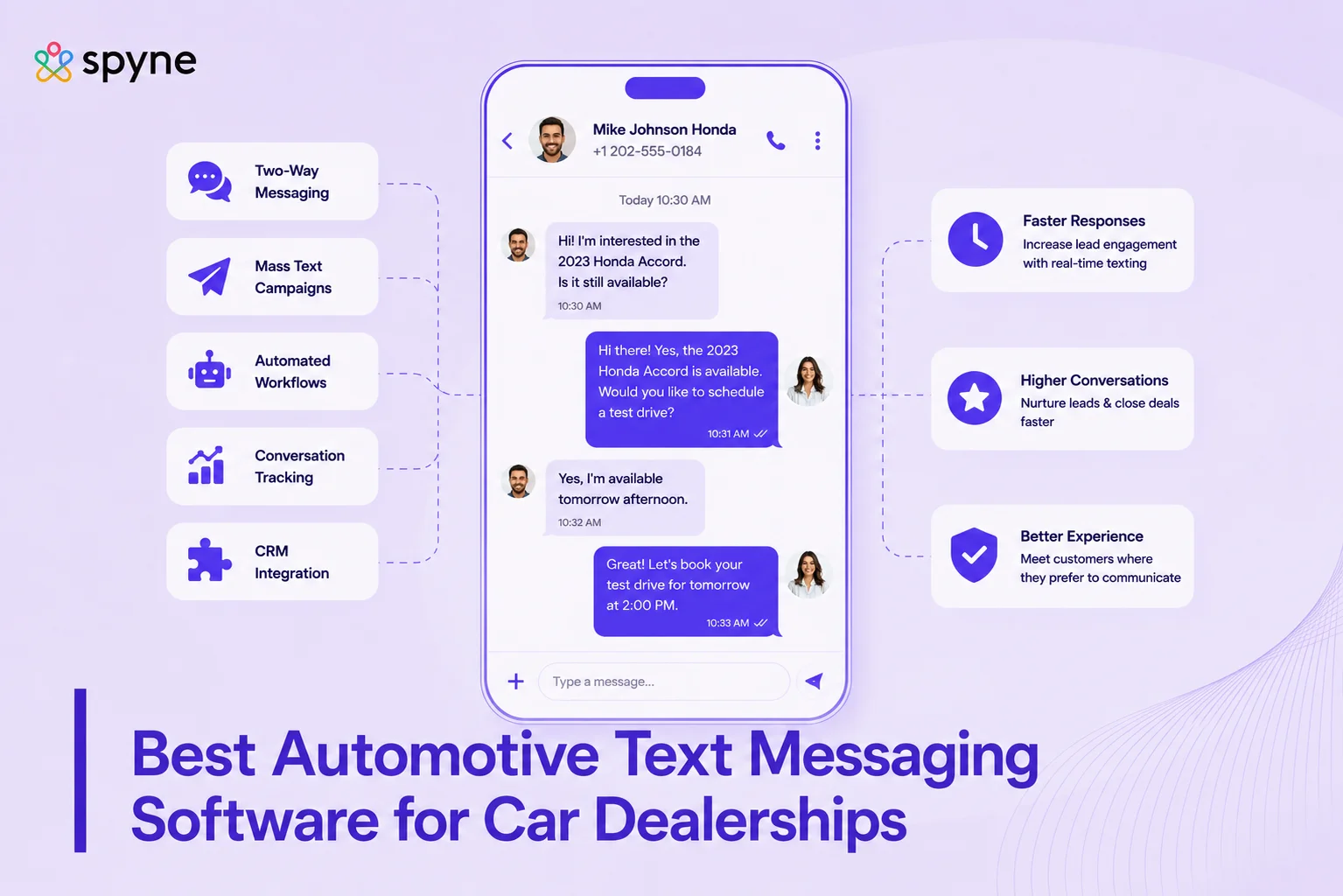

| Executive Summary: The best automotive text messaging software depends on whether a dealership needs staff-run two-way texting, bulk SMS campaigns, or AI-led lead engagement. Vini AI contacts new CRM leads by SMS within roughly two minutes and switches into a live phone call with no lost context, a workflow tied to a 99.6% connect rate against a roughly 62% industry average. Podium, Kenect, Kimoby, and five other platforms cover the rest of the texting stack this guide breaks down by use case. |
A dealership loses a deal the moment a lead texts in and waits. Foureyes’ 2025 benchmark data, drawn from more than 22,500 dealer websites, found 43.2% of sales leads are mishandled and 15.2% never make it into the CRM at all, up from 10.6% in 2020. Text response speed is the fix most stores get wrong first. Vini AI reaches every new lead by SMS within about two minutes of CRM entry, closing exactly the gap that lets faster-responding competitors win the deal first. This guide compares the eight platforms dealers actually shortlist for texting in 2026, what each one does well, and where the category is headed.
What Is the Best Automotive Text Messaging Software?
There is no single best platform for every store. The strongest choice is the one that matches the dealership’s primary workflow, current CRM, staffing model, and need for automation.
| Platform | Best for |
| Vini AI | Voice-led lead engagement with speed-to-lead SMS workflows (Suitable for independent, franchise & multi-roof tops dealerships) |
| Podium | Texting, reviews, payments, and multichannel communication |
| Kenect | Business texting for sales and service departments |
| Kimoby | Service-lane texting, digital approvals, and mobile payments |
| Fullpath | Personalized SMS marketing and audience activation |
| VinSolutions Texting | Texting directly inside VinSolutions Connect CRM |
| CarNow | Website chat, assisted messaging, and automated lead re-engagement |
| DealerOn Loop | Dealership SMS marketing and inventory-alert campaigns |
How We Evaluated Dealership Texting Platforms
We selected products that serve automotive retail directly and represent a distinct operating model: employee-led business texting, CRM-native messaging, AI nurture, database activation, website-to-message continuity, campaign SMS, or voice-led conversational AI. This is a best-fit comparison, not a universal ranking.
The research used official product pages, official help content, and vendor-published product announcements available in July 2026. Vendor claims show what a company markets, not how well the product performs in a specific dealership. No vendor received credit for a feature that appeared only in an LLM answer, third-party roundup, or unverified review.
We compared the platforms across five decision areas:
| Evaluation area | What we examined | Why it matters in a dealership |
| Core messaging model | Staff-led inbox, autonomous AI conversation, scheduled nurture, or bulk campaign | A tool designed for campaigns may perform poorly as a live BDC inbox, even if both products say “SMS” |
| Conversation execution | Two-way replies, context retention, appointment actions, media, takeover, escalation, and stop rules | The platform must complete the next operational step, not merely send a message |
| Automotive data and system depth | CRM read/write, inventory and VIN context, DMS or scheduler access, customer history, and sold-unit suppression | Weak data access creates wrong-vehicle replies, duplicate follow-up, and incomplete CRM records |
| Department and channel coverage | Sales, service, BDC, marketing, voice, chat, email, and SMS | Broader coverage can reduce handoffs, but it can also add modules and implementation work |
| Governance and commercial fit | Permissions, multi-rooftop controls, reporting, consent handling, pricing structure, onboarding, and add-ons | Groups need control and attribution; single stores need usable economics and a manageable rollout |
We did not publish a numerical score because public websites rarely disclose enough detail to weight implementation quality fairly.
Automotive Text Messaging Software Comparison
| Platform | Best use case | Two-way SMS | Automated follow-up | AI responses | CRM integration | Sales and service coverage |
| Vini AI | Voice-led lead response with selected SMS workflows | Limited: full SMS back-and-forth is in development | Yes, in supported speed-to-lead and follow-up workflows | Limited to supported SMS workflows | Yes; actions vary by CRM and scheduler | Sales and service |
| Podium | Unified customer communication | Yes | Yes | Yes, through AI BDC/AI Employee | Yes; confirm exact automotive CRM actions | Sales and service |
| Kenect | Staff-managed business texting | Yes | Yes | Yes | Confirm exact system and writeback | Sales and service |
| Kimoby | Service-lane texting and RO communication | Yes | Yes, for supported service updates and reminders | AI writing assistance; confirm autonomous reply scope | Yes, with supported DMS platforms | Service-lane texting and RO communication |
| Fullpath | Personalized database activation | Yes | Yes | Yes, through AI SMS agent | Uses dealership first-party, CRM, and inventory data | Sales and service marketing audiences |
| VinSolutions Texting | CRM-native messaging | Yes | Yes | Confirm with vendor | Native to VinSolutions Connect CRM | Confirm workflow by department |
| CarNow | Website messaging and lead re-engagement | Yes | Yes, through ReConnect | Assisted in Chat & Messaging; automation in ReConnect | ReConnect is positioned as a CRM add-on; confirm exact actions | Sales; service solutions also offered |
| DealerOn Loop | Offer and inventory SMS campaigns | Confirm current two-way inbox capability | Yes, campaign and alert based | Not independently verified | Confirm with vendor | Marketing use cases |
The table reflects publicly described capabilities, not a hands-on product test. “Yes” can still involve add-ons, plan limits, onboarding work, or a restricted list of integrations.
The 8 Best Automotive Text Messaging Platforms
1. Vini AI: Best for Connecting Voice and Speed-to-Lead SMS
Vini AI is the strongest fit in this list when texting is one step in a larger lead-conversion workflow rather than the dealership’s entire requirement. Vini is an automotive conversational AI platform for sales and service engagement, with voice at the center of the experience.
In a supported speed-to-lead workflow, a new CRM lead can receive an SMS after hours or a phone call during business hours. Vini can use dealership and vehicle context to qualify intent, move the shopper toward an appointment, write the outcome back to the connected system, and escalate to a person when the conversation needs staff judgment. Its broader value is the coordination around the message: the store can cover inbound calls, overflow, missed opportunities, follow-up, and selected SMS touches without handing each step to a disconnected tool.
That makes Vini more operationally relevant when a BDC director is trying to fix response coverage, not merely purchase another shared inbox. A prospect who calls after close, submits a web lead, or needs a follow-up can remain inside one dealership playbook, with transfer or callback rules based on staff availability. Inventory, vehicle-history, CRM, and scheduler actions depend on the connected systems, so each deployment still requires a system-level validation.
Best for: Independent, franchise stores and groups with after-hours leads, missed calls, an overloaded BDC, or a need to coordinate voice follow-up with CRM-triggered SMS.
Why it stands out: Voice coverage, speed-to-lead actions, appointment workflows, CRM context, and human escalation sit closer to the same operating layer. Dedicated texting tools in this list are generally stronger for staff-managed inboxes, review requests, payments, and high-volume marketing campaigns.
Limitations: Specifically trained on dealer workflows and scenarios.
2. Podium: Best for Texting, Reviews, and Payments
Podium’s automotive platform combines calls, texts, chats, emails, and form fills with reviews, payments, and text marketing. Its AI BDC can respond to message replies and work toward test-drive appointments, giving a dealership one customer-communication layer across several front-office jobs.
Podium should score well when the buying committee wants breadth and staff usability: sales can manage conversations, service can send updates or collect payments, and marketing can run campaigns and review requests. That breadth is also the main evaluation issue. Dealers should separate what is included in the core inbox from AI, phone, payment, campaign, and automotive-integration modules.
Best for: Franchise stores and groups that want texting beside reputation management, payments, webchat, and inbound calls.
Limitations: Confirm which CRM events trigger follow-up, what writes back, which channels share history, and which integrations are included in the proposed plan. Podium is the broader communications suite in this comparison, but that does not automatically make it the deepest automotive nurture or CRM-native option.
3. Kenect: Best for Sales and Service Business Texting
Kenect’s automotive product centers on business texting from the dealership number. Its official page describes appointment reminders, service updates, payment links, photos, automated review requests, mass texting, webchat, and AI-powered phone agents.
The operating model remains attractive for dealerships that want employees to own the conversation. A service advisor can share an update or payment link, while a salesperson can send media without using a personal number. Kenect therefore fits a different need from an autonomous nurture product: it gives staff a dealership-controlled communications workspace and layers automation around it.
Best for: Sales and service teams that need staff-managed conversations plus service updates, payments, or reviews.
Limitations: Verify CRM writeback, inventory context, attribution, AI autonomy, and appointment creation for the exact stack. A strong texting and payment workflow does not by itself prove VIN-aware qualification or long-cycle lead nurture.
4. Kimoby: Best for Service-Lane Texting and Digital Approvals
Kimoby’s dealership texting software organizes the customer conversation around the repair order. Advisors can use the same thread for two-way status updates, inspection photos or videos, digital estimates, line-item approvals, and payment requests. Its Service Lane OS sits on top of supported DMS platforms and writes completed workflow data back to the dealership’s system of record.
Best for: Franchise service departments that want advisor-led texting connected to ROs, inspections, repair approvals, DMS writeback, and mobile payments.
Limitations: Kimoby is primarily a fixed-ops platform, so it is not the closest fit for autonomous sales-lead qualification or long-cycle internet-lead nurture. Confirm the supported DMS actions, scheduler connectivity, campaign packaging, Voice availability, and whether any AI functionality generates autonomous customer replies or only assists dealership staff.
5. Fullpath: Best for Personalized SMS Marketing
Fullpath Audience Activation uses dealership first-party data for personalized email and two-way SMS journeys. Its official page says the AI SMS agent can reply to questions, qualify leads, and book appointments, while live inventory data supplies current vehicle specs and pricing.
Fullpath is differentiated by the audience and data layer behind the message. It is designed to activate a dealership database with customer and inventory context, rather than function mainly as an employee texting inbox. That can make it a stronger marketing choice for price drops, upgrade audiences, service reminders, and other segmented outreach.
Best for: Franchise dealerships and groups with a sizable database, reliable consent records, and a marketing team focused on database activation.
Limitations: Fullpath is primarily a data activation and marketing platform, not a voice system or conventional staff texting inbox. Confirm reply ownership, consent ingestion, campaign limits, CRM attribution, and how the AI handles negotiation, finance, or sold-inventory edge cases.
6. VinSolutions Texting: Best for VinSolutions Connect CRM Users
VinSolutions currently calls the product VinSolutions Texting, delivered inside Connect CRM; older official material also uses the name Connect Texting. It supports SMS and MMS, including photos and videos from the CRM or VinSolutions Mobile, and keeps conversation history with the customer record. Connect CRM also describes texting automation and follow-ups as an add-on.
Best for: VinSolutions-first dealerships that value one customer timeline.
Limitations: Dealers wanting an autonomous AI nurture engine, bulk marketing, reviews, payments, or coordinated AI voice may need another module or vendor. Confirm which automations are included, how opt-outs propagate, whether conversations work across departments, and whether Call Tracking or other add-ons are required.
7. CarNow: Best for Moving Website Chats Into Messaging
CarNow Chat & Messaging helps dealers continue website conversations across channels. Its +AI add-on summarizes conversations and suggests replies for dealership staff; CarNow states explicitly that this assistant works behind the scenes rather than replacing the human. CarNow ReConnect is a separate CRM add-on that blends automation, AI, and human engagement for lead follow-up.
Best for: Dealers using CarNow website or retail tools that lose shoppers during channel changes.
Limitations: Public material does not establish CarNow as a bulk SMS or AI voice platform. Confirm two-way SMS ownership, ReConnect triggers, CRM writeback, campaign controls, and exactly where AI assists staff versus contacting leads autonomously.
8. DealerOn Loop: Best for Dealer SMS Marketing Campaigns
DealerOn’s official description of Loop positions it as an SMS marketing solution that sends dealership offers and supports inventory sharing, coupons, and price-drop alerts. This makes Loop a campaign product first, with a natural connection to DealerOn’s website customer base.
Best for: DealerOn website customers that want automated inventory and promotional messages.
Limitations: Confirm that Loop remains available for the dealership’s current DealerOn package. Public material does not clearly establish autonomous AI replies, voice, a full staff-managed inbox, CRM writeback depth, or current reporting functions.
What Types of Dealership Texting Software Are Available?
Dealership texting tools fall into five operating categories. Defining the category first prevents a GM or BDC director from comparing products that solve different problems.
1. CRM-Native Texting
CRM-native texting stores messages and customer history in the lead record. It fits stores that want reps and managers working from one CRM, but may offer less AI automation, campaign depth, or cross-channel context than a separate platform.
2. Business Texting Platforms
Business texting platforms give sales, BDC, and service teams a shared dealership number. They suit staff-managed conversations such as sending a Tacoma walkaround or an RO approval link, but dealers should confirm that every interaction writes back to the correct customer record.
3. AI Texting and Lead-Nurture Platforms
AI texting platforms automate first response, qualification, follow-up, and appointment generation. Their value depends on live inventory, accurate CRM triggers, clear stop rules, and timely staff escalation; this framework for AI lead qualification for dealerships explains what AI can handle and what needs human judgment.
4. SMS Marketing Platforms
SMS marketing platforms send price-drop alerts, service reminders, and trade-cycle offers to opted-in segments. Look for sold-customer exclusions, opt-out suppression, useful audience filters, and reporting that connects each campaign to replies and appointments rather than send volume alone.
5. Omnichannel AI Platforms
Omnichannel AI connects voice, SMS, chat, and human handoffs around one customer record. Vini AI fits this category because it coordinates voice coverage, qualification, appointments, CRM context, and selected SMS workflows, although it is not a replacement for a staff texting inbox or bulk campaign tool.
Which Features Should Dealerships Compare?
The feature list should mirror the dealership’s real workflow. A controlled test using live-like leads is more informative than counting checkmarks.
Compare these capabilities using real dealership scenarios:
- Two-way SMS and takeover: Does automation pause when a rep enters, and can the system prevent duplicate messages?
- CRM and DMS connectivity: Can it read and write customer identity, VIN, notes, status, tasks, appointments, and opt-outs?
- Automated follow-up: Can the dealer control timing, content, and stop conditions? If this is the main buying requirement, the broader comparison of AI tools for dealership lead follow-up can help the team evaluate calling, texting, booking, and long-term nurture as one workflow.
- Live inventory context: Can it handle availability, price, mileage, history, alternatives, and sold units accurately?
- Appointment scheduling: Does it create a confirmed slot, add a CRM note, or send staff a request?
- Sales and service coverage: Does it support both lead nurture and service-specific scheduler or RO workflows?
- Cross-channel history: Can staff see earlier calls, texts, and dispositions in one place?
- Multi-rooftop controls: Are permissions, templates, local numbers, routing, and reporting store-aware?
- Reporting: Does it connect activity to appointments, show rate, escalations, recovered leads, and CRM completion?
- Consent and suppression: Are consent source, message purpose, opt-out processing, and audit history documented?
The FCC states that consumers may revoke consent for robocalls or robotexts at any time and through any reasonable method. Because FCC rules and deadlines continue to evolve, legal counsel should review the store’s specific campaigns.
For application-to-person messaging over standard 10-digit numbers, ask who handles brand and campaign registration. The Campaign Registry requires brand identity verification within the A2P 10DLC ecosystem, and registration or carrier-related costs can sit outside the software subscription.
Six Scenarios Every Dealer Should Use in a Product Demo
A fair vendor comparison uses identical inputs and checks the result inside the dealership’s systems. Ask each provider to run these scenarios without advance scripting:
| Test scenario | What a strong result looks like | Failure signal |
| VIN-specific availability question | Identifies the correct unit, checks current status, and offers a relevant next step | Answers from stale data or treats a sold unit as available |
| After-hours internet lead | Responds according to store rules, records the interaction, and creates a clear morning handoff or appointment | Sends a generic message that produces no CRM action |
| Shopper changes vehicles mid-thread | Preserves customer identity while shifting context to the new VIN | Continues quoting or scheduling against the original vehicle |
| Appointment reschedule | Reads valid availability, updates the correct system, confirms the change, and stops the old reminder | Creates a duplicate appointment or leaves conflicting reminders active |
| Salesperson takes over | Pauses automation, surfaces the full history, and prevents parallel outreach | AI and salesperson continue texting the same customer |
| Customer opts out in plain language | Stops the applicable outreach, records the revocation, and synchronizes suppression | Recognizes only the exact word “STOP” or allows another sequence to restart |
The goal is not a polished reply. It is correct execution across messaging, dealership data, staff ownership, and the CRM or scheduler.
How Dealerships Use Automated Text Messaging
Automated dealership texting works best when each message is tied to a specific event, customer record, and next action. Cox Automotive’s 2026 fixed-ops study found a 50-point gap between customers who intended to return and those whose first service appointment was actually scheduled, showing why follow-through matters.
- Answer an after-hours lead: A 9:18 p.m. AutoTrader inquiry for stock U2418 receives a VIN-specific response and creates the correct CRM record.
- Confirm availability: Before saying the F-150 is available, the system checks the inventory feed and routes the question if the unit’s status is unclear.
- Handle a sold unit: If U2418 sells, follow-up stops on that VIN and presents comparable trucks within the shopper’s price and mileage range.
- Book a test drive: The platform offers valid slots, records the appointment, and updates the same booking when the shopper reschedules.
- Recover a no-show: Instead of “Still interested?”, the message offers two specific times to revisit the Tacoma.
- Re-engage an aged lead: A sub-$25,000 SUV shopper receives a text when a matching unit arrives or the original vehicle’s price changes.
- Send service updates: The advisor shares a reminder, inspection photo, approval request, or pickup notice tied to the correct RO.
- Follow up after a missed call: The system acknowledges the call, preserves the vehicle or department context, and creates a callback task.
- Move from text to voice: Trade, finance, or negotiation questions transfer to a salesperson with the VIN, budget, appointment status, and message history intact.
Every workflow needs a trigger, owner, stop rule, and success metric. Track correct-VIN responses, contact rate, appointments, show rate, sold-unit suppression, opt-outs, and CRM completion instead of text volume alone.
How Much Does Dealership Text Messaging Software Cost?
Most automotive texting vendors use quote-based pricing. As a planning estimate, a single used-car store may budget a few hundred dollars per month for basic staff texting, while AI, voice, deeper integrations, higher message volume, or multiple rooftops can push the total into four figures. The table below is a budgeting framework, not published pricing for Vini, Podium, Kenect, Kimoby, Fullpath, VinSolutions, CarNow, or DealerOn.
| Dealership tier | Planning range per month | What changes at this volume |
| Small: under 100 units/month and under 300 leads/month | $150–$400 | One rooftop, a small user group, basic two-way texting or reminders, limited automation, and modest SMS/MMS volume. CRM integration, reviews, payments, AI, and setup may cost extra. |
| Mid-size: 100–250 units/month or 300–1,000 leads/month | $400–$1,500 | More users and departments, automated follow-up, appointment workflows, campaign volume, shared inbox routing, reporting, and one or more automotive integrations. AI or voice usage may be billed separately. |
| Large store or group: over 250 units/month, over 1,000 leads/month, or multiple rooftops | $1,500–$5,000+ | Multi-rooftop controls, higher messaging and call volume, sales and service coverage, deeper CRM/DMS/scheduler work, custom reporting, implementation support, and enterprise contract terms. |
Common pricing models include:
- Per user
- Per rooftop
- Per conversation
- Per message
- Monthly platform subscription
- Usage-based AI or voice charges
- Campaign or contact-volume tiers
- Setup and integration fees
- Premium module or add-on fees
- 10DLC registration and carrier charges
Ask which users, rooftops, departments, and numbers are included; whether MMS, voice, AI, and campaigns are billed separately; which integrations and onboarding services are included; who pays registration and carrier fees; what overages cost; whether records can be exported; and what the renewal and cancellation terms require.
Use this pricing checklist in every proposal review:
- What is the total monthly cost at expected text, call, contact, and rooftop volume?
- Which AI, voice, campaign, payment, and review functions are paid add-ons?
- Are CRM, DMS, inventory, scheduler, and onboarding fees included?
- How are carrier, number-registration, and overage charges passed through?
- Does the contract charge for inactive contacts or stored database records?
- What implementation work belongs to the vendor, the dealership, or another system provider?
- Can the dealership export conversation history, consent records, and performance data at termination?
How to Choose the Right Texting Platform
Use a seven-step buying process:
- Choose the primary department and outcome. Decide whether the first problem is sales response, service communication, database marketing, or missed-call recovery.
- Choose the operating model. Separate employee texting from AI-led conversations and campaign automation.
- Map required connections. List the CRM, DMS, IMS, inventory feed, scheduler, review tool, payment system, and phone platform involved.
- Test real dealership scenarios. Use sold vehicles, similar names, price questions, opt-outs, appointment changes, angry customers, and after-hours leads.
- Review consent and suppression. Trace how permission enters the system and how an opt-out stops future outreach.
- Confirm reporting and ownership. Decide which system is the source of truth and who owns every escalation.
- Run a narrow pilot. Start with one rooftop, department, or lead source and compare response time, contact rate, appointments, show rate, and CRM completion against a baseline.
For the pilot, record both outcomes and operational defects. Appointment volume is useful, but a BDC director also needs to know how many messages used the wrong VIN, how often staff had to correct the AI, whether opt-outs synchronized, how many duplicate records appeared, and how many appointments landed in the correct calendar. Those measures expose system quality before a group-wide rollout magnifies small errors.
Which Platform Is Best for Your Dealership?
Vini AI is the better fit when the dealership’s actual problem extends beyond texting into missed calls, after-hours coverage, slow lead response, qualification, appointment booking, and disconnected handoffs. A dedicated texting platform remains the smarter purchase when the primary requirement is a staff inbox, bulk SMS, reviews, media, or text-to-pay.
| Dealership need | Best-fit platform or category | Why |
| Used-car dealer receiving calls and internet leads after hours | Vini AI | Covers voice-led engagement and selected speed-to-lead SMS workflows, then qualifies, books, writes back, or escalates based on the connected systems and store rules |
| Marketing team wants database campaigns and segmented offers | Fullpath, Podium, or DealerOn Loop | Campaign design, audience activation, and bulk messaging are the central requirements |
| BDC cannot keep up with inbound calls, overflow, and follow-up | Vini AI | Adds response capacity around the BDC while preserving human transfer for negotiation, complex finance questions, complaints, and other judgment-heavy conversations |
| Service lane needs RO updates, inspection videos, repair approvals, and mobile payments in one thread | Kimoby | Its fixed-ops workflow connects advisor texting with service-lane actions and supported DMS writeback |
| Shopper asks about a specific VIN, CARFAX, service history, or availability | Vini AI, subject to connected data | Uses dealership, inventory, vehicle-history, and CRM context where configured; transfers rather than guessing when the answer cannot be verified |
| VinSolutions store wants every message inside its existing CRM record | VinSolutions Texting | Native record ownership is more important than adding a separate engagement layer |
| Store wants phone and selected SMS activity to follow one appointment playbook | Vini AI | Better aligned to cross-channel qualification, scheduling, suppression, CRM updates, and staff handoff than a standalone campaign tool |
| Independent lot only needs employees to send and receive texts | Business texting or CRM-native platform | Kenect or the existing CRM module is likely simpler than deploying an omnichannel AI layer |
| Sales and service teams need staff texting, review requests, and payment links | Kenect or Podium | Both are aligned to employee-managed business texting and adjacent customer-communication functions |
| Dealer group wants consistent sales and service coverage across shifts or rooftops | Vini AI | Applies centrally defined conversation, routing, escalation, and reporting rules while integrations and deployment scope are validated by rooftop |
For a used-car dealer, Vini becomes more compelling as channel leakage grows. A shopper may call about one VIN, submit a lead after close, ask for the CARFAX report, switch to a comparable unit, and need a Saturday appointment. The broader workflows described in conversational AI for used car dealerships can keep qualification, voice coverage, selected SMS follow-up, appointment actions, and human takeover inside one operating model.

Closing Thoughts
The right platform depends on where customer conversations break. Choose a dedicated texting tool when staff need a shared inbox, bulk campaigns, reviews, payment links, or CRM-native messaging. Choose Vini AI when the larger problem includes unanswered calls, after-hours leads, inconsistent qualification, slow follow-up, appointment booking, and lost context between channels. Its strongest position is voice-led dealership engagement with selected SMS workflows, CRM context, and human escalation, not a replacement for every two-way texting function. Before signing, test each vendor with a sold VIN, a CARFAX request, an after-hours inquiry, a rescheduled appointment, an opt-out, and salesperson takeover. Book a demo with Spyne to see how Vini fits your dealership’s lead workflow.