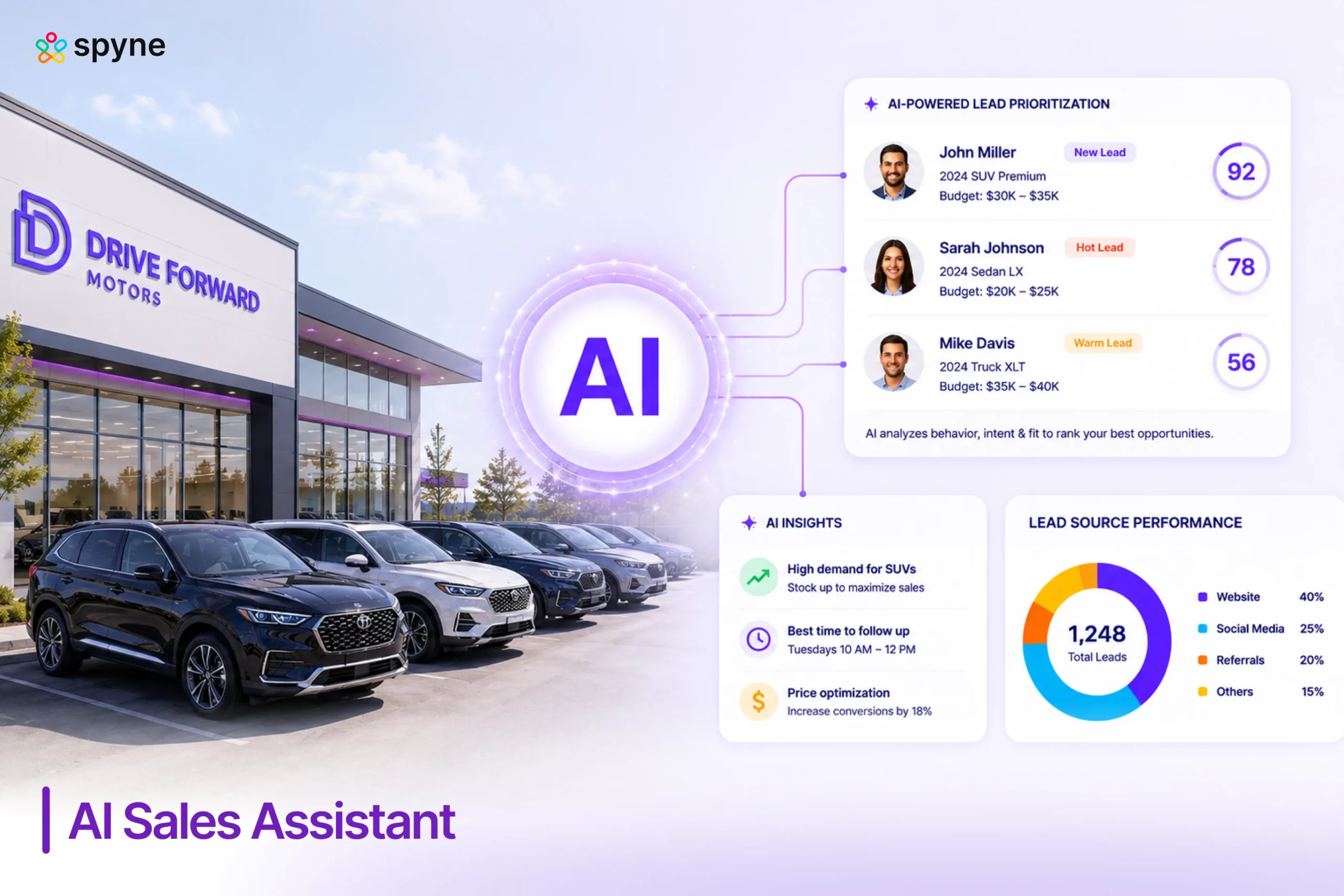

Dealerships are adopting AI quickly, but lead execution still breaks down between the first inquiry and the salesperson who is supposed to take over. Cox Automotive reported in August 2026 that 82% of dealers already use AI, while Foureyes found 42.7% of qualified dealership leads were mishandled. That is not a people problem. It is a workflow design problem. An AI sales assistant helps cover intake work that often gets delayed or handled inconsistently, including first response, inventory questions, qualification, follow-up, appointment coordination, CRM updates, and human handoff. This guide explains where AI fits in a dealership sales workflow, which tasks should stay with people, how to evaluate vendors, and which metrics show whether the process is improving.
What Is an AI Sales Assistant for Car Dealerships?
An AI sales assistant for a car dealership is conversational AI designed to handle repeatable sales activities before and around salesperson involvement. It can engage inbound inquiries, answer supported inventory questions, gather buying intent, continue follow-up, coordinate appointments, record outcomes, and route customers who need a person.
The distinction that matters is operational. An AI sales assistant owns much of the intake workflow. A salesperson owns the conversion workflow. These jobs require different skills at different points in the customer’s buying journey. Conflating them is where sales teams end up spending valuable time chasing basic information while active buyers wait for attention.
A buyer submitting a Cars.com lead on an F-150 at 9:40 p.m. does not need a complete desk deal from AI. They need an immediate, accurate response, confirmation that the dealership understands what they want, and a clear next step.
What Does an AI Sales Assistant Handle, and What Should Stay With the Sales Rep?
An AI sales assistant should handle high-volume, repeatable sales work where speed, consistency, and documentation matter. Salespeople should retain conversations where judgment, persuasion, negotiation, product expertise, or managerial authority can influence the deal.
What the AI sales assistant can handle
- Responding to inbound sales inquiries across supported channels
- Handling inquiries outside normal staffing hours
- Answering dealership-approved inventory and vehicle questions
- Gathering vehicle preference and buying intent
- Asking about purchase timeline and trade-in interest
- Scheduling or coordinating showroom and test-drive appointments
- Continuing approved follow-up when customers stop responding
- Recording conversation outcomes and next actions
- Routing qualified or complex opportunities to the right employee
What the sales representative should handle
- Vehicle selection requiring deeper product expertise
- Price negotiations and manager-approved exceptions
- Detailed trade appraisal conversations
- Complex payment or finance discussions
- Objection handling requiring judgment
- In-store relationship building
- Deal structure and closing
The problem at many stores is not that reps are incapable of intake. It is that a rep processing new leads cannot spend that same time working buyers already moving toward a deal.
That trade-off matters more as digital lead volume increases. Spyne’s automo tive sales solutions extend this model across lead capture, qualification, follow-up, and sales workflow automation while keeping the salesperson involved where the conversation needs them.
Why Do Fast, Complete Lead Responses Still Matter in 2026?
Fast response still matters because vehicle shoppers frequently contact several stores, but speed alone does not create a strong dealership response. The first interaction also needs to answer the shopper’s question, preserve context, and give the customer a reason to continue the conversation.
Pied Piper’s 2026 Internet Lead Effectiveness study tested 3,290 dealership websites representing all major automotive brands. The industry’s average ILE score increased to 71 out of 100 as dealerships expanded multichannel outreach and automation.
More importantly:
- 51% of dealerships delivered what Pied Piper classified as a “perfect response,” meaning the customer’s question was answered quickly through multiple communication paths.
- Dealers answered customer questions through text 54% of the time, up from 38% the previous year.
- Three-quarters of online customers received a dealership phone call.
- Dealerships combined a written response with a phone call 62% of the time, compared with 49% the previous year.
Foureyes adds urgency further down the funnel. Among sales leads that eventually purchased, 61.2% completed their purchase within three days of the initial website inquiry. That makes “response time” a broader operating question than how quickly an autoresponder fires.
A dealership needs to know:
Did we respond? Did we answer the question? Did the customer respond back? Did the conversation progress?
Stores trying to improve phone-specific sales coverage can go deeper into the workflow through Spyne’s AI voice agents for dealership sales teams guide.
What Should the CRM Queue Look Like on Monday Morning?
A dealership’s Monday CRM queue shows whether weekend lead coverage is actually working. The difference an AI sales assistant creates is not a prettier dashboard. It is the amount of useful work already completed before the salesperson begins the week.
Without an AI sales assistant
| Monday-morning problem | What the salesperson inherits |
| Weekend website leads | Records waiting for first contact |
| Vehicle questions | No answer or a generic automated reply |
| Buyer intent | Mostly unknown |
| Appointment requests | Still waiting for employee action |
| CRM notes | Lead form information with limited context |
| First sales activity | Qualification begins from scratch |
With an AI sales assistant
| Monday-morning status | What the salesperson can inherit |
| Weekend website leads | Initial conversations already started |
| Vehicle questions | Supported questions addressed |
| Buyer intent | Qualification information captured |
| Appointment requests | Scheduling conversation underway or completed |
| CRM notes | Vehicle interest, conversation history, and next action |
| First sales activity | Rep prioritizes active buyers |
The salesperson did not suddenly become better on Monday morning. The workflow simply stopped forcing that person to recreate work that could have happened while the buyer was actively shopping.
That is the practical value of dealership automation. It changes where the rep enters the conversation.
How Should an AI Sales Assistant Handle Inventory, Pricing, and Offers?
An AI sales assistant should answer inventory, pricing, and offer questions from dealership-approved information rather than generating an answer from general knowledge. When reliable data is unavailable, the correct action is to acknowledge the gap and move the question to somebody authorized to answer it.
That sounds basic, but inventory questions are rarely generic.
Customers ask:
- Is stock number 24197 still available?
- Does this specific Tahoe have the Premium Package?
- Do you have the same trim in black?
- Is the advertised offer still active?
- Can I test-drive this vehicle tonight?
- What would you give me for my trade?
- Can you get my payment below $600?
The first five can potentially be handled from connected, approved dealership data. The last two require much tighter boundaries.
AI can generally support:
- VIN and stock availability
- Trim, mileage, drivetrain, and listed features
- Published pricing
- Approved dealership offers
- Similar available vehicles
- Appointment availability
- Initial trade-in information collection
A salesperson, manager, or F&I employee should usually own:
- Negotiated pricing
- Unpublished discounts
- Trade appraisal decisions
- Complex financing scenarios
- Credit-specific recommendations
- Deal structure
- Policy exceptions
The objective is to make sure the customer gets the right next action without receiving an unsupported answer.
Dealerships that need to tighten the systems behind this workflow can also review Spyne’s automotive lead management capabilities, which connect lead capture, prioritization, follow-up, and pipeline activity.
How Should an AI Sales Assistant Qualify a Dealership Lead?
AI lead qualification should collect information that changes what the salesperson does next. Asking questions simply because another field exists in the CRM creates friction without improving the sales conversation.
The useful qualification data varies by customer, but typically includes:
- Vehicle interest: the specific unit or vehicle category the buyer is considering.
- Purchase timeline: this afternoon and three months from now require different routing.
- Trade-in status: whether a trade is involved and basic information where appropriate.
- Purchase or lease intent: when the customer already knows their preference.
- Appointment preference: when and how the buyer wants to continue.
- Contact preference: whether the customer wants a phone call, text, or another channel.
- Unresolved question: what the salesperson actually needs to address.
The conversation should not feel like a seven-field interrogation.
If somebody asks, “Is this Tacoma still available?”, answer the inventory question first. Qualification can develop naturally as the conversation continues.
AI should also avoid pretending qualification means the buyer has been financially approved, their trade has been valued, or the dealership has committed to a particular deal.
For a deeper view of the capture-to-handoff process, Spyne’s AI lead qualification guide for dealerships covers the operational qualification workflow in detail.
The Leads Already in Your CRM May Be the Bigger Opportunity
The most recoverable sales opportunity in many dealerships is not another batch of purchased leads. It is better execution against prospects the store has already paid to generate.
Foureyes’ 2026 benchmark exposes the size of that process problem. Across more than 22,900 automotive dealership websites:
- 42.7% of qualified leads were mishandled.
- 15.2% were never logged into the CRM.
- 62.8% of returning sales leads did not hear from a salesperson within 24 hours of returning to the dealership website.
- 61.2% of eventual buyers purchased within three days of their first website inquiry.
These numbers should not be translated into a simplistic “X lost leads equals Y lost gross” calculation. A mishandled opportunity does not automatically become a lost sale.
They should trigger a CRM audit. Instead, dealerships should audit CRM performance by lead source, lead age, contact history, appointment activity, and eventual sales outcome to identify exactly where follow-up is breaking down.
Then break those numbers down by lead source, age, salesperson, and follow-up status. A dealership may discover that it does not need another 100 leads. It needs to do more with the 100 leads already sitting in the CRM.
AI can help by continuing approved follow-up, identifying new responses, recording engagement, and returning active opportunities to the team. Spyne’s automated lead follow-up system for car dealerships addresses this part of the workflow specifically.
What Makes an AI-Booked Appointment Actually Qualified?
A qualified dealership appointment contains enough customer, vehicle, intent, and scheduling context for the salesperson to prepare before the shopper arrives. Appointment volume by itself is a weak measure because the number can include vague bookings, duplicate appointments, customers attached to unavailable inventory, or prospects who were never meaningfully qualified.
A useful AI-booked appointment should include:
- Customer identity and preferred contact information
- Specific vehicle or vehicle category
- Appointment date and time
- Vehicle availability status where confirmed
- Purchase timeline
- Trade-in interest where disclosed
- Purchase or lease preference where known
- Relevant customer questions
- Unresolved issues requiring an employee
- Conversation summary
- Assigned salesperson or routing destination
- Confirmation status
Managers should separate appointment performance into clear stages, including appointments set, confirmed appointments, showroom arrivals, and completed sales. Looking at appointment-set rate alone can hide where the process is actually breaking down.
For example, if Store A sets 60 appointments but only 18 customers show, while Store B sets 40 appointments and gets 28 showroom visits, the two stores have very different problems. Store A should investigate qualification quality, confirmation, and whether appointments are being set too loosely. Store B may need stronger lead coverage or more appointment volume because the quality of its booked appointments is already comparatively stronger.
What Should the Rep Actually Receive When AI Hands Off a Lead?
A useful AI-to-human handoff gives the salesperson enough context to continue the existing conversation rather than restart it. This is one of the most important parts of dealership AI because automation can work correctly until the exact moment a customer needs a person.
Pied Piper identified this failure point in its 2026 study. When an automated interaction required human help, dealership evaluations scored nine points lower on average, and customers were twice as likely to receive no personal response.
That means an AI escalation cannot end with “salesperson notified.”
A useful handoff should contain:
- Who the customer is
- Vehicle of interest
- What the buyer is trying to accomplish
- Important qualification information already gathered
- Questions already answered
- The unresolved question
- Appointment status
- Customer urgency
- Recommended next action
The salesperson should also be able to see the conversation transcript or a usable summary. Consider the buyer who has already explained that they want a specific Camry, have no trade, prefer financing, can visit Saturday, and want to know whether the advertised APR applies.
A poor handoff gives the salesperson a name and number. A good handoff tells the salesperson exactly where to pick up.
That difference determines whether salespeople trust the AI’s work or quietly re-qualify every lead themselves. Spyne’s guide to connected dealership AI conversations and handoffs explores this context problem across calls, texts, and other customer touchpoints.
AI Sales Assistant vs. BDC: Which Work Belongs Where?
An AI sales assistant and a dealership BDC should not be treated as competing versions of the same employee. AI works best on high-volume, repeatable sales activity, while BDC representatives are more valuable when persuasion, judgment, recovery, and customer nuance become important.
| Sales activity | AI sales assistant | BDC or salesperson |
| Late-night inbound lead | Can provide immediate coverage | Depends on staffing |
| Weekend form inquiry | Can respond and qualify | Handles when staffed |
| Initial inventory question | Handles supported information | Handles complex questions |
| Routine follow-up | Automated at configured cadence | Handles priority conversations |
| Appointment coordination | Can automate | Handles exceptions and recovery |
| Price negotiation | Escalates | Handles directly |
| Trade appraisal | Collects initial information | Appraises and structures |
| Complex F&I question | Routes | Handles or transfers |
| Customer asks for a person | Transfers with context | Takes ownership |
The mistake is paying skilled employees to spend too much of their day doing work where human skill adds little value, then wondering why active buyers are waiting for callbacks.
The stronger operating model runs both in sequence. AI supports intake, routine qualification, coverage, and repetitive follow-up. The BDC works the conversations where an employee can materially improve the outcome.
Dealers building that division of responsibility can benchmark the human side using Spyne’s automotive BDC metrics guide.
How Should Dealerships Evaluate an AI Sales Assistant?
Dealerships should evaluate an AI sales assistant by testing what happens in real sales workflows, particularly when information is incomplete or the AI reaches its limit. Claims such as “automotive-trained,” “24/7,” and “CRM integration” now appear across the category, so the real differentiation is in execution.
1. Does the AI Write Back to the CRM, or Only Pull Information?
“CRM integration” can describe very different products. Ask what the AI can read and what it can write. A dealership should determine whether the workflow can record:
- Conversation outcome
- Qualification information
- Vehicle of interest
- Appointment status
- Lead disposition
- Next action
- Conversation transcript or summary
- Human escalation
If employees need to manually recreate the appointment or qualification record after every AI conversation, an important part of the workflow remains manual.
Ask the vendor: Which specific fields and actions write back to our existing CRM or scheduler?
2. Does It Understand Automotive Sales Scenarios?
Do not ask whether the system is “trained for automotive.” Ask it to handle actual dealership situations.
For example:
- The customer’s original vehicle sold this morning.
- Two similar units are available.
- A customer asks for a trade estimate before visiting.
- A buyer wants a payment the AI cannot authorize.
- The customer changes from a new-car inquiry to a used alternative.
- A shopper wants a human immediately.
The important test is whether the AI knows which information to use, what action it is allowed to take, and when to stop.
3. How Does It Handle Incorrect or Unverifiable Information?
AI quality is not defined by the easiest 95 conversations. It is often defined by what happens during the five conversations that do not match the expected workflow.
Managers should be able to identify:
- Unsupported answers
- Incorrect inventory information
- Poor qualification
- Wrong routing
- Failed appointments
- Misleading pricing language
- Repeated customer questions
- Escalations that went unanswered
Ask how these conversations are reviewed and how corrections make their way into future behavior.
4. Where Does the AI Stop on Pricing, Trade-Ins, and Financing?
The dealership should define the AI’s authority before customers begin asking difficult questions.
A strong configuration should clearly establish how the AI handles:
- Negotiated selling prices
- Unpublished discounts
- Trade valuation
- Financing approval
- Credit-sensitive information
- Payment calculations
- Deal structure
- Manager exceptions
A conversational system that knows when it cannot safely complete the customer’s request is more useful than one designed to produce an answer at any cost.
5. What Happens When AI Needs a Human?
Pied Piper’s 2026 research makes this question particularly important. Customer questions requiring human assistance were twice as likely to receive no personal response.
A dealership should test whether an escalation actually:
- Identifies the correct person or department
- Passes the customer’s context
- Records why human help is required
- Alerts the employee clearly
- Tracks whether somebody takes ownership
A transfer attempt is not the same as a successful handoff.
6. Does Reporting Show Funnel Outcomes or AI Activity?
Calls answered, texts sent, conversations started, and average response time are useful operating metrics. They do not tell a Dealer Principal or GSM whether sales execution improved.
Cox Automotive found that despite 82% dealer AI adoption, about one in three dealers either are not measuring AI’s impact or lack clarity about how they measure it. Only 22% of AI users in the study reported sales and revenue growth from AI at the time of the research.
Which Metrics Show Whether an AI Sales Assistant Is Working?
An AI sales assistant should be measured across the complete lead funnel, from eligible inquiry to sold vehicle. Dealerships should resist creating an AI-specific reporting layer where high conversation volume looks successful even when appointment quality, CRM integrity, or customer follow-through declines.
A practical dealership scorecard includes:
| Metric | What it tells the dealership |
| Eligible lead coverage | How much of the intended lead pool AI actually works |
| Meaningful first-response time | How quickly a useful response begins |
| Contact rate | Percentage entering a two-way conversation |
| Qualification completion | Whether useful buyer context is gathered |
| Appointment set rate | How often conversations become scheduled visits |
| Appointment confirmation rate | Whether bookings remain active |
| Appointment show rate | Whether scheduled buyers reach the store |
| Human handoff completion | Whether escalated customers reach an employee |
| CRM write-back accuracy | Whether the rep receives the correct information |
| Sold rate | How many AI-worked leads ultimately purchase |
| Error and escalation rate | Where AI or workflow design requires improvement |
There is no defensible universal “good conversion rate for AI sales assistants.” A franchise rooftop receiving OEM leads has different economics from a used-car operation buying marketplace leads. Lead quality, inventory, BDC structure, market, sales process, and appointment definitions all change the result.
Use outside benchmarks to identify suspicious gaps. Use the dealership’s own pre-AI funnel as the performance baseline.
How Does Vini AI Fit Into the Dealership Sales Workflow?
Vini AI is Spyne’s conversational AI for dealership customer interactions. Within a sales workflow, Vini AI can support lead capture, buyer qualification, follow-up, appointment-related conversations, inventory-aware interactions, customer routing, and CRM-connected workflows across voice, SMS, and chat.
The useful way to position Vini AI is not as a digital salesperson trying to own the entire deal. It operates around the repetitive conversation and workflow steps that happen before a salesperson’s time creates the most value.
For example, Vini AI can support:
- Engaging new inquiries outside normal staffing hours
- Capturing vehicle interest and buyer intent
- Answering supported dealership and inventory questions
- Following up when prospects stop responding
- Moving appointment conversations forward
- Recording customer context for employees
- Routing conversations that require salesperson judgment
A dealership still controls the rules around pricing, trade-in discussions, financing, routing, escalation, and employee ownership.
That is important because the goal of dealership AI should not be removing people from the sales process. It should be removing avoidable delays and repetitive work before the customer reaches the person best equipped to move the deal forward.

Closing Thoughts
The dealerships getting value from AI sales assistants will not necessarily have the most automated sales floor. They will know exactly where customer intent disappears between the website, phone, CRM, BDC, and salesperson. In 2026, that distinction matters because AI adoption is already widespread while qualified leads are still being mishandled and human handoffs continue to fail. The opportunity is therefore not adding another automated response. It is creating a sales workflow where every conversation reaches the right next action with usable context. If your team wants to see how that process works across real dealership conversations, book a demo with Spyne.