
F&I is still the most profitable square footage in any dealership, but the deals it loses are almost never lost inside the box. They’re lost in the 45 minutes before a buyer reaches the finance office, when no one has addressed their financing anxiety and they’ve had time to reconsider. According to CDK Global’s 2025 F&I Shopper Study, the likelihood a customer recommends the dealership falls by 25% when they wait more than 30 minutes before seeing the finance manager.
Meanwhile, Cox Automotive’s 2025 Car Buyer Journey Study found that 40% of buyers want to engage with F&I products before their visit, but only 16% can. That 24-point gap represents deals where the customer arrived cold, unengaged, and objection-ready. This blog covers where F&I friction originates, what Vini AI does at each pre-finance touchpoint, and which competing platforms do and do not cover this use case.
Why Do F&I Deals Stall Before They Reach the Finance Office?
The three pre-F&I drop-off points are not mysteries, they’re predictable, measurable, and almost entirely addressable before the buyer reaches the box.
- Financing anxiety. Most buyers have no idea what their credit situation actually qualifies them for. They’ve seen interest rates in the news, they’ve done rough math on monthly payments, and they’ve convinced themselves the deal won’t work. When no one addresses this during the sales process, it calcifies into a defensive posture by the time they sit down with the finance manager.
- Wait time. The CDK 2026 Friction Points Study found that 64% of buyers complete the purchase process in two hours or less, but those who wait over 30 minutes specifically for F&I show sharp NPS declines. Waiting with unresolved questions turns anxiety into resistance.
- Unprepared buyers. According to Cox Automotive’s data, while 40% of consumers want to select F&I products before arriving, only 16% are given that opportunity. The finance manager inherits a buyer who has never heard of a VSC, has no frame of reference for GAP coverage value, and is already fatigued from the sales process.
None of these three conditions requires a better closer. They require better buyer preparation upstream.
What Does AI Actually Do in the F&I Workflow?
AI does not replace the finance manager. It removes the friction that forces the finance manager to spend the first 15 minutes of every deal overcoming resistance that should have been addressed hours earlier.
The F&I workflow has three distinct phases where AI creates measurable value:
- Pre-visit: A buyer submits an internet lead for a specific vehicle. Vini AI responds within 5 seconds, not just confirming inventory, but asking qualifying questions about their trade, timeline, and financing preferences. By the time the salesperson makes contact, the buyer’s credit comfort level has already been established conversationally.
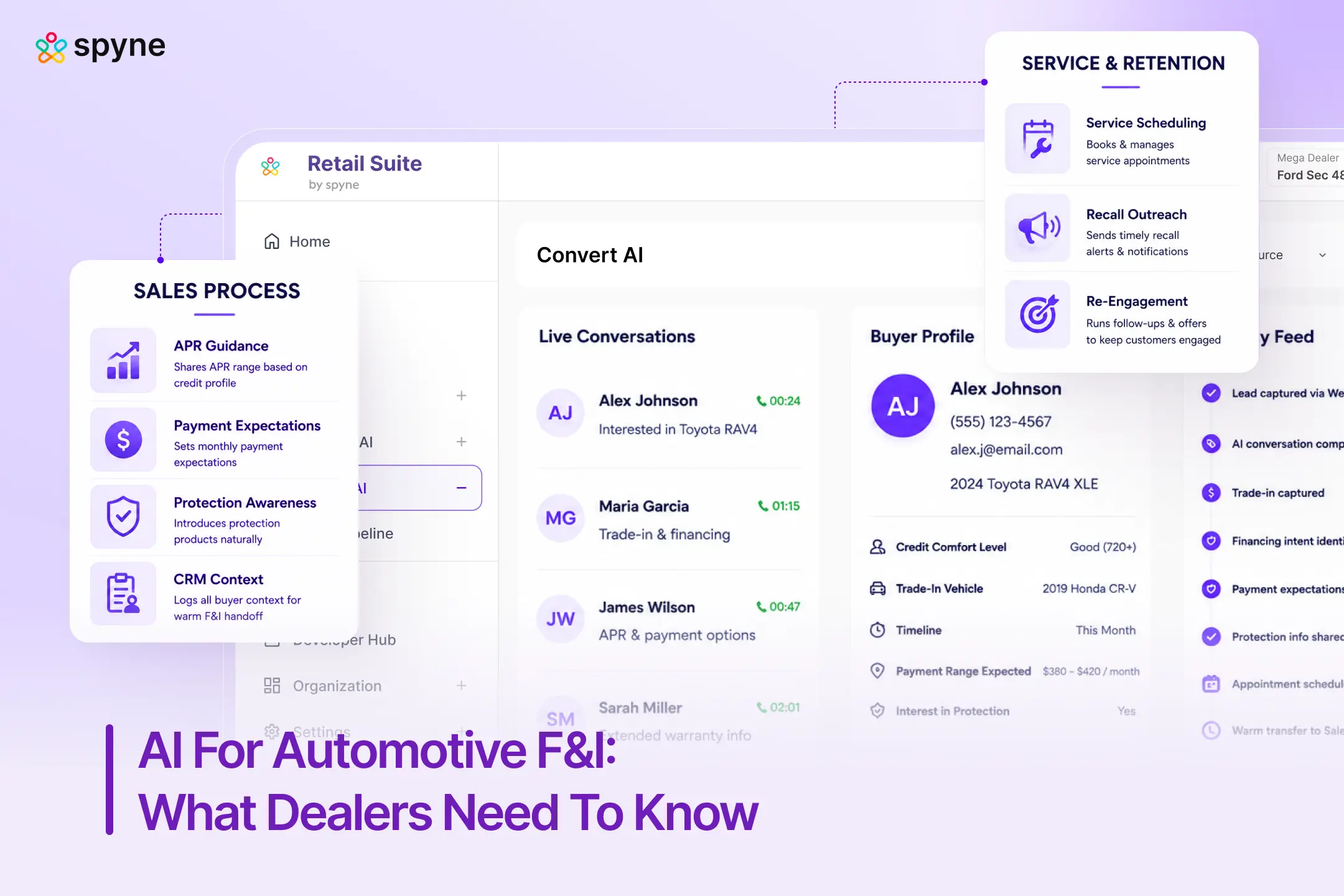
- During the sales process: While the deal is being desked, Vini AI can deliver APR range information based on the buyer’s stated credit profile, introduce the concept of protection products in natural conversational language, and flag to the CRM that the buyer asked questions about extended warranties. This gives the F&I manager context before the handoff.
- Post-sale and service retention: Vini AI handles service scheduling, recall outreach, and declined-service follow-up, keeping the customer relationship active between the purchase and the next service visit, which increases the probability of a CPO or F&I product renewal conversation later.
The net result: the F&I manager sits down with a buyer who is informed instead of anxious, prepared instead of guarded, and has already mentally engaged with the value of protection products.
How Does Vini AI Handle F&I-Adjacent Conversations?
Spyne’s conversational AI, Vini runs as four specialised voice agents, Sales Inbound, Sales Outbound, Service Inbound, and Service Outbound, on one omnichannel platform spanning voice, web chat, and SMS. Finance and payment conversations are handled as capabilities within the Sales agents, not as a separate module. Here is what that looks like in practice:
#1- Lead qualification that feeds the F&I handoff
- Vini answers every inbound sales call in under 5 seconds and immediately begins qualifying: vehicle of interest, trade-in situation, timeline, and financing intent
- These fields are logged to the CRM in real time, so by the time a human salesperson or F&I manager engages, the buyer’s context is already captured
- Warm transfers include a spoken summary of what the buyer said, the finance manager is not walking in cold
#2- Payment range conversations (with OfferLogix integration)
- For dealers running the OfferLogix integration (live), Vini can surface monthly lease and finance payment estimates, including incentives, credit-score adjustments, and down-payment scenarios, during the inbound call
- Without this integration, Vini collects qualifying information and defers specific payment numbers to the finance team, it does not guess or estimate
- This is accurate expectation-setting, not a closing tactic: buyers who understand the rough payment range before the F&I presentation arrive with fewer surprises
#3- Pre-appointment context that protects the handoff
- Every Vini conversation is logged to the CRM with full context: what the buyer asked, what they were told, any objections raised, their payment expectations, and their stated timeline
- The F&I manager receives this as a structured handoff, not a voicemail note or a salesperson’s verbal summary
- Buyers who shared financing questions during lead response are flagged so the finance manager can prepare accordingly
#4- After-hours and outbound coverage that fills the upstream gap
- 41% of dealership calls arrive after hours, Vini answers every one of them (Spyne data)
- Outbound agents run pre-approved offer campaigns (e.g. Capital One lender pre-approvals), lease-end outreach, and aged-lead re-engagement, all of which feed qualified, finance-ready buyers back into the pipeline
- Human handoff is triggered whenever negotiation, trade-in valuation, or co-buyer situations arise, Vini does not attempt to close deals
What Vini explicitly does not do
- Negotiate price or payment.
- Deliver final monthly payment numbers without OfferLogix or Informativ integration.
- Present or sell VSC, GAP, or protection products, that role belongs entirely to the licensed F&I manager.
- Handle parts or finance as standalone agents, these are capabilities within the four core agents.

The F&I Manager Benefit: What Changes When Buyers Arrive Pre-Educated?
When buyers arrive having already shared their financing intent, timeline, and vehicle interest with Vini AI, the finance manager’s job changes in four concrete ways.
#1- Objection volume drops
The most common F&I objections, “I can’t afford more,” “I don’t need a warranty,” “what is GAP anyway?”, are all symptoms of a buyer who arrived with unresolved questions. When qualifying conversations happen upstream, the finance manager spends more time presenting value and less time managing anxiety built up in a waiting room.
#2-Product penetration improves
According to StoneEagleDATA’s Q1 2026 F&I Benchmark Report, VSC penetration held at 45% and GAP reached 40% industrywide, both near multi-year highs. Top-performing stores running structured buyer education processes show penetration 8–12 percentage points higher across both products. The mechanism is straightforward: an informed buyer evaluates the product on its merits; an uninformed buyer defaults to “no” out of unfamiliarity.
#3-Time-in-box decreases
CDK’s research confirms that buyers who spend 15–30 minutes with the finance manager, the optimal window, generate higher satisfaction and higher product attachment than those in longer sessions driven by cold starts and objection handling. When qualifying context is captured before the buyer arrives, the F&I presentation starts at step three, not step one.
#4-Back-end gross stabilizes
With F&I PVR at $2,515 per vehicle for publicly traded dealer groups in Q2 2025 (Haig Partners), a 10-unit per month improvement in product penetration represents $12,000–18,000 in additional monthly back-end gross from the same unit volume, same team, same ad spend, better preparation.
What Metrics Improve When AI Handles Pre-F&I Buyer Prep?
The table below reflects industry benchmarks for dealerships running structured pre-F&I buyer preparation versus those relying on cold handoffs. The Vini AI column represents outcomes from stores where qualifying context is captured upstream and passed to the finance manager before the buyer sits down, not projections.
| Metric | Without AI Buyer Prep | With Vini AI Pre-Education |
| Time-in-box (average) | 45–60 minutes | 20–30 minutes |
| VSC penetration | 40–45% | 50–55% (industry benchmark for structured prep) |
| GAP penetration | 38–42% | 48–55% |
| Buyer satisfaction (F&I) | Drops 25% with 30+ min wait (CDK) | Higher with shorter, more focused sessions |
| Deal abandonment (pre-F&I) | Untracked at most stores | Reduced through payment expectation-setting |
| CRM handoff quality | Incomplete buyer context | Full conversation log, objections flagged |
How Vini AI Fits the Full Dealership Workflow: Sales to F&I to Service
Vini AI is not a point solution for one department. It operates across the full customer lifecycle:
- Sales: Instant lead response under 5 seconds, qualifying fields captured (vehicle, trade, timeline, financing intent), appointment booking, after-hours and weekend coverage for internet and phone inquiries
- F&I-adjacent: Qualifying context captured and CRM-logged before handoff; payment estimates available with OfferLogix integration; warm transfer with buyer profile to the finance manager
- Service: Service scheduling, recall outreach, RO rate improvement, declined service follow-up, after-hours appointment booking (+35% RO rate lift, Spyne data)
- BDC overflow: Handles 70% of routine sales and service calls without human intervention, freeing the BDC team for qualified, high-intent conversations (Spyne data)
The value of a unified AI agent covering all three touchpoints is continuity of buyer relationship data. The service advisor sees the same buyer history the F&I manager saw. The BDC team works from a CRM built by the AI, not populated manually. That data quality is what makes follow-up calls, reactivation campaigns, and loyalty offers actually work.
Dealership AI Platforms for F&I Workflows: What Each One Actually Does
Most dealership AI platforms were built to solve the same problem: missed calls and unbooked service appointments. That is a real problem, and most of them solve it well. What this comparison focuses on is the narrower question relevant to this blog, which platforms capture buyer context before the finance handoff, and which ones stop at the front door.
1. Vini AI by Spyne
Best for: Dealerships that want one AI platform covering Sales, BDC, and Service, with qualifying context captured and CRM-logged before buyers reach the finance office.
Not a fit if: You only need service lane scheduling and have no interest in covering the sales-to-F&I handoff layer.
Core capabilities (F&I-relevant):
- Answers inbound sales calls in under 5 seconds and captures qualifying context: vehicle, trade, timeline, and financing intent
- With OfferLogix integration: surfaces monthly payment estimates and down-payment scenarios during the call; without it, defers specific numbers to the finance team
- Logs a complete CRM handoff profile before the F&I manager engages, buyer context, payment intent, and objections flagged
- Warm transfer includes a spoken buyer summary; human handoff triggered on negotiation, trade valuation, and co-buyer situations
- Covers after-hours calls; runs outbound campaigns for pre-approved offers, lease-end, and aged-lead re-engagement
- SOC2, TCPA, GDPR, and DNC compliant; human QA on every call daily
Pricing: Custom.
2. Numa
Best for: Service departments managing high call volume that need advisor workflow tools, CSI protection, and a unified inbox.
Not a fit if: You need outbound AI voice or sales-to-F&I qualifying context captured before the handoff.
Core capabilities (F&I-relevant):
- Smart Inbox consolidates calls, texts, and missed calls with full customer history for the advisor team
- Appointment Agent books service appointments directly; Call Intelligence Agent scores and coaches advisors on every call
- HeatCase detection flags escalating sentiment in real time to protect CSI before a review posts
- No documented F&I buyer qualification, payment context capture, or pre-handoff buyer profiling
Pricing: Custom pricing by dealership.
3. Podium (Jerry AI)
Best for: Dealerships that want a messaging-first platform covering multi-channel lead capture, review management, and sales BDC automation.
Not a fit if: You need outbound AI voice calling or qualifying context passed to the finance manager before the buyer arrives.
Core capabilities (F&I-relevant):
- Jerry responds instantly to inbound leads across text, phone, webchat, social, and email; books test drives and service appointments autonomously
- Unified inbox and review management tools built into the same platform; FordDirect integration available with OEM pricing
- No documented F&I buyer qualification, payment context capture, or pre-handoff buyer profiling
Pricing: Plans from $399/month; AI BDC (Jerry) available as an add-on.
4. Pam AI
Best for: Dealerships with significant fixed-ops call volume that need a voice-first solution deeply integrated with service management software.
Not a fit if: You need sales AI coverage or a pre-F&I qualifying and handoff workflow.
Core capabilities (F&I-relevant):
- Handles inbound calls, texts, chats, and emails 24/7; books service appointments directly into the DMS
- Preferred Voice AI Partner for Dealer-FX serving 3,000+ dealerships; integrates with CDK, Xtime, WiAdvisor, DealerFX, Tekion, and others
- No documented F&I buyer qualification, payment context capture, or pre-handoff buyer profiling.
Pricing: Custom pricing.
5. Toma
Best for: Service-lane-focused dealerships that want a voice AI that adapts to their specific workflows over time through reinforcement learning.
Not a fit if: You need omnichannel coverage beyond voice, or qualifying context passed to the finance manager before the buyer sits down.
Core capabilities (F&I-relevant):
- Low-latency voice AI with Toma IQ adaptive learning, gets more accurate to each dealership’s policies the longer it runs
- Covers voice and SMS; 20+ CRM and DMS integrations; backed by a16z ($17M Series A, 2025)
- No documented F&I buyer qualification, payment context capture, or pre-handoff buyer profiling
Pricing: Custom pricing.
At a Glance
| Platform | Best For | Sales Lead Response | Service Scheduling | Qualifying Context Captured Pre-F&I | Pricing |
| Vini AI (Spyne) | Full lifecycle: Sales + Service + F&I prep | Yes, voice, text, chat | Yes, +35% RO lift | Yes, CRM handoff with buyer profile | Custom |
| Numa | Service ops + CSI protection | Yes | Yes, primary use case | No | Custom |
| Podium (Jerry AI) | Sales BDC + messaging | Yes, multi-channel | Partial | No | From $399/mo + add-on |
| Pam AI | Voice AI + service scheduling | Yes | Yes, DMS-integrated | No | Custom |
| Toma | Fixed ops adaptive voice AI | Yes | Yes, primary use case | No | Custom |
Every competitor in this category has built a strong answer to the missed-call and service-scheduling problem. The qualifying context and CRM handoff gap, the one that directly affects what the finance manager walks into, remains unaddressed by all of them.

Closing Thoughts
With F&I PVR near historic highs and front-end gross under pressure from affordability headwinds, back-end performance is no longer a secondary priority, it is what keeps the P&L intact. The 24-point gap Cox Automotive identified between buyers who want to engage with F&I products before their visit and those who actually can is not a technology problem. It is a preparation gap. Every qualifying conversation that does not happen before the buyer sits down becomes an objection the finance manager has to absorb.
If your buyers are arriving at F&I without their payment expectations set, see what Vini AI captures before a buyer reaches your finance office, book a demo with Spyne.