
Spyne competes across two major automotive AI categories: vehicle merchandising and dealership customer engagement. Studio AI helps dealerships create professional inventory photos, 360-degree experiences, videos, and marketplace-ready vehicle content. Vini AI helps dealerships manage customer conversations through voice, chat, SMS, and automated follow-up. Because these products solve different dealership problems, Spyne’s competitive landscape depends on whether a dealership needs better inventory presentation, faster lead response, improved service communication, or broader dealership automation.
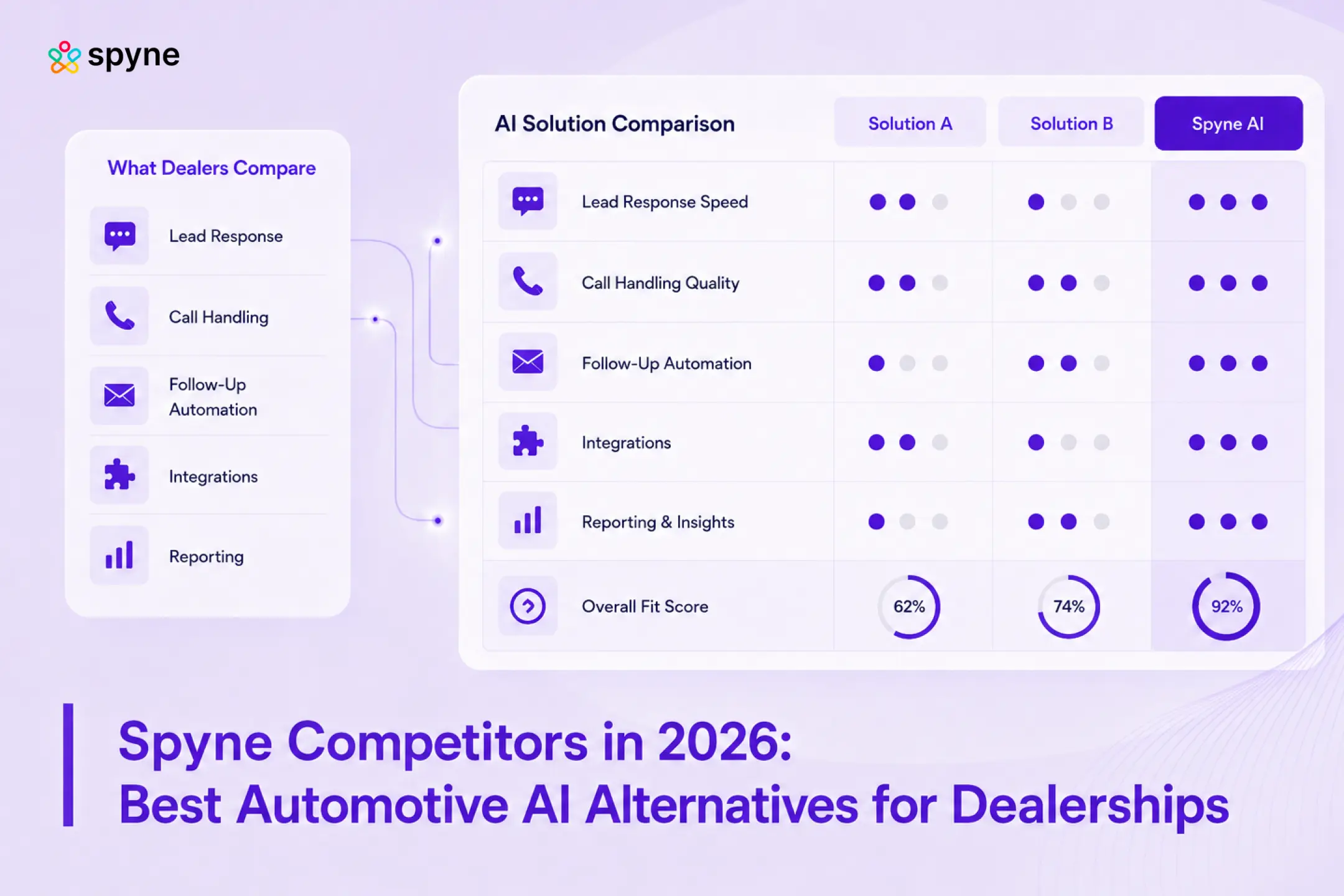
This guide compares Spyne alternatives across automotive merchandising and conversational AI categories to help dealerships evaluate platforms based on workflow fit, integrations, and operational outcomes.
What Does Spyne AI Do for Car Dealerships?
Spyne provides AI-powered solutions for two critical dealership workflows: automotive inventory merchandising and customer communication. Studio AI focuses on creating consistent, marketplace-ready vehicle content, while Vini AI focuses on conversational AI workflows across sales, service, BDC, and customer engagement.
Modern dealerships increasingly evaluate AI based on the operational problem it solves rather than the technology category alone. A used car manager may need faster vehicle presentation, while a BDC manager may need better speed-to-lead and appointment conversion.
Spyne addresses both sides of the dealership journey: helping stores present inventory more effectively online and helping them respond to shoppers after those customers engage
Studio AI for Automotive Vehicle Merchandising
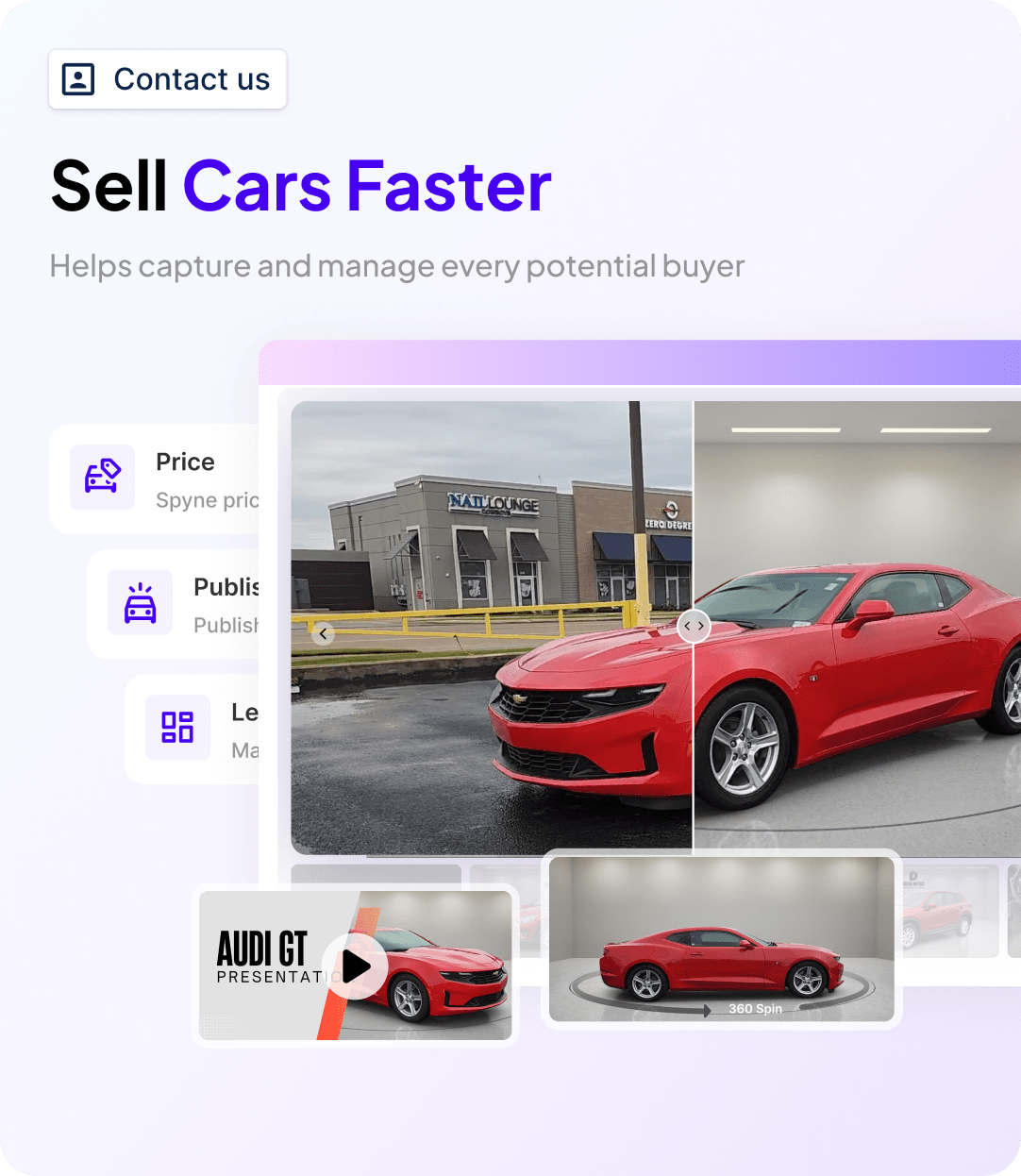
Spyne Studio AI helps dealerships improve vehicle presentation by turning standard inventory photos into professional digital merchandising assets. The system supports workflows including AI photo enhancement, background replacement, vehicle image consistency, 360-degree experiences, and video creation.
For dealerships, the challenge is not only taking vehicle photos. It is maintaining consistent quality across hundreds or thousands of listings while reducing the time between acquisition, recon completion, and online merchandising.
Key Studio AI capabilities include:
- AI-powered vehicle photography enhancement
- Background replacement and digital environments
- Consistent inventory presentation across marketplaces
- 360-degree vehicle experiences
- Automated vehicle videos
- Faster vehicle listing workflows
For dealer groups managing multiple rooftops, consistency becomes a major operational challenge. A centralized automotive merchandising workflow helps ensure every vehicle meets the same presentation standards regardless of location.
Vini AI for Automotive Conversational AI
Vini AI helps dealerships manage customer conversations through AI-powered voice, chat, SMS, and follow-up workflows. It is designed for dealership sales, service, BDC, and customer engagement operations.
Vini AI supports workflows such as:
- Answering inbound dealership calls
- Recovering missed call opportunities
- Qualifying sales leads
- Scheduling showroom appointments
- Booking service appointments
- Handling customer questions
- Routing conversations to dealership staff
- Supporting CRM and DMS-connected workflows
Dealerships lose opportunities when customers cannot reach the right person quickly. Industry benchmarks show that 30% to 40% of inbound dealership calls can be missed during peak periods, creating appointment and revenue gaps.
Vini AI focuses on improving dealership response coverage by handling routine conversations, supporting after-hours engagement, and helping teams focus on higher-value customer interactions.
Who Are Spyne’s Main Competitors in 2026?
Spyne’s competitors depend on the product category being evaluated. Studio AI competes with automotive merchandising platforms such as CarCutter, MotorCut, Autofox, Phyron, and MotorStreet 360. Vini AI competes with dealership conversational AI providers such as Numa, Toma, Stella Automotive AI, Podium, PAM, and Matador AI.
A dealership comparing Spyne alternatives should first identify whether the priority is inventory merchandising, customer communication, or a broader automotive AI workflow.
| Spyne Product | Category | Main Competitors | Primary Dealership Workflow |
| Studio AI | Automotive merchandising | CarCutter, MotorCut, Autofox, Phyron, MotorStreet 360 | Vehicle photos, 360 experiences, video, inventory presentation |
| Vini AI | Conversational AI | Numa, Toma, Stella Automotive AI, Podium, PAM, Matador AI | Calls, lead response, appointments, follow-up, customer engagement |
How Should Dealerships Compare Spyne Alternatives?
Dealerships should compare AI vendors based on the workflow they improve rather than only the number of features they offer. Automotive merchandising platforms should improve inventory presentation and speed-to-market, while conversational AI platforms should improve response time, appointment conversion, and customer communication.
A strong evaluation framework should consider:
- Automotive specialization
- Integration capabilities
- Workflow coverage
- Ease of dealership adoption
- Reporting and analytics
- Multi-rooftop scalability
- Ability to support existing teams
The right AI platform depends on whether a dealership is solving an inventory visibility problem, a customer communication problem, or both.
What Should Dealers Compare in Automotive Merchandising Platforms?
Automotive merchandising platforms should be evaluated on how effectively they improve vehicle presentation and listing speed.
Important comparison criteria include:
| Criteria | Why It Matters |
| Photo quality | Better vehicle presentation improves online shopper engagement |
| AI editing accuracy | Reduces manual correction work |
| Capture workflow | Determines how quickly inventory moves online |
| 360 capabilities | Creates stronger digital shopping experiences |
| Video generation | Supports modern vehicle discovery |
| Inventory integrations | Reduces manual listing effort |
| Marketplace publishing | Helps maintain consistent listings |
| Multi-rooftop management | Supports dealer group operations |
Best Spyne Studio AI Alternatives for Automotive Merchandising
The closest Spyne Studio AI alternatives include CarCutter, MotorCut, autofox, Phyron, and MotorStreet 360. However, these platforms do not compete with Spyne in exactly the same way. Some specialize in AI vehicle photography and background replacement, while others focus more heavily on automated video, guided capture, or physical 360-degree studio workflows.
Dealerships should therefore compare alternatives based on the merchandising bottleneck they need to fix, including photo capture, image consistency, vehicle tours, video creation, inventory publishing, or multi-rooftop standardization.
#1 CarCutter: AI Vehicle Photography and 360-Degree Merchandising
CarCutter provides vehicle merchandising technology for dealerships and dealer groups, with an emphasis on guided image capture, automated enhancement, branded backgrounds, 360-degree experiences, and publishing workflows. Its official dealership offering also supports visual consistency across multiple rooftops and connections with IMS and DMS systems.
CarCutter’s Next Gen 360 can generate an interactive exterior spin from four standard vehicle photographs, while its interior 360 workflow uses a compatible 360-degree camera.
The overlap with Spyne Studio AI is strongest around vehicle photography, background enhancement, digital merchandising, and interactive inventory presentation. Dealers comparing the two should examine how capture, editing, car tours, publishing, and group-level controls fit their existing merchandising process.
#2 MotorCut: AI Car Photo Editing and Background Replacement
MotorCut primarily focuses on automotive photo editing and background transformation for dealerships. According to MotorCut, its Half-Cut workflow replaces the background while preserving the original floor and vehicle shadows, while Full-Cut replaces both the background and surface for a more extensively transformed image.
MotorCut also offers web and mobile workflows, batch image processing, image upscaling, branded backgrounds, and tools for creating a consistent visual identity across dealership inventory. Its web application supports processing large batches of vehicle images through drag-and-drop uploads.
#3 autofox: VIN-Based Capture, Image Optimization, and Publishing
autofox provides an AI vehicle photography workflow built around smartphone capture and VIN recognition. A dealership employee scans the VIN and photographs the vehicle, after which autofox removes the existing background and places the car within a customized virtual showroom.
Because the vehicle is associated with its VIN, autofox says processed images can then be pushed to a dealership’s DMS, IMS, or website through FTP or API connections. The company also offers license plate inlays, an Ad Manager, and video advertising products.
#4 Phyron: Automated Vehicle Videos, Photography, and Advertising Content
Phyron is broader than an inventory video provider alone. Its current AI Suite includes guided car photography, enhanced still images, automated inventory videos, and paid advertising content for automotive retailers. Phyron says its system can use vehicle photos and specification data to create branded content for dealership websites, marketplaces, and social channels.
Its inventory video product automatically turns vehicle imagery and data into videos, while Phyron’s Enhanced Stills capability can remove original environments and apply consistent branded backgrounds. The company also offers automated publishing and paid social advertising workflows.
#5 MotorStreet 360: Physical Car Studios and Interactive 360-Degree Spins
MotorStreet 360 takes a different approach from AI-first vehicle photography products. Its offering combines custom physical car photo studios, cameras, turntables, a dealer portal, and interactive 360-degree car spins. MotorStreet states that its dealer portal can connect with inventory systems such as HomeNet and vAuto to support vehicle merchandising on VDPs.
Its turnkey studio packages can include a physical vehicle turntable, DSLR cameras, 360-degree cameras, lighting, studio equipment, software, training, and HomeNet integration.
Which Spyne Studio AI Alternative Fits Different Dealership Merchandising Needs?
There is no single Studio AI alternative that matches every merchandising workflow. CarCutter and autofox overlap strongly with AI-enabled vehicle photography and capture, MotorCut concentrates more heavily on image editing and background replacement, Phyron combines imagery with automated video and advertising, while MotorStreet 360 centers its offering on physical 360-degree studio infrastructure.
| Dealership Need | Platforms to Compare |
| AI vehicle photography | Spyne Studio AI, CarCutter, autofox, Phyron |
| AI background replacement | Spyne Studio AI, CarCutter, MotorCut, autofox, Phyron |
| Guided vehicle capture | Spyne Studio AI, CarCutter, autofox, Phyron |
| Interactive 360 experiences | Spyne Studio AI, CarCutter, MotorStreet 360 |
| Automated inventory video | Spyne Studio AI, Phyron |
| Physical 360 photo studio | MotorStreet 360 |
| Multi-rooftop merchandising consistency | Spyne Studio AI, CarCutter |
| AI-first virtual studio workflow | Spyne Studio AI, CarCutter, autofox |
A dealer should ultimately compare the complete path from vehicle capture to a finished VDP, rather than counting isolated features. Spyne’s guide on how faster automotive merchandising affects dealership workflows provides additional context for evaluating capture time, post-production, consistency, and how quickly frontline-ready inventory becomes shopper-ready online.
Best Vini AI Competitors for Dealership Conversational AI
Vini AI competes with automotive conversational AI platforms like Numa, Toma, STELLA Automotive AI, Podium, Pam, and Matador AI. Although all six address dealership communication or automation, their scope differs across inbound calls, lead response, service scheduling, outbound engagement, messaging, and broader dealership operations.
Dealers comparing these AI call bots should start with the actual workload they need AI to handle. A store struggling with unanswered service calls has different requirements from a BDC trying to improve speed-to-lead across marketplace inquiries, SMS, email, and phone.
Spyne’s conversational AI, Vini is built around this broader customer-engagement problem, supporting dealership conversations across sales, service, BDC, parts, and finance.
#1 Numa: AI Operating System for Dealership Customer Operations
Numa describes itself as an AI operating system for car dealerships. Its official site emphasizes capturing calls and texts, booking appointments, identifying at-risk customers, coordinating dealership communication, and connecting with CRM, DMS, and scheduling systems. Its Voice AI can use dealership system context while handling customer requests.
Numa also covers sales and Fixed Ops scheduling, including after-hours and BDC overflow scenarios. Its positioning has expanded beyond basic phone answering toward coordinating customer communication and dealership operations across channels.
#2 Toma: AI Coworkers for Automotive Enterprises
Toma positions its offering as “AI Coworkers for the automotive enterprise.” Its current product scope includes inbound automation across phone, SMS, and email, lead response and continued follow-up, dealership scheduling, inventory-related workflows, deal desking, back-office automation, and reporting. Toma states that its agents connect with dealership DMS, CRM, and scheduler systems.
That positioning makes Toma broader than a standalone dealership phone agent. Its official site presents AI coworkers as handling customer interactions and selected operational workflows while dealership employees intervene where human attention is required.
#3 STELLA Automotive AI: AI Agents for Reception, Sales, Service, and Outreach
STELLA Automotive AI offers multiple dealership-specific AI agents rather than positioning everything around a single receptionist workflow. Its current suite includes STELLA Reception, Sales Agent, Service Agent, Outbound Agent, Lead Agent, Recall Agent, Equity Agent, Defector Agent, and performance analytics.
STELLA Reception provides 24/7 inbound call handling and routing, while its broader suite supports sales engagement, service appointment booking, lead follow-up, recalls, and outbound customer engagement. STELLA Catalyst additionally supports outbound calls and two-way SMS for sales and service campaigns.
#4 Podium: AI Employee for Automotive Sales and Service
Podium’s automotive offering centers on Jerry, its AI Employee for dealership sales and service. According to Podium, Jerry can respond across phone, text, chat, and email, qualify leads, access inventory context, schedule test drives and service appointments, and continue proactive customer follow-up.
Podium also combines these AI capabilities with its existing customer communication products, including a unified inbox, phones, reviews, messaging, and other engagement workflows. That makes its scope different from providers built exclusively around automotive voice AI.
#5 Pam: AI Workforce for Inbound and Outbound Dealership Communication
Pam positions itself as an “AI Workforce for Automotive” and currently separates its offering into two primary agents. The Receptionist Agent handles inbound calls, service scheduling, sales intent, routing, approved customer questions, warm transfers, and after-hours or overflow demand.
Its Outbound Marketing Agent works customer lists through calls and texts for use cases including retention, recalls, lost customers, and declined service. Pam also states that sales calls can include inventory and pricing questions, qualification, test-drive booking, warm transfer, and CRM logging.
How it compares with Vini AI: There is substantial overlap around inbound calls, appointment scheduling, sales inquiries, follow-up, and outbound engagement. Dealerships should compare communication channels, department breadth, CRM/DMS connectivity, campaign controls, and how customer context transfers between AI and employees.
#6 Matador AI: AI Sales and Lead Engagement for Dealerships
Matador AI places a strong emphasis on dealership sales and lead management. Its current sales offering includes AI Engage, AI Reply, AI Follow-Up, and Chat AI, with workflows designed to respond to internet leads, re-engage inactive opportunities, continue customer conversations, and move leads toward appointments.
Matador states that its sales workflow can first-touch internet leads in around 30 seconds and supports integrations with automotive systems and lead sources including Reynolds & Reynolds, CDK, DealerSocket, VinSolutions, Elead, Tekion, Dealertrack, Cars.com, Autotrader, CarGurus, and Kelley Blue Book.
| Platform | Primary Focus Based on Official Positioning | Where It Overlaps With Vini AI |
| Vini AI | Automotive conversational AI across dealership departments | Voice, messaging, lead response, appointments, follow-up |
| Numa | AI operating system for dealership customer communication and operations | Calls, texts, appointments, CRM/DMS-connected workflows |
| Toma | AI coworkers for automotive enterprises | Calls, SMS, email, leads, scheduling, dealership workflows |
| STELLA Automotive AI | AI agents across dealership reception, sales, service and outbound engagement | Calls, scheduling, lead follow-up, outbound engagement |
| Podium | AI employee for automotive sales and service | Phone, chat, text, email, lead response and appointments |
| Pam | AI workforce with inbound and outbound dealership agents | Calls, texts, appointments, sales and service follow-up |
| Matador AI | AI-powered dealership sales and lead engagement | Lead response, follow-up, chat and appointment generation |
Where Does Vini AI Fit Within Spyne’s Automotive AI Platform?
Vini AI expands Spyne from automotive merchandising into dealership customer engagement. Studio AI helps dealers create and present inventory online, while Vini AI helps dealership teams respond when shoppers call, message, inquire about vehicles, request appointments, or need service assistance.
The distinction is straightforward:
- Studio AI focuses on the vehicle. It helps dealerships create better inventory photography, virtual backgrounds, rotating vehicle experiences, and video content.
- Vini AI focuses on the conversation. It manages dealership customer interactions across voice and digital channels, including qualification, scheduling, follow-up, and routing.
- Together, they address two connected automotive retail workflows: merchandising inventory and engaging the customers who respond to that inventory.
This matters for how Spyne should be evaluated as an automotive AI company. Spyne is not limited to virtual vehicle photography. Its current offering includes both visual merchandising and automotive conversational AI.
A shopper, for example, may discover a professionally merchandised vehicle online and then submit an inquiry after the BDC has closed. Vini AI can handle the customer-engagement side of that journey, while Studio AI supports the vehicle presentation that generated the initial interest.
Dealers exploring the conversational side can review Vini AI for dealership customer engagement, while groups evaluating inventory presentation can use Spyne’s virtual car photography studio to understand the merchandising side of the product portfolio.
What Makes Spyne Different From Other Automotive AI Platforms?
Spyne differentiates itself by covering both inventory merchandising and customer engagement within the same automotive AI ecosystem. Studio AI focuses on how vehicles are presented online, while Vini AI focuses on how dealerships respond to and manage customer conversations.
Key differentiators include:
- Two distinct automotive AI products: Studio AI supports vehicle merchandising, while Vini AI supports dealership conversations across sales, service, BDC, parts, and finance.
- Broader merchandising coverage: Spyne supports AI vehicle photography, background replacement, car tours, and video workflows, including its virtual car photography studio.
- Conversational AI beyond basic call answering: Vini AI can support lead qualification, appointment workflows, routing, follow-up, and inbound customer conversations through features such as Spyne’s AI call bot for car dealerships.
- Automotive-specific workflows: Both Studio AI and Vini AI are built around dealership operations rather than generic image editing or general-purpose AI assistants.
- Support across the shopper journey: Studio AI improves inventory presentation before a customer engages, while Vini AI supports the dealership once that customer calls, messages, or submits an inquiry.
Spyne’s value proposition is not that it replaces every system in a dealership’s technology stack. It is that dealerships can use one automotive AI ecosystem to improve both how inventory is merchandised and how customer interest is handled after engagement begins.
Should Dealerships Buy Separate AI Tools or One Automotive AI Platform?
Dealerships should choose separate AI tools when a single department has a highly specialized requirement, but a broader automotive AI environment can make more sense when multiple rooftops or departments need consistent workflows, integrations, governance, and reporting.
The decision is less about buying fewer vendors and more about whether consolidating workflows creates an operational advantage.
When do separate AI tools make sense?
Separate products can be the better choice when the dealership has one clearly defined bottleneck and an existing technology stack that already handles everything around it.
For example, a used car department that only needs a physical 360-degree capture studio may have little reason to replace its customer communication systems. Similarly, a service department looking specifically for after-hours phone coverage may not need to change its merchandising operation.
Best-of-breed products can make sense when:
- One department owns the problem and budget.
- The required workflow is highly specialized.
- Existing CRM, DMS, IMS, and scheduling integrations already work well.
- Replacing adjacent systems would introduce unnecessary disruption.
- The dealership has internal resources to manage multiple vendors and data flows.
The risk appears when several isolated tools begin touching the same customer or inventory record. That can create duplicate follow-up, inconsistent reporting, integration gaps, and unclear ownership between systems.
When does a broader automotive AI platform make sense?
A broader automotive AI environment becomes more valuable when dealerships want common workflows across departments or multiple rooftops. Dealer groups need consistent execution, but they also need enough local control for each store’s inventory, staffing, call routing, appointment rules, and brand standards.
Spyne’s franchise dealership solution is built around this multi-rooftop requirement, combining inventory merchandising and conversational engagement while standardizing execution across locations.
A more unified approach can be useful when:
- A dealer group manages several rooftops.
- Sales, service, and BDC teams share customer data.
- Leadership wants group-level visibility into AI performance.
- Inventory and customer engagement workflows rely on connected data.
- The organization wants fewer disconnected AI deployments to govern.
- Teams need consistent brand and communication standards across stores.
The objective should still be operational fit, not consolidation for its own sake. A dealership should only combine workflows when the shared system improves execution, data accuracy, or managerial visibility.
How Should Dealers Choose Between Spyne and Its Competitors?
Dealers should choose between Spyne and competing automotive AI providers by starting with the operational bottleneck, then testing whether each vendor can complete the actual dealership workflow. Feature counts matter less than whether the AI works correctly with the store’s inventory, CRM, DMS, scheduler, employees, and customers.
1. Identify the workflow that is actually breaking
Start with the operational problem instead of the vendor.
Is inventory waiting several days for photography? Are after-hours calls reaching voicemail? Are marketplace leads sitting untouched? Are service advisors spending too much time scheduling routine appointments? Are BDC agents working repetitive intake rather than qualified customers?
Defining the bottleneck prevents dealerships from buying broad AI capabilities that do not address the underlying problem.
2. Check whether the AI is genuinely automotive-specific
A dealership AI system should understand automotive workflows, terminology, inventory data, appointment structures, departments, and customer intent.
For conversational AI, test realistic interactions. Ask about a specific VIN, request a test drive, reschedule service, ask for a warm transfer, change the appointment halfway through the conversation, or introduce a question the AI cannot answer.
Spyne’s guide to AI voice agents for dealership sales teams explains why successful deployment depends on what happens between the initial customer request and qualified human handoff.
3. Evaluate integrations by workflow, not logo count
An integration logo does not prove that the AI can complete the dealership’s required action.
Dealers should ask whether the system can read the required data, write the outcome back correctly, identify duplicate records, update an appointment, log the conversation, and preserve attribution inside the existing CRM or DMS.
A BDC manager evaluating lead automation should specifically test how the system handles capture, qualification, routing, and follow-up. Spyne’s automotive lead management software provides an example of how these stages can operate within one connected workflow.
4. Test handoffs and exceptions, not only the perfect demo
The strongest dealership AI is not the system that handles an easy appointment request during a sales demo. Dealers should test what happens when a customer changes intent, becomes frustrated, requests an employee, asks an unusual inventory question, or needs a department the AI cannot resolve independently.
Human handoff should preserve the context already collected so the customer does not have to start over.
5. Measure outcomes that correspond to the original problem
Every AI implementation should have a baseline before launch.
For conversational AI, useful measures can include:
- Response time
- Answer rate
- Lead contact rate
- Appointment set rate
- Appointment show rate
- AI resolution rate
- Human transfer rate
- CRM or DMS write-back accuracy
- After-hours opportunities captured
For merchandising, the relevant measures change to photography turnaround time, time-to-live, listing consistency, inventory coverage, and the proportion of frontline-ready vehicles that are actually published.
The best Spyne alternative is therefore not automatically the vendor with the longest feature list. It is the product that resolves the dealership’s highest-cost workflow problem, works with the systems already in place, and produces an outcome management can measure.

Conclusion
Choosing among Spyne competitors should begin with the dealership workflow that needs improvement, not with a generic AI feature checklist. Studio AI addresses inventory merchandising, where photography quality, content consistency, car tours, video, and time-to-market matter. Vini AI addresses customer engagement, where response coverage, qualification, appointments, follow-up, integrations, and human handoff become critical.
The broader decision is whether a dealership needs a specialized product or an automotive AI ecosystem spanning multiple workflows. As dealerships deploy more AI, integration quality, operational fit, and measurable results will matter more than feature volume.
See how Spyne’s automotive AI solutions fit your dealership workflows. Book a demo with Spyne.