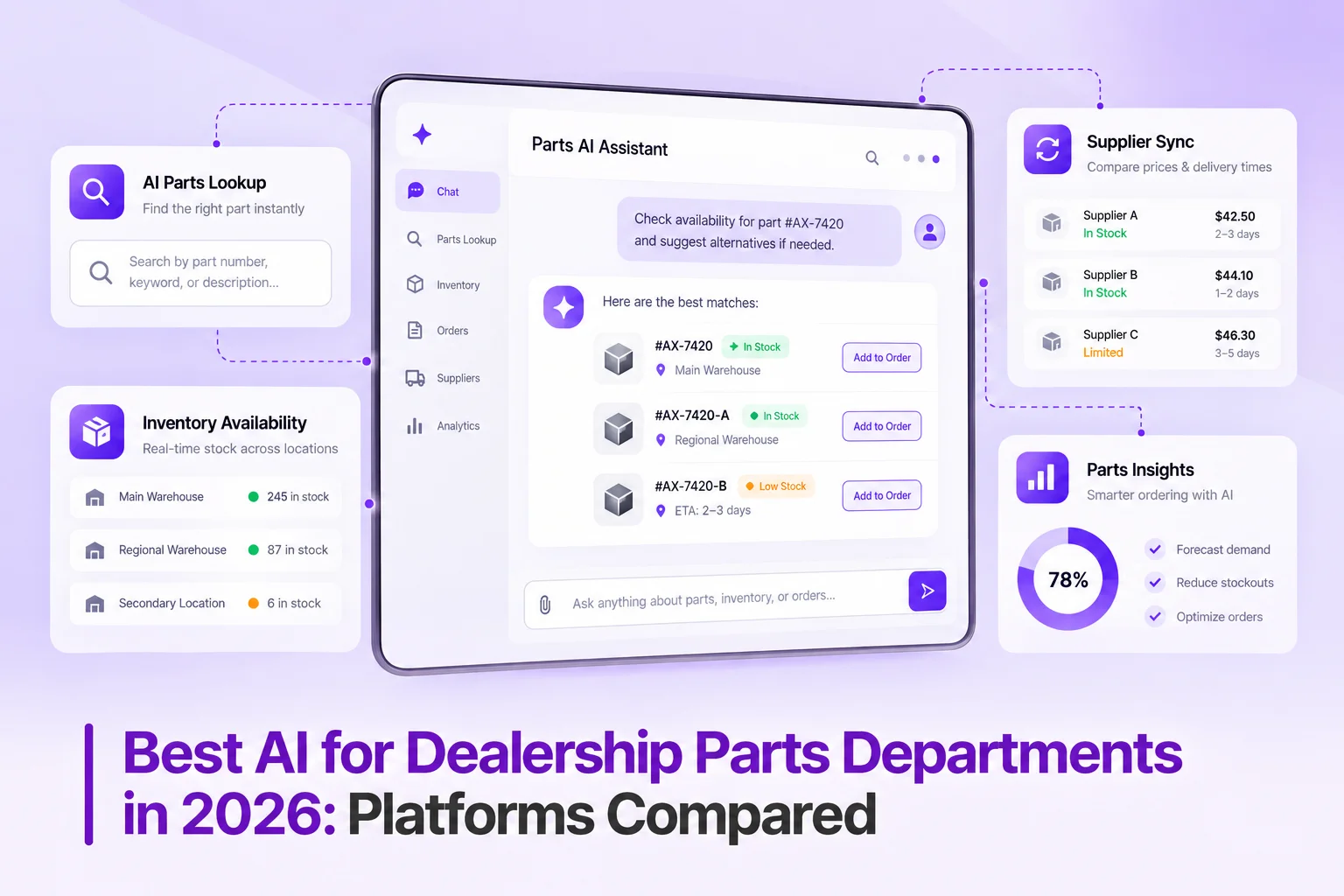

| Executive Summary: AI for dealership parts department calls uses voice automation to answer inbound inquiries, identify customer intent, collect vehicle or VIN information, check supported dealership data, provide order updates, and route complex requests to Parts Advisors. The distinction matters because answering a parts call is easier than completing one. In 2026, dealerships should compare platforms on parts-specific workflows, DMS connectivity, VIN handling, availability checks, order-status access, pricing controls, outbound notifications, and human escalation. NADA reports U.S. franchised dealers generated nearly $83 billion in service and parts sales during the first half of 2026, making call coverage a meaningful fixed-ops issue. |
Parts departments rarely have a demand problem. They have a capacity problem when technicians, wholesale buyers, retail customers, and ringing phones hit the counter simultaneously. A missed sales call can become another opportunity later; a body shop waiting for an OEM part may simply call the next dealer. That makes parts-call automation different from standard dealership reception. The AI must understand the request, capture accurate vehicle details, use available dealership data, and know when a Parts Advisor needs to step in. This guide compares the AI platforms covering dealership parts calls in 2026 and explains which capabilities dealers should verify before choosing one.
What Are the Best AI Platforms for Dealership Parts Department Calls in 2026?
The most relevant platforms for dealership parts calls include Vini AI, LotTech Voice, Numa, STELLA Automotive AI, Toma, Pam AI, Podium, and Gubagoo. However, their documented capabilities differ substantially. Some are designed to resolve automotive workflows, while others primarily answer, qualify, route, or support broader customer communication.
Dealers should therefore compare what happens after the AI identifies a parts caller, rather than whether a vendor simply lists Parts among its supported departments.
| Platform | Documented Parts Scope | Automotive-Specific | Key Strength for Parts Calls | What Dealers Should Verify |
| Vini AI by Spyne | Parts included within dealership conversational AI | Yes | Cross-department voice, service and parts context, VIN-aware interactions | Exact inventory, pricing and DMS permissions for deployment |
| LotTech Voice | Purpose-built for service and parts | Yes | VIN decoding, parts requests, DMS workflow | Depth of live pricing and inventory completion |
| Numa | Fixed-ops calls including parts inquiries | Yes | DMS-connected voice context and call resolution | Exact parts inventory and pricing access |
| STELLA Automotive AI | Multi-department AI including Parts | Yes | Recall and parts-availability workflows | Whether standalone parts inquiries resolve without transfer |
| Toma | Service-centric voice automation | Yes | Recall workflows and dealership-specific call logic | General parts-counter workflow depth |
| Pam AI | Parts inquiries and department-specific workflows | Yes | 24/7 answering, intent detection and routing | Live parts inventory and account-specific pricing |
| Podium | Dealership voice and service AI | Yes | Calls, scheduling, DMS-driven service communication | Dedicated parts-counter functionality |
| Gubagoo | Parts information through messaging ecosystem | Yes | VIN/vehicle-based parts search heritage and omnichannel communication | Current voice-based parts automation depth |
The comparison should not be interpreted as a universal ranking. Public vendor documentation varies significantly, and a dealer should require a live demonstration using realistic parts-counter scenarios before assuming that “Parts supported” means an inquiry can be completed without an employee.
Why Do Dealership Parts Departments Need AI Call Automation?
Dealership parts departments need AI call automation because phone volume competes directly with technician support, retail counter traffic, and wholesale account work. An automated first-response layer can absorb routine questions, collect vehicle information, maintain after-hours coverage, and reduce interruptions without pushing every caller into voicemail.
The financial context is significant. NADA reported that U.S. franchised light-vehicle dealerships wrote more than 136 million repair orders and generated nearly $83 billion in service and parts sales during the first half of 2026. Full-year 2025 service and parts sales exceeded $164 billion.
Dealers are also accelerating AI adoption. Cox Automotive’s Q1-Q2 2026 AI in Auto Retail Tracker found 82% of dealers were already using AI, with 40% using it to automate routine tasks and another 40% using it for customer follow-up. However, only 22% said they had actually experienced the sales and revenue growth they expected from AI. That gap makes workflow selection important.
Call handling remains one of those workflows. A 2025 STELLA Automotive AI survey found 85.7% of automotive dealers considered call handling a significant challenge, with dealerships reporting that as much as 26% of calls could be missed during business hours.
For the parts counter, AI is useful when it removes repetitive intake work instead of creating another transfer.
What Should AI Handle on a Dealership Parts Department Call?
A dealership parts AI should handle routine information gathering and repeatable requests while escalating transactions requiring judgment, sensitive pricing, or complex catalog expertise. The goal is not to make every Parts Advisor unnecessary. It is to keep straightforward calls from continuously interrupting higher-value work.
Useful parts-call workflows include:
- Identifying whether the caller needs retail, wholesale, service-related, or special-order support.
- Capturing year, make, model, VIN, part description, and callback details.
- Checking supported parts availability or collecting the details needed for a lookup.
- Providing special-order or backorder status where system access allows it.
- Answering common hours, pickup, delivery, and department questions.
- Detecting recall-related parts questions.
- Notifying customers when special-order parts arrive.
- Routing complex orders to the correct Parts Advisor with context already captured.
The difference between call handling and call completion is critical. If the AI collects a VIN and immediately transfers the customer, it has reduced intake work. If it can access supported dealership data and resolve the customer’s question, it has automated more of the actual transaction.
How Is Parts Department AI Different From an AI Receptionist?
A dealership AI receptionist generally answers calls, identifies intent, provides common information, schedules supported appointments, and routes customers to the correct team. Parts department AI requires a deeper layer of automotive context because many calls depend on vehicle identification, parts availability, order status, and account-specific information.
That distinction separates this use case from the broader AI receptionist software for car dealerships category.
| Capability | General AI Receptionist | Parts-Capable Dealership AI |
| Answer calls 24/7 | Yes | Yes |
| Identify Parts intent | Yes | Yes |
| Capture caller details | Yes | Yes |
| Collect VIN/vehicle information | Sometimes | Should |
| Check parts-related dealership data | Limited | Depends on integration |
| Retrieve order status | Limited | Depends on integration |
| Handle parts-arrival communication | Limited | Often supported by broader fixed-ops platforms |
| Apply wholesale pricing | Rare | Must be specifically verified |
| Escalate complex requests | Yes | Yes |
Dealers evaluating the category should ask vendors to show the parts workflow rather than demonstrate another service appointment.
Which AI Platforms Cover Dealership Parts Department Calls?
1. Vini AI by Spyne
Vini AI is Spyne’s automotive conversational AI platform covering sales, service, BDC, parts, and finance conversations. Its broader value for a dealership is that parts does not sit inside a standalone communications tool; the same AI layer can operate across multiple departments and customer journeys.
Spyne’s AI platform for car dealerships describes Vini as VIN-aware and context-aware, with dealership integrations and 24/7 lead and service engagement. For parts teams, that creates a foundation for identifying the vehicle, understanding why the customer called, handling supported routine questions, and escalating conversations with the gathered context intact.
Vini is particularly relevant for dealerships that want parts coverage alongside sales and service rather than another isolated point solution. Dealers can also compare its wider inbound capabilities in Spyne’s dealership inbound-call AI comparison.
Best fit: Dealers seeking one conversational AI layer across parts, service, sales, and BDC.
2. LotTech Voice
LotTech Voice is one of the clearest parts-specific products in the market. The company describes it as an always-on call-answering solution purpose-built for service and parts departments, with DMS integration and VIN decoding built directly into its workflow.
When a customer calls, LotTech says its agent can collect the VIN or license plate, decode the vehicle, and help the caller order parts or schedule service. Requests then populate its dashboard and dealership systems, with a fixed-ops employee reviewing requests for accuracy.
Best fit: Dealerships prioritizing a highly focused parts-and-service voice workflow.
3. Numa
Numa positions itself as an AI operating system for dealerships, with Voice AI connected to DMS context. Its public materials describe handling fixed-ops call types including scheduling, status, recalls, parts, and after-hours conversations.
Numa also says its voice system can use real-time DMS information to respond with customer-specific service context. That makes it relevant for parts-adjacent questions, although dealers should verify exactly which inventory, order-status, catalog, and pricing fields are available within their own DMS deployment.
Best fit: High-volume fixed-ops departments that want voice, messaging, DMS context, and workflow coordination in one environment.
4. STELLA Automotive AI
STELLA focuses on dealership conversational AI and multi-department call handling. Its 2026 vendor-evaluation guidance explicitly says AI should recognize when a caller needs Parts and either answer the question or intelligently route the customer.
STELLA also documents more advanced recall workflows involving VIN lookup, parts availability, scheduling, and outbound parts-arrival notifications. That gives the platform meaningful parts-related capability, particularly where Parts and Service workflows intersect.
Best fit: Dealerships prioritizing automotive call automation, recalls, scheduling, and department routing.
5. Toma
Toma is strongest in dealership service-call automation, particularly inbound fixed-ops volume and customized dealership workflows. In a Middletown Honda case study, Toma describes handling recall inquiries, notifying employees about parts availability, and managing customer expectations around timing.
That shows meaningful parts awareness inside service workflows, although it does not establish that every retail or wholesale parts-counter transaction can be completed autonomously.
Best fit: Service-heavy dealerships where parts questions frequently originate from recalls and service customers.
6. Pam AI
Pam supports dealership-specific workflows across sales, service, and parts. Its automotive receptionist product documents parts requests as a distinct department flow and says the AI can answer routine questions, detect intent, capture information, and transfer callers with context.
Dealers should specifically test whether their deployment supports live parts inventory, order status, and pricing rather than assuming those capabilities from department routing alone.
Best fit: Dealers primarily looking to improve 24/7 call coverage and intelligent routing across multiple departments.
7. Podium
Podium’s automotive AI platform focuses heavily on customer communication, Voice AI, service booking, DMS activation, and follow-up. Its Service AI product reports an 86% reduction in missed calls across a sample of 100 rooftops.
Podium can answer dealership questions and manage conversations across voice and digital channels, but its public automotive materials emphasize sales and service more strongly than full parts-counter transaction automation.
Best fit: Dealers already building customer communications around Podium and seeking broader voice coverage.
8. Gubagoo
Gubagoo is primarily known for automotive chat and conversational commerce rather than parts voice automation. However, it has longstanding parts-search functionality. Its Parts Directory allows operators to find part information using VIN, year, make, model, or part name and send descriptions and pricing through chat or SMS.
Its current GubaIQ offering is more heavily positioned around shopper conversations and digital retail, so dealers evaluating it specifically for phone-based parts automation should confirm current voice capabilities.
Best fit: Dealers prioritizing digital messaging and parts inquiries alongside broader online customer engagement.
Which Parts Calls Should Dealerships Automate First?
Dealers should automate the most repetitive, structured calls first because those conversations require less judgment and create the greatest interruption at the counter. A successful deployment should reduce unnecessary touches while preserving Parts Advisor involvement where expertise or relationship management matters.
Start with:
- Parts-department hours and directions.
- Special-order arrival checks.
- Basic order-status questions.
- VIN and vehicle-information collection.
- Common availability requests where live data is accessible.
- Parts-arrival notifications.
- Recall-related parts questions.
- After-hours inquiry capture.
Keep complex catalog interpretation, disputed fitment, sensitive wholesale negotiations, unusual substitutions, multi-line commercial orders, and relationship-heavy wholesale accounts with experienced Parts Advisors.
That same principle applies across dealership fixed-ops AI: automate repetitive communication, not the judgment that makes experienced employees valuable.
What Integrations Does AI Need to Automate Parts Calls?
Parts-call automation is only as useful as the data the AI can safely access. Natural voice quality may improve the experience, but system connectivity determines whether the caller gets an answer or another callback promise.
Depending on the workflow, dealers should evaluate access to the:
- DMS
- OEM parts catalog
- VIN decoder
- Parts inventory
- Special-order records
- Customer history
- CRM
- Service scheduler
- Recall information
- Voice and SMS communication history
This is especially important because dealership technology integration is becoming a competitive differentiator. Cox Automotive’s 2026 Fixed Operations and Ownership Study found 58% of high-performing dealers reported stronger parts-and-service technology and data integration with the broader dealership.
Spyne’s fixed operations guide for dealerships provides additional context on how parts, service, and body-shop operations contribute to dealership profitability.
How Should Dealers Evaluate AI for Parts Department Calls?
Dealers should evaluate parts AI with real calls, real dealership terminology, and realistic exceptions rather than accepting a polished generic demo. Ask vendors to show what the AI does when the answer is unavailable, the VIN is unclear, the caller has a wholesale account, or the part requires human verification.
During evaluation, test these scenarios:
- Availability: “I need a passenger-side mirror for a 2023 F-150. Do you have it?”
- VIN identification: Give the agent a VIN and ask it to identify the relevant vehicle context.
- Special order: “I ordered a transmission control module last week. Has it arrived?”
- Recall: Ask whether a recall part is available and what happens next.
- Wholesale: Call as a local body shop and ask about multiple parts for one repair.
- After-hours: Place the same call when the counter is closed.
- Failed request: Ask for something deliberately outside the AI’s scope and assess the handoff.
The vendor should clearly explain what the AI knows, retrieves, completes, records, and escalates.
Why Parts-Call Automation Matters Beyond the Phone
Parts automation affects more than answer rates because the parts counter sits inside the wider fixed-ops customer experience. Faster communication can protect technician productivity, wholesale relationships, service-cycle timing, and customer retention when a repair depends on parts availability.
Cox Automotive’s 2026 study shows why those relationships matter. Average dealership service and parts revenue reached $9.23 million in 2025, up 33% from 2018, even while dealerships’ share of service visits slipped from 33% to 29%. It also found that 74% of buyers who returned for dealership service were likely to buy their next vehicle from the same dealership, compared with 44% among customers who did not return for service.
Technology cannot replace parts expertise. It can make that expertise easier to reach when it is genuinely required.

Conclusion
The best AI for dealership parts calls is not necessarily the platform with the most natural voice. Dealers should look at how much of the parts workflow the system can actually complete: identifying the vehicle, collecting a VIN, checking supported data, handling order-status questions, communicating parts arrivals, recording the interaction, and escalating correctly when a Parts Advisor is needed. With U.S. franchised dealerships already generating nearly $83 billion in service and parts sales in the first half of 2026, small communication gaps sit inside a very large revenue operation. Test vendors against real parts-counter scenarios before signing a contract. Book a demo with Spyne to see how Vini AI can support dealership parts and fixed-ops conversations.