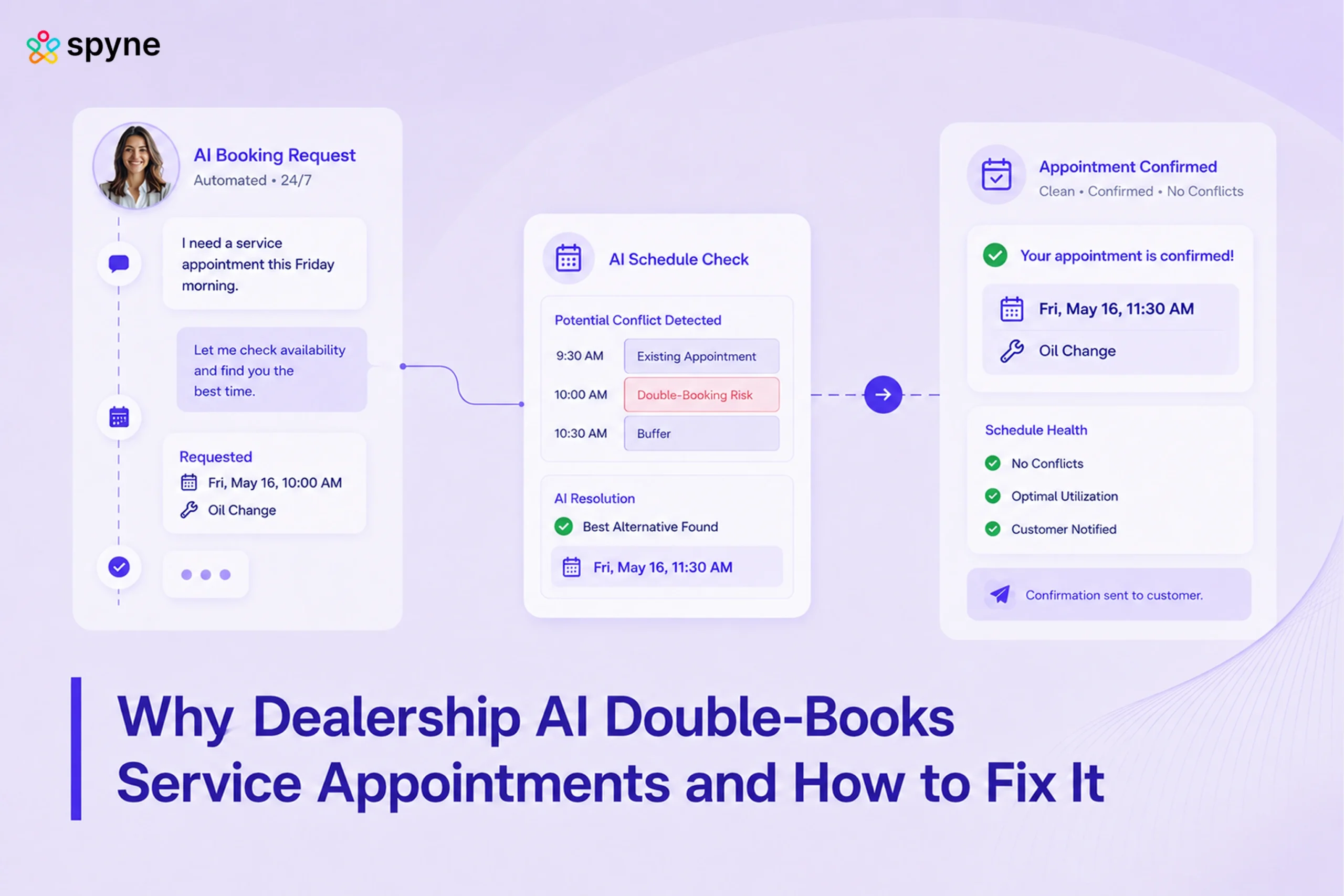

| Executive Summary: Reliable AI service scheduling depends on transaction integrity, not conversational quality alone. The AI must read current availability, match the correct customer and vehicle, apply dealership scheduling rules, commit the appointment to the authoritative system, and confirm that the resulting record matches what the customer was promised. Common failures include stale availability, duplicate transactions, incomplete opcode mapping, identifier mismatches, write-back failures, and unsynchronized reschedules. Dealers should therefore measure verified bookings, duplicate rates, write failures, modification success, and integration latency alongside appointment conversion. A booking should count only after the dealership’s authoritative service scheduler successfully stores and returns the appointment. |
AI can conduct a flawless service conversation and still leave a dealership with a bad appointment. The failure usually happens after the customer selects a time, when the AI must reconcile live capacity, customer and vehicle records, service opcodes, transportation requirements, and appointment status across connected systems. Stale availability can oversell capacity, unsafe retries can create duplicates, and incomplete write-back can produce appointments customers expect but advisors cannot see. This guide explains where dealership AI scheduling breaks technically and how fixed-ops leaders should validate appointment integrity before trusting the booking volume reported by an AI platform.
Why Booking Integrity Matters More Than Appointment Volume?
AI service scheduling should be measured by whether appointments reach the service lane correctly, not simply by how many bookings the AI reports.
J.D. Power’s 2026 U.S. Customer Service Index Study, based on 51,228 verified owners and lessees, found that only 26% experienced nine or ten of the study’s ten highest-impact service KPIs. When all ten were delivered, satisfaction reached 979 out of 1,000, compared with 632 when only three were delivered.
For fixed ops teams, appointment conversion measures demand captured. Booking integrity measures whether that demand can actually be fulfilled as promised. Both belong on the service dashboard.
What Should Count as a Confirmed AI Service Appointment?
A confirmed AI service appointment should mean that the dealership’s authoritative scheduling system has accepted the booking and can return the stored appointment with the same details promised to the customer.
A completed conversation is not enough. Before the customer hears that an appointment is confirmed, the scheduling workflow should establish that:
- the requested capacity is still available;
- the selected service maps to a valid dealership operation;
- the correct customer and vehicle records are attached;
- the authoritative scheduler accepted the transaction;
- the resulting appointment can be retrieved after creation;
- the stored date, time, service, and other critical fields match the request.
The last step is often called read-after-write verification. Instead of assuming a transaction worked because the integration submitted it successfully, the system retrieves the resulting appointment and validates the record.
That distinction becomes important as dealerships connect AI for car dealerships with schedulers, CRMs, and DMS platforms. A successful AI response and a successfully committed dealership transaction are separate events.
Which Dealership System Should Be the Source of Truth for Service Appointments?
CRM, DMS, and scheduling platforms can all contain appointment-related data, but they do not necessarily control the same part of the workflow.
A CRM may own customer communication and lead activity. The DMS can maintain customer, vehicle, repair, and financial records. A service scheduler may control appointment capacity, operation codes, advisors, transportation options, and shop rules.
Before deploying AI scheduling, the dealership should define one authoritative source for appointment state and capacity.
Xtime’s current integration documentation demonstrates why this matters. Its Dealertrack integration supports bi-directional repair-order management and parts and labor write-back, while other connected products expose different service workflows. Integration depth therefore depends on the specific action being performed.
Fixed-ops and IT teams should ask:
| Integration question | Why it matters |
|---|---|
| Which system supplies appointment availability? | Prevents AI from reading a secondary calendar |
| Where is service capacity configured? | Ensures the AI respects real shop constraints |
| Which system owns the final appointment? | Establishes one authoritative booking record |
| Is availability queried live or cached? | Determines exposure to stale slots |
| Can the AI create appointments? | Separates scheduling from simple availability lookup |
| Can it retrieve appointments after creation? | Enables write verification |
| Can it modify an existing appointment? | Prevents duplicate reschedules |
| Can it cancel appointments correctly? | Ensures unused capacity is released |
| Which service rules are exposed? | Prevents invalid appointment configurations |
This is also why dealership teams comparing AI tools for fixed operations should evaluate transaction capabilities rather than relying on an integration logo.
Why Stale Availability Causes Double-Booked Service Appointments?
A service slot can be available when the AI checks the scheduler and unavailable seconds later when the customer confirms it. Advisors, BDC staff, website schedulers, and AI agents may all be competing for the same capacity.
The main failure points are:
- Delayed availability: The AI works from a cached or outdated calendar rather than the scheduler’s current capacity.
- Check-to-book delay: Another employee or customer takes the slot between the initial availability lookup and booking request.
- Multiple booking channels: Phone, web, SMS, and BDC workflows reference different versions of appointment availability.
- No commit-time validation: The system assumes the previously returned slot remains available when the appointment is created.
Reliable AI scheduling should therefore revalidate capacity when the appointment is committed, not treat an earlier availability response as a reservation. For dealerships, the technical question should be more precise than “Is scheduling real time?” Ask how recently availability was read and whether the slot is validated again before confirmation.
Why Does Dealership AI Create Duplicate Service Appointments?
Duplicate appointments usually appear when the same customer request is treated as multiple independent transactions.
Common triggers include:
- an API request times out after the scheduler has already created the appointment;
- the AI retries the transaction without checking whether the first write succeeded;
- a reschedule creates a new booking while the original remains active;
- website, phone, and SMS channels create separate records;
- the same customer exists under multiple dealership records;
- staff manually recreate an appointment because the first booking is not visible.
Preventing duplicates with idempotent booking requests
Suppose the AI submits a booking request and the scheduler creates the appointment, but the response back to the AI times out. The AI cannot immediately tell whether the transaction failed before or after appointment creation.
Blindly submitting the request again can create a second appointment. A stronger integration uses an idempotency key, or another unique transaction identifier, for the booking attempt. If the same transaction is retried, the integration can return the original booking rather than create another one.
Customer and vehicle matching also prevent duplicate bookings
The AI also needs enough reliable identifiers to recognize that the customer may already have an appointment.
Useful matching fields can include:
- DMS customer ID;
- phone number;
- email address;
- VIN;
- vehicle record;
- existing appointment ID;
- rooftop or dealership identifier.
The objective is not aggressive record merging. It is to check for an existing relevant appointment before creating another transaction.
For an omnichannel platform such as Vini AI, this becomes particularly important when a customer moves between phone, text, and web interactions. The communication channel may change, but the underlying appointment should remain one dealership record. Spyne states that Vini supports real-time service rescheduling and CRM/DMS integrations across dealership workflows.
Why DMS Write-Back Errors Break AI Service Scheduling
“DMS write-back” sounds like a single action, but a service appointment can contain numerous fields that must satisfy the connected system’s validation rules. Depending on the dealership and scheduler, the transaction can include:
- customer identifier;
- VIN or vehicle identifier;
- service opcode;
- appointment date and time;
- expected duration;
- advisor assignment;
- waiter or drop-off status;
- transportation requirement;
- customer notes;
- source or campaign attribution.
A connection can therefore remain technically available while the appointment transaction still fails.
Service opcode mapping errors
Customers describe problems conversationally. They say their brakes squeak, the air conditioning stopped cooling, or the vehicle needs its 30,000-mile service. The dealership scheduler operates differently. The request may need to map to a configured service operation, duration, resource requirement, or opcode.
Incorrect mapping can produce:
- the wrong appointment duration;
- inappropriate technician or capacity allocation;
- missing service information;
- a rejected transaction.
Dealership AI should therefore translate customer intent into dealership-approved service taxonomy, not invent operational definitions.
Required-field failures
Schedulers can require specific fields before accepting a booking. A missing VIN, invalid advisor ID, unsupported transportation choice, or incomplete customer record may block creation. The AI needs defined behavior for each case. It should gather missing information where appropriate or escalate the transaction instead of silently creating substitute data.
Identifier mismatches across systems
A CRM, DMS, and scheduler may use different identifiers for the same advisor, customer, vehicle, department, or service operation.
Accurate cross-system mapping is therefore part of appointment integrity. A write associated with the wrong customer or rooftop may technically succeed while remaining operationally incorrect.
Partial and delayed writes
Some service workflows update several connected systems. One component can complete while another remains pending or fails.
Dealerships should therefore distinguish among:
- request submitted;
- transaction accepted;
- appointment created;
- appointment verified;
- dependent systems synchronized.
The stronger standard is verified write-back: the dealership can prove that the final appointment exists with the expected operational data.
How Should AI Handle Service Appointment Rescheduling and Cancellation?
AI should treat a reschedule as a modification of an existing appointment, not as a completely new booking.
When a customer moves a Tuesday appointment to Thursday, the workflow should:
- identify the existing appointment;
- retrieve the current booking state;
- validate Thursday’s capacity;
- update the correct appointment;
- verify the modification;
- release Tuesday’s capacity;
- send the updated confirmation.
If the system creates Thursday without properly resolving Tuesday, the dealership can end up with two active appointments. Cancellation needs similar state management. The AI should locate the correct appointment, apply the supported cancellation action, confirm the resulting status, and make sure capacity becomes available again where appropriate.
A useful appointment-state model might include:
| Appointment state | Operational meaning |
| Requested | Customer has expressed booking intent |
| Availability validated | An eligible slot has been identified |
| Commit pending | Booking transaction is being processed |
| Confirmed | Authoritative scheduler accepted the transaction |
| Verified | Saved appointment has been retrieved successfully |
| Modified | Existing appointment was changed successfully |
| Cancelled | Existing appointment was cancelled |
| Exception | Human or system intervention is required |
The customer should receive a final confirmation only after the transaction reaches the dealership’s defined confirmed state. Dealers evaluating these workflows can compare the capabilities discussed in Spyne’s guide to dealership scheduling software.
How Should Dealership AI Account for Service Bay and Shop Capacity?
An open calendar slot does not necessarily mean the service department has capacity for the requested work. An oil change, diagnostic concern, alignment, recall, transmission repair, and tire replacement can require different amounts of technician time, bay availability, equipment, parts, and advisor attention.
NADA’s May 2026 guidance identifies aligning capacity, demand, and production as a priority for improving dealership service profitability. AI scheduling needs to follow the same operational principle.
Depending on the store, appointment logic may need to account for:
- express-lane capacity;
- main-shop availability;
- diagnostic slots;
- service operation duration;
- advisor schedules;
- technician skill or resource constraints;
- waiter versus drop-off appointments;
- loaner availability;
- shuttle availability;
- pickup and delivery;
- recall workflows;
- dealership-specific opcodes.
The AI should therefore schedule against operational capacity exposed by the dealership’s scheduling system, rather than interpret an empty calendar position as universally bookable time.
This requirement becomes especially relevant for franchise operators running multiple service workflows, as discussed in Spyne’s 2026 guide to AI for franchise dealership fixed ops.
What Should Dealership AI Do When a Service Booking Fails?
When the authoritative scheduling system has not accepted an appointment, AI should not tell the customer that the booking is confirmed.
The fallback should depend on the failure:
- Slot conflict: retrieve another verified appointment time.
- Missing customer data: collect the required information where appropriate.
- Invalid service mapping: route the request for dealership review.
- Scheduler unavailable: record the customer’s requested time as pending rather than confirmed.
- Write failure: preserve the request and create an employee-owned follow-up task.
- Complex service request: hand the interaction to the appropriate service employee.
The human receiving the exception should inherit the customer’s context, including vehicle, service concern, requested time, transportation requirement, and the reason automation could not complete the transaction.
That approach avoids making the customer restart the conversation. It also reduces the advisor workload discussed in Spyne’s guide to reducing service advisor overload with AI.
Which AI Service Booking Metrics Should Fixed Ops Teams Track?
Appointment-set rate should remain a dealership KPI, but it cannot show whether AI-created bookings are operationally correct.
A fixed-ops dashboard should also monitor:
1. Booking commit rate
Percentage of scheduling transactions accepted by the authoritative system.
2. Booking verification rate
Percentage of created appointments successfully retrieved and validated after the write.
3. Duplicate appointment rate
Percentage of AI-associated service requests resulting in more than one active booking for the same intended visit.
4. Write-back failure rate
Percentage of booking attempts rejected, incomplete, or unavailable in the expected scheduling system.
5. Reschedule integrity rate
Percentage of reschedules correctly modifying the original appointment without leaving obsolete capacity occupied.
6. Cancellation integrity rate
Percentage of cancellation requests accurately reflected in the authoritative scheduler.
7. Integration latency
Time required for an appointment or modification to become reliably visible across systems that depend on the record.
8. Exception rate
Percentage of scheduling interactions that cannot safely complete without human assistance. Dealership groups should segment these measures by rooftop, DMS, scheduler, service opcode, channel, and failure type. A strong group-wide average can otherwise hide a broken mapping or synchronization problem at a single store.
The same operational discipline matters when dealerships use AI to improve service communication and dealership CSI.
What Should Dealers Test Before Launching AI Service Scheduling?
A scripted product demo proves that an AI can complete an ideal scheduling conversation. Production testing needs to prove that it can handle dealership exceptions safely.
A pre-launch test matrix should include:
| Test scenario | Required result |
| Returning customer | Existing customer and vehicle matched |
| New customer | Record created without unnecessary duplication |
| Standard maintenance | Correct service and duration selected |
| Diagnostic complaint | Appropriate scheduling rules applied |
| Missing VIN | Approved fallback used |
| Existing appointment | AI identifies it before booking again |
| Simultaneous slot requests | Capacity is not oversold |
| API timeout | Retry does not produce another appointment |
| Reschedule | Existing appointment is modified |
| Cancellation | Correct appointment is cancelled |
| Waiter request | Waiter-specific capacity is respected |
| Loaner request | Transportation rules are applied |
| Invalid opcode | Transaction stops or escalates safely |
| Scheduler outage | No false confirmation is issued |
| Employee changes appointment | AI retrieves the new state |
| Customer changes channels | Existing appointment context persists |
| Multiple rooftops | Appointment reaches the correct store |
The dealership should validate both sides of every test: what the customer was told and what ultimately appeared in the scheduler.
What Does the 2026 Automotive Market Tell Us About AI Service Scheduling?
AI scheduling is already moving into meaningful fixed-ops volume, which makes transaction reliability increasingly important. J.D. Power’s 2026 CSI study found that dealership service satisfaction improved overall, but customers remain highly sensitive to operational execution. Only 26% experienced nine or ten of the ten highest-impact service KPIs, demonstrating how difficult it remains to deliver the entire service process consistently.
NADA’s 2026 service guidance reinforces the operational requirement, recommending that dealerships align capacity, demand, and production while managing from actual data.
AI vendors are responding by moving deeper into dealership systems. STELLA’s 2026 Auto/Mate integration books appointments directly into the connected scheduler, while Numa describes live DMS read/write capabilities for service scheduling. Xtime, meanwhile, documents bi-directional repair-order management and parts/labor write-back with Dealertrack DMS.
Spyne’s Vini AI conversational platform similarly supports service appointment scheduling, real-time rescheduling, CRM/DMS connectivity, and omnichannel dealership conversations. Spyne currently lists 50+ integrations across its platform.
The market direction is therefore clear: dealership AI is moving from answering questions toward executing transactions. The evaluation standard needs to move with it.

Conclusion
AI service scheduling fails when dealerships automate the conversation without validating the transaction behind it. Once a customer chooses a time, the system still has to confirm capacity, identify the correct vehicle and customer, apply dealership service rules, write the appointment successfully, and keep that record synchronized through every later change. As AI handles more fixed-ops volume in 2026, appointment integrity should become a dealership KPI alongside conversion, show rate, and repair-order performance. The strongest deployments verify every committed booking, control transaction retries, monitor integration failures, and route unresolved exceptions with complete context rather than giving customers false confirmation.
Book a demo with Spyne to see how Vini AI can support connected service scheduling and appointment workflows across your dealership.