
| Executive Summary: One AI BDC can support both sales and service, but only through separate workflows. Sales depends on inventory, CRM data, qualification, and showroom scheduling. Service requires vehicle records, scheduler access, OP codes, and advisor escalation. The real advantage is shared coverage, faster response, cleaner handoffs, and unified reporting. Dealers should judge platforms by booking accuracy, integration depth, transfer success, and data writeback, not voice quality alone. Start with the department losing the most calls, prove performance, then expand across the dealership. |
Dealership phone demand does not follow departmental staffing. Sales calls spike while teams work showroom traffic, and service advisors are interrupted by scheduling, recall, transportation, and status questions. CDK reported in July 2026 that 47% of customers book sales appointments by phone, while 61% book service appointments by phone. It also found that 29% of service shoppers experienced scheduling difficulty by phone, with average service hold times reaching 9.3 minutes. Using separate tools can fragment customer history, yet one generic AI flow creates wrong answers and weak transfers. This article explains the required sales and service workflows, integrations, routing, escalation rules, measurement framework, implementation plan, and Vini AI’s cross-department role.
Can One AI BDC Really Handle Sales and Service Calls?
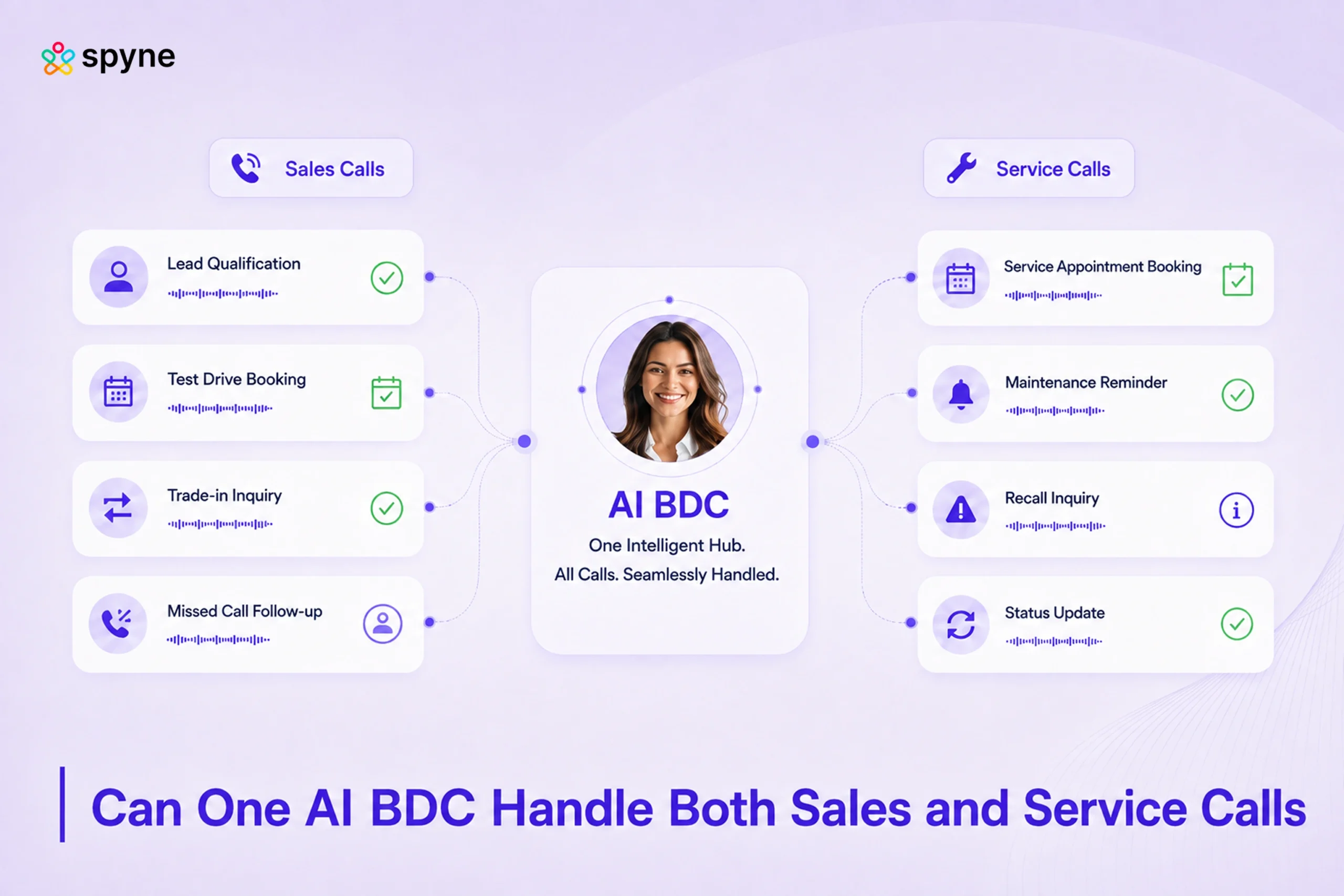
One AI BDC can support sales and service, but one platform should never mean one script, calendar, or reporting model. It must identify intent, open the correct workflow, access the relevant data, complete supported actions, and escalate exceptions.
A capable cross-department platform should:
- Identify whether the caller needs sales, service, parts, finance, or another department.
- Apply department-specific questions, terminology, hours, and rules.
- Read the correct CRM, inventory feed, DMS, or service scheduler.
- Book into the correct showroom calendar or service scheduler.
- Transfer complex conversations with a useful summary.
- Record each interaction and measure departmental outcomes separately.
Dealers evaluating AI BDC software should test both departmental workflows rather than accept a generic “handles all calls” claim.
How Are Sales and Service BDC Calls Different?
Sales and service share the phone system, but their objectives, data dependencies, terminology, and risk boundaries differ.
| Dimension | Sales calls | Service calls |
| Typical caller | New or returning shopper | Owner or existing service customer |
| Primary objective | Qualify interest and secure a visit | Resolve the request or book service |
| Core data | CRM, IMS, VIN, pricing, vehicle history | Customer record, VIN, scheduler, service history |
| Common questions | Availability, features, trade-in, payments | Maintenance, recall, appointment, transportation |
| Appointment type | Showroom visit or test drive | Service lane appointment |
| Main human handoff | Salesperson, BDC, manager, F&I | Advisor, parts, warranty, fixed ops |
| Primary metrics | Contact, set, show, sold | Resolution, booking, show, RO |
Many service callers are existing customers seeking an operational answer, not new “leads.” Treating every service conversation as a sales opportunity produces irrelevant scripts and weak customer experiences.
NADA reported that franchised light-vehicle dealers wrote more than 276 million repair orders during 2025, generating over $164 billion in service and parts sales. Service communication is therefore a core dealership workflow.
Which Sales Calls Can an AI BDC Handle?
An AI BDC can manage sales conversations when answers come from current dealership data and approved rules.
Supported workflows may include:
- New and used vehicle inquiries
- VIN-specific availability and vehicle-history questions
- Feature, trim, and specification questions
- Basic pricing information from approved systems
- Lead qualification
- Test-drive or showroom appointment booking
- After-hours inquiries and callback requests
- Routing to sales, management, or F&I
A useful qualification record may include vehicle interest, timeline, trade status, visit preference, financing interest, and unresolved questions. Spyne’s guide to AI lead qualification for dealerships explains how these fields improve the CRM handoff.
Example: A shopper calls about a used SUV. The AI verifies the VIN, answers supported questions, confirms the timeline, and offers valid appointment times. When the shopper requests an exact trade value, the AI routes the call or schedules follow-up with the vehicle and trade context attached.
AI should not independently negotiate final pricing, value trades, approve financing, confirm unsupported out-the-door figures, or promise expired incentives. These requests require dealership authority and current deal information.
Which Service Calls Can an AI BDC Handle?
Service automation works best for routine, rules-based requests completed through a connected scheduler and approved knowledge base.
Supported workflows may include:
- Service appointment booking
- Rescheduling and cancellations
- Hours, directions, and basic service FAQs
- Maintenance and verified recall appointment requests
- Advisor callbacks
- Transportation or loaner-policy questions
- After-hours and overflow calls
- Routing to service, parts, warranty, or fixed operations
Pied Piper’s July 2026 Service Scheduling Effectiveness study found that roughly two-thirds of service customers still prefer telephone scheduling. Customers reached an associate within one minute 65% of the time at top-performing groups, compared with 42% at the lowest performers.
Example: A customer requests an oil change. The AI confirms the vehicle, selects the supported operation, checks available slots, books the appointment, and sends confirmation. When the caller describes an intermittent braking concern, the AI routes the conversation to a qualified advisor without attempting diagnosis.
Diagnosis, exact repair estimates, warranty decisions, disputed charges, earlier-work complaints, safety concerns, and unsupported parts questions should remain employee-led.
What Is the Best AI for Dealership Service Departments?
There is no universally best service AI for every dealership. The right choice depends on whether the priority is inbound scheduling, advisor-call reduction, retention outreach, native DMS access, or one AI layer across sales and service. Vendor claims should be validated through live testing inside the dealership’s technology stack.
| Platform | Best fit |
| Vini AI | One platform for separate sales and service call workflows, appointment booking, routing, and CRM logging |
| Numa | Fixed ops communication, scheduling, missed-call recovery, and service-lane customer management |
| Toma | High-volume service calls and direct appointment scheduling |
| Impel Service AI | Due-service, declined-work, and lapsed-customer retention outreach |
| CDK AIVA | 24/7 service scheduling within a CDK-centered fixed ops environment |
| Tekion Service AI | Scheduling and advisor workflows inside Tekion’s wider retail platform |
| Mia | Voice-first inbound coverage, reception, routing, and after-hours scheduling |
For this article’s cross-department use case, Vini AI is the most relevant fit when a dealership wants one platform to support sales and service without merging their workflows. A service-only department may prioritize another platform based on its scheduler, DMS, retention strategy, or advisor process.
The decisive demo test is completion, not voice quality. Run each finalist through oil changes, recalls, transportation requests, multiple concerns, existing appointments, upset customers, and human transfers. Pied Piper’s 2025 service-call research found AI completed 91% of supported calls without human help, but transfers failed 56% of the time when assistance was required. This should be identified as 2025 research rather than a 2026 result.
How Does an AI BDC Route Calls to the Right Department?
Routing should follow intent and customer context rather than a simple keyword match.
A reliable flow is:
- Identify the caller’s main objective.
- Confirm the customer, vehicle, appointment, or stock context when required.
- Open the correct sales, service, parts, or finance workflow.
- Access the relevant system.
- Resolve the supported request.
- Book, transfer, or schedule a callback.
- Record the outcome and next action.
Cross-department calls are the real test. A service customer may consider replacing a vehicle. A shopper may ask about an existing vehicle’s recall. An owner may want both service scheduling and trade information.
The AI should complete the supported task, preserve context, and route the remaining request. The receiving employee should see what was verified, completed, and still unresolved.
What Data Does AI Need for Sales and Service Calls?
AI accuracy depends on current data, clear permissions, and reliable writeback.
Data required for sales conversations
- Customer and lead records
- Live inventory, VINs, specifications, and approved prices
- Vehicle-history information
- Current offers
- Sales hours and employee directory
- Showroom availability
- Previous conversation notes
Data required for service conversations
- Customer and vehicle information
- Existing appointments
- Scheduling rules and available slots
- Supported services and OP codes
- Advisor availability
- Recall and permitted service-history information
- Transportation and loaner policies
If the system cannot verify availability, pricing, recall status, warranty coverage, or appointment capacity, it should say so and arrange follow-up. A transparent limitation is safer than a confident unsupported answer.
The FTC also requires covered automobile dealers to oversee service providers that access protected customer information. AI vendors should therefore be included in security, access, retention, and vendor-risk reviews.
Which Integrations Are Required for Cross-Department Coverage?
Integration depth must be evaluated at the action level, not by logo count.
| System | Sales role | Service role |
| CRM | Lead history, follow-up, notes, appointments | Customer context, notes, callbacks |
| Inventory system | VIN availability, price, features, alternatives | Limited vehicle-identification context |
| Service scheduler | Usually unnecessary | Slots, OP codes, rescheduling, cancellations |
| DMS | Customer and transaction context | Vehicle, appointment, RO, service context |
| Vehicle-history source | Used-vehicle questions | Recall or service context where supported |
| Phone system | Answering, routing, recording, transfers | Answering, advisor routing, transfers |
| Reporting layer | Qualified, set, show, sold | Resolved, booked, shown, RO |
Ask whether each integration can read, write, refresh, and recover from failure. A preferred time recorded in CRM is not a confirmed service slot.
The Spyne integrations overview explains how synchronized data supports customer and appointment continuity. Pied Piper’s 2026 sales and service studies also found that failures can occur between AI, CRM, DMS, websites, messaging, and phone systems even when internal dashboards show activity.
Should Sales and Service Use the Same AI Voice and Scripts?
A dealership can use a consistent brand voice, but it needs separate greetings, qualification questions, appointment goals, hours, directories, escalation rules, disclosures, terminology, follow-up permissions, and success criteria.
A service caller should not enter a sales qualification flow. A shopper should not encounter service scheduling questions. The correct model is a shared communication layer with department-specific workflow modules. Spyne’s automotive virtual assistant guide provides additional context on dealership-specific conversation design.
When Should AI Transfer the Customer to an Employee?
AI should transfer whenever the request needs authority, technical judgment, sensitive handling, or information it cannot verify.
| Situation | Recommended destination |
| Final price or OTD request | Salesperson or manager |
| Trade-in valuation | Appraisal or sales team |
| Financing approval or final terms | F&I |
| Vehicle-specific diagnosis | Service advisor |
| Warranty determination | Warranty or service employee |
| Earlier-work complaint | Service manager |
| Exact parts price or availability | Parts department |
| Safety concern or breakdown | Qualified service employee |
| Named employee request | Requested person or callback queue |
| Conflicting records | Appropriate department employee |
A warm transfer should include the caller, vehicle, request, verified information, completed actions, and remaining question. When nobody is available, the AI should create a callback task with the correct queue and expected response window.
Pied Piper’s July 2026 study found that roughly one in three attempted AI-to-human service transfers failed through voicemail, disconnection, or extended hold. Those failures occurred after customers had already spent about 90 seconds in the interaction. Handoff success should therefore be measured independently.
Does a Cross-Department AI BDC Replace Dealership Employees?
A cross-department AI BDC is best evaluated as a coverage and workflow layer.
AI is well suited to immediate response, after-hours coverage, overflow handling, routine qualification, standard booking, repetitive FAQs, CRM documentation, and structured handoffs.
Employees remain essential for negotiations, diagnosis, complaints, unusual exceptions, manager approvals, and high-intent conversations requiring judgment or persuasion. The practical model is AI-first and human-escalated: automation absorbs predictable volume while skilled employees handle interactions where dealership expertise creates value.
How Should Dealerships Measure Sales and Service AI Separately?
One combined “conversion rate” hides whether the system actually works.
| Sales AI BDC metrics | Service AI BDC metrics |
| Call answer rate | Call answer rate |
| Qualified conversation rate | Request-resolution rate |
| Appointment-set rate | Service-booking rate |
| Appointment show rate | Service appointment show rate |
| Warm-transfer success | Advisor-transfer success |
| Callback completion | Reschedule and cancellation completion |
| Lead-to-sale rate | Booked-to-RO rate |
| CRM disposition coverage | Scheduler and CRM disposition coverage |
Both departments should also track incorrect answers, failed bookings, abandoned conversations, duplicate appointments, and escalation rates. Spyne’s guide to automotive BDC metrics covers the wider response-to-outcome funnel.
What Can Go Wrong With One AI Across Both Departments?
The main risks are operational:
- The same script is used for every caller.
- Service customers are routed into sales.
- Inventory or appointment data is outdated.
- The AI books into the wrong calendar.
- Preferred times are mistaken for confirmed appointments.
- Repair, warranty, finance, or pricing answers exceed approved limits.
- Context disappears during transfers.
- Outbound calls lack appropriate consent or suppression controls.
- Sales and service are measured with identical KPIs.
- Both departments launch before one workflow is stable.
For outbound AI voice programs, the FCC has confirmed that AI-generated voices fall under TCPA rules governing artificial or prerecorded voice calls. Dealership counsel should review consent, disclosure, calling-time, opt-out, and recordkeeping requirements before launch.
How Should a Dealership Implement AI Across Sales and Service?
Use a controlled rollout:
- Audit sales and service calls separately.
- Identify missed, abandoned, overflow, and after-hours demand.
- Select one initial workflow with a measurable baseline.
- Document approved answers and prohibited claims.
- Define negotiation, complaint, diagnosis, warranty, finance, and safety escalations.
- Verify CRM, inventory, DMS, phone, and scheduler capabilities.
- Configure department-specific hours, directories, routing, and callbacks.
- Test routine, ambiguous, cross-department, and upset-customer scenarios.
- Run a limited pilot and review real conversations daily.
- Expand after validating bookings, transfers, data writeback, and customer completion.
Begin where the operational gap is clearest. Severe morning hold times support a service-first rollout. Lost after-hours buyer calls support a sales-first rollout.
For related planning, see Spyne’s guide to an AI call overflow solution for dealerships. Multi-rooftop operators can also use the AI platform evaluation framework for dealer groups.
How Vini AI Supports Sales and Service BDC Operations
Vini AI is Spyne’s automotive conversational AI platform for separate dealership sales and service workflows on shared infrastructure.
Documented capabilities include:
- 24/7 inbound sales and service call handling
- Inventory-aware sales qualification
- Showroom, test-drive, and service appointment booking
- Service rescheduling and cancellation
- Department and employee routing
- Warm transfers and callback scheduling with context
- CRM logging, status updates, reminders, and approved outreach
- Separate operating hours and escalation rules
| Vini sales workflow | Vini service workflow |
| Verifies shopper and vehicle intent | Confirms service and vehicle context |
| Uses inventory, VIN, pricing, and CRM data | Uses scheduling rules and supported customer data |
| Books showroom or test-drive visits | Books, reschedules, or cancels service |
| Routes negotiation, trade, and finance | Routes diagnosis, warranty, complaints, and safety |
| Measures qualified, set, show, and sold | Measures resolved, booked, shown, and RO |
Vini should not be presented as independently handling negotiations, trade valuations, credit decisions, diagnosis, warranty determinations, unsupported estimates, or every complaint.
McGrath Acura of Westmont deployed Vini AI for Sales Inbound and Service Inbound across more than 3,000 monthly calls. Spyne’s published case study reports 25% higher demand capture, 15% of bookings after hours, a 40% qualified-to-booking rate, and more than 50 additional monthly appointments. Review the McGrath Acura case study and Spyne’s guide to AI tools for dealership fixed operations.
Which Dealerships Benefit Most From a Unified AI BDC?
A unified AI BDC works best when both departments have measurable call leakage and the dealership has reliable systems, documented rules, and clear escalation ownership.
| Strong fit | Warning sign |
| Sales or service regularly misses peak and after-hours calls | Existing teams answer consistently and call volume is limited |
| Customers are transferred repeatedly | Department ownership remains unclear |
| CRM, inventory, DMS, and scheduler data are dependable | Customer, vehicle, or appointment data is frequently outdated |
| Sales and service can define separate scripts and KPIs | Management expects one generic workflow |
| Employees can accept transfers and callbacks | Calls route into unmanaged voicemail |
| Multiple rooftops need consistent standards | Store processes remain undocumented and employee-dependent |
Dealer groups can standardize response, routing, summaries, and reporting while retaining store-specific hours, directories, inventory, capacity, and transportation policies.
Begin with the clearest loss. After-hours shopper leakage supports a sales-first launch. Long service holds and frequent advisor interruptions support a service-first launch. Expand only after booking accuracy, writeback, and human handoffs remain reliable under real call volume.

Conclusion
One AI BDC can create meaningful operational leverage across sales and service, but only when each department retains its own data, scripts, booking logic, escalation paths, and KPIs. The right deployment should reduce missed calls, protect advisor and salesperson time, and move customers toward a verified next step without overstepping into negotiation, diagnosis, or policy exceptions. Start with the call type causing the clearest revenue or capacity loss, validate booking and transfer accuracy, then expand. See how Vini AI can unify dealership call coverage without flattening departmental workflows. Book a demo with Spyne.