
| Executive Summary: Dealership AI has moved from a standalone chatbot to a coordination layer across CRM, DMS, communications, and inventory systems. Car Wars’ 2026 tracking data found dealerships missed roughly 19 million of 53 million inbound service calls in 2025, most through voicemail or abandoned hold queues, and only 44% of those missed calls were ever recovered. This guide explains what dealership AI actually is, what it replaces, how to evaluate vendors, what it costs, and how to roll it out in a sequence that doesn’t disrupt your team. |
Most dealerships don’t lose deals to competitors down the street. They lose them to a missed call at 7 PM, a lead sitting untouched in the CRM overnight, or a service customer who gave up after two rings. CDK Global’s January 2026 study found nearly 40% of dealers now run AI somewhere in their operation to close that exact gap.
Yet most adoption is still one tool bolted onto one department, not a platform covering the store end to end. That gap between adoption and true coverage is where buying decisions go wrong: comparing vendors demo by demo, without defining “covered” first, means comparing polish instead of outcomes. This guide closes that gap before your first vendor call.
What Dealership AI Actually Is, and What It Replaces
Dealership AI is the coordination layer that sits across every customer interaction, phone, text, chat, and email, between first contact and the moment a human needs to step in. It is not a single feature. It is infrastructure that decides how fast a lead gets touched and how consistently a customer gets an accurate answer.
Dealership AI vs. a CRM
A CRM is a record system. It stores customer data, deal history, and pipeline stage. Dealership AI is an action system, it handles the live interaction in real time and writes the outcome back into the CRM. The two are complementary, not interchangeable; a vendor pitching AI as a CRM replacement is usually overselling one half of the product.
Dealership AI vs. a DMS
A DMS manages the transactional record: the repair order, the parts inventory, the deal paperwork. AI manages the conversation happening around that transaction. When AI pulls a live RO status to answer “is my car ready,” it is querying the DMS, not replacing it.
Dealership AI vs. a Phone System
Traditional telephony routes calls. It doesn’t understand what’s being said, respond to it, or coordinate it with a text thread from the same customer. AI closes that gap by treating every channel as one conversation rather than separate, disconnected ones.
What It Typically Replaces in Daily Operations
- Manual answering of routine inbound calls, status checks, scheduling, hours
- After-hours voicemail that customers distrust and staff rarely return promptly
- Reactive text replies that sit unanswered until someone notices them
- Manual appointment-confirmation calls
- Missed-call recovery currently absorbed by the BDC or front desk
What It Does Not Replace
- The CRM’s record-keeping and pipeline management
- The DMS’s repair order and parts transaction history
- Service advisors handling upsell conversations and repair authorizations
- Sales staff handling trade-in negotiation and financing conversations
In short: a platform claiming to replace your CRM, DMS, and phone system simultaneously is almost always mediocre at each. The strongest platforms integrate deeply with all three without trying to become any of them.
What a Dealership Should Confirm Before Evaluating AI Vendors
Most AI buying decisions go wrong before the first vendor call, not during it. Four things need to happen internally first, and skipping any of them is why demos start looking interchangeable.
- Audit your current technology stack. List every system already in place, DMS, CRM, phone provider, marketing tools, and identify what’s outdated, what can integrate, and where the actual coverage gaps sit. A vendor evaluation without this audit is a guess dressed up as due diligence.
- Assess staff readiness, not just technology readiness. A rollout is as much a people problem as a technical one. Quick internal surveys or manager conversations surface who’s comfortable with AI-assisted workflows and who will resist, and resistance handled early is far cheaper than resistance discovered at go-live.
- Set measurable ROI goals before shopping vendors. Define what success looks like in numbers, faster lead response, higher service booking rate, a specific reduction in missed calls, so every vendor gets evaluated against the same yardstick instead of their own marketing claims.
- Name the decision-maker and the department with the worst leakage. A GM comparing five vendors without knowing which department is bleeding the most opportunity, or who owns the final call, ends up extending the evaluation for months without closing it.
In short: define scope, ownership, and success metrics before the first vendor call. For the full working scorecard to bring into vendor conversations, see the Dealership AI Platform Evaluation Checklist.
Should You Buy One Platform, Go Best-of-Breed, or Build In-House?
There is no single right answer here, the market has settled into three distinct patterns, and which one fits depends on dealership size, technical resources, and how many departments actually need coverage.
| Approach | Who Typically Chooses It | Strongest Fit | Main Trade-off |
| Single platform | Single-rooftop stores, smaller groups | Simpler procurement, one login, unified customer data | Less flexibility to swap the underlying model or vendor later |
| Best-of-breed stack | Mid-size and large dealer groups | Strongest tool per workflow, voice, chat, CRM, analytics | Integration complexity across tools; requires a clean data layer to avoid silos |
| Build in-house | Very large groups with dedicated engineering | Maximum control and customization | Ongoing engineering investment; slowest to deploy |
The Test That Cuts Through Vendor Marketing
Rather than asking which AI model is “best,” the more useful evaluation question is: if this vendor disappeared in 18 months, how hard would it be to replace them?
Dealers making the smoothest progress tend to keep customer data separate from the AI layer itself, avoid contracts that lock them into one underlying model, and benchmark vendors against the same real dealership scenarios rather than demo scripts. That gives them room to swap tools if a better one emerges without rebuilding their entire data layer.
Why Dealer Groups Face a Harder Version of This Decision
Multi-rooftop groups carry an added variable: DMS compatibility across every store. A platform requiring one uniform DMS environment can block a mixed-DMS group from deploying company-wide, a common problem for groups that grew through acquisition and never standardized systems.
In short: single stores generally lean toward one platform; groups should weigh DMS compatibility and data portability before committing to any of the three models. For a named comparison built specifically for dealer groups, see Which AI Platform Is Right for Your Dealer Group’s Operation.
Where Vini AI Fits Into This Decision?
Among conversational AI platforms built specifically for automotive retail, Vini AI is designed around the single-platform model above: one system covering sales, service, and BDC (Business Development Center) conversations, rather than a point tool for one channel.
- Coverage: sales, service, and BDC conversations across phone, text, and chat from one system
- DMS integration: writes back into the DMS in real time, rather than reading from it passively, the distinction between a platform that can close the loop and one that leaves a staff member to finish the job
- Response speed: responds in under 5 seconds
- Automation rate: handles roughly 70% of routine sales and service interactions without human involvement
- Oversight: a human QA layer reviews conversations rather than letting the system run fully unsupervised
For dealerships weighing the single-platform approach from the table above, that combination, speed, DMS write-access, and cross-department coverage, is the specific pattern worth testing for during vendor evaluation, regardless of which platform ultimately wins the comparison.
The Major AI Categories in Dealership Operations
Dealership AI is not one feature, it maps to distinct workflows, and vendors specialize differently across them.
| Category | Use Cases | Vendors Active Here | Where Vini AI Fits |
| Customer communication | Voice AI, website chat, SMS, email automation | Vini AI, Numa, Podium | Covers phone, text, and chat from one system with shared conversation context |
| AI BDC / lead response | Qualification, follow-up cadences, appointment booking | Vini AI, Numa, STELLA | Handles intake and qualification, routes engaged buyers to live staff |
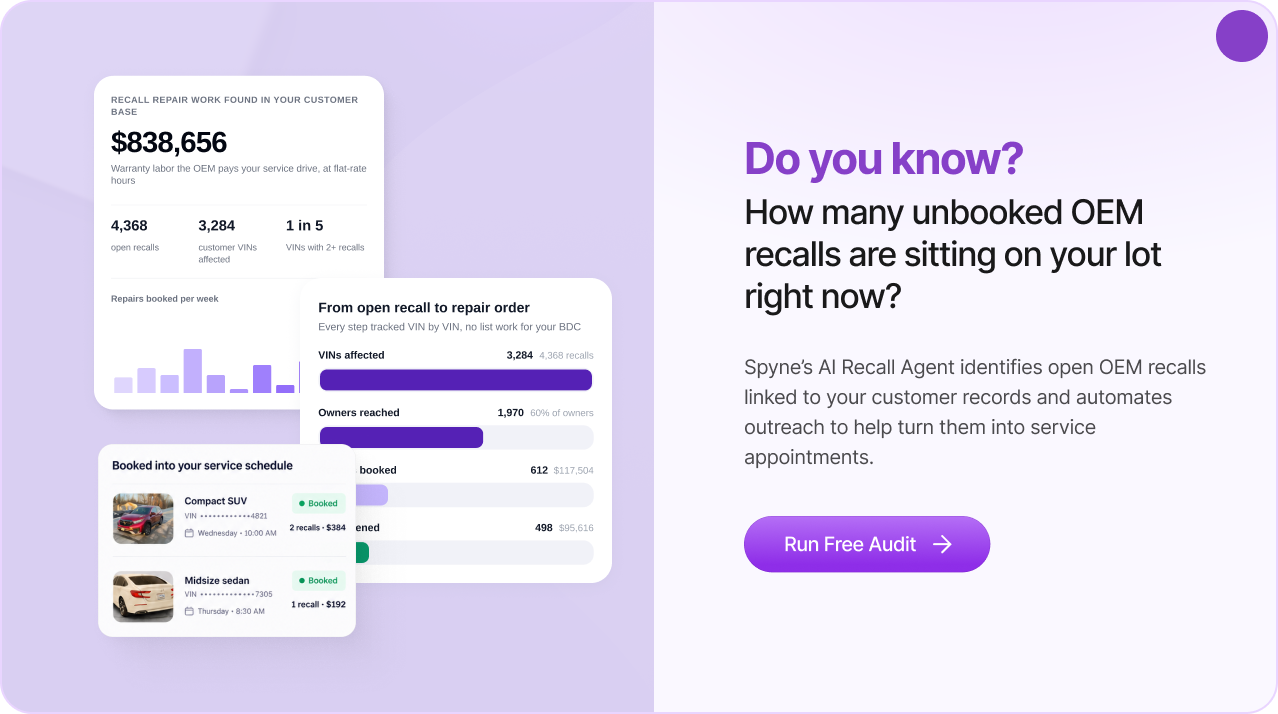
| Fixed ops automation | Service scheduling, RO status updates, recall outreach | Vini AI, Numa | Books directly into the DMS scheduler and pulls live RO status for status calls |
| Automotive merchandising | Dynamic pricing, vehicle descriptions, photo quality, market comparisons | Spyne Studio AI | Handled by Spyne’s separate visual merchandising product, not Vini AI |
| Dealer analytics | Sales forecasting, lost-opportunity detection, staff performance monitoring | Various dealership analytics platforms | Not a core Vini AI workflow; reporting focuses on conversation and appointment outcomes |
Customer communication and AI BDC workflows consistently show the fastest measurable payback, since they sit closest to a specific missed-call or missed-lead dollar figure. Merchandising and analytics investments compound value over a longer window.
How to Evaluate a Dealership AI Vendor Before You Sign?
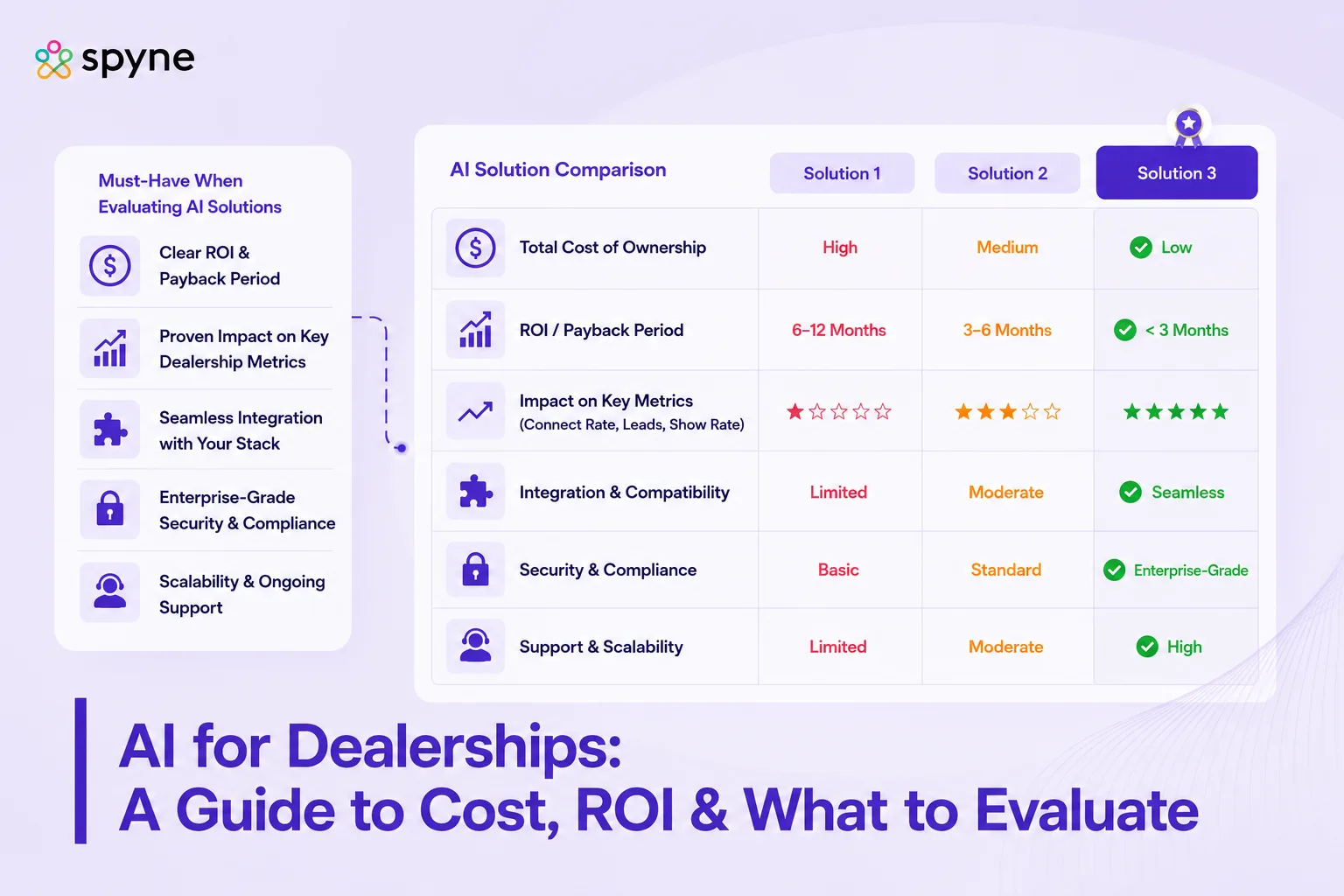
Beyond overall scope, five dimensions separate a durable platform from a demo that looks polished for twenty minutes.
Integration depth is the first and most consequential. Ask whether the platform writes back into your DMS scheduler or only reads from it, since that distinction determines whether a status call or booking actually resolves or just gets logged for a human to finish. Confirm which specific DMS and CRM systems it natively supports, not a vague claim of integrating “with most systems,” and check whether it can pull live inventory data to answer real-time availability questions.
Automotive-specific knowledge separates purpose-built platforms from generic AI wrapped in dealership branding. A platform worth considering should handle VIN lookups, trade-in workflows, and OEM incentive structures without falling back on generic answers, and it should understand finance terminology and service scheduling conventions specific to your store type. Ask to see it tested against your actual inventory rather than a scripted demo built for a generic dealership.
Human handoff logic determines whether escalations feel seamless or jarring to the customer. Find out what specifically triggers an escalation to a live staff member, whether that staff member sees the full conversation history at handoff or starts cold, and how a service advisor or BDC rep gets briefed on what the AI already covered before they pick up.
Security and compliance questions are frequently the ones vendors answer vaguely, which is itself a signal. Ask directly how customer data is stored, what the model training policies are, and whether encryption, role-based access, and audit logs are standard. Confirm the vendor addresses TCPA compliance for outbound calls and texts, including consent tracking for call recording.
Vendor durability is the category most dealers skip and regret skipping. Ask for a reference customer running your exact DMS, not just a similar one. Ask what percentage of conversations get resolved without staff involvement, measured rather than estimated, and what happens when the AI can’t answer, whether it fails gracefully or leaves the customer stuck.
In short: these five dimensions are the shortlist, not the full scorecard. For the complete question-by-question evaluation document to bring into vendor calls, see the Dealership AI Platform Evaluation Checklist.
How Much Does Dealership AI Actually Cost?
There is no single number, and any vendor quoting one flat rate before asking about your call volume and department scope is skipping a step.
Common Pricing Models in the Category
Most vendors price using one of these structures:
- Monthly subscription per rooftop
- Per-user licensing
- Per-call or per-conversation pricing
- Usage-based AI token pricing
- Enterprise pricing negotiated for multi-rooftop groups
Many vendors also charge a one-time onboarding or integration fee separate from the recurring cost, ask about this explicitly, since it rarely appears in a headline quote.
How Deployment Scope Changes the Number
| Starting Point | What It Covers | Who It Fits |
| Single-agent entry | One use case, usually inbound sales or after-hours coverage | Small, single-rooftop stores testing the model |
| Full sales + service | Multi-department coverage, one system | Mid-size stores with gaps in more than one area |
| Full suite + outbound | Sales, service, BDC, and proactive outreach | Dealer groups running centralized operations |
Some vendors offer a trial period before billing starts, letting recovered call volume prove the case before a dealer commits to a full contract.
In short: ask every vendor to quote against your actual lead and unit volume, and confirm which pricing model they use before comparing headline numbers across vendors.
How Long Until an AI Platform Pays for Itself?
Most dealerships see measurable ROI within 30 to 90 days, driven by recovered missed calls and improved appointment conversion, not headcount reduction.
- Response speed compounds fast. First responder wins 78% of deals industry-wide, and response under 5 minutes converts 3 to 4 times better than response over 30 minutes.
- Missed calls are the single biggest leak. Roughly 19 million of 53 million inbound service calls tracked industry-wide in 2025 went unconverted, split between voicemail (53%) and abandoned hold queues (29%), and only 44% of those were ever recovered after the fact.
- RO rate lift is measurable, not theoretical. Comparable AI service-scheduling deployments have driven RO rate increases as high as 35% once fully live.
- Payback compounds faster with phased rollout than all-at-once deployment. Dealerships that launch every workflow simultaneously typically see slower, harder-to-measure results than those following a fixed sequence.
A Phased Rollout Beats an All-at-Once Deployment
The fastest path to measurable ROI runs through four phases, integration and configuration, testing and sign-off, go-live, and post-live performance review, typically clearing in two to four weeks for a single rooftop already on a supported CRM. For the full phase-by-phase timeline, see the AI Implementation Roadmap for Dealerships.
Common Mistakes When Buying or Implementing Dealership AI
- Launching every workflow at once. Nobody can tell what’s actually working, and debugging becomes close to impossible.
- No single owner per workflow. Someone needs to review outcomes weekly, or quality drifts within weeks of go-live.
- Tracking activity instead of outcomes. More calls handled isn’t the same as more revenue, track appointments booked and revenue recovered instead.
- Skipping the pre-deployment baseline. Without 30 days of pre-AI data, there’s no credible way to measure improvement afterward.
- Ignoring DMS data quality. An AI platform is only as accurate as the data it can query, inconsistent RO status tagging produces wrong answers to customers, not a technology failure.
Most of these mistakes surface after the contract is signed, when they’re expensive to fix. The vendor-side equivalent, the signals worth catching before you sign anything, look a little different.
Red Flags to Watch For When Evaluating Vendors
These red flags rarely show up as a single dramatic failure. They show up as small evasions during a demo or vendor call, a vague answer where a specific one should exist, a claim nobody offers to back up with a real customer. Catching them early costs nothing; catching them after signing costs a rebuild.
Be cautious if a vendor:
- Claims “100% autonomous” operation with no human-in-loop process at all
- Has no automotive-specific integrations or terminology in its demo
- Cannot produce a measurable ROI figure from an existing customer
- Requires replacing your CRM entirely with no clear migration plan
- Cannot explain how the AI decides when to escalate to a human
- Has no reference customer running your exact DMS
None of this means AI should stay confined to a single narrow use case, though. The most common question once a dealership clears these evaluation steps is whether AI belongs alongside the team already doing the work, not instead of them.
Can AI Work Alongside Your Existing BDC?
Yes, the strongest deployments are built around augmentation, not replacement, and this is one of the few questions in this guide with real evidence behind it: dealers are asking this exact question at meaningful volume, phrased almost exactly the way the four questions below are titled.
Is AI BDC Better Than an In-House BDC, or Does It Work Alongside One?
Neither framing is quite right. AI outperforms a human BDC on speed and consistency, responding in seconds rather than minutes, and never dropping a follow-up cadence because of a shift change or a sick day. A human BDC still outperforms AI on complex negotiation, emotional de-escalation, and judgment calls that don’t follow a script. The strongest operating model isn’t a contest between the two; it’s a division of labor where each side handles what it’s structurally better at.
Which AI BDC Tools Can Replace or Support Your Dealership BDC Team?
Most AI BDC platforms, Vini AI included, are built to support rather than replace a BDC team, absorbing the volume a human team can’t realistically staff for around the clock. A handful of vendors market themselves as full replacements, and that claim is worth treating as a red flag on its own: a platform that promises to eliminate the team entirely is usually overselling how well it handles the judgment-heavy conversations that come up daily. For a named, feature-by-feature comparison of AI and outsourced BDC options, see Best BDC Companies for Dealerships: AI vs. Outsourced.
Can AI BDC Handle Leads When Your Team Is Unavailable?
This is the highest-value use case, and it’s a timing problem, not a headcount problem. Even a fully staffed BDC misses 30 to 40% of inbound calls during peak hours, and after-hours coverage typically drops further, no amount of additional hiring closes a gap that happens at 9 PM on a Sunday. AI absorbs exactly that window: after-hours calls, peak-hour overflow, and routine status questions, so the human team’s time goes to engaged buyers instead of first-touch triage. A human QA layer reviewing conversations daily keeps the handoff accountable rather than letting the system run unsupervised.
Can AI BDC Handle Both Sales and Service Leads?
Yes, when the platform is built to cover more than one department from a single system. Sales and service conversations require different context, inventory availability versus RO status, financing questions versus recall outreach, and a platform that only handles one leaves the other department to fall back on manual coverage. Vini AI is built to handle both from one system, which matters most for stores trying to close the after-hours gap across the whole dealership rather than one department at a time.
Most dealers start narrow, after-hours call coverage in one department, confirm the recovered call volume, then expand into daytime overflow and a second department. Building an AI receptionist for car dealerships this way, one call type at a time, is what keeps the rollout from overwhelming staff who are still learning what the system handles versus what still routes to them. Dealers comparing dedicated automotive answering service options at this stage are usually deciding between exactly that kind of phased, single-department start and a fuller multi-department deployment.

Closing Thoughts
The dealerships pulling ahead in 2026 aren’t running the most AI tools, they’re the ones that named a specific, measurable gap first, evaluated vendors against it directly, and rolled out in a defined sequence with one owner reviewing outcomes weekly.
Every month spent comparing demos without that groundwork is another month of missed calls and cold leads compounding against you, and industry data shows most of those never get recovered later.
See what Vini AI can cover in your first 30 days, book a demo with Spyne.