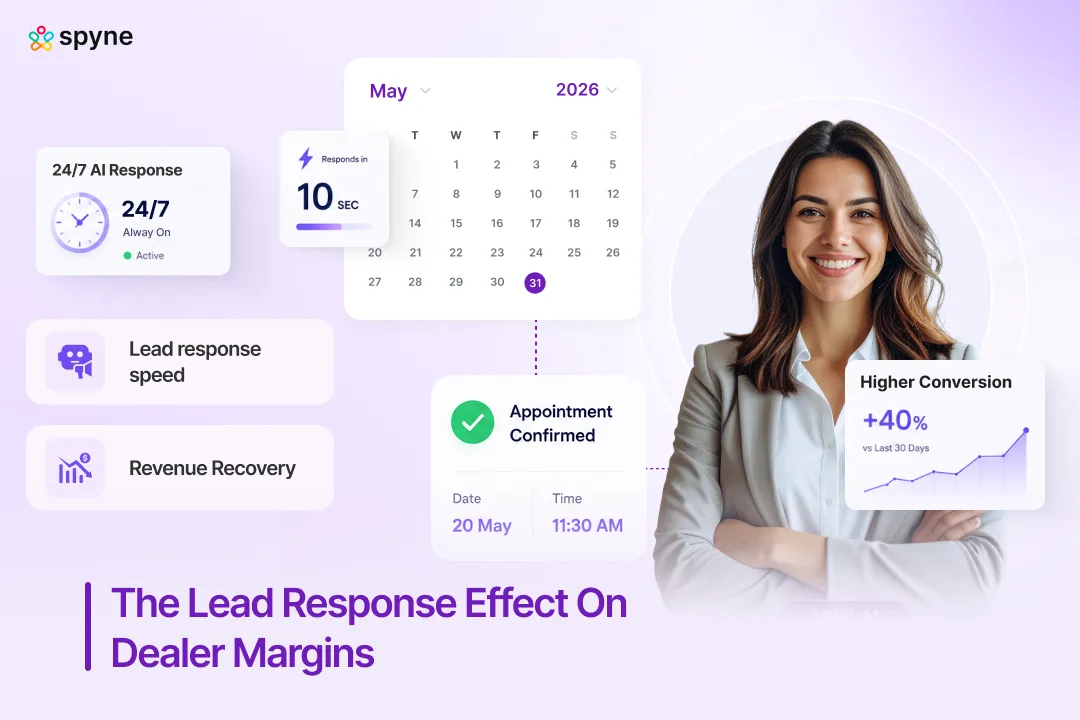

Your dealership’s lead response time determines whether you win or lose deals before your sales team picks up the phone. This is not a hypothesis; it’s backed by data that most dealers haven’t fully reckoned with.
Buyers who receive a fast response convert at meaningfully higher rates, and most dealerships are nowhere close to fast. The average dealership takes 2-6 hours to follow up on a new lead.
This article breaks down why lead response time directly impacts your bottom line, what the numbers look like for high-performing versus average stores, and the practical steps you can take to fix the workflow, starting this week.
Why Speed Is No Longer a Differentiator for Dealerships?
There was a time when responding to a lead within a day felt acceptable. That time has passed.
Understanding what today’s car buyer expects before they hit submit changes how you think about speed to lead. They have already completed 80% of their research before contacting your store. They know the vehicle, the variant, and the price range. When they submit a form or call your BDC, they are not in the browsing phase but are already in the decision phase. And they are almost certainly reaching out to two or three dealerships at the same time.
The first dealership to make meaningful contact wins the appointment. The first appointment usually wins the sale.
Industry research shows that close rates are 5x higher when leads are responded to within the first 10 minutes.
Foureyes’ analysis of 1.1 billion dealership website visits found 60% of buyers who purchased a vehicle did so within the first three days of their initial inquiry, meaning most of the decision window closes before a week passes.
Which brings up a question worth sitting with: why is a 24-hour response window effectively opting out? Because dealerships operating on that timeline are not just slow, they are handing the sale to whoever moved first.
The Real Revenue Cost of a Slow Average Response Time
What is the average dealership lead response time, and why does it matter? The number is 9.2 hours, and it matters because the buyer’s decision window is considerably shorter than that.
Let’s put some numbers on the table.
If your store converts leads at an industry-average rate of 2-5%, and your average front-end gross is $1,528 per unit (2025 average for public retailers), then every lead that goes cold before contact is a lost opportunity to earn that gross.
But it goes further than front-end gross. A buyer who purchases also generates F&I revenue (averaging $2,534 Per Vehicle Retail at historic highs), drives CSI scores, and becomes a service customer. The lifetime value of a single buyer relationship is multiples of that one transaction.
When you lose a lead to a faster competitor, you do not lose one deal. You lose every deal that the buyer would have ever brought to your store.
How does lead response time affect dealership sales conversion? Every hour of delay narrows the window, and every lead that goes cold before contact takes its lifetime value with it.
For a high-volume store handling 150-200 inbound leads per month, even a modest improvement in lead response can translate to several additional units per month. At $4,000+ combined front-end and F&I gross, the math becomes very straightforward.
The 5 Friction Points Slowing Your Dealership Down
So why do dealerships lose leads before the first call? In most cases, it is not one reason but five compounding ones. Speed is rarely the problem in isolation. The 9.2-hour average response time is symptomatic of workflow problems at multiple layers.
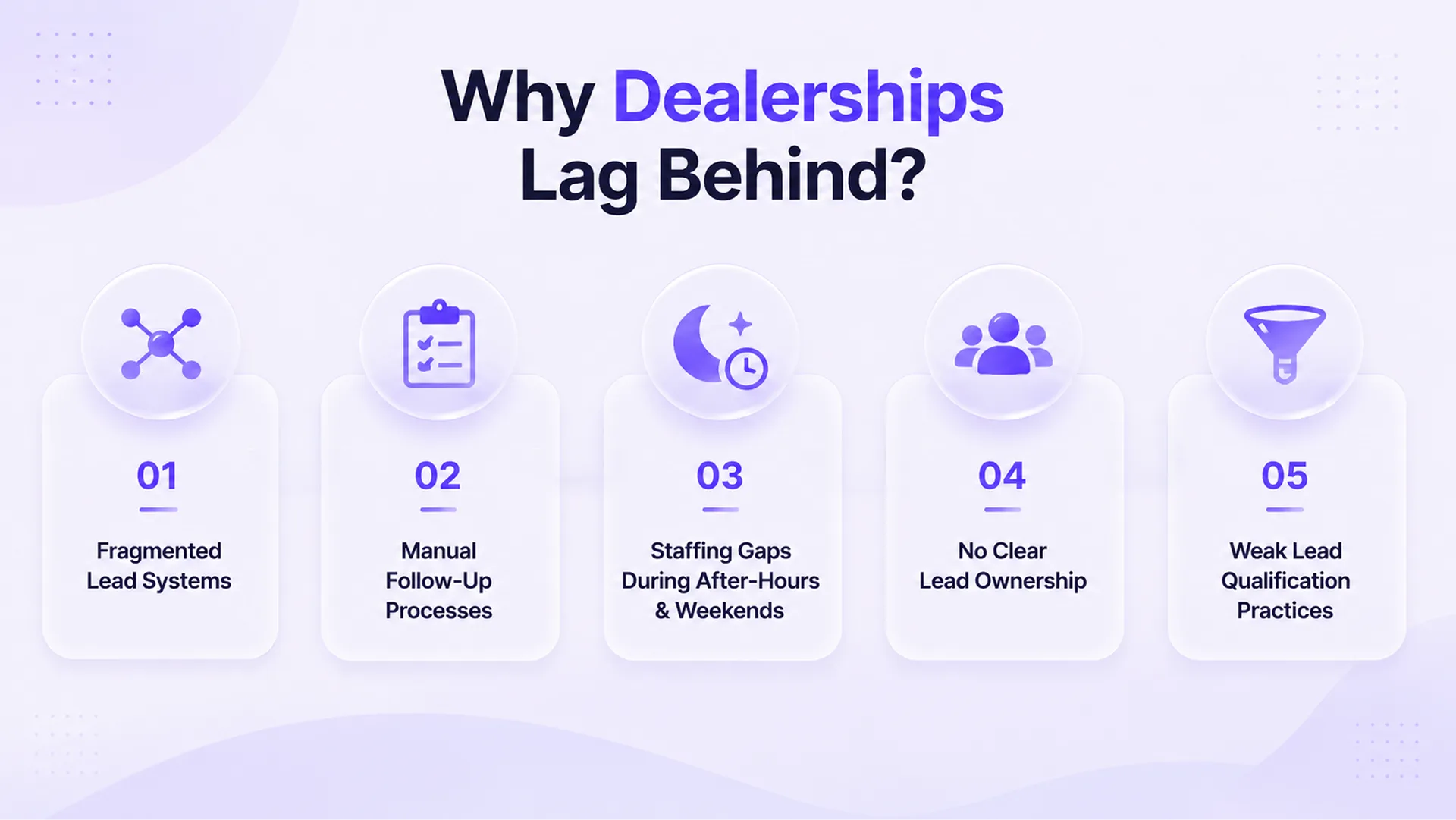
Here are the five most common friction points in dealerships:
1. Fragmented Lead Systems
Most dealerships are receiving leads from their website, third-party marketplaces (AutoTrader, Cars.com, CarGurus, and others), manufacturer portals, social media, and direct calls- all simultaneously. When these sources aren’t unified into a single routing system, leads fall into gaps. Someone sees the email notification, assumes a colleague handled it, and moves on. This leads to aged leads.
2. Manual Follow-Up Processes
A BDC rep who is managing a live call while a new lead comes in through the website cannot drop the call to respond to the new inquiry. Manual processes create natural delays, especially during high-volume periods. The more steps between lead arrival and first contact, the more opportunities for delay.
3. Staffing Gaps After Hours and on Weekends
A significant portion of inbound leads arrives outside business hours. Buyers browse listings on Saturday night. They submit inquiries at 10 PM on a Sunday. If your store has no coverage during those windows, those leads wait 12-36 hours for a first response. By Monday morning, many have already made a decision.
4. No Clear Lead Ownership
When a lead is visible to multiple people but assigned to no one in particular, diffuse accountability creates delayed responses. Everyone assumes someone else handled it. The lead readiness scorecard in the next section raises a direct diagnostic question on this point: “Does every lead have a clearly defined owner and workflow?” Most stores that are honest about their answer know the answer is no.
5. Weak Lead Qualification Practices
When BDC teams spend time engaging low-intent buyers: price-sensitive buyers, early-stage researchers, or non-buyers, high-intent buyers wait longer for attention. Without a qualification layer, your fastest responders are often talking to the wrong people first.
Dealership Lead Response Benchmarks: Where Does Your Store Stand?
What is a good lead response time SLA for a car dealership? High performers BDC metrics against three specific tiers. High-performing dealerships do not define their lead response standards loosely; they measure against specific metrics and hold their teams accountable to them.
Here’s what high-performing dealerships measure:
| Metric | High Performers | Industry Average | Risk Zone |
| First response time | Under 10 minutes | 2-6 hours | Over 30 minutes |
| After-hours response coverage | 70-90% of leads engaged | 15-30% | Under 10% |
| Lead-to-sale conversion rate | 10-15% | 2-5% | Under 1% |
| Lead response source variance | Under 20% | 25-40% | Over 40% |
If your first response time consistently exceeds 30 minutes, or your after-hours engagement is below 40%, the data suggests you are likely losing 1 in 3 qualified buyers before a first conversation ever takes place.
That’s not a projection- it’s the operational pattern that shows up repeatedly across dealerships that have audited their response data.
To see how your dealership benchmarks on the KPI scorecard, download the Lead Response Effect Playbook.
The Fast-Lead Framework: How to Fix Lead Response Without Adding Headcount?
What is the Fast-Lead Framework for dealerships? It is a four-pillar workflow architecture built around one principle: fixing response speed at the process level, not the headcount level. Fixing lead response is not about hiring more people. It is about fixing the workflow architecture.
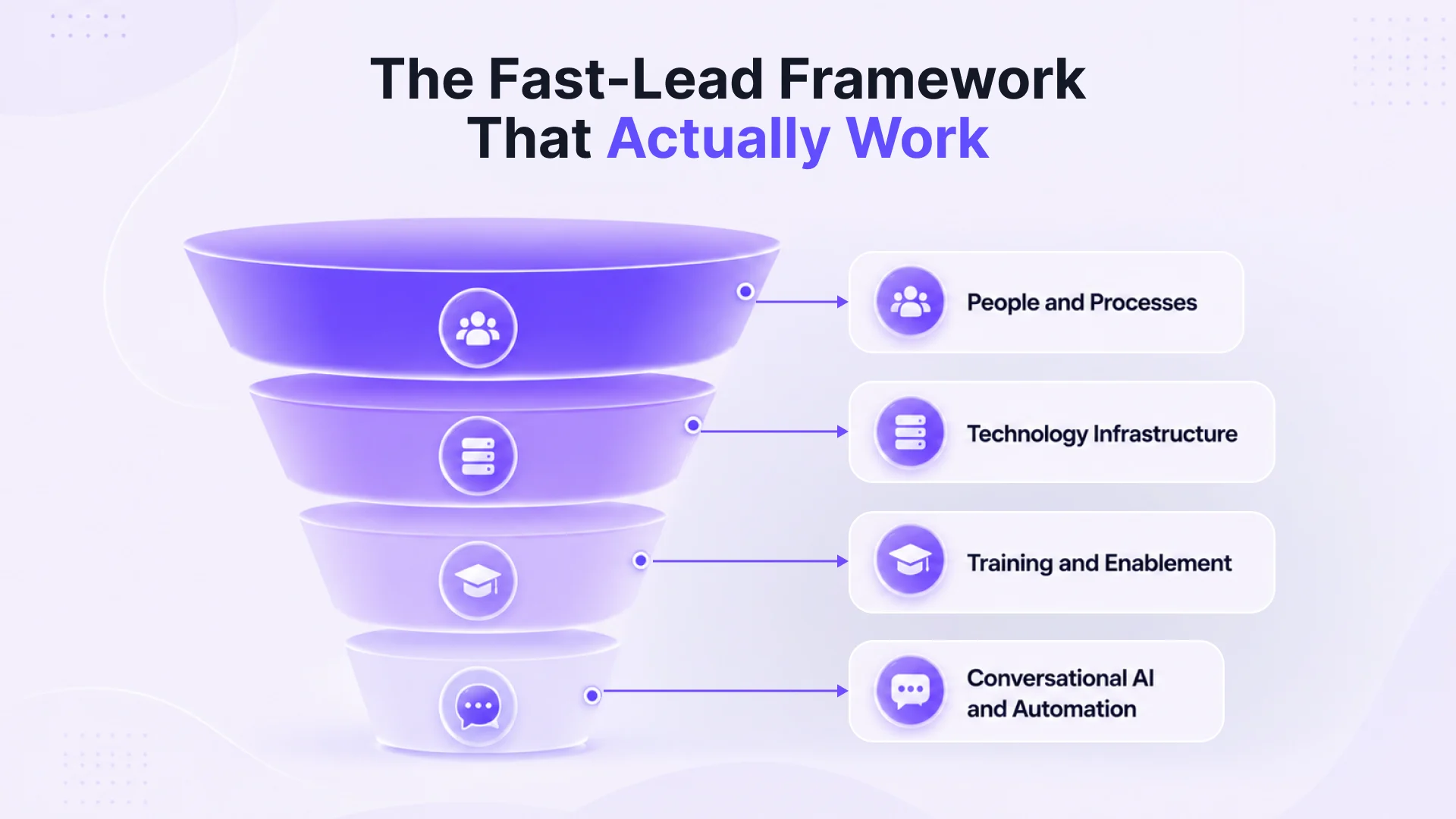
The Fast-Lead Framework covers four areas:
1. People and Process
The simplest structural change is also the most impactful: every lead must have one clearly defined owner. Remove shared accountability. Implement SOP-driven handoff rules that are actually followed. A few well-placed alert triggers during high-volume periods prevent the “I thought someone else handled it” failure mode.
2. Technology Infrastructure
Centralizing all lead sources into a single CRM, with automated routing rules, removes fragmentation at the source. Real-time SLA dashboards give managers visibility into which leads are aging, which channels are lagging, and where escalation is needed before a lead goes cold.
3. Training and Enablement
Build the team’s muscle memory around speed. A 10-minute response standard is achievable, but only if it’s practiced and reinforced. Pre-approved templates and response scripts eliminate writing delays. Speed-to-response drills during simulated peak load scenarios build confidence and consistency.
4. Conversational AI and Automation
This is where significant structural gaps, particularly after-hours delays, high inbound volume, and multi-channel fragmentation, are best addressed at scale. How do dealerships handle after-hours leads without adding overnight staff? This is precisely the structural gap conversational AI is built to close.
Vini AI, Spyne’s conversational AI for dealerships, handles the initial touch across every channel: website chat, inbound calls, WhatsApp, email, and marketplace inquiries. It responds in under 60 seconds, qualifies the buyer, shares vehicle information, and books appointments directly into the dealership’s scheduler 24/7, including weekends and peak overflow periods.
How Paragon Honda Recovered $314K in 30 Days by Fixing Lead Response?
The answer lies in two specific gaps they identified and closed in their response workflow. Paragon Honda is one of the most recognized Honda dealerships in the United States, moving 300+ vehicles per month. As their volume scaled, they identified two specific gaps: missed calls from high-intent buyers and inconsistent follow-up on recall outreach.
They deployed Vini AI for 24/7 inbound coverage and integrated it with their CRM and CARFAX/DMS systems. They also activated Studio AI, Spyne’s VDP optimization tool, to ensure every listing was market-ready the moment inventory was photographed.
The 30-day results:
- $314,524 in recovered revenue
- 172 leads handled with 100% inbound coverage
- 48% appointment-to-sale rate
- 53% recall connection rate, 33% booking rate
Brian Benstock, GM and VP at Paragon Honda, noted: “Agility is everything today, and Spyne gives us that edge.”
The recovery didn’t come from an increase in the marketing budget. It came from closing the response gaps that had been silently leaking revenue.
5 Lead Response Fixes You Can Implement This Week
You don’t need to overhaul your entire operation to see improvement in lead response at your rooftop.
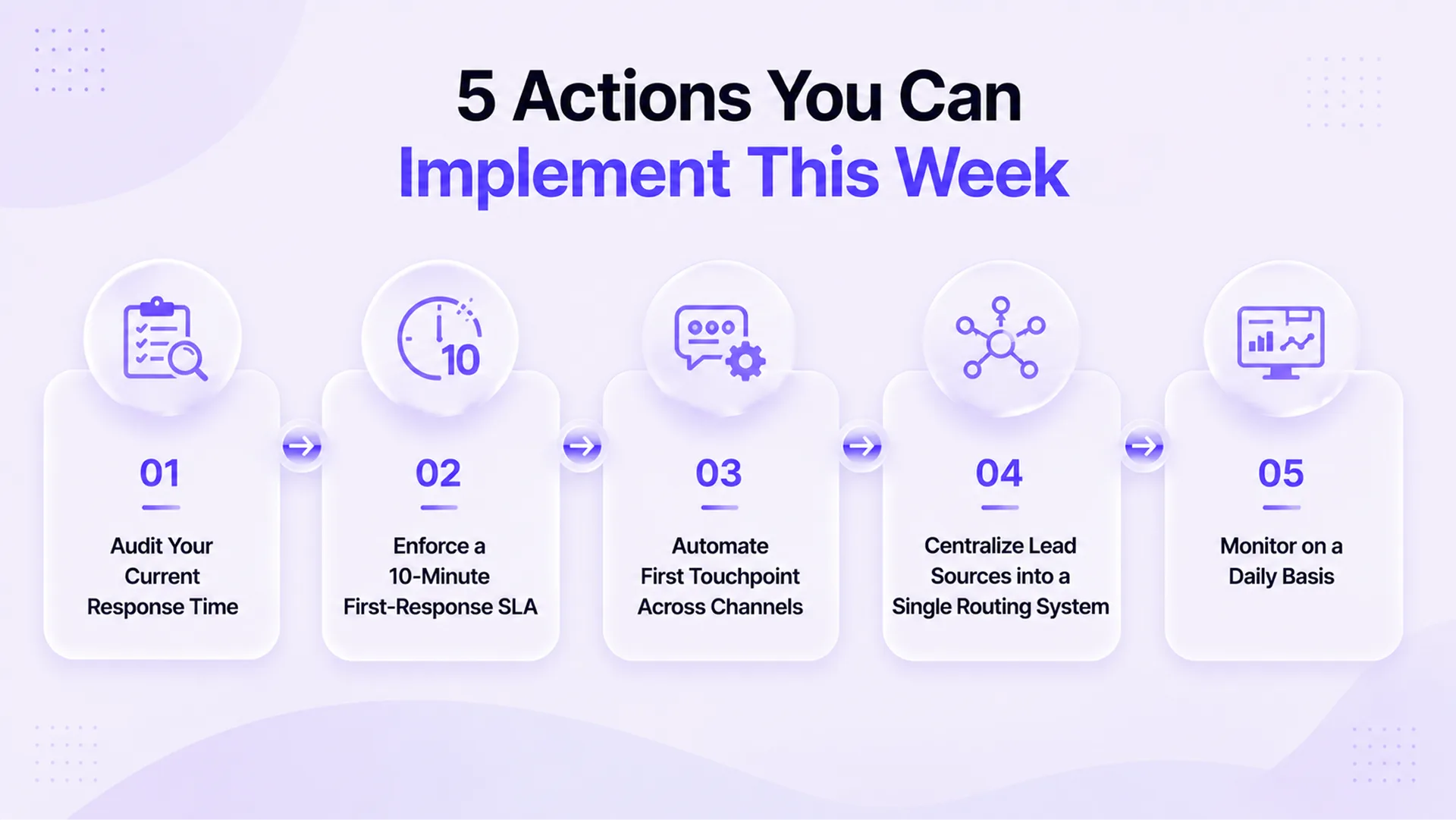
These five changes have the highest immediate impact:
- Audit your actual response times: Pull the data from your CRM across every lead source. Most dealers are surprised by what they find. Identify which channels have the longest average response times and which percentage of leads are going uncontacted.
- Enforce a 10-minute first-response SLA: Set it as a non-negotiable standard. Configure automated alerts in your CRM when a lead ages past 10 minutes without contact. Establish clear escalation paths when the assigned rep is unavailable.
- Automate the first touchpoint on every channel: No buyer should receive silence after submitting a lead. Even an automated acknowledgment confirmation, such as “We’ve received your inquiry on the 2024 Accord and will be in touch in the next few minutes,” keeps the buyer in the conversation and signals responsiveness.
- Centralize all lead sources into a single routing system: If your team is checking three different portals and an email inbox, consolidation alone will cut response time meaningfully.
- Run a daily stalled-lead check: A five-minute review of aged or uncontacted leads each morning catches the ones that slipped through the previous day. It’s low-effort with a direct impact on conversion.
The Bottom Line
The dealerships consistently winning on lead conversion aren’t outspending their competitors on marketing. They’re outperforming them on execution- specifically, the execution window between buyer intent and first meaningful contact.
Speed sells cars, and silence loses them.
The operational changes required to compete on lead response time are not cost-prohibitive. Many are process changes that require no additional headcount. And for the structural gaps, such as after-hours coverage, high inbound volume, and multi-channel fragmentation, conversational AI provides coverage that wasn’t achievable with staffing alone.
If you’d like to see how Vini AI handles first-response coverage for your store, book a demo, and our team will walk you through it.