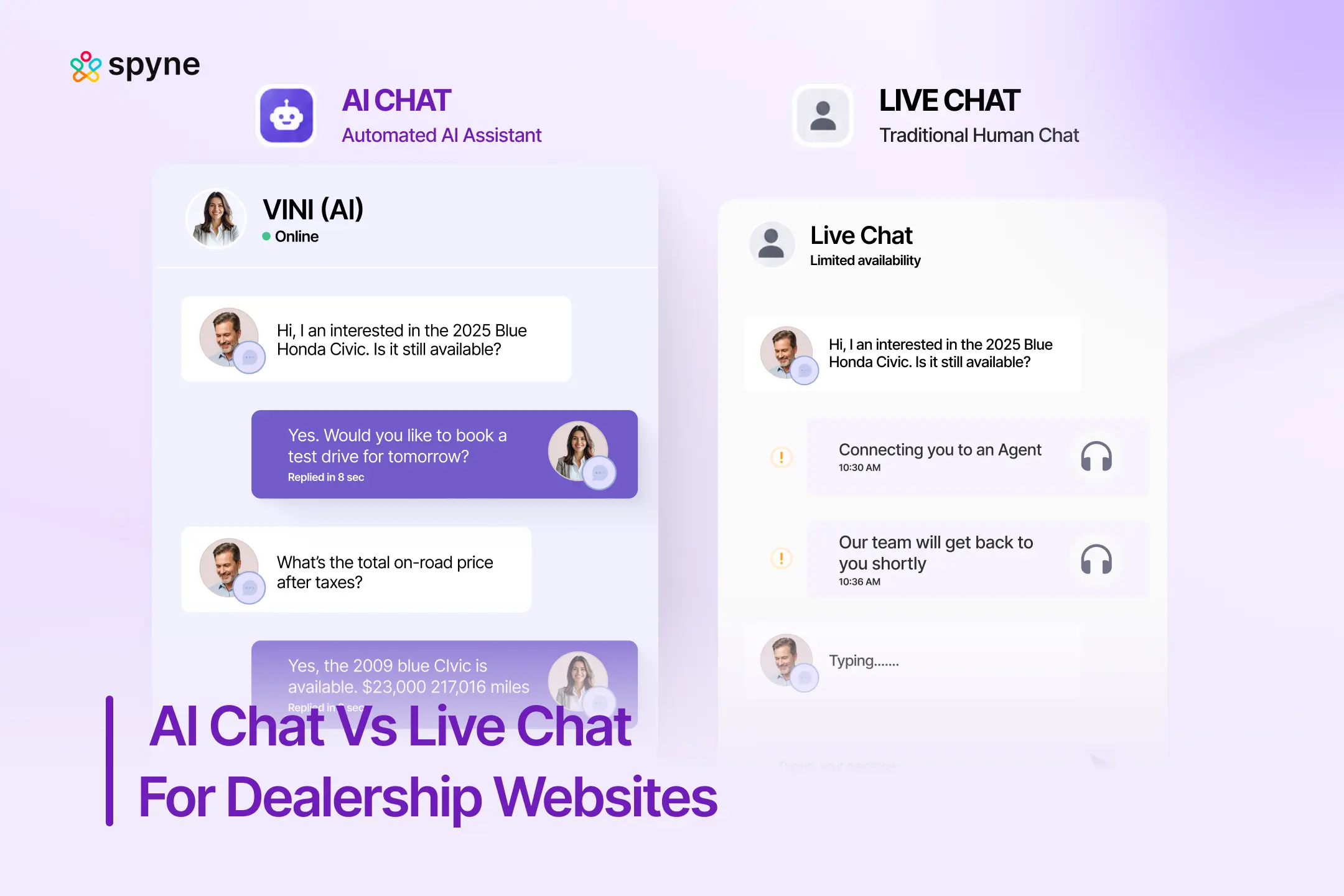

For most dealerships, AI chatbot outperforms live chat on three dimensions that directly impact lead conversion: 24/7 coverage, response speed, and operational cost. Live chat retains a real but narrow edge in late-stage, high-intent conversations where a buyer is within one or two questions of a purchase decision.
The practical answer is not either/or. The highest-converting dealership chat setup in 2026 is AI as the primary response layer, handling qualification, scheduling, and after-hours coverage, with human escalation triggered for complex, late-funnel conversations. Spyne Vini AI is built around this hybrid model, integrating directly with a dealership’s DMS and CRM to deliver 100% lead coverage with zero additional headcount.
The Real Problem with Live Chat at a Car Dealership
Live chat sounds like the right move. It puts a human face on the website, suggests immediate help, and mirrors the conversational format buyers prefer. At most dealerships, it functions as a contact form with a chat aesthetic.
The root cause is staffing dependency. Live chat only works when a human agent is present, available, and watching the queue. The moment that agent is occupied, on break, or offline, the widget breaks down in one of two ways:
- The buyer sees an “unavailable” message and closes the tab
- The chat collects a form submission that gets followed up hours later
Neither outcome captures the lead. Both waste the intent that brought the buyer to the site in the first place.
Why Response Speed Is Non-Negotiable?
Ninety percent of consumers expect an immediate response to their inquiries. In automotive retail, where the average buyer visits 4.2 websites before contacting a dealership, speed to respond is often the deciding factor in which store earns the appointment.
Dealership websites where chat is staffed by sales associates juggling floor traffic, phone calls, and walk-ins simply cannot deliver consistent sub-60-second responses. The widget is live; the agent is not always watching.
The After-Hours Blind Spot
Between 35% and 40% of dealership website traffic occurs outside standard business hours, evenings, weekends, and the early-morning window when buyers research before work. A live chat tool staffed only during the day captures less than two-thirds of inbound website intent by definition.
Every after-hours visitor who opens a chat and receives an offline message represents a lead that went unengaged at its peak intent moment. That buyer does not wait until 9 AM. They move on to the next search result.
35–40% of dealership website traffic is after-hours. Live chat captures near zero of that intent without round-the-clock staffing.
Live Chat vs. AI Chat: Head-to-Head Comparison for Dealerships
The comparison below reflects typical outcomes for a single-rooftop dealership with standard BDC staffing and an AI chat solution that integrates directly with the DMS and CRM.
| Factor | Live Chat (Human-Staffed) | AI Chat (Spyne Vini AI) |
| Response speed | 30 seconds to several minutes | <5 seconds |
| After-hours availability | None without 24/7 staffing | Always on, 100% coverage |
| Monthly staffing cost | $2,000–$8,000+ USD | Platform cost only |
| Consistency across conversations | Varies by agent | Identical on every interaction |
| Appointment booking | Requires agent + scheduler access | Direct DMS integration |
| Complex negotiation handling | Strong, human judgment applies | Routes to human with full context |
| Lead capture after hours | Near zero without staffing | 100% captured and logged |
| CRM logging | Manual or partial | Automatic (full transcript and intent data) |
| Simultaneous conversations | One per agent | Unlimited |
| Lead-to-appointment conversion | Varies widely by agent quality | +20–25% lift vs. unassisted baseline |
What Happens to Chat Leads When No Agent Is Online?
With a pure live chat setup, a buyer who opens the chat widget after hours receives an offline message and a contact form. The research on this is consistent: offline chat form submissions convert at a fraction of the rate of synchronous, real-time conversations.
The buyer’s intent at the moment they opened the chat is the highest it will be. That intent does not carry over to the next morning when a BDC rep calls to follow up. It dissipates the moment they close the tab.
With automotive chatbot like Spyne(Vini AI) handles a conversation at 1 AM on Saturday with the same response quality as a Tuesday afternoon inquiry. The buyer gets accurate vehicle information, availability confirmation, financing ballpark answers, and, if ready, a booked service or sales appointment with a confirmation pushed to their phone. The dealership sees that booked appointment in the DMS the next morning.
Operational example: A dealership averaging 800 website visitors per month, with 38% of traffic after hours, has approximately 304 monthly visitors arriving when live chat is unavailable. At a 3% chat engagement rate, that is roughly 9 after-hours chat sessions per month going unengaged under a live-only setup. At an average gross of $2,800 per vehicle, recovering even two of those per month is $5,600 in additional gross opportunity, from coverage alone.
When Does Live Chat Outperform AI Chat at a Dealership?
AI chat doesn’t eliminate the value of a live agent, it narrows the situations where one is actually needed. That distinction matters, because the situations where live chat genuinely outperforms AI are specific and identifiable. Live chat has a real edge in one scenario: the late-stage, high-intent conversation where trust is the deciding factor.
Buyers who benefit most from a live agent:
- A shopper comparing two vehicles at similar price points who wants to negotiate terms, not just get information.
- A fleet buyer evaluating a multi-unit purchase where flexibility, volume pricing, and relationship carry weight.
- A customer in an active trade-in discussion where the numbers are close and rapport is doing real work.
These conversations share a common thread, implied flexibility, interpersonal reading, and the kind of trust-building that AI in its current form cannot fully replicate.
How AI Chat for Car Dealerships Actually Works
AI chat for automotive dealerships is not a generic chatbot that answers FAQ questions from a static knowledge base. An integrated AI BDC tool like Spyne Vini AI connects directly to three systems: the DMS (for real-time inventory and scheduling), the CRM (for lead logging and attribution), and the website (for visitor context and session data).
What an AI Chat Tool Does in a Real Conversation?
- Greets the visitor and identifies intent, sales inquiry, service scheduling, or general information
- Checks the DMS in real time to confirm vehicle availability, trim levels, and current pricing
- Qualifies the lead, asking about trade-in, financing needs, timeline, and preferred appointment window
- Books the appointment directly into the DMS scheduler with confirmation sent to the buyer
- Logs the full conversation transcript, lead source, and intent data into the CRM automatically
- Escalates to a live agent or BDC rep when the conversation enters territory where human judgment adds value, passing full context so the rep does not start from zero.
What Does This Means for the BDC and Sales Team?
AI chat does not replace the BDC. It changes what the BDC team is working on. Instead of spending capacity on routine qualification calls, availability checks, and appointment reminders, the team handles the conversations where relationship and judgment close the deal. Dealers using Vini AI report a 15–25% productivity gain per advisor, not from working harder, but from working on higher-value interactions.
Measurable Outcomes: What AI Chat Delivers for Automotive Dealerships
The case for AI chat is not theoretical. The operational metrics below reflect observed outcomes from Vini AI deployments across franchise and independent dealerships.
| Metric | Typical Outcome with Vini AI |
| Inbound coverage rate | 100% of calls and chats answered instantly |
| Average response time | Under 5 seconds for chat; under 60 seconds for calls |
| Lead-to-appointment conversion lift | +20–25% vs. unassisted baseline |
| After-hours lead capture | 100% (no session goes unengaged) |
| CRM logging completeness | Full transcript, lead source, and intent data on every interaction |
| Advisor productivity gain | +15–25% efficiency improvement |
| CSI score improvement | +10–15% in measured deployments |
| ROI timeline | 5–10x ROI within first 90 days for most rooftops |
How to Add AI Chat to an Existing Dealership Website
Deploying an AI chat tool on a dealership website is a technical integration, not a platform migration. The process for Spyne Vini AI follows three stages:
- Website embed: A standard JavaScript snippet is added to the site. This takes under 30 minutes regardless of the website platform (CDK, DealerSocket, Dealer.com, or custom builds).
- DMS integration: Vini connects to the DMS for real-time inventory access and direct appointment scheduling. This step takes one to two weeks depending on the DMS platform (CDK, Reynolds & Reynolds, DealerTrack, and others are supported).
- CRM configuration: Lead data, conversation transcripts, and source attribution are mapped to the dealership’s existing CRM fields. Logging is automatic from day one of go-live.
Most dealerships reach full operational deployment, website live, DMS connected, CRM logging active, within two weeks of kickoff.

The Right Chat Setup for Dealerships in 2026
The live chat vs. AI chat framing is increasingly a false choice. Live chat tools that rely on human availability have a hard ceiling: they perform well when agents are available and fail quietly when they are not. That failure is most costly precisely when website intent is highest, after hours, on weekends, and during peak floor traffic when agents are occupied.
AI chat covers 100% of inbound website engagement, qualifies leads at the moment of intent, books appointments directly into the DMS, and logs everything into the CRM without manual intervention. For the specific conversations where human judgment still closes deals, late-stage negotiation, complex trade-ins, fleet discussions, it hands off with full context, not a cold transfer.
The dealerships seeing the highest lead-to-appointment conversion rates in 2026 are not choosing between live and AI chat. They are running AI as the primary layer and humans as the escalation layer.
If your store is still relying on live chat alone to capture website leads, you’re leaving after-hours intent on the table every night. Every after-hours visitor your live chat misses is a lead your competitor didn’t. Book a demo and see how Vini AI closes that gap.