
Running a business today comes with high customer expectations, instant responses, personalized service, and quick problem resolution. Missed calls or long hold times can cost leads, sales, and even damage your brand reputation. Many businesses struggle to keep up with every incoming inquiry efficiently. This is where inbound call center solutions help businesses overcome these challenges and meet customer expectations.
It helps businesses manage all calls, chats, and messages in one place, ensuring timely, professional support, helping resolve issues, answer questions, and schedule appointments. Let’s dive deeper into the blog to explore how call center inbound software actually helps businesses meet customer expectations and scale.
What is an Inbound Call Center?
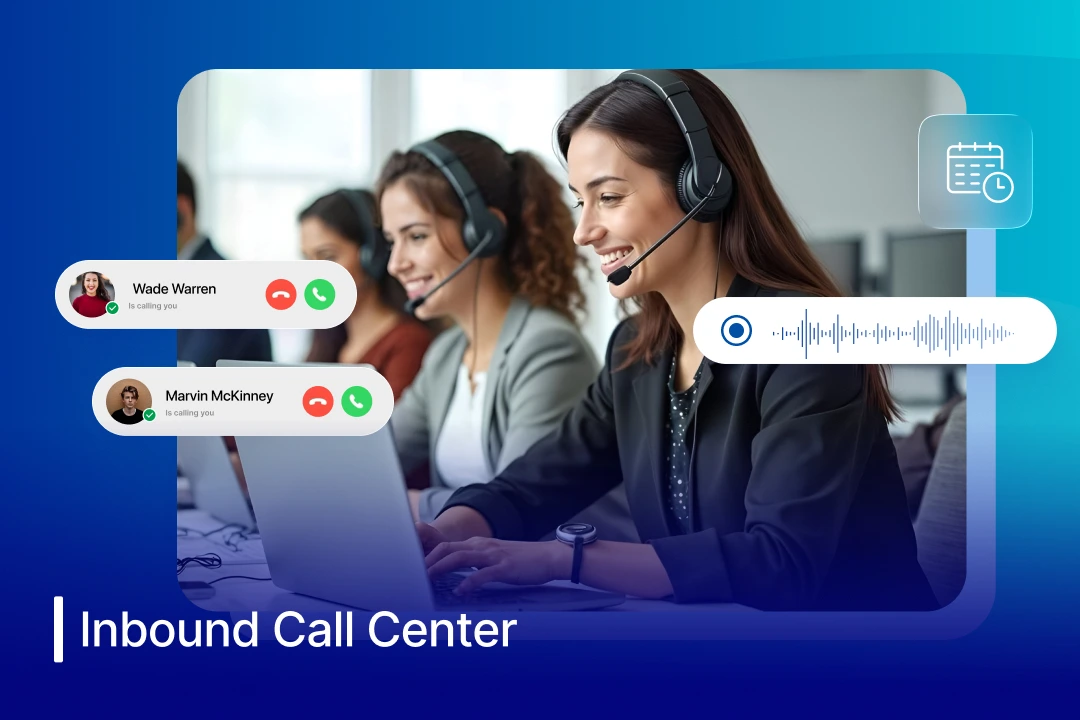
An inbound call center is a team of agents who handle all incoming calls from customers, or prospects, seeking inquiries, customer, or technical support. It handles customer interactions via call, live chat, and text, delivering an enhanced customer experience.
Inbound call centers primarily focus on resolving customer issues, answering questions, processing orders, and building customer loyalty. These agents often use phones and automated call center software inbound for handling customer calls and messages effectively.

Importance of an Inbound Call Center for Businesses
Having an inbound call center is important for businesses because it enables them to handle customer inquiries, support requests, and sales opportunities efficiently. Further, by combining skilled agents with advanced technology, it enhances customer experience, boosts operational efficiency, and provides valuable insights that drive growth.
1. Deliver Enhanced Customer Experience
Inbound call centers ensure to deliver quick, accurate, and personalized responses to customers’ needs and preferences. This reduces customer wait times, making them feel valued and enhancing their experience.
2. Build Brand Loyalty and Reputation
Professional call handling leaves a positive impression on customers at every touchpoint. Offering reliable and friendly support to your customers reflects your commitment to delivering quality service. This fosters customer trust and enhances your brand’s reputation, turning them into loyal, long-term customers.
3. Actionable Customer Insight
Agents working at the call center inbound software collect all crucial information about customer preferences, concerns, and feedback during the call. This data helps you understand the pain points and identify the areas for improvement. These insights also help in making better business decisions.
4. Boost Operational Efficiency
Inbound call centers utilize automated and AI-powered solutions to manage customer calls effectively and efficiently. This reduces wait times and streamlines your business workflows by allowing your staff to focus on core tasks and enhancing your business’s operational efficiency.
5. Scalability
Inbound call centers can easily handle large call volumes, even during peak hours or marketing campaigns. This ensures that every call gets an instant response 24/7 and no opportunity slips away.
6. Lead Conversion & Sales
Inbound call center agents nurture customers and guide them to take action, booking appointments or making a purchase. Skilled agents provide relevant information, accurate answers, and convert inquiries into sales opportunities, boosting the conversion rate.
Inbound vs. outbound call center: What’s the difference?
Call centers are divided into two categories: inbound and outbound call centers. Even if they serve different purposes, both are equally important for businesses.
| Inbound Call Center | Outbound Call Center |
| In an inbound call center, calls are typically initiated by customers, making it a reactive approach to handling customer needs and queries. | In contrast, in an outbound call center, calls are initiated by agents rather than customers, making it a proactive approach to customer engagement and outreach. |
| The purpose of an inbound call center is to deliver customer support, issue resolution, and assistance. | An outbound calling center focuses on Sales, lead generation, and market outreach. |
| It helps in improving customer satisfaction (CSAT) and retention. | Ountound call center helps businesses drive revenue and expand their customer base. |
| IVR (Interactive Voice Response) and ACD (Automatic Call Distribution) technologies are used in inbound call centers. | Outbound call centers use predictive dialers, power dialers, and CRM integrations. |
| Inbound call centers are typically used for customer service, technical support, and order inquiries. | Outbound call centers are used for telemarketing, follow-ups, appointment setting, and surveys. |
How to Handle Inbound Calls Effectively?
Effective inbound call handling requires the right balance of speed, empathy, and technology. Every call you receive is a sales opportunity. Having trained agents, the right tools, and effective strategies helps you handle all incoming calls effectively while delivering an enhanced customer experience. Here’s how you handle inbound calls effectively:
- Answer Promptly & Professionally
- Warm Greeting & Personalization
- Active Listening & Empathy
- Use IVR & Smart Call Routing (ACD)
- Leverage CRM Data
- Focus on First Call Resolution (FCR)
- Maintain Control & Positivity
- Take Detailed Notes
- Ensure Timely Follow-Ups
- Offer Additional Assistance
Learn more about inbound call handling with its best strategies and practices.
Top 6 Advantages of Inbound Call Centers
Inbound call centers help businesses deliver professional, efficient, and personalized support while managing high call volumes seamlessly. They boost customer satisfaction, streamline operations, and provide valuable insights to drive smarter business decisions.
1. Experts Handling Calls
Inbound call centers rely on trained agents who know how to handle customers’ complex inquiries with clarity and confidence. These agents are skilled in understanding concerns, resolving issues quickly, and delivering personalized responses all within a single call
2. Valuable Customer Data
Every customer interaction becomes a source of insight. Inbound call center agents collect all customer data preferences, common issues, and behavior patterns. This data helps businesses make smarter decisions, improve service quality, and identify new growth opportunities.
3. Advanced Technology
Modern inbound call centers use advanced technologies like automatic call distribution (ACD), interactive voice response (IVR), CRM integrations, and real-time analytics. These inbound call center software solutions and tools optimize business workflows by intelligently routing calls, minimizing wait times, and connecting customers instantly to the right agent whenever needed.
4. Enhance Customer Satisfaction
These inbound call centers ensure to deliver quick, personalized, and connected responses, meeting modern customer expectations. Agents focus on first call resolution (FCR), which builds trust and strengthens long-term relationships with the brand.
5. Boost Efficiency & Productivity
Inbound call centers handle customer first interactions and routine calls, allowing your staff to focus on priority tasks, which leads to closing deals faster and more effectively. Reducing workload boosts your staff productivity and focus on business growth.
6. Handle Large Volume Calls
When businesses grow, incoming calls increase. However, call centers are designed to handle high call volumes without compromising on service quality. They ensure each call gets answered, even outside business hours, ensuring no opportunity slips away.
How to Choose the Right Inbound Call Center Solution for Your Business?
Choosing the right inbound call center solution is important for businesses. Investing in the wrong inbound call center solution can directly affect your sales and business growth. Here are the key factors to consider when choosing the right solution for your business:
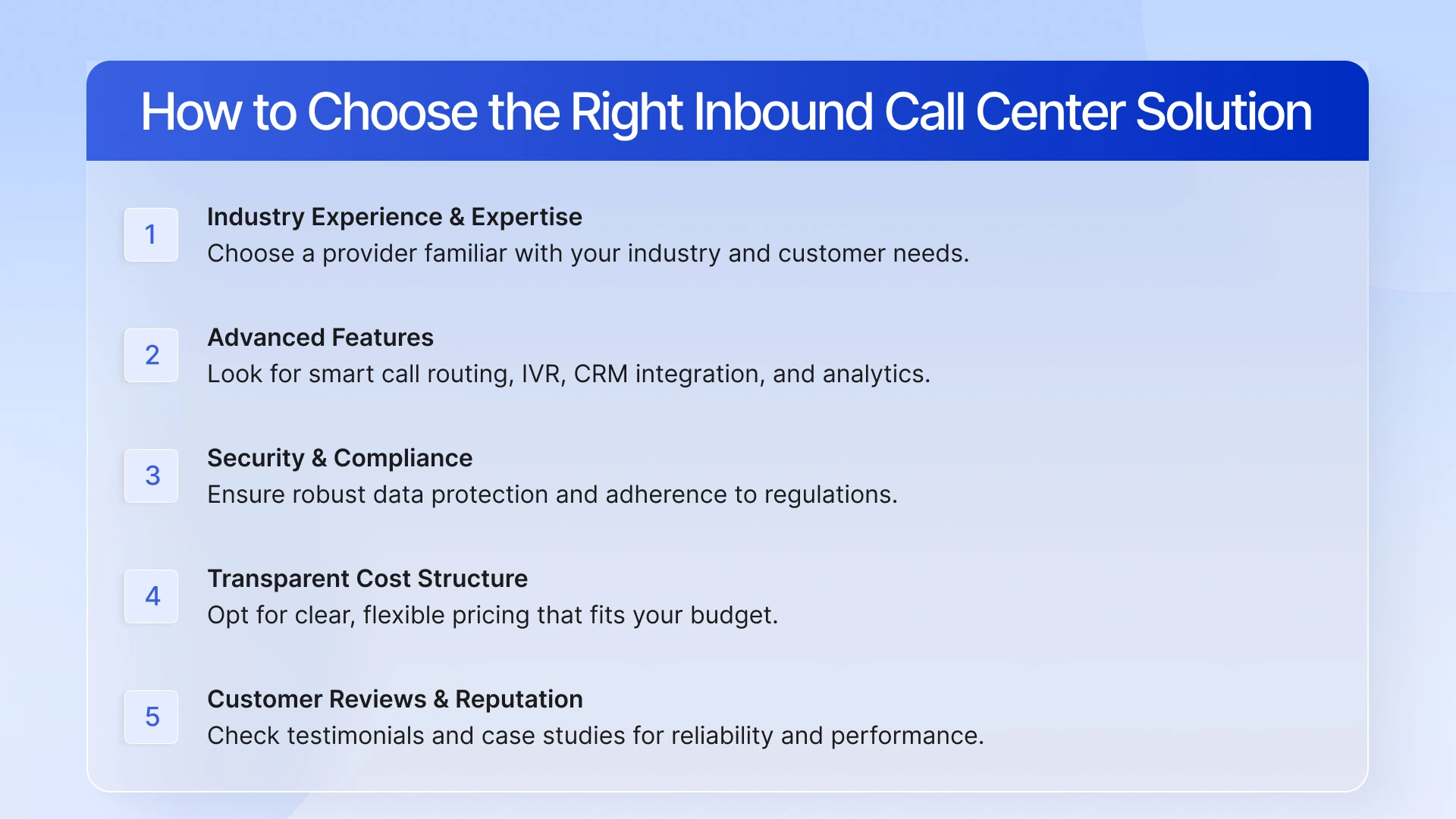
1. Industry Experience & Expertise
The first thing to look for when choosing the right inbound call center solution for your business is its experience and expertise in your industry. A team with relevant expertise understands the common customer challenges and knows how to handle them efficiently.
2. Advanced Features
Look for a solution that offers advanced features to streamline your operations. These features include:
- Virtual Receptionist
- CRM Integration
- Smart Routing
- Call Monitoring & Recording
- Analytics
- Scalability
- Omnichannel Support
3. Security & Compliances
Data security and regulatory compliance are essential when selecting a call center solution. Ensure that the provider follows industry-standard practices to protect customer information, safeguard your business, and build trust with customers.
4. Cost Structure
Compare the cost structures of different solutions and choose one that aligns perfectly with your budget and business goals. Also, look for transparency in setup fees to ensure there are no hidden charges.
5. Reviews & Demos
Look at client testimonials, case studies, and reviews to evaluate the reliability and performance of multiple inbound call center solutions. These insights will help you understand how well the provider delivers on service quality and meets customer expectations. Additionally, request a free demo to experience the solution firsthand before making a decision.
Best 10 Practices When Implementing an Inbound Call Center?
Implementing inbound call center solutions effectively requires a mix of skilled agents, smart technology, and continuous process improvement. Following best practices ensures higher customer satisfaction, operational efficiency, and long-term business growth.
1. Empower Your Agents
Provide your agents with training sessions in empathy, active listening, and product or service knowledge. Equip them with AI and automation tools like screen pops or CRM dashboards to access customer history instantly. This will help them understand customer intent, behavior, and tone during the call and deliver personalized responses.
2. Optimize Call Routing (ACD & IVR)
Use intelligent call routing through automatic call distribution (ACD) and interactive voice response (IVR) systems. This ensure customer get connected to the right department and agent at the right time without any delay impacting first-call resolutions and customer satisfaction.
3. Implement Omnichannel Support
Offer consistent service to customers across multiple channels, including phone, email, chat, and social media. It allows customers to switch channels seamlessly without losing context and ensures a unified and convenient experience for every interaction.
4. Leverage Self-Service Options
Utilize IVR systems and automation tools to handle routine inquiries like order status or account information. This frees up agents to focus on more complex issues. Self-service options improve efficiency while maintaining customer satisfaction.
5. Track KPIs
Track essential metrics like first call resolution rate (FCR), average handle time (AHT), abandonment rate, and customer satisfaction (CSAT). Analyzing these metrics will help you find areas for improvement and improve your service quality.
6. Implement Quality Monitoring
Record calls using AI tools and analyze them regularly to evaluate agent performance against standards. Implementing quality monitoring ensures consistent service, reduces errors, and identifies training needs.
7. Ensure Data Security
Protect customer data and information using secure verification methods. Further, following security rules builds trust and protects your business. Safe systems also help prevent data breaches and reduce risks.
8. Reduce Workload
Maintain manageable workloads, provide adequate breaks, and offer support resources for your human agents. Also, consider flexible or hybrid work models for your staff to reduce burnout. It will empower your employees and boost their productivity.
9. Use Advanced Tools & Solutions
Leverage AI tools to streamline your business workflow. It enables proactive decision-making and personalized service. Further, AI data-driven insights help optimize staffing, call routing, and overall operational efficiency.
10. Continuous Improvement
Encourage agents and supervisors to share feedback on processes and customer interactions. Use this information to refine workflows, training, and service strategies. Continuous improvement ensures the call center evolves with customer expectations and business goals.
What Do Businesses Use Inbound Call Centers For?
Businesses use the best inbound call centers software to efficiently manage incoming customer interactions, from support and sales to technical and financial queries. These centers help improve response times, enhance customer satisfaction, and drive business growth.
1. Customer Support & Service
Businesses often use outsource inbound call center services or an AI inbound call center solution to handle customer queries, complaints, and service requests. Customers these days expect a lot from businesses, instant responses, and resolution. Inbound customer support & services are responsible for meeting customer expectations and improving customer satisfaction.
2. Marketing & Inbound Sales
Most businesses use inbound call centers to convert interest into revenue by handling calls generated from marketing campaigns. Whenever a customer initiates a call, call center agents guide them, answer queries, and close sales.
3. Technical Support & Help Desk
Inbound call centers also act as IT help desks for businesses, assisting customers with technical issues. From software troubleshooting to system support, agents provide step-by-step guidance to resolve problems with minimal call disruption.
4. Order & Payment Processing
Businesses also use AI or outsource inbound call center services for managing orders, billing queries, and payment-related concerns. Agents assist customers with purchases, refunds, cancellations, and account-related questions to ensure a smooth customer journey.
5. Appointment Scheduling & Bookings
Inbound call centers help businesses manage their appointments, reservations, and cancellations. These call centers ensure smooth scheduling and timely updates, improving customer convenience and operational efficiency.
6. Feedback & Surveys
Some businesses use inbound call centers to gather customer feedback and measure customer satisfaction. Post-call surveys and interactions help businesses get customer insights. These insights are valuable for improving services and making data-driven decisions.
7. Finance & Accounting Support
Inbound call centers also handle a wide range of finance-related queries for businesses, such as billing, invoices, payments, and refunds. They ensure the delivery of quick financial assistance to both customers and internal teams for smooth financial operations.
8. Upgrades, Renewals & Cross-Selling
Inbound call center services enable opportunities for businesses to drive revenue through upgrades and renewals. Agents can recommend better plans, renew subscriptions, or cross-sell relevant products based on customer needs, maximizing customer lifetime value.
Why Auto Businesses Need an Inbound Call Center Solution?
Most automotive businesses struggle to meet customer expectations and respond to their calls. This is because many auto buyers tend to call outside regular business hours, such as in the evening, late at night, or during holidays, when no one is available to answer their calls. This is why having an inbound call center solution, whether it’s an automotive call center outsourcing solution or an AI-powered solution, is important for auto businesses. This helps you in:
1. Eliminating Missed Opportunities
An advanced automotive inbound call center service helps businesses receive all incoming calls, ensuring no opportunity slips away. Attending each call, agents guide customers to take action, turning their interest into appointments, test drives, and sales, even during peak times.
2. Enhancing Lead Management
Experts handling calls ensure to respond promptly and professionally. These trained agents prioritize leads based on their high-intent and route them to the right department and agent, reducing wait times.
3. Enhancing Customer Experience (CX)
Automotive inbound call center agents understand customers’ intent and preferences during the call to deliver personalized responses, meeting their requirements. This helps build brand trust and loyalty while enhancing overall customer experience.
4. Increasing Operational Efficiency
An effective inbound call center software solutions improves your dealership’s operational efficiency by automating repetitive tasks. This reduces your staff workload while ensuring calls are effectively handled without adding headcount to your dealership.
5. Driving Customer Insights
Inbound call center services capture and analyze call data through CRM integrations to track customer interactions and performance metrics. These insights help identify customer trends, missed opportunities, and areas for improvement, enabling smarter and more efficient operations for your dealership.
6. Connecting With Customers 24/7
Automotive-specific inbound call center software solutions or automotive BPO offers 24/7 support for customers. It ensures that every call, even outside business hours, is answered instantly, reducing wait times and lost opportunities, while enhancing customer satisfaction.
How Spyne’s AI-Powered Inbound Call Center Solution Is the Perfect Choice For Automotive Businesses?
Unlike traditional call center inbound software that relies solely on human agents and fixed schedules, Spyne’s AI call handling center for inbound calls offers 24/7 intelligent support with real-time CRM insights. This combination of AI and human-like interactions enhances lead conversion, improves customer experience, and streamlines dealership operations far beyond conventional call handling.
1. Conversational AI Agent
We offer you a conversational AI agent that handles all customer interactions effectively as a real human does. It understands customers’ tone, behavior, intent, and preferences in real time and delivers personalized responses, meeting their expectations.
2. 24/7 Availability & Scalability
Spyne ensures 24/7 connectivity, so no call goes unanswered. Whether it’s evenings, holidays, or peak campaign hours, the system scales automatically to handle high call volumes without compromising service quality. This 24/7 accessibility enhances customer satisfaction and builds trust in your dealership.
3. Enhanced Lead Management & Conversion
Our AI-powered inbound call center solution prioritizes high-intent leads, routing them to the right department or agent while providing agents with instant context from CRM integrations. By delivering prompt, professional responses, Spyne’s inbound sales call center helps turn inquiries into appointments, sales, and test drives, boosting conversion rates.
4. Operational Efficiency & Cost Savings
By automating routine tasks, call routing, and data capture, Spyne reduces staff workload while maintaining consistent, high-quality service. Dealerships can focus on in-person customer engagement without increasing headcount, achieving cost savings and improved productivity.
5. Data Driven Insights
Our AI inbound call center technology captures and analyzes call data in real time, offering actionable insights on customer preferences, trends, and pain points. This allows you to refine sales strategies, marketing campaigns, and customer service practices for smarter, data-driven decisions.
6. Enhanced Customer Experience
By combining advanced conversational AI with human-like interaction, Spyne delivers personalized, empathetic, and efficient customer service inbound calls. Agents and AI work together to provide first-call resolution, reduce hold times, and ensure every interaction enhances customer loyalty and brand reputation.
7. Smooth Integration
We offer a smooth integration with your dealership’s existing CRM and inventory management systems, giving agents instant access to vehicle availability, pricing, and customer history. This allows for faster, informed responses and smoother customer interactions.

Conclusion
An effective inbound call center system is no longer optional, it’s essential for businesses. By handling every customer interaction with speed, professionalism, and personalization, businesses can boost customer satisfaction, capture more leads, and strengthen their brand reputation. Advanced AI-powered solutions, like Spyne, take this a step further by combining human-like interactions with intelligent automation, ensuring no opportunity is ever missed.
Investing in modern AI-powered inbound call center technology helps dealerships streamline operations, reduce workload, and make data-driven decisions that drive growth. With 24/7 availability, smart lead management, and actionable insights, Spyne empowers automotive businesses to deliver exceptional customer experiences while increasing efficiency and revenue. See Spyne’s AI inbound call center solution in action for your dealership. Book a demo!