
Imagine customer engagement that feels intuitive, timely, and tailored to each person’s needs, this isn’t a future vision; it’s happening now. Customer engagement has evolved from a cost center into a strategic growth engine, with Artificial Intelligence (AI) driving that shift. Instead of relying on static segments or past campaign data, AI customer engagement enables brands to interpret live behavioral signals, uncover intent patterns, and respond with precision in real time. Meanwhile, 59% of consumers believe AI will significantly change how they interact with companies in the near future.
What once relied on rule-based triggers has progressed into adaptive AI systems that continuously analyze data and optimize engagement as it happens. In this blog, we unpack what AI in customer engagement works, its capabilities, how to measure ROI, use cases, and the future of AI-powered engagement across industries like automotive.
What Is AI Customer Engagement?
AI customer engagement is the use of intelligent technologies to automate, personalize, and optimize interactions across digital channels. It uses technologies like machine learning, natural language processing (NLP), predictive analytics, conversational AI, and digital assistants to deliver fast, relevant, and proactive experiences at scale. By analyzing real-time behavior, intent, and context, it determines the most appropriate action, message, or interaction for each customer, moving beyond fixed schedules to moment-based, data-driven engagement that adapts dynamically to individual needs.
How AI in Customer Engagement Works Across the Funnel?
There’s no denying that AI has elevated customer engagement by making interactions faster, smarter, and more relevant. Below are the key ways organizations are using AI technology to transform how they connect with customers across the entire journey.
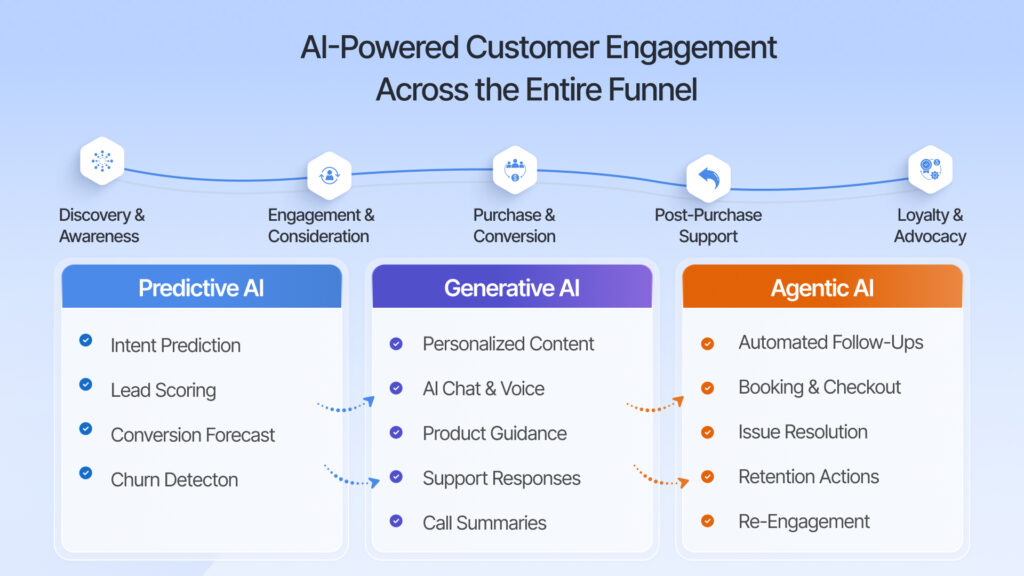
1. Discovery & Awareness (Pre-Purchase)
AI-Powered Audience Insights: Modern AI customer engagement platforms use machine learning to identify high-intent audiences from behavioral and contextual signals. These dynamic segments update in real time based on browsing patterns, searches, and engagement data, ensuring outreach stays relevant and timely.
Hyper-Personalized Content: AI-powered customer engagement enables brands to deliver tailored content across web, mobile, email, and paid channels. By aligning messaging with real-time intent, it boosts early-stage engagement and drives more meaningful interactions.
2. Engagement & Consideration (Pre-Purchase)
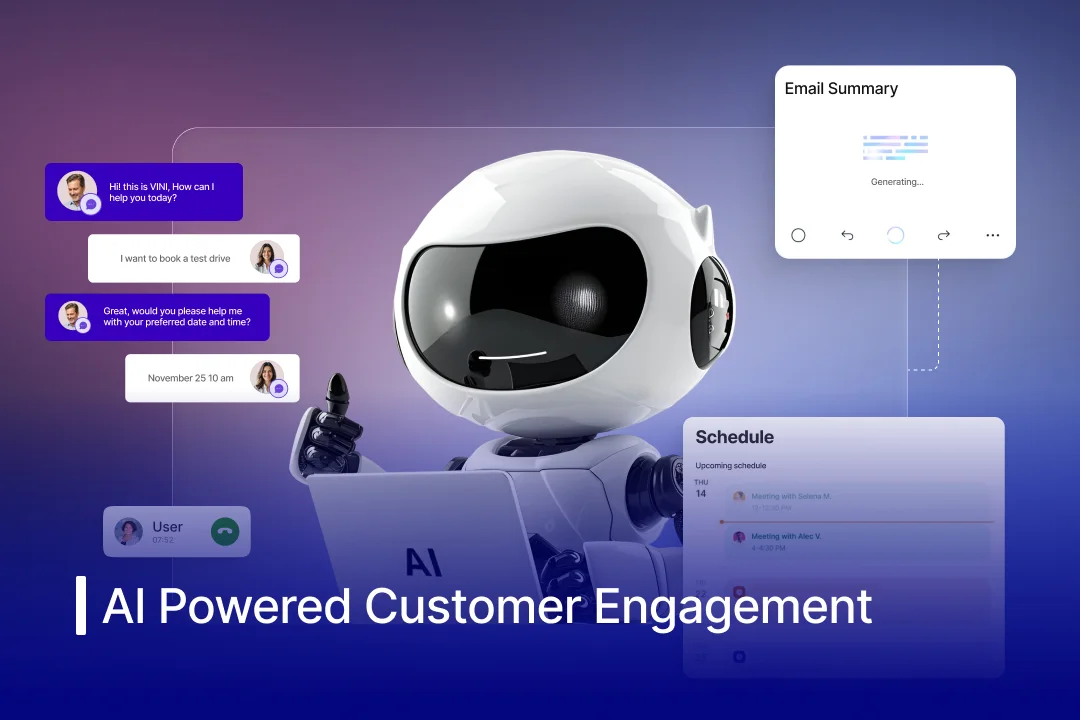
Conversational AI for Customer Engagement: Conversational AI for customer engagement enables real-time interaction via chatbots, AI voice agent, and messaging platforms. These AI systems answer questions like “Is this available?” or “Can I book a demo?” instantly, improving response times and increasing lead qualification.
Personalized Recommendations & Real-Time Intent Detection: AI in customer engagement enables brands to deliver personalized product suggestions, inventory highlights, and targeted content based on individual behavior, preferences, and real-time interactions. By leveraging AI customer engagement strategies, one can continuously monitor signals such as page dwell time, form interactions, and search behavior.
3. Purchase & Conversion (Transaction)
AI-Powered Buying Assistance: AI answers critical questions, guides comparisons, and explains features, helping buyers make informed decisions. By integrating AI powered customer engagement into transaction flows, brands improve confidence, reduce hesitation, and increase completed conversions.
Dynamic Offers & Smart Pricing: Businesses can deliver personalized offers and optimize pricing in real time. AI analyzes behavior, demand, and purchase context to ensure add-ons and upgrades feel helpful, not intrusive.
4. Post-Purchase Support & Experience (Retention)
24/7 AI Customer Support: AI chatbots for customer engagement function as an automotive answering service, providing round-the-clock support across channels, answering routine queries instantly, and escalating complex issues to human teams with full context.
Proactive Issue Resolution: Using AI in customer communications, brands can anticipate problems before they occur. By analyzing usage patterns and prior interactions, AI triggers proactive alerts, guidance, or follow-ups, preventing frustration and reducing inbound support volume.
5. Loyalty, Retention & Advocacy (Long-Term)
Predictive Churn Prevention: AI customer engagement platforms detect early warning signs of churn, such as reduced activity, engagement drop-offs, or sentiment changes. By triggering timely outreach, offers, or support interventions, brands can proactively retain customers.
Personalized Re-Engagement & Rewards: AI powered customer engagement enables brands to tailor loyalty campaigns, follow-ups, and rewards based on past behavior and preferences.
Core AI Customer Engagement Capabilities
Leading businesses are using AI to interpret real-time behaviors, deliver personalized experiences, and orchestrate conversations seamlessly across channels. Below are the five strategic pillars that shape modern AI-driven engagement and set top brands apart.
1. Predictive Personalization Across Channels
AI models analyze massive data streams like browsing activity, purchase history, interaction sequences, and even sentiment, to determine what each customer is likely to want next. For example, AI can surface a follow-up offer after a user abandons a cart or send a custom onboarding message based on in-app behavior, increasing engagement likelihood.
According to industry insights, 71% of marketers report improved customer data insights using AI, while 56% see better lead generation thanks to predictive engagement capabilities.
2. Omnichannel Engagement Orchestration With Unified Customer Context
Customers don’t think in buckets, they move fluidly between apps, web browsers, email, social media, and phone calls. Yet many brands still treat each channel as a silo. AI changes that by creating a single engagement fabric that knows a customer’s preferences and history no matter where the interaction happens.
3. Proactive & Event-Driven Engagement Automation
With AI for customer engagement, businesses no longer rely on static rules or delayed triggers. Instead, AI continuously analyzes customer behavior, intent signals, and engagement patterns to decide when, where, and how to engage.
What makes AI-driven customer engagement effective is its ability to adapt. AI models learn from engagement outcomes, opens, clicks, responses, and conversions, and refine future interactions automatically.
4. AI-Augmented Conversations: Chatbots and Conversational AI
Conversations remain the backbone of customer engagement, and conversational AI for customer engagement is redefining how those interactions scale. Modern AI chatbots for customer engagement today handle common queries instantly, such as order updates, FAQs, and appointment scheduling, while complex issues are escalated to human agents with full conversation history intact.
5. Adaptive Segmentation & Sentiment Intelligence
Using AI in customer engagement, businesses move beyond static customer lists to dynamic, self-updating segments powered by real-time behavior, engagement history, and emotional signals.
Advanced AI-powered customer engagement platforms also analyze customer sentiment across chats, emails, reviews, and voice interactions. As a result, companies using AI for customer service report stronger retention, better CSAT, and more efficient resource allocation.
Top 4 AI Customer Engagement Strategies & Best Practices
High-performing AI-driven customer engagement strategies focus on timely relevance, behavioral context, and continuous optimization, not just automation. The following strategies help brands move from reactive communication to predictive, high-converting engagement.
Strategy #1: Deploy Predictive AI Models to Turn Customer Data into Intent Signals
Predictive AI turns raw customer behavior into forward-looking intent signals, enabling brands to anticipate needs and serve the right message at the right time.
Example: An AI model detects that a returning visitor has compared three mid-size SUVs, checked financing options twice, and downloaded a brochure within 48 hours. The system assigns a high purchase-intent score and instantly triggers a personalized offer, such as a limited-time financing rate or a test-drive booking.
Strategy #2: Leverage AI Chatbots and Virtual Assistants for Always-On Engagement
Customers expect fast, personalized responses at every touchpoint. AI chatbots for customer engagement and intelligent virtual agents (IVAs) deliver 24/7 conversational engagement without sacrificing context. Powered by NLP and LLMs, they understand intent, interpret sentiment, and adapt responses in real time.
When integrated with CRM and behavioral data, these conversational AI agents can recommend products, qualify leads, resolve queries, and trigger follow-ups automatically, demonstrating exactly how AI improves car dealership follow ups by ensuring every inquiry is tracked, personalized, and responded to at the right time with the right message.
Strategy #3: Activate AI Journey Orchestration Platforms for Funnel Optimization
AI customer engagement orchestration platforms unify data and automate cross-channel interactions in real time. Instead of fixed workflows, AI analyzes signals across email, web, SMS, to trigger the optimal next action, delivering context-aware experiences that reduce friction and improve conversions.
Strategy #4: Apply AI Sentiment and Emotion Analysis to Guide Customer Responses
AI sentiment and emotion analysis evaluates tone, language, and context across chat, email, and voice to detect frustration, intent, or churn risk in real time. It can auto-prioritize tickets, suggest retention offers, and guide agent responses instantly.

How to Measure ROI from AI Customer Engagement?
Companies using AI for customer service are seeing measurable gains in efficiency and customer experience, with up to 95% of customer interactions expected to be AI-powered by 2026. Many businesses report 12–27% improvements in customer satisfaction when AI is implemented effectively.
Below are the most reliable and widely used metrics to measure ROI from AI customer engagement.
- Customer Lifetime Value (CLV) Lift: Measure increases in total revenue per customer after AI-driven personalization and engagement programs are introduced.
- Conversion Rate Improvement: Track changes in visitor-to-lead and lead-to-customer conversion rates from AI chat, recommendations, and automated journeys.
- Lead Response Time Reduction: Compare average first-response time before vs. after AI automation in chat, messaging, and lead routing.
- Customer Retention Rate: Monitor whether AI-powered engagement and proactive outreach improve repeat business and reduce churn.
- Engagement Rate Across AI Channels: Measure click-through rates, chat interaction depth, session duration, and return visits driven by AI personalization.
- Cost per Acquisition (CPA) Reduction: Evaluate whether AI targeting and automated nurturing lower the cost to acquire each new customer.
- Support Cost per Interaction: Calculate cost savings from AI handling routine inquiries vs. human-only support models.
- Automation Resolution Rate: Percentage of customer queries fully resolved by AI without human escalation.
- Average Resolution Time: Time to close customer queries with AI assistance compared to manual workflows.
- Upsell and Cross-Sell Conversion Rate: Revenue generated from AI recommendation engines and next-best-offer prompts.
- Customer Satisfaction (CSAT) and NPS Impact: Changes in satisfaction and loyalty scores after deploying AI engagement tools.
Top 5 Challenges Businesses Face While Implementing AI Customer Engagement & How to Fix Those?
Teams adopting AI for customer engagement often face gaps around empathy, integration, governance, and operational readiness. Here are the most critical challenges and how to address them.
#1. Loss of Human Empathy and Context
AI powered customer engagement systems, especially AI chatbots for customer engagement, can struggle with emotional nuance, edge cases, and high-friction scenarios. This creates interactions that feel scripted instead of supportive, hurting satisfaction in sensitive journeys like complaints or escalations.
How to overcome it:
Use conversational AI for customer engagement primarily for triage, routing, and structured queries, not emotionally complex cases. Build hybrid flows where AI in customer communications detects sentiment and triggers fast human takeover. T
#2. Legacy System Integration Complexity
Many AI customer engagement platform rollouts stall because CRMs, ticketing systems, call center tools, and marketing stacks aren’t cleanly connected. This breaks personalization and weakens automated customer engagement outcomes.
How to overcome it:
Map integration dependencies early. Choose the best AI-powered customer engagement software with proven CRM and contact-center connectors.
#3. Data Privacy, Security, and Compliance Risk
AI driven customer engagement relies on large volumes of behavioral and conversation data. That raises regulatory exposure and governance risk, especially under GDPR, CCPA, and call-recording rules tied to best AI voice services for customer engagement.
How to overcome it:
Implement data minimization, masking, and role-based access controls. Add disclosure and consent into AI-enabled customer service flows. Align models with compliance review before launch, not after, and log all automated decision paths.
#4. Accuracy Gaps, Bias, and AI Hallucinations
AI in customer engagement can generate incorrect or overconfident answers when knowledge sources are weak or prompts are poorly constrained. This is one of the fastest ways to erode trust in AI customer engagement initiatives.
How to overcome it:
Ground responses in approved knowledge bases and policy documents. Limit free-generation in regulated or high-risk customer service AI use cases. Add confidence thresholds and fallback responses. Continuously retrain using real conversation transcripts and QA reviews.
#5. Underestimated Implementation Cost and Resource Load
Scouting the best AI tools for customer engagement still requires configuration, training data preparation, workflow redesign, and monitoring. Teams often budget for software, but not for operational change.
How to overcome it:
Plan for enablement, not just licenses. Budget for conversation design, model tuning, QA, and analytics. Leading customer engagement suite deployments allocate ongoing optimization resources, not one-time setup teams.
7 Use Cases of AI in Customer Engagement
Below are the most impactful customer service AI use cases reshaping dealership performance today:
1. AI-Powered Virtual Assistants & 24/7 Lead Qualification
AI chatbots for customer engagement and virtual assistant handle website, SMS, and social inquiries instantly, answering inventory questions, sharing pricing details, checking availability, and pre-qualifying leads before routing them to the BDC. When AI call handling is done right, no after-hours inquiry goes cold and improves speed-to-lead without increasing staffing costs.
2. Predictive Lead Scoring & Sales Prioritization
AI-driven customer engagement platforms analyze VDP views, repeat visits, payment calculator usage, and financing interactions to rank leads by purchase intent. Sales managers can route hot prospects first, increasing close rates and reducing wasted follow-ups on low-intent inquiries.
3. AI-Powered Inventory and Pricing Optimization
AI analyzes historical sales, seasonal trends, and CSI data to optimize stocking and pricing decisions, accelerating inventory turn, reducing aged units, and aligning inventory strategy with real-time market demand.
4. Automated Appointment Setting & Show-Rate Optimization
A conversational AI for customer engagement, powered by AI call analytics, can book test drives, confirm appointments, send reminders, and handle reschedules automatically. By analyzing call intent and customer responses, it delivers smart nudges that reduce no-shows and increase showroom traffic, without adding pressure to the BDC team.
5. Proactive Service Scheduling & Retention Automation
Automated engagement also extends into the service lane. An AI receptionist can send maintenance reminders based on mileage, lease timelines, or service history. It can also handle inquiries and book appointments instantly, creating a seamless, always-on experience.
6. Behavioral Retargeting & Personalized Marketing
AI in customer engagement, powered by a chatbot, tracks shopper behavior across touchpoints, identifies early buying signals, and re-engages prospects with tailored offers, price-drop alerts, and timely incentive reminders.
7. Post-Purchase Engagement & Lifecycle Management
An AI customer engagement platform doesn’t stop at delivery. From warranty reminders and recall notifications to upgrade recommendations and lease maturity campaigns, AI maintains ongoing communication that drives repeat purchases and long-term retention.
Why AI in Customer Engagement Is Critical for Modern Automotive Retail?
Today’s car buyers complete most of their purchase journey before ever stepping into a showroom. By the time they submit a form, they already know the models, pricing benchmarks, and competing dealerships in their area. Consider the current reality:
- Most buyers engage with multiple dealerships before making a decision.
- Average internet lead conversion rates remain between 2–10%, despite high digital intent.
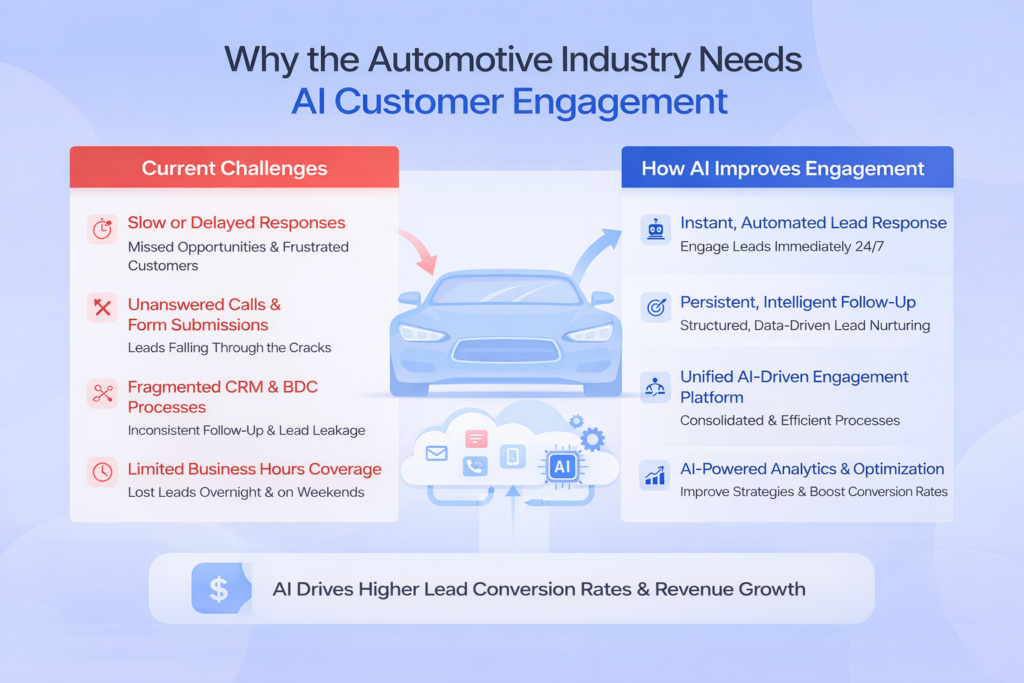
Speed compounds the challenge. Studies on lead response times show that contacting an internet inquiry within five minutes can make you more than 20× more likely to qualify the lead compared to delayed follow-ups. When engagement relies solely on manual outreach, fragmented CRM workflows, and limited BDC bandwidth, lead leakage becomes predictable. When engagement depends solely on manual outreach, fragmented CRM workflows, and limited BDC capacity, gaps are inevitable.
How Spyne Drives AI-Powered Customer Engagement for Businesses in Automotive Industry?
Modern dealership teams need more than just faster replies, they need intelligent, always-on engagement that connects merchandising, automotive lead response, and buyer conversations. That’s where Spyne’s automotive-focused AI stack stands out. Built specifically for dealer workflows, it combines conversational engagement and AI-ready inventory presentation so sales and BDC teams can respond faster, qualify better, and convert more opportunities without adding headcount.
Why Leading Automotive Dealerships Choose Spyne?
Here’s how Vini by Spyne enables structured, measurable AI for customer engagement across the entire dealership funnel, positioning itself among the best AI-powered customer engagement software options built specifically for automotive teams.
1) Faster speed-to-lead and stronger contact rates
Vini responds to inbound inquiries within seconds and intelligently ranks prospects based on urgency and buying signals. Instead of leaving hot leads waiting, the system engages immediately, books appointments, and keeps conversations moving. That lift in response speed directly improves contact rates and early-stage conversion.
2) Proactive follow-ups that prevent revenue leakage
Missed showroom visits, unattended service bookings, and aging internet leads are automatically re-engaged. As an AI call bot for car dealerships, Vini places structured reminder calls, confirms appointments, and nudges customers to reschedule, helping stores recover business that would otherwise slip away.
3) BDC productivity without increasing headcount
High-volume outbound communication, appointment confirmations, service reminders, lead nurturing, is automated while still sounding natural and context-aware. Sales and service teams spend more time closing deals and managing in-store experiences, while AI for car dealerships handles repetitive outreach at scale.
4) Clear performance visibility for leadership teams
Dealers can track metrics such as contact rate, booked appointments, show ratios, and revenue influenced by AI-driven conversations. Instead of guessing whether engagement efforts are working, managers see measurable output tied to daily KPIs.
5) Compliance-first communication framework
Every interaction follows pre-set regulatory and quality standards, supporting TCPA alignment and consistent messaging across calls. Dealerships maintain brand integrity while scaling outreach confidently.
The Future of AI Customer Engagement (What Will Actually Stick)
The next frontier of customer engagement AI-enabled customer service will combine automation, predictive personalization, and human-centric responsiveness to deliver truly proactive interactions. A study by McKinsey highlights that AI-enabled customer service is emerging as the most effective route to deeper engagement and personalization at scale, unlocking new value while reducing cost-to-serve. In fact, the AI customer service market is projected to grow from about $12.06 billion in 2024 to nearly $47.82 billion by 2030, a robust 25.8 % compound annual growth rate that underscores how central AI has become to engagement strategies.

Conclusion
Customer engagement today is driven by anticipation, not reaction. Brands that understand intent, personalize in real time, and remove friction at every touchpoint are the ones building lasting loyalty and increasing customer lifetime value.
Companies like Spyne are demonstrating how AI can power intelligent engagement, particularly in industries like automotive, where timing, relevance, and personalization directly impact conversions.
If you’re ready to transform customer engagement into a measurable growth engine, book a demo with us and see how intelligent, AI-driven engagement delivers real results.