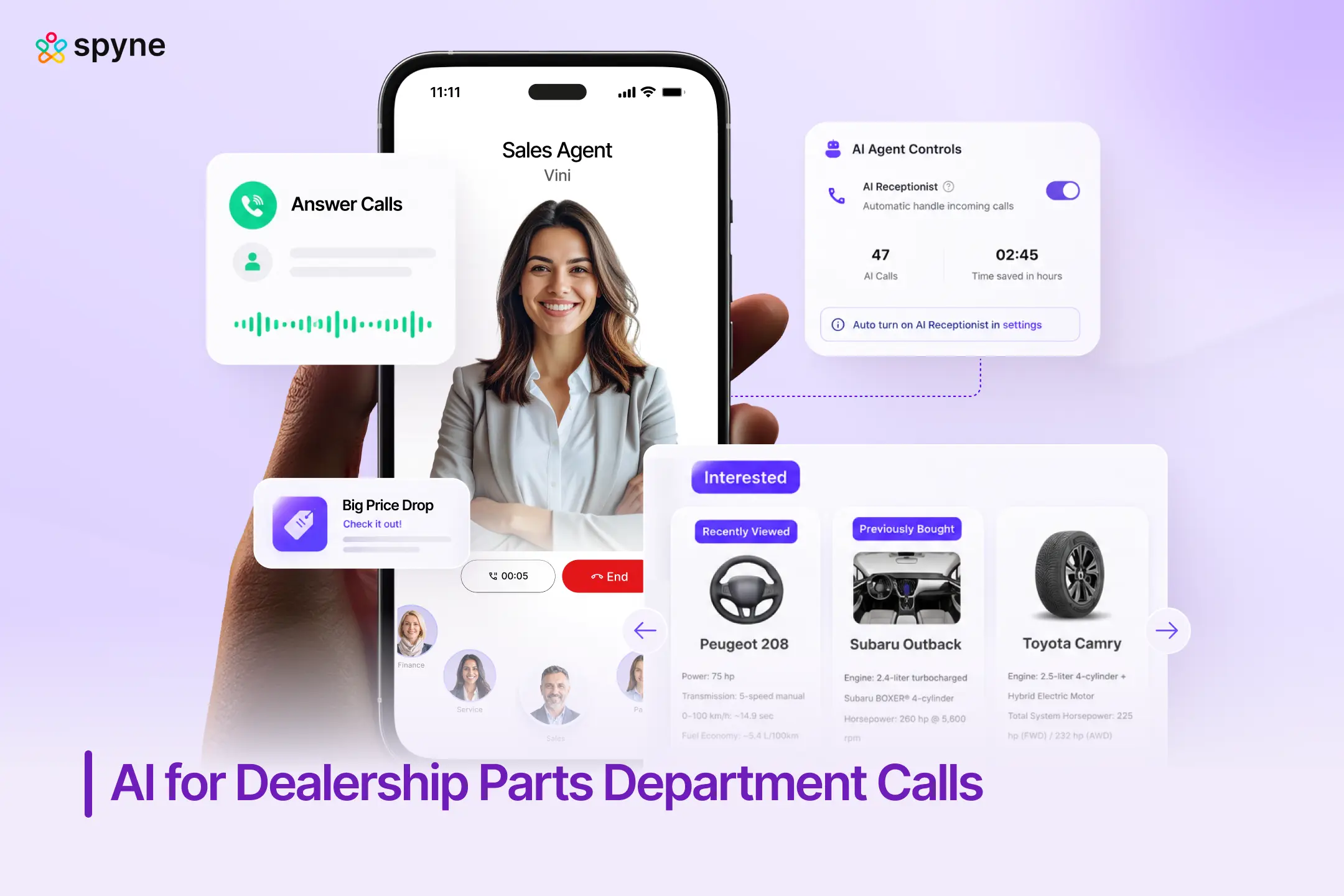

The parts department runs one of the highest inbound call volumes in the dealership and has historically had the least dedicated AI coverage.
According to NADA’s 2025 Annual Data Report, US franchised dealerships wrote more than 276 million repair orders and generated over $164 billion in combined service and parts revenue, with wholesale parts alone accounting for $8.55 billion annually. That revenue depends on a Parts Advisor picking up the phone when a body shop calls. CallRevu data indicates that roughly 42% of dealership inbound calls go unanswered, and the parts counter follows the same pattern, often worse, because parts advisors split their attention between phone callers, technicians pulling jobs, and walk-in retail customers simultaneously.
This guide covers what the parts call problem actually looks like, which platforms have built meaningful coverage for it, and what to require from any vendor claiming to handle dealership parts inquiries.
What Makes a Parts Call Different From a Service Call or a Sales Lead?
Parts calls are transactional by nature. The caller already knows what they want, they need one specific answer, delivered fast enough that hold time is not acceptable. A body shop Parts Manager confirming availability for a morning job pull is not waiting four minutes on hold. They have three other dealer numbers in their contact list and will place the order with whoever picks up first.
This makes the parts department structurally different from the BDC or the service lane. Parts calls are short, high-volume, and time-critical. The AI handling them needs to complete the transaction, not acknowledge the call and promise a callback.
What a parts call actually requires from an AI system:
- Live inventory access connected to the dealership’s DMS (not a static catalog)
- VIN decoding to verify fitment before quoting availability
- Real-time pricing by account tier, wholesale accounts versus retail counter customers
- Order status pull for special orders and back-orders in progress
- Escalation to a Parts Advisor with a structured handoff when the query goes beyond automated scope
Most general dealership AI platforms handle the first layer: answer and route. The vendors worth evaluating are the ones that complete the transaction without human handoff for the majority of calls.
Why Parts Calls Go Unanswered: A Coverage Problem, Not a Staffing Problem
A Parts Advisor cannot simultaneously support a technician pulling a job, quote a multi-line wholesale order, and answer a retail availability call. Something drops. What usually drops is the ringing phone.
Analysis of nearly 3,000 US dealerships shows Monday 10 AM to 12 PM is the highest inbound call window across all departments, and parts follows the same curve. That peak window is exactly when the counter is already running at capacity.
Research from Numa across nearly 600 dealerships found that service departments miss an average of 158 appointment-related calls per month, translating to up to $1.17 million in annual revenue at risk per store. The parts department carries that same structural exposure, with an additional layer that service doesn’t: wholesale account attrition doesn’t appear on the P&L immediately. A body shop that quietly moves its parts volume to a competing dealer doesn’t announce it, the revenue just stops arriving.
Revenue exposure at a mid-size franchise store:
| Call Type | Est. Daily Volume | Avg. Ticket | Revenue at Risk (at 30% Miss Rate) |
| Retail availability inquiry | 20–30 calls | $85–$150 | $510–$1,350 |
| Wholesale quote or order | 15–25 calls | $300–$800 | $1,350–$6,000 |
| Special-order status | 10–20 calls | Account retention | Churn risk |
| VIN fitment verification | 10–15 calls | $50–$200 | $150–$900 |
A single active wholesale body shop account placing calls five times a week represents $3,000 to $8,000 in monthly gross. Lose the account to a competitor with better phone coverage and recovering it requires price concessions that erase the margin you were protecting.
How Does Conversational AI Benefit Auto Parts Dealers?
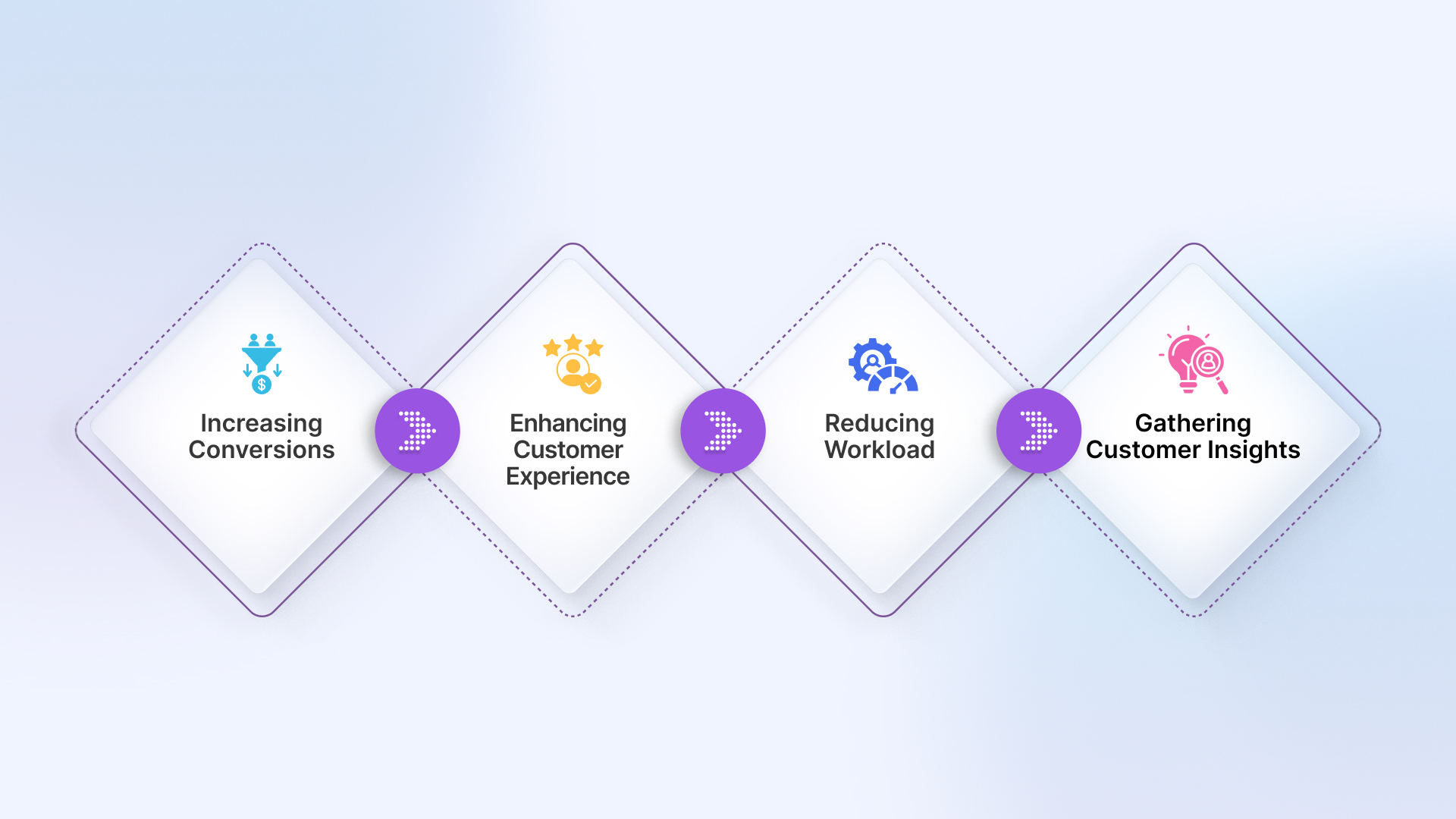
You might be thinking, how can this AI in car parts shops help you with your business growth? Well, with its advanced features, it helps in:
Role Of Conversational AI In The Near Future
The way buyers are rapidly switching to online purchasing. With more customers turning to online channels, the demand for quick, personalized, and intelligent support is higher than ever. Buyers expect instant answers to their queries, accurate recommendations, and the best assistance. The Conversational AI is stepping up to meet all these expectations and providing human-like, real-time responses, solving buyers’ queries.
In the near future, this AI will go beyond chat-based, call-based assistance. We’ll see the rise of voice-based shopping, AI-driven fitment visualization, and predictive support that anticipates buyer needs before they even ask. Auto parts dealers or dealerhips that embrace these technologies early will gain a strong competitive edge. It will be easy for them to build loyal relationships and stay ahead in the digital automotive space.
The Buyer’s Map: Which AI Platforms Actually Cover Parts Department Calls in 2026?
Not every platform that claims parts coverage actually handles the transaction. The market splits cleanly into two groups: platforms that complete the parts call, availability confirmed, price quoted, order status given, and platforms that answer the call and route it to a Parts Advisor to finish. The table below shows where each vendor actually sits.
Platforms With Documented Parts-Call Depth (Head-to-Head Comparison)
| Vini AI (Spyne) | LotTech Voice AI | Alpha Drive AI | Numa | Toma | Pam AI | |
| Best fit | Dealers who want parts + service + sales + outbound on one platform | Dealers who need parts-counter AI only, no cross-department requirement | Dealers wanting omnichannel across all departments | Service-focused stores; parts as routing layer | Fixed ops-heavy stores; parts as routing layer | Service appointment-focused; parts as routing layer |
| Parts call coverage | Yes, within Service Inbound agent | Yes, primary product focus | Listed as covered department | Routes parts calls | Routes parts calls | Routes parts calls |
| VIN decoding for fitment | Via service scheduler integration | Yes, stated as core differentiator | Not documented publicly | Not documented | Not documented | Not documented |
| OEM catalog integration | Not documented | Yes | Not documented | No | No | No |
| Wholesale account recognition | Not documented | Not documented | Not documented | No | No | No |
| Live DMS inventory lookup | Via scheduler integration (xTime, Tekion, CDK, MyKaarma, Evenflow, DealerFX) | Yes, direct DMS integration | Not documented | Service scheduling only | Service scheduling only | Service scheduling only |
| Sales BDC coverage | Yes, Sales Inbound + Outbound agents | No | Yes | No (Ficus acquisition adding sales; early stage) | Limited | No |
| Service scheduling | Yes | Yes (Tier 2 plan) | Yes | Yes, core product | Yes, core product | Yes, core product |
| Outbound campaigns | Yes, recalls, due service, parts-arrival, aged leads | No | Yes | Limited | Service reminders only | No |
| CRM integrations | VinSolutions, Tekion, DriveCentric, eLeads/CDK CRM | Not documented | Not documented | Yes, multiple DMS | Yes, multiple DMS | XTime, CDK, WiAdvisor, Tekion |
| Human QA on every call | Yes, daily human QA layer | Yes (fixed-ops employee reviews all requests) | Not documented | No | No | No |
What the table shows: LotTech and Vini AI are the only two platforms with documented parts-call depth beyond basic routing. They solve different problems. LotTech is a parts-first point solution, no sales coverage, no outbound, launched in 2025 with a small team. Vini AI covers parts within a cross-departmental platform that 5,000+ dealerships already run for sales and service. Alpha Drive AI, Numa, Toma, and Pam AI route parts calls competently but do not complete the parts transaction, availability, pricing, or order status, without a Parts Advisor on the line.
Which to choose:
- Parts counter automation only, no existing AI platform → LotTech is the most purpose-built option
- Parts coverage plus service scheduling, recalls, and sales BDC on one system → Vini AI
- Already running Vini AI for service or sales → parts call coverage is already included in the Service Inbound deployment; no additional contract required
Platforms That Answer Parts Calls But Don’t Complete Them
Numa, Toma, Pam AI, Clearline, AutoAce (YC F25), Cleo AI, Kenect, and Podium can all route an inbound parts call to the counter queue. None of them document wholesale account recognition, live DMS parts inventory lookup, or order status pull in their public product specifications. For a dealer evaluating these platforms, that means parts calls get answered, but a Parts Advisor still needs to complete the transaction. The call was caught; the work was not done.
The distinction matters most at peak hours. A Parts Advisor who gets a warm transfer still has to drop what they are doing to handle the call. AI that completes the transaction, confirms availability, quotes pricing, gives an order status, is the only model that actually removes the burden from the counter.

How Vini AI’s Service Inbound Agent Handles Parts-Related Calls
The workflow below describes how Vini AI handles parts calls that arrive through the Service Inbound channel, from the initial ring to CRM log. Because parts conversations are handled within the Service Inbound agent rather than a standalone deployment, dealers add parts call coverage without a separate agent or integration.
When a parts-related inbound call arrives:
- Vini AI answers in under 5 seconds, no IVR menu required
- Conversational AI identifies the call type: availability check, wholesale inquiry, order status, fitment question, or parts arrival confirmation
- For service scheduler-integrated stores, Vini can access vehicle and customer context from the DMS, supporting fitment and service history questions
- The call resolves at the AI layer where the query is within scope, availability, general fitment, parts arrival notification
- Calls requiring live DMS inventory lookup (exact on-hand quantity, pricing quote) or wholesale account-specific pricing are escalated to a Parts Advisor with a structured summary: caller details, vehicle information, what was already discussed, and the specific question that triggered escalation
- A full interaction record is logged to the CRM or Spyne Console, caller, vehicle, inquiry type, outcome, and any follow-up items flagged
The Service Outbound agent runs parts-arrival notifications as part of its campaign engine, proactively calling or texting customers when a special-ordered part has arrived, eliminating that category of inbound status call before it is placed.
What this means operationally: a dealer running Vini AI’s Service Inbound and Service Outbound agents gets parts call coverage, inbound handling for parts inquiries and proactive parts-arrival outreach, as part of the same deployment that handles service scheduling, recall outreach, and declined-service follow-up.
This is the cross-departmental efficiency argument that purpose-built parts-only tools cannot match: one platform, one integration, one contract, one CRM log layer covering service and parts simultaneously.
How Parts Advisors Work Differently When AI Absorbs the Routine Call Volume
The operational shift is reallocation, not reduction. Parts Advisors freed from answering routine availability and status calls do not run out of work, they become significantly more productive on the tasks that require their expertise.
Before AI handles inbound parts call volume:
- Parts Advisor tied to the phone during the 10 AM peak while technicians queue at the counter window
- Wholesale body shop accounts on hold for three to five minutes, then calling the competing dealer
- Retail callers reaching voicemail and ordering from RockAuto or Amazon instead
- After-hours special-order status calls going unanswered until the counter opens
After Vini AI absorbs routine inbound volume:
- Parts Advisors supporting technicians pulling jobs without phone interruption during peak windows
- Wholesale accounts reaching a live AI response in under 60 seconds, availability confirmed, escalated to a Parts Advisor for complex multi-line orders
- Proactive parts-arrival outbound handled by the Service Outbound agent, customers notified before they call to check
- After-hours inquiries logged and actioned at open, with follow-up items structured for the Parts Advisor rather than pieced together from voicemails
Dealer industry reporting found that AI-handled dealership operations increased call volume absorbed by 60% and booked appointments by 80% at one dealer group. The parts department benefits from the same compounding effect: more calls handled means more transactions completed without adding payroll.
The Eight Questions to Ask Before Signing With Any Parts AI Vendor
This checklist is derived from the actual capability gaps that cause a parts call to fail in practice. Use it in any vendor demo.
| Capability | Why It Matters |
| Live DMS inventory lookup during the call | A static catalog tells you what should be in stock. Live DMS tells you what actually is. Without this, the AI cannot confirm real availability, it can only route to a Parts Advisor. |
| VIN decoding for fitment verification | Fitment errors are the highest-frequency parts return cause. Without VIN lookup, fitment questions cannot be answered definitively on the call. |
| OEM catalog integration for special-order and availability beyond on-hand stock | Special orders require OEM data, not just DMS on-hand quantity. Platforms without this cannot handle the full range of parts availability questions. |
| Wholesale account tier recognition with correct pricing | Body shops and independent repair facilities operate on negotiated pricing. An AI that quotes retail rate to a wholesale account damages the relationship systematically. |
| Order status pull for special orders and back-orders | “Where is my special order?” is the second most common parts call type. Completing this call requires live DMS order status access, not a callback promise. |
| Escalation to a Parts Advisor with a structured handoff | When the AI cannot resolve the call, the Parts Advisor should receive: caller ID, vehicle details, parts discussed, and the specific question that triggered escalation. No starting over. |
| CRM logging of every AI-handled interaction | After-hours parts calls handled by AI disappear without a logged record. Follow-up gaps and wholesale account attrition both trace back to missing call records. |
| Outbound parts-arrival notification capability | Proactive “your part has arrived” outbound calls eliminate an entire category of inbound status calls before they are placed. |

Conclusion
Ask each vendor to demonstrate capabilities 1, 2, 4, and 5 in a live demo against your actual DMS. If they cannot show a live parts inventory lookup, their “parts coverage” is call routing.
The parts counter is the most overlooked revenue lever in fixed ops, and the phone is where that revenue either stays or walks. Most platforms in this space answer the call and hand it back to a Parts Advisor to finish, which solves nothing during a peak morning window when the counter is already at capacity.
The dealers who are closing this gap are not adding headcount. They are adding coverage that actually completes the transaction.
If your store is missing 30% of parts calls during peak windows, that revenue is not sitting idle, it is moving to whichever competitor picks up first.
Book a demo with Spyne and see Vini AI handling parts calls in your actual dealership environment.