See How Bob King Mazda Captured 30% More Service Demand with Vini AI

,
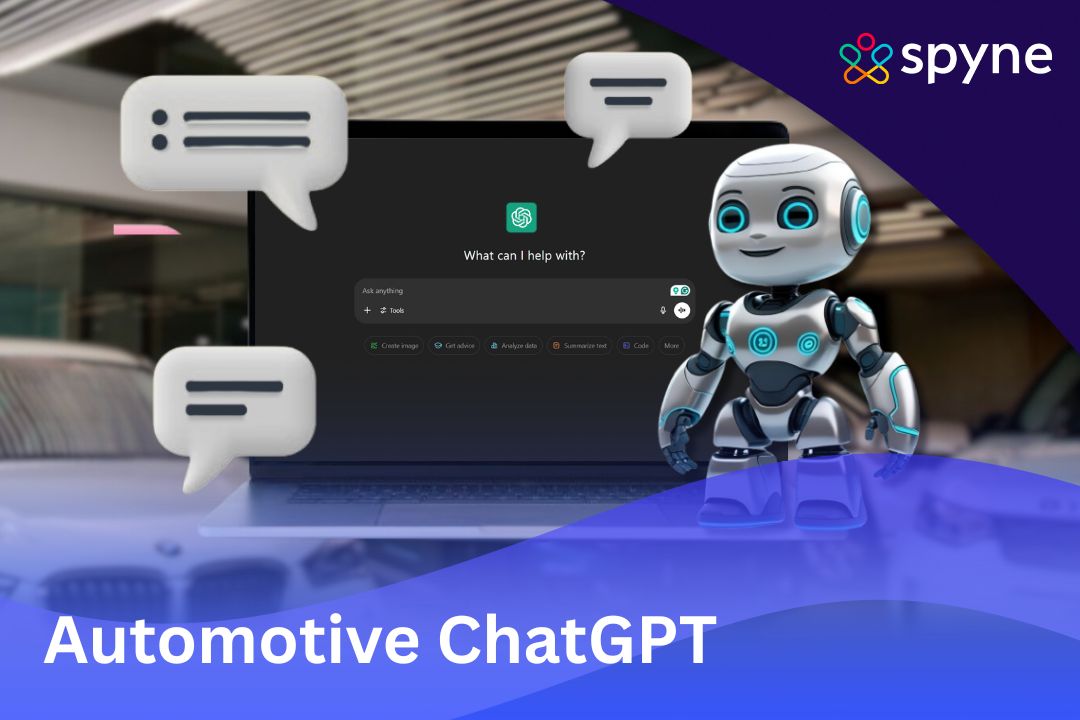
Automotive ChatGPT: How It Transforms the Auto Industry
Automotive ChatGPT

Automotive ChatGPT: How It Transforms the Auto Industry

Nyla Uddin
Content Writer
July 17, 2026
May 29, 2025
5 Min Read
5 Min Read
Automotive ChatGPT

When opening and running a used car dealership in today’s day and age, you need to know it’s not just about giving great deals. It’s also about how you communicate with customers and whether your strategies are good enough to keep them engaged and coming back. Automotive ChatGPT speaks your customers’ language, handles questions 24/7, and even helps your staff save time. This tool can be used to generate and qualify leads like no other, and it might just be the boost your dealership needs. Keep reading to find out the importance of automotive GPT and how choosing the right AI-powered tool changes the game.


What is Automotive ChatGPT for Car Dealerships?

Automotive ChatGPT is an advanced AI language model made by OpenAI. It can understand natural language and have conversations like a human. This makes it a powerful tool for car dealerships, as they can communicate with their customers better and faster. Automotive GPT is different from generic chatbots in that it can hold real conversations, answer detailed questions, and adapt to the buyer’s persona. This helps dealerships stay connected with their customers constantly.

Car dealer ChatGPT is not scripted. Instead, it learns from millions of interactions, so it can answer questions about vehicle capabilities, trade-ins, financing, and more, without sounding like it’s a robot. It even remembers previous conversations, so responses are more on-point and human-sounding.

In the automotive industry, dealerships use ChatGPT to talk to website visitors and qualify leads, handle their inquiries and solve them efficiently, and provide after-sales support with follow-ups. It’s also helpful for staff as it reduces manual work by compiling customer conversations and reviews and generates reports. Therefore, ChatGPT for the car industry improves customer experience and efficiency without adding to the budget.

 

Your AI Sales Assistant is Ready


10 Key Areas Automotive ChatGPT Can Help In

ChatGPT in automotive is truly a turning point for car dealerships. It can be used in many ways, be it enhancing customer walk-ins, optimizing manufacturing plants, or even in-car experiences; it has become a practical solution for today’s dealers. Here are some ways it’s being used today:

1. Responding to Reviews

Automotive ChatGPT helps in generating personalized and quick responses to reviews in minutes, making customers feel seen and strengthening relationships. All you have to do is paste the review, and ChatGPT makes a relevant 2-3 sentence reply for you. Since these replies are public and tied to your dealership’s name, it’s worth running them through an AI humanizer first, so they read like a real person took the time to respond, not a copy-pasted bot reply.

2. Inventory and Parts Management

ChatGPT can also be used to generate stock lists and suggest various suppliers to get your vehicles from. This would help dealerships manage parts effectively, especially during new location openings.

3. Describing Service Details

ChatGPT helps service advisors explain complex repair and maintenance information in simple language, improving customer understanding and assurance.

4. Diagnostic Code Support

Artificial intelligence interprets diagnostic codes that you may not understand. It then provides a list of issues that are likely and also the steps to solve those issues. Always double-check ChatGPT suggestions with expert technicians, though.

5. Driver-Vehicle Interaction

ChatGPT supports voice/text interaction within vehicles, providing real-time vehicle status, driving guidelines, and safety alerts through natural conversation.

6. Autonomous Driving Assist

ChatGPT in the car industry helps self-driving vehicles identify voice commands and navigate challenging routes effectively and safely.

7. Customer Service Automation

ChatGPT automates customer service through 24/7 automotive chatbots responding to FAQs, product details, and scheduling, making the workload lighter for sales teams.

8. Marketing and Sales Support

ChatGPT creates personalized vehicle recommendations, product descriptions, and supports lead generation, improving customer engagement.

9. Product Development Insights

Car dealer ChatGPT analyzes customer feedback and examines current trends to decide on new features your cars should have. It also gives suggestions to optimize inventory.

10. Production and Quality Assurance

ChatGPT gives you a sense of security since it helps in overseeing autonomous production, inspects the quality of cars, and also sets times for maintenance. This enhances production efficiency and reduces downtime.


8 Challenges of Implementing AI in the Automotive Sector

It’s a sure fact that automotive GPT is helping the industry, but it doesn’t come without setbacks. From a lack of proper knowledge and privacy risks to here-and-there decisions, here are eight key limitations of using AI like ChatGPT in automotive.

1. Restricted Automotive Knowledge

Though AI such as ChatGPT can answer general questions, it doesn’t have the ability to give exact advice for more specific automotive situations. This means that automotive chatGPT may not be able to make correct diagnoses or give technical advice in garage settings.

2. Data Compliance & Privacy Risks

You have to make sure that ChatGPT is giving you accurate information so that you don’t misinform your customers. That being said, this software does have the risk of privacy and compliance issues, and can be misused if it doesn’t adhere to industry rules correctly.

3. Misinterpreting Context

AI tends to fail to understand detailed and complex customer questions, resulting in irrelevant and confusing answers rather than giving actionable suggestions. This kind of hurdle can be a problem in situations like buying a car or sending it for repair.

4. No Human Touch

AI is unable to substitute empathy, trust, or knowledge that derives from human contact. To most customers, that human touch is what matters most in decision-making.

5. Ethical & Security Concerns

From deepfakes as a potential abuse to exposure to cyberattacks in networked vehicles, AI provides critical ethical and safety concerns in automotive use.

6. Vague Decision-Making

ChatGPT’s decision-making process is not transparent, which makes it difficult to understand how it comes to responses. This raises the question of how accurate it is.

7. Heavy Data Dependence

The scaling and training of AI involves heavy data and software that small dealerships or auto repair shops may not have access to, which could be an issue in adoption and performance.

8. Compliance Challenges

The automotive industry’s compliance rules and regulations are constantly changing. ChatGPT could lag behind and provide out-of-date or misleading advice in highly regulated fields.


Top 8 Benefits of Automotive ChatGPT for Dealerships in 2025

Automotive chatGPT has a significant impact on the vehicle industry. Whether it’s selling better with smarter strategies and sales plans, optimizing your inventory, or enhancing customer service with personalized marketing, here are the benefits of ChatGPT for the automotive industry:

1. Increase Customer Engagement with Human-Like Chat

Using advanced technology, ChatGPT helps dealerships respond faster and better to their customers with natural, free-flowing chats. This puts a customer at ease and increases trust, engagement, and the chance that they will come back.

2. Reduce Support Costs with 24/7 AI Support

Automotive GPT reduces support costs by removing the need for manual work for everyday activities. ChatGPT can be used to create AI-powered bots that handle a high volume of calls 24/7, answering in real-time without hiring more staff.

3. Shorten the Sales Cycle with Instant Info and Follow-Ups

ChatGPT supports buyers every step of the process, from answering inventory questions to booking appointments easily. This tool simplifies your sales process and reduces wait times, keeping customers happy.

4. Personalize Every Interaction Based on User Data

Data from your automotive CRM guides the software in analyzing customer trends and behavior. Then, this data is used to offer customized car recommendations, price guidance, and service tips, turning generic queries into relevant, high-converting conversations.

5. Get Smarter Insights to Guide Business Decisions

Each conversation session in ChatGPT is worth it if you know how to use it for your dealership. Use ChatGPT’s analytics to monitor trends, understand customer demands, and ask how you can optimize various aspects of your sales and marketing.

6. Improve Safety through Voice-Controlled Driving Assist

For in-car applications, ChatGPT improves driving safety by responding to voice commands, giving turn-by-turn directions, reading diagnostic results, or even explaining how to change a tire, hands-free and distraction-free.

7. Make Autonomous and Connected Vehicle Features Possible

ChatGPT can even help you with ADAS and self-driving features. Since it’s more advanced and can understand complex commands, it can process sets of data that humans may not be able to. This way, you’d know what was going on with every vehicle sold from your dealership and the health of each one your customers drive.

8. Amplify Marketing Campaigns and Lead Gen

You can even use ChatGPT to write compelling marketing ads, qualify leads directly on your car dealer website, and send targeted ads to the right buyers. ChatGPT’s insights are worth it, and you have all the freedom to use it as you see fit to suggest campaign ideas and different ways to improve your strategies.

 

Upgrade Your Dealership with Automotive ChatGPT


How Spyne Uses Automotive ChatGPT to Help Used Car Dealerships

Spyne’s Retail AI suite integrates with providers like ChatGPT to handle inquiries and qualify leads on your website or marketplaces instantly. We also automate customer responses, which means you can reply to leads hands-free and still get more buyers. Spyne uses ChatGPT to give you smarter conversations, faster conversions, and more engagement.

1. 24/7 Intelligent Chat on Your Website

Our website’s automotive live chat feature integrates with ChatGPT and responds to all questions in real time. Your customers get the answers they are looking for in an instant, whether about your website, services, or vehicle inventory. Our chat is fed and trained with the necessary information and runs 24/7, so your customers are always heard.

2. Lead Capture, Qualification & CRM Sync

Automotive ChatGPT does the work of multiple salespeople. Apart from responding to leads, it captures important information like their preferences and budget, detects their buying intent, and then sends leads directly to Spyne’s automotive CRM for follow-up in real time.

3. Personalized Buyer Conversations

With real-time data gathered from the CRM and updated customer profiles, our car dealer chatGPT personalizes each conversation for each visitor. It can match them with their perfect car, suggest add-ons and special features, and update them whenever they need to take the vehicle for servicing.

4. Instant Test Drive & Service Scheduling

Customers can book test drives, service appointments, or showroom visits whenever they like. They don’t have to wait in line or make multiple calls, all our automotive chat needs is some basic information and their time and date preference, and it’s sent directly to your calendar.

5. Vehicle Exploration & Comparisons

Clients can ask ChatGPT to compare different models they may have difficulty choosing between. Our automotive chat software compares vehicles, trims, and features side-by-side, just like a salesperson would.

6. AI Assistance for Maintenance Inquiries

Customers simply need to input their vehicle information and purchase date, and automotive chatGPT will tell them the services they should consider. This conversational AI feature keeps customers informed of their vehicle’s health and encourages them to return.

7. AI Helpdesk for Dealership Staff

Spyne offers training guides and AI-generated notes to help new employees grasp CRM software or educate them on how to respond to customers. Users can use our GPT tool to get insights into how they can resolve common issues or comprehend workflows faster.

8. Visual & Conversational Synergy

Using Spyne.ai, you can pair stunning, studio-quality vehicle listings with smart, human-like chat. We’d say it’s the perfect combination to convert browsing shoppers into serious buyers.


Conclusion

Think of automotive chatGPT as your digital chatbot. It might be hard to visualize, but when you realize how it can help with lead capture and 24/7 service support, you might change your mind. It helps you deliver better experiences to your customers without running through your team. With Spyne’s AI suite built around it, you get even more value, speed, and engagement. So, if you’re ready to serve faster and stand out in the market, book a demo with us today!

SHARE THIS POST

CONTENT

THE SPYNE STORY

Built to Handle Massive Scale

5M+
5M+
Read More
Images processed every month​
75+
75+
Read More
Computer vision models deployed
10+
10+
Read More
Fortune 500 clients
100+
100+
Read More
Enterprise customers and partners
Previous
Next
FAQs

Got questions? We've got answers.

Find answers to common questions about Spyne and its capabilities.
  • What is ChatGPT and how is it used in the automotive industry?

    ChatGPT is a large language model (LLM) developed by OpenAI that understands and generates natural, contextually aware human language. In the automotive industry, it is used across dealership operations, vehicle manufacturing, and in-vehicle experiences. Dealerships use ChatGPT-powered tools to respond to customer inquiries, qualify leads, draft follow-up messages, and automate customer service 24/7. Manufacturers apply it to quality control analysis, supply chain optimization, and production data insights. In vehicles, OEMs like Volkswagen and Mercedes-Benz have integrated ChatGPT into voice assistants, allowing drivers to control vehicle functions and get real-time information through natural conversation. NADA data shows that a quarter of new-vehicle buyers already use AI tools like ChatGPT as part of their car research process.

  • How does ChatGPT help car dealerships?

    ChatGPT helps car dealerships in four primary ways. First, it powers conversational tools that respond to website visitors instantly, answering inventory questions, capturing lead information, and qualifying buyer intent without requiring staff. Second, it assists BDC teams by drafting personalized email and SMS follow-ups based on lead source, vehicle of interest, and next steps, reducing response delays. Third, it helps generate marketing content: vehicle descriptions, ad copy, and promotional messaging at scale. Fourth, it supports data analysis, dealership GMs are using ChatGPT to analyze CRM and GA4 data against industry benchmarks, generating actionable executive summaries that replace manual reporting. Dealerships using AI tools report a 32% increase in lead conversion rates and a 70% reduction in response times.

  • What is the difference between ChatGPT and a traditional automotive chatbot?

    Traditional automotive chatbots are scripted, they follow predefined conversation flows and can only respond to questions that fall within their programmed knowledge base. When a buyer asks something outside those parameters, the bot either gives an irrelevant answer or transfers to a human. ChatGPT-powered tools are fundamentally different: they understand natural language, maintain context across a full conversation, generate personalized responses based on what the customer has said, and handle a virtually unlimited range of questions without scripts. A ChatGPT-powered automotive chatbot can discuss specific vehicle trims, financing options, trade-in estimates, and service availability in the same conversation, adapting its tone and detail level to the buyer’s responses throughout.

  • Can ChatGPT be used for automotive customer service?

    Yes. ChatGPT automates customer service for dealerships by handling high-volume, repetitive inquiries, vehicle availability, service hours, financing FAQs, appointment scheduling, and 24/7 without manual staff involvement. It responds in real time across website chat, SMS, and email, and escalates complex or high-intent conversations to human representatives with full context preserved. Platforms like Spyne’s Vini AI use ChatGPT capabilities to power automotive customer service that answers questions naturally, captures lead data, and books appointments in the same interaction. This reduces support costs, eliminates after-hours gaps, and ensures consistent brand communication across every customer touchpoint regardless of inquiry volume.

  • How is ChatGPT used in vehicle manufacturing?

    In vehicle manufacturing, ChatGPT’s analytical and language capabilities are applied to several operational challenges. Quality control teams use it to analyze production data and sensor outputs, identifying defects or anomalies faster than manual review. Assembly line managers apply it to identify bottlenecks and model workflow improvements. It is also used to generate employee training materials, translate technical documentation, and summarize complex engineering reports for non-technical stakeholders. Supply chain managers use ChatGPT to analyze demand patterns and optimize inventory across supplier networks. Toyota has used generative AI to accelerate EV design concepts from text descriptions, significantly compressing the product development timeline.

  • Which automakers are using ChatGPT in their vehicles?

    Several major OEMs have integrated ChatGPT directly into their vehicle systems. Volkswagen integrated ChatGPT with its IDA in-vehicle voice assistant, announced at CES 2024, enabling natural conversation for navigation, infotainment, and vehicle function control. Mercedes-Benz deployed ChatGPT integration across more than 900,000 vehicles in the US, allowing drivers to control vehicle features and receive personalized responses through the MBUX voice assistant using natural language rather than fixed commands. Škoda Auto integrated ChatGPT with its Laura voice assistant. These implementations represent a shift from keyword-triggered voice commands to genuinely conversational in-vehicle AI that understands driver intent and context.

  • How does ChatGPT improve lead management at car dealerships?

    ChatGPT improves dealership lead management by automating the first-response and nurturing layers that are most prone to delays. When a lead comes in through a web form, chat, or marketplace inquiry, a ChatGPT-powered system can respond within seconds with a message personalized to the specific vehicle and inquiry, rather than a generic acknowledgment. It captures qualification data during the conversation (budget, timeline, trade-in status), scores the lead’s intent, and routes high-value leads to the right rep with context already collected. For BDC teams, ChatGPT helps draft outreach messages at scale, maintaining personalization without the manual time investment. Dealerships using AI-powered lead management report 27% higher showroom appointment set rates compared to those without.

  • What are the limitations of using ChatGPT in automotive dealerships?

    ChatGPT has several important limitations in automotive dealership contexts. It can hallucinate, presenting incorrect information confidently, which makes it unsuitable for autonomous use in pricing, finance terms, incentive details, or inventory availability without human review. It lacks access to real-time dealership data (live inventory, current pricing, DMS records) unless specifically integrated with those systems, so responses about specific vehicles can be inaccurate without proper connectivity. Its decision-making process lacks transparency, making compliance oversight difficult in regulated areas like credit decisions and advertising accuracy. It also cannot replicate the empathy and trust that buyers expect in high-stakes purchase conversations. The most effective dealership implementations treat ChatGPT as a language and reasoning assist layer, not an autonomous decision-maker.

  • How can dealerships use ChatGPT for marketing content?

    Dealerships use ChatGPT to produce marketing content faster and at greater scale than manual copywriting allows. Practical applications include: generating unique vehicle descriptions for VDP pages (avoiding duplicate content across inventory); drafting email and SMS campaigns for specific customer segments; creating social media posts, ad headlines, and promotional copy for monthly specials; and producing blog content targeting local search terms. ChatGPT can also analyze customer reviews and summarize sentiment, helping marketing teams identify messaging themes that resonate. The key constraint is accuracy: any pricing, incentive, or financing content generated by ChatGPT must be reviewed by a human before publication to ensure compliance and factual correctness.

  • Can car buyers use ChatGPT to research vehicles?

    Yes, and this is a growing behavior dealerships need to actively account for. NADA research shows that a quarter of new-vehicle buyers now use AI tools like ChatGPT as part of their car research process. The Fullpath Auto Intelligence Index (2026) identifies large language models as a rapidly growing referral source for car shoppers. Buyers are asking ChatGPT questions like “what’s the best SUV under $40,000,” “compare the Honda CR-V vs Toyota RAV4,” and “what should I know before buying a used car.” Dealerships that structure their website content, FAQs, and inventory pages to answer these types of questions directly are more likely to be surfaced in AI-generated responses, making AEO (Answer Engine Optimization) an important extension of traditional SEO strategy.

  • How does ChatGPT support automotive inventory management?

    ChatGPT-assisted inventory management works by combining language model capabilities with dealership data systems. Managers can query inventory performance in natural language, “which vehicles have been on the lot more than 60 days?” or “what models are underrepresented in our current mix?”, and receive actionable summaries without navigating complex DMS reports. Some dealership operators have built prompts that analyze sales history against local market supply data to determine optimal new vehicle orders. ChatGPT can also summarize inventory aging reports, flag pricing anomalies, and generate recommended actions, replacing manual spreadsheet analysis with conversational, data-driven insight. This application keeps ChatGPT in its optimal lane: language and reasoning support for decisions that still require human judgment.

  • What is automotive ChatGPT and how is it different from standard ChatGPT?

    Automotive ChatGPT refers to ChatGPT implementations that are configured, fine-tuned, or integrated specifically for automotive dealership or manufacturing contexts, as opposed to the general-purpose ChatGPT available to consumers. Standard ChatGPT has broad knowledge but no connection to a dealership’s live inventory, CRM data, pricing systems, or DMS. Automotive ChatGPT implementations are connected to these systems, allowing the AI to answer vehicle-specific questions accurately, reference real availability and pricing, and operate within a dealership’s defined workflows and brand voice. Spyne integrates ChatGPT capabilities into its Vini AI platform to deliver this automotive-specific version, trained on dealership interaction data and connected to CRM and live inventory for accurate, compliant responses.

  • How does ChatGPT help with automotive sales training?

    ChatGPT is being used as a real-time enablement tool for dealership sales teams, particularly for newer reps who need guidance on process and messaging. It can reinforce follow-up cadences, flagging when to call, what questions to ask, and when to involve a desk manager, creating consistency across shifts and experience levels. It summarizes call and chat transcripts, helping managers quickly review interactions without listening to full recordings. It generates role-play scenarios for training sessions, drafts objection-handling scripts, and can be queried by sales reps in real time for suggested responses to specific customer situations. DriveCentric’s analysis of dealer ChatGPT use emphasizes its value for “next-best-action guidance”, reinforcing proven sales processes rather than replacing sales judgment.

  • What are the privacy and compliance risks of using ChatGPT in automotive?

    Dealerships face two main risk categories with ChatGPT use. First, data privacy: customer information input into ChatGPT through a personal or unmanaged account may be used for model training and is not protected under dealership-grade security protocols. Managing ChatGPT access through an organizational workspace with defined data retention policies and admin controls is essential. Second, compliance accuracy: ChatGPT can generate advertising copy, pricing statements, or financing language that inadvertently violates FTC, CFPB, or state-level disclosure requirements if not reviewed before publication. Automotive-specific AI implementations from providers like Spyne include compliance safeguards and human review checkpoints built into the workflow, addressing risks that generic ChatGPT use does not resolve automatically.

  • Will ChatGPT replace automotive salespeople or service advisors?

    No, and industry consensus is clear on this. ChatGPT replaces delay, not people. It handles speed-sensitive and repetitive tasks, first response, follow-up cadence, FAQs, and scheduling, which currently leak revenue when left to manual processes. The judgment, negotiation, empathy, and trust-building that close car deals and retain service customers remain human functions that AI cannot replicate. The most effective dealership implementations position ChatGPT as a first-responder and enabling layer: AI handles the initial inquiry and early nurturing; humans step in at the moment of real buying intent. This division of roles allows sales and service teams to spend their time on the highest-value conversations rather than triaging inboxes, chasing cold leads, or answering routine questions for the hundredth time.

Related Articles

THE SPYNE STORY

Built to Handle Massive Scale

5M+

Images processed every month

75+

Computer vision models deployed

10+

Fortune 500 clients

100+

Enterprise customers and partners

Recent Blogs

Ready to Revolutionize
Your Workflow?

Join thousands of forward-thinking companies already using Spyne to dominate their industries.

Bring the studio
to your cars.

Let's get Started

Just drop in your details to book a Demo