

‘Dealership profitability’ is talked about constantly in the automotive industry, but is often misunderstood. As per the National Automobile Dealers’ Association (NADA) reports, average car dealerships operate on slim net margins of 1-2% of total sales. Yet, most dealerships continue to calculate profitability based on selling more cars, when in reality, profit lies in how fast the inventory moves, how consistently leads are handled, and how tightly operations are executed.
In this guide, we cover the real meaning of dealership profitability, how car dealerships generate profits when margins quietly leak, and practical strategies top-dealerships use to improve results. We also dive deep into how AI-powered, end-to-end dealership ops management helps enterprises’ accountability at scale, turning profitability into an achievable outcome, each time.
What is Dealership Profitability?
Dealership profitability refers to the overall financial health of generating sustainable net income after accounting for all operating costs across its revenue streams. This includes not only low-margin new car sales but also high-profit areas such as service & parts, finance & insurance (F&I), and fixed operations revenue from service and parts, as well as operational efficiency in people, processes, and technology, which contribute the majority of the net dealership profit margin.
At its core, dealership profitability is the outcome of execution speed, consistency, and accountability across every revenue-generation workflow.
A dealership may sell a large number of cars and still not make enough money when it does not deliver the same result. This is why the dealership’s profitability is not only a financial metric, but an operational measure as well.
How Do Dealerships Make Money?
To determine dealership profitability, you’d need to understand how dealerships make money. Similarly, for those starting a car dealership and evaluating profitability from the ground up, understanding the fundamentals of dealership setup and revenue structure is essential to analyze how early operational decisions influence profitability down the line.
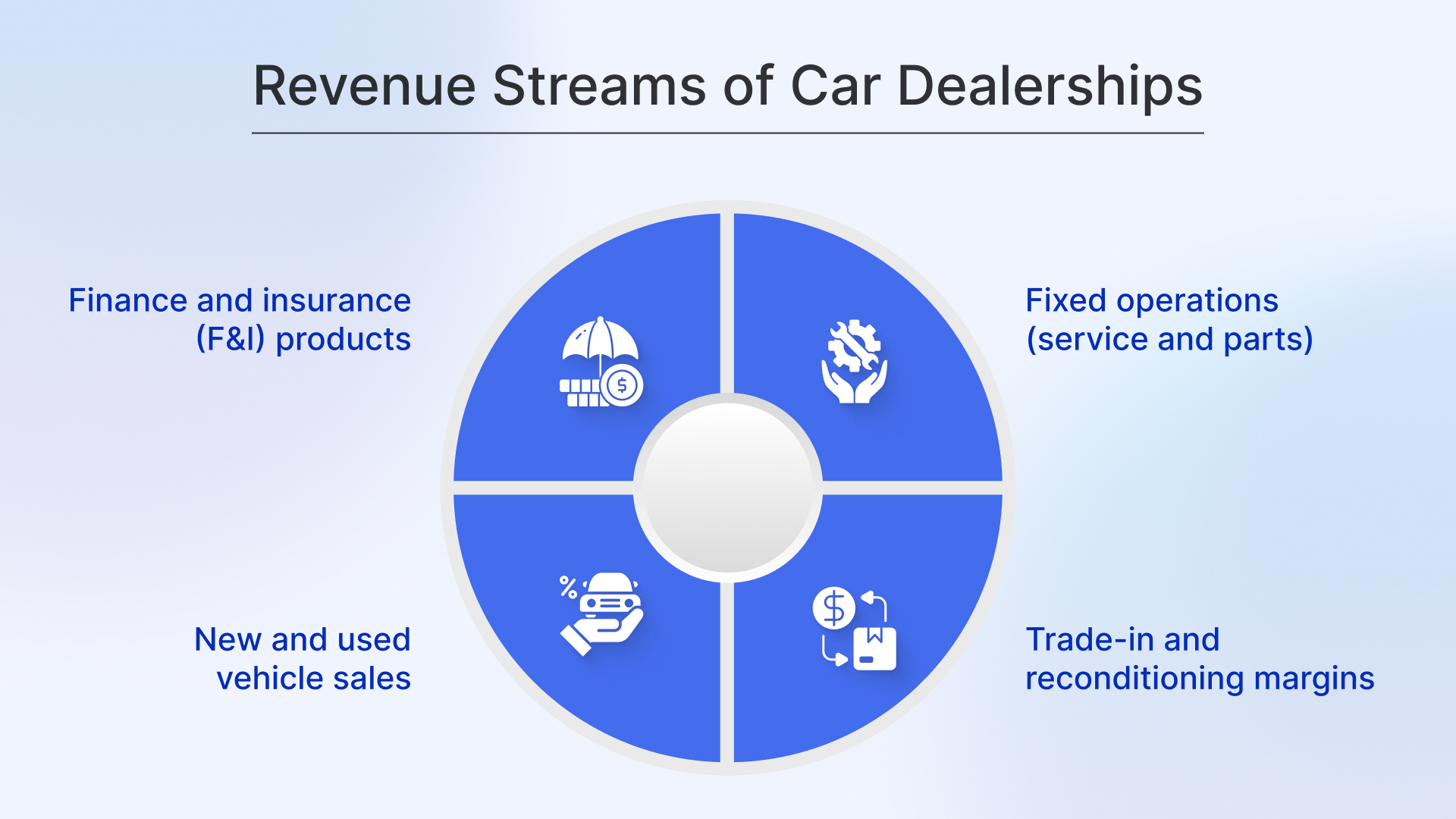
Profitability doesn’t depend on revenue streams; it depends on how efficiently they’re executed.
Reasons Dealership Profitability Faces Execution Gaps in Today’s Market
The automotive retail market has become exponentially competitive. With tighter accountability, increased inventory-carrying costs, slower buyer decisions, rising op costs, and more competition across digital channels, the automotive industry has become harsher than ever. Even minor execution gaps rise exponentially in this environment, and dealerships that consistently cater to dealership calls, speed-to-listing, and follow-ups often outperform the market. The difference isn’t luck; it’s accountability, quality of execution, and responsibility.
#1 Intensifying competition across digital channels
Buyers now compare inventory, pricing, and responsiveness instantly, leaving little room for slow or inconsistent execution.
#2 Rising inventory-carrying and operating costs
Longer holding periods and higher overhead magnify even small delays in merchandising and decision-making.
#3 Slower, more deliberate buyer journeys
Shoppers take longer to decide, making consistent follow-ups and timely engagement critical to conversion.
#4 Tighter accountability expectations
In today’s environment, missed calls, delayed listings, and inconsistent follow-ups translate directly into lost profit.
#5 Execution gaps compound faster than demand gaps
Minor lapses in lead handling, speed-to-listing, or follow-through scale quickly, eroding margins over time.
#6 Shift from volume-led to execution-led profitability
Emerging trends in dealership profitability show that faster speed-to-listing, 24/7 lead responsiveness, and integrated fixed ops now drive results more than raw sales volume.

Dealerships embracing execution-led operations, supported by AI-driven pricing and standardized workflows, outperform peers by executing better across inventory, leads, and service.
5 Leaks Draining Dealership Profitability
Most dealerships do not make a profit because of execution failures, rather than poor demand. Typical leak points consist of:
- Unanswered/missed inbound calls
- Slow response times
- Vehicle listing delays
- Inconsistent follow-ups across teams or shifts
- Underutilized fixed operations
All of the above problems aren’t always evident in the account statements, but in the long run, these greatly decrease the used car dealerships’ profit margin.
Core KPIs That Top-Performing Dealerships’ Profitability Analysis Reveal
Traditional dealership profitability analysis focuses on gross profit per vehicle, expense ratios, and inventory aging. Although these metrics are important, they do not help understand the cause of fluctuating performance.
The high-performing dealerships use the following indicators of operation:
- Lead response times
- Call handling rates
- Inventory-to-listing speed
- Appointment show rates
The operational lens exposes where accountability breaks down, and profitability can be recovered.
4 Major Issues Affecting Dealership Profitability
Most profitability issues are caused by the lack of transparency across workflows, such as
#1 Lead Ownership Gaps
When inbound leads aren’t clearly owned across shifts and channels, automotive BDC workflows become fragmented, and response quality gets thrown out of the window, especially without automation.
#2 Inventory-to-Listing Delays
Each day that a vehicle is not posted online decreases buyer visibility and interest.
Delays between vehicle acquisition and online publishing directly increase days-on-lot and holding costs, making car lot management a critical lever in improving dealership profitability and inventory turnover.
#3 Fixed Operations Silos
Service and parts are also some of the most common departments, which are usually not connected to digital lead capture. When automotive fixed operations function in silos, dealerships miss recurring, high-margin revenue opportunities, weakening overall automobile dealership profitability and long-term margin stability.
#4 After-Hours Blind Spots
The larger portion of buyer inquiries occurs after working hours. In the absence of coverage, such leads become dead. Lack of after-hours responsiveness leads to silent lead leakage, directly reducing car dealership profitability by allowing high-intent buyers to disengage before follow-up.
6 Proven Strategies to Drive Car Dealership Profits
Maximizing dealership profitability is not about chasing volume and blind cost reduction. It comes down to tightening performance across workflows, directly impacting automobile dealership profitability. Top-performing dealerships aim for speed, consistency, and accountability.
Here are six proven ways dealerships maximize car dealership profitability in today’s market:
#1 Eliminate Missed Leads and Calls
Each unanswered call is a potential lost sale. Most dealerships underestimate how much revenue is lost because inbound inquiries aren’t managed uniformly, especially after office hours or during peak times.
One of the quickest methods of enhancing dealership profitability without spending more on marketing programs is by enabling automotive live chat for real-time engagement on lost VDP leads.
#2 Improve Speed-to-Listing of Inventory
The quicker a vehicle becomes online, the quicker it sells. Delays in vehicle acquisition and online listing increase the holding costs and decrease used car dealership profitability.
Improving merchandising workflows with automated, immersive car tours, automotive video tours directly enhance VDP visibility, leading to higher interest, lead generation, and profitability, driving stronger used car dealer margin outcomes.
#3 Strengthen Fixed Operations Contribution
Service and parts can also provide the most consistent margins, but they are not fully-utilized.
Optimizing fixed operations with automotive scheduling software improves overall dealership profitability analysis and enhances long run profitability of the automobile dealerships.
#4 Standardized Lead Follow-Ups Across Teams
The lack of consistent follow-ups will result in the lack of consistent results. When processes vary by salesperson or shift, dealership profitability becomes dependent on individuals rather than systems.
Automotive sales solutions standardize the process of increasing dealer profitability, improving execution across the board.
#5 Use Data to Identify Execution Gaps
The conventional financial reports show what happened, but not why the profits changed.
Monitoring execution measures is critical to properly analyzing the profitability of the dealerships and assists the dealerships in comprehending how car dealers generate more profits than surface-level margins.
#6 Decrease Dependency on Manual Processes
Human processes slow down the teams and lead to higher operational costs in the long run.
Reducing manual labor is how dealerships move from reactive execution to maximized dealership profitability with software.
How AI-Powered Software Maximizes Dealership Profitability
Dealerships today need more than just isolated tools or manual process boosts. With rising lead volumes, inventory listings, and multiple customer touchpoints, fragmented systems often expose gaps that hamper overall impact margins. This is where automation comes into play, that provide an AI-powered, end-to-end dealership operations management, unifying sales, service, inventory, and communication workflows into a single operational layer. This way, not only are manual gaps eliminated, but consistency is also ensured across different workflows. When execution becomes standardized and measurable, dealerships achieve maximized dealership profitability with software, rather than relying on manual intervention or individual effort.
#1 Invest in Instant Lead Response Systems
AI-powered chatbots, virtual assistants, and AI receptionists for car dealerships handle inbound calls, chats, and forms 24/7, ensuring no buyer inquiry is missed. Faster response times reduce lead leakage and directly improve dealership profitability by increasing appointment set rates and conversions.
#2 Personalized Marketing Campaigns
By analyzing customer behavior and engagement data, an AI sales assistant improves conversions by initiating personalized follow-ups and offers. This targeted outreach supports improving auto dealership profitability by driving higher conversion rates without increasing marketing spend.
#3 Smarter Prospecting
AI identifies high-intent buyers most likely to purchase, trade in, or upgrade. This allows sales teams to focus efforts where it matters most, supporting dealership profitability strategies through better use of time and resources.
#4 Accurate Forecasting
AI-driven demand forecasting uses historical sales and market trends to guide stocking decisions. Better forecasting reduces overstocking and understocking, strengthening used car dealership profitability and improving cash flow.
#5 Dynamic Pricing
AI adjusts vehicle pricing based on market movement, regional demand, and competitor activity. Dynamic pricing protects margins while keeping inventory competitive: key to maintaining a strong used car dealer profit margin.
#6 Optimized Acquisition
AI evaluates trade-in values and future resale potential to support smarter acquisition decisions. This reduces inventory risk and improves long-term automobile dealership profitability.
#7 Task Automation
AI automates routine tasks such as appointment reminders and follow-ups, reducing manual workload. Automation improves efficiency and supports maximized dealership profitability with software by lowering operational costs.
#8 Service Efficiency
Optimized scheduling and AI in auto parts selling improve service throughput and first-time fix rates. Efficient service operations make fixed ops a more reliable contributor to overall dealership profitability analysis.
#9 Faster Lending Approvals
By assessing more data points during loan applications, AI improves approval rates and speeds up financing, enhancing customer experience while supporting how to increase dealer profitability.
#10 Increased Revenue
Faster sales cycles, higher conversions, and stronger service retention directly boost car dealership profitability.
#11 Reduced Costs
Lower inventory holding costs, optimized staffing, and automated workflows reduce expenses and strengthen margins.
#12 Improved Cash Flow
Faster inventory turns and fewer markdowns improve liquidity and long-term financial health: critical to sustainable dealership profitability.

How Spyne’s AI Ecosystem Builds Long-Term Dealership Profitability
Long-term dealership profitability isn’t achieved by adding more tools but comes from removing execution gaps in inventory, leads, and operations. This is where Spyne’s AI-native transforms the way dealerships function.
Instead of fragmented systems, Spyne offers an end-to-end dealership operations layer that is based on two fundamental profit drivers, including speed-to-listing and speed-to-lead.
Studio AI powers the inventory side of profitability. By automating vehicle merchandising with AI-generated visual tools like a virtual car photography studio, Studio AI helps dealerships get inventory live to online marketplaces within hours, not days. Faster listings improve visibility, reducing days-on-lot, and directly strengthen used car dealership profitability and inventory turnover.
On the demand side, Vini, Spyne’s 24/7 automotive-aware conversational AI agent, ensures no buyer intent is missed. Vini handles inbound calls, chats, and messages, manages after-hours inquiries, supports multilingual conversations, and books appointments automatically. By standardizing lead handling and follow-ups across shifts and channels, Vini reduces lead leakage and improves response consistency; key to improving car dealership profitability without increasing headcount.
Together, Studio AI and Vini form a unified execution layer that sits on top of your existing systems. The result is measurable accountability across sales, service, and inventory workflows: turning profitability from a variable outcome into a repeatable process.
Conclusion
Dealership profitability is no longer about selling more cars; it’s about executing better at every step of the operation. High-performing dealerships win by focusing on execution: faster speed-to-listing, consistent lead handling, tighter accountability, and smarter use of AI across workflows. This is what modern dealership profitability analysis reveals, and why execution-led operations are replacing volume-led thinking.
By adopting AI-powered, end-to-end dealership operations management, dealerships can reduce manual dependency, eliminate blind spots, and achieve maximized dealership profitability with software, without adding complexity or cost. Book a demo today and learn how our AI ecosystem can help in increasing your car dealership’s profitability firsthand.